
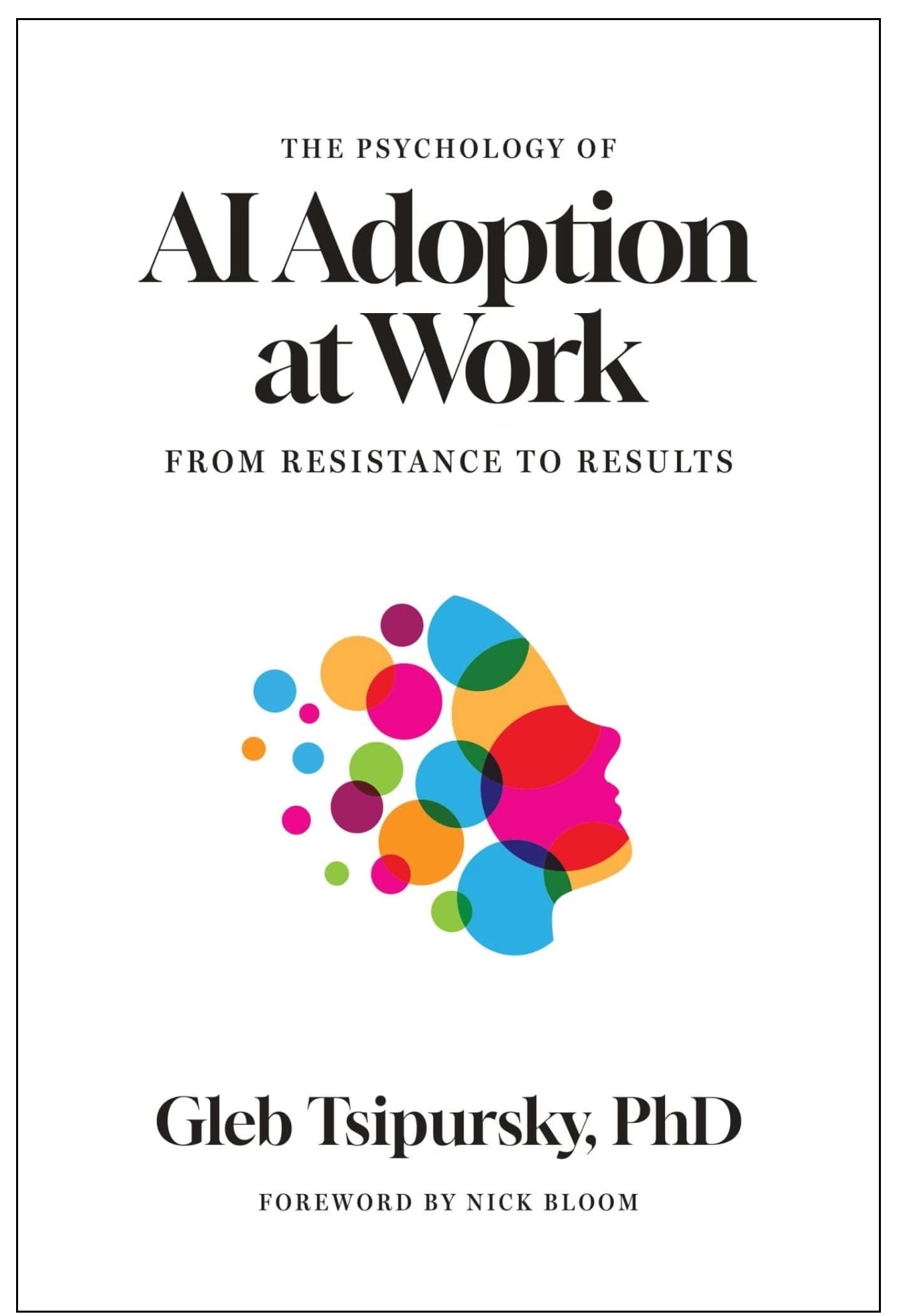
Dr. Gleb Tsipursky postulates that AI roll-outs usually fail because leaders completely ignore the human responses to it.
The real barrier is automation anxiety; employees literally fearing they are training their robotic replacements, and the status quo bias.
Employees deeply distrust “black box” software handed down by management.
The author recommends taking steps to involve employees in implementation to encourage their buy-in, focusing on pulling the most stubborn complainers into the process.
To truly win with generative AR, Dr. Tsipursky states it is essential to consider the hearts and minds of the workforce.

“This is the brief on the psychology of AI adoption at work. So in his 2026 book, The Psychology of AI Adoption at Work, Dr. Gleb Tsipursky points out that corporate AI roll-outs usually fail because leaders completely ignore the messy, emotional human response to it.
Now, you might be wondering, if this generative AI tech is so incredibly powerful, why are so many roll-outs totally flat-lining?
Well, first, it’s all about the psychological roadblock. The real barrier is automation anxiety—people literally fearing they’re training their robotic replacements—and the status quo bias. Employees deeply mistrust black-box software handed down from management. Dropping a shiny, mysterious AI tool on a stressed-out team without emotional support is like handing someone the keys to a race car without teaching them how to drive. They’re just going to be terrified.
Second, we need an empowerment solution. Instead of buying expensive, opaque vendor software, let your front line workers use simple no-code, drag-and-drop tools to build their own custom AI assistants for their specific daily headaches. You know, it’s the classic IKEA effect: when we build the furniture ourselves, we love it way more. People just naturally support what they create.
Finally, how do you actually scale this across the whole company without total chaos? You leverage the extremes. Identify your enthusiastic shadow AI users secretly breaking the rules, and officially promote them to peer mentors. At the same time, put your biggest doubters—those pragmatic resistors—on your AI advisory boards to stress-test everything. Wait, literally put your most stubborn complainers in charge of testing the AI? Absolutely, because they will find the flaws faster than anyone else.
To truly win with generative AI, organizations absolutely have to manage the hearts and minds of their workforce, not just the code and data.”
Contact Factoring Specialist, Chris Lehnes
Read a sample or purchase here

Here is an outline summarizing the core concepts and frameworks from the document:
- Executive Summary and Core Premise:
- Human-centric integration: Generative AI (Gen AI) transforms organizations when implemented through empathetic leadership, cultural readiness, and continuous learning, rather than as a top-down IT installation.
- Empowerment approach: Enabling internal teams through low-code/no-code platforms to build, adapt, and own custom AI tools reduces resistance, avoids black-box vendor lock-in, and compounds organizational learning.
- Evolution from Traditional ML to Generative AI:
- Predictive vs. generative capabilities: Traditional machine learning optimizes existing processes using clean historical data, whereas Gen AI generates novel content, automates knowledge work, and democratizes advanced capabilities for midsize firms.
- Empirical business impact: Studies demonstrate that thoughtful Gen AI implementation increases developer coding speed by 30–50%, accelerates writing tasks by 37%, elevates lower-skilled worker output, and delivers measurable revenue expansion.
- Psychological and Structural Barriers to Adoption:
- Attitudinal and emotional blockers: Trust in AI is declining globally due to black-box opacity, high-profile AI hallucinations, data privacy fears, and automation anxiety driven by loss aversion and identity threats.
- Technical and organizational roadblocks: Technical integration is hindered by legacy enterprise systems, data quality issues, and talent shortages; structural failure stems from scattered pilot projects, lack of governance, and inadequate change management.
- Risk Management and Ethical Stewardship:
- Multidimensional threat landscape: Organizations face security vulnerabilities like prompt injection and jailbreaking, severe PR risks from AI misstatements, inherent dataset bias, and principal-agent alignment issues like “reward hacking”.
- Governance infrastructure: Mitigation requires interdisciplinary AI governance councils, specialized roles like AI Ethicists and AI Risk Managers, clear data tiering, and proactive crisis-response plans.
- Psychographic Profiles of Managers and Employees:
- Middle-manager attitudes: Middle managers manage frontline anxieties while pursuing executive goals, falling along a spectrum: AI Skeptics, Wait-and-See Traditionalists, Cautious Implementers, Enthusiastic Experimenters, and AI Catalysts.
- Employee attitudes: Nonmanagerial staff exhibit eight distinct archetypes ranging from resistant to enthusiastic: AI Alarmists, Pragmatic Resisters, Skeptical Observers, Apathetic Bystanders, Reluctant Adopters, Cautious Optimists, Efficiency Seekers, and AI Evangelists.
- Strategies for Engagement, Upskilling, and Innovation:
- Targeted engagement and Choice Architecture: Leaders must use surveys and focus groups to gauge sentiment, construct behavioral “nudges” and optimal defaults to reduce friction, and harness hidden “shadow users” into mentored champion networks.
- Continuous learning and co-creation: AI upskilling should be role-specific, microlearning-driven, and embedded in daily workflows, creating a safe, fail-forward culture that leverages human-AI co-creation to drive product, operational, and business model innovation.
- Measurement and Long-Term Strategic Planning:
- Multidimensional KPI dashboards: Organizations must track adoption depth, efficiency gains, business impact, employee satisfaction, capability transfer, and compliance metrics to prove tangible ROI.
- Three-year transformation roadmap: Long-term strategy progresses from Year 1 (foundational enablement, narrow use-case builds, and champion activation) to Year 2 (workflow integration, capability badges, and scaling reskilling) and Year 3 (institutionalized assistant catalogs, vendor diversification, and preparing for agentic AI and robotics).