

Intel fourth-quarter and full-year 2025 earnings report, as detailed in the Wall Street Journal and other financial outlets, highlights a company in the midst of a massive structural turnaround while grappling with a challenging semiconductor market.

According to the report released on January 22, 2026, Intel outperformed its own guidance and analyst expectations for the quarter, though it remains in a delicate financial position.
Financial Performance (Q4 2025)
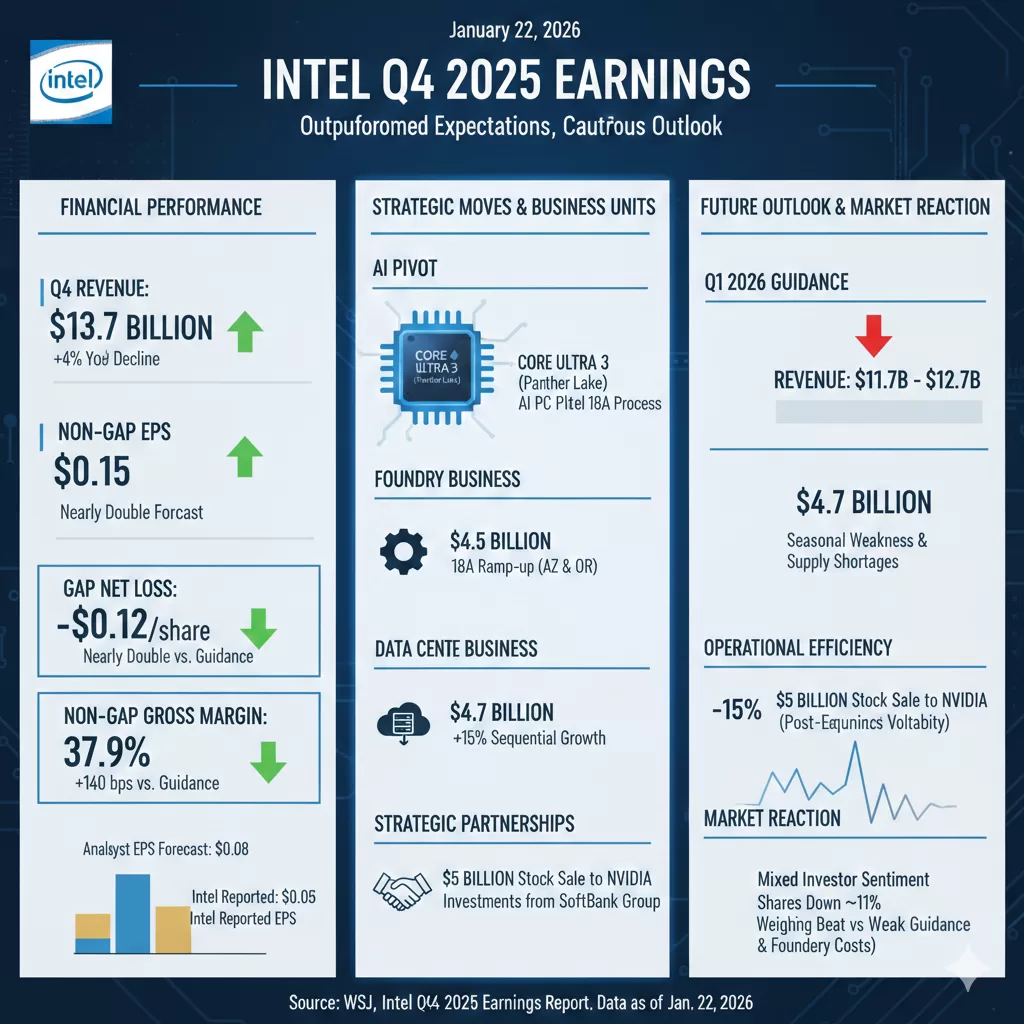
- Revenue: Intel reported $13.7 billion in Q4 revenue, a 4% decline year-over-year but higher than the forecasted $13.4 billion.
- Earnings Per Share (EPS): The company posted a non-GAAP EPS of $0.15, nearly double the $0.08 analysts expected. However, on a GAAP basis, it recorded a net loss of $0.12 per share ($591 million total).
- Gross Margin: Non-GAAP gross margin reached 37.9%, exceeding guidance by 140 basis points, driven by higher-than-expected revenue and disciplined spending.
Key Strategic Moves & Business Units
- AI Pivot: CEO Lip-Bu Tan emphasized the “essential role of CPUs in the AI era.” Intel launched its Core Ultra Series 3 (Panther Lake), the first AI PC platform built on the advanced Intel 18A process.
- Foundry Business: Intel Foundry reported $4.5 billion in revenue. The company is aggressively ramping up its 18A process in Arizona and Oregon to regain manufacturing leadership.
- Data Center and AI (DCAI): This segment saw its fastest sequential growth of the decade, rising 15% to $4.7 billion, signaling a potential recovery in server demand.
- Strategic Partnerships: The balance sheet was bolstered by a significant $5 billion stock sale to NVIDIA and new investments from SoftBank Group.
Future Outlook
- Q1 2026 Guidance: Intel provided a cautious outlook for the coming quarter, projecting revenue between $11.7 billion and $12.7 billion. This lower forecast is attributed to “seasonal weakness” and industry-wide supply shortages, which the company expects to hit a low point in Q1 before improving.
- Operational Efficiency: Intel reduced its full-year operating expenses by 15% (down to $16.5 billion) through organizational streamlining.
Market Reaction
Despite the earnings “beat,” investor sentiment remained mixed. Shares experienced volatility—trading down as much as 11% in some sessions following the report—as the market weighed the positive surprise against the weak Q1 2026 guidance and the heavy capital costs associated with the foundry transition.
Contact Factoring Specialist Chris Lehnes
