
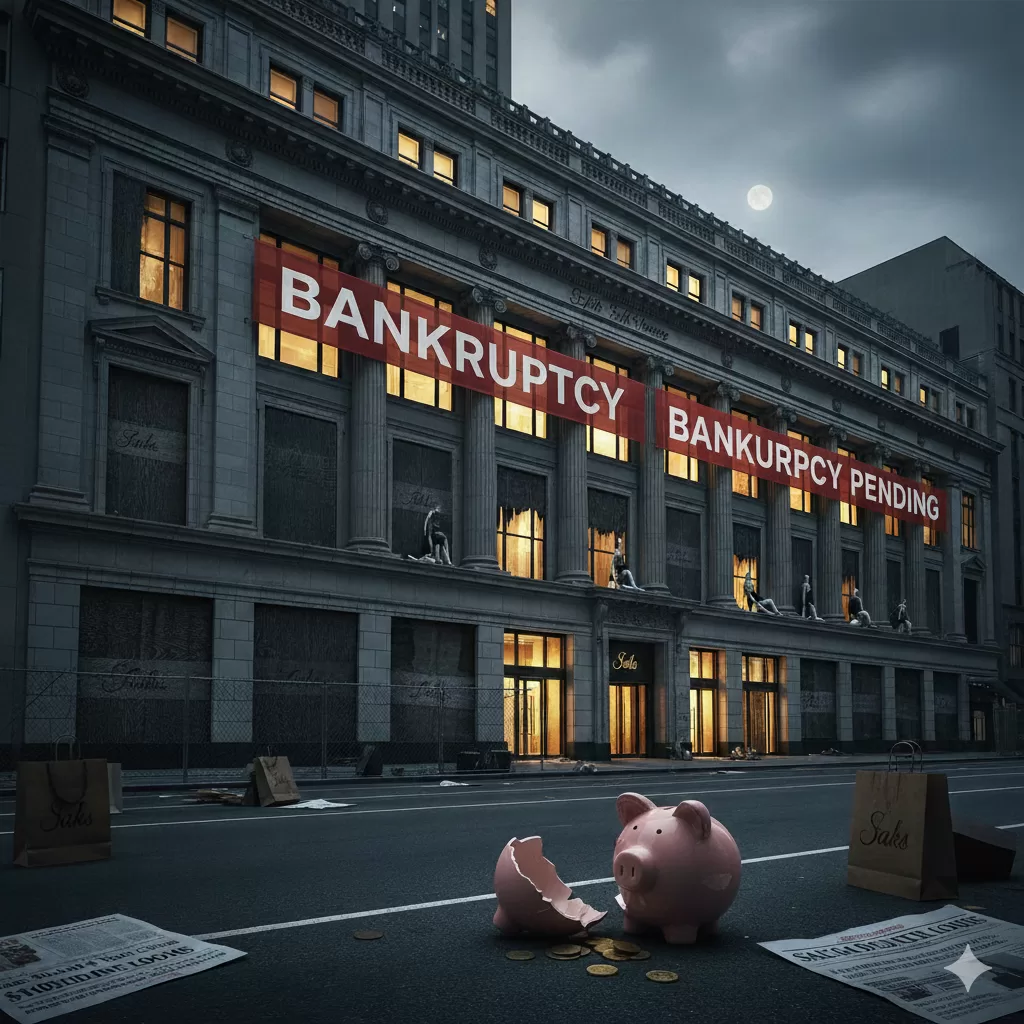
From its beginnings as a single storefront in Washington, D.C., to its current status as the centerpiece of a multi-billion dollar luxury conglomerate, Saks Fifth Avenue has been the ultimate arbiter of American high fashion. However, as of late December 2024 and 2025, the gilded halls of its flagship stores face a grim reality: the threat of Chapter 11 bankruptcy.1
Following a massive $2.7 billion acquisition of Neiman Marcus Group, the newly formed Saks Global is grappling with a staggering $4.7 billion debt load, severe vendor payment backlogs, and a “last resort” consideration of bankruptcy as a major $100 million debt payment looms.2
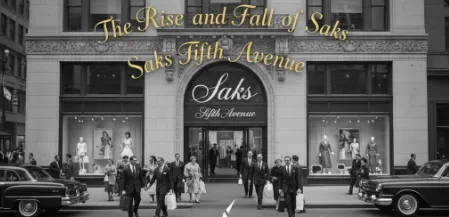
Part I: The Gilded Origins (1867–1924)
The story of Saks begins with Andrew Saks, a young merchant who opened his first clothing store in Washington, D.C., in 1867.3 By 1902, he moved his operations to New York City, opening a massive store in Herald Square.4 After Andrew’s death in 1912, his son Horace Saks took the reins, envisioning a retail experience that moved beyond the middle-class bustle of 34th Street.5
The 1924 Flagship Opening
The defining moment in the brand’s history occurred in 1924. Horace Saks partnered with Bernard Gimbel of the Gimbel Brothers department store empire.6 Together, they opened the flagship Saks Fifth Avenue at 611 Fifth Avenue, directly across from what would later become Rockefeller Center. It was a revolutionary move: the first major retail operation to open in what was then a residential district.7
Part II: The Golden Era and National Expansion (1926–1990s)
After Horace Saks’s sudden death in 1926, Adam Gimbel—Bernard’s cousin—became president.8 Adam was a visionary who redecorated the store in the Art Moderne style and pioneered the concept of “specialty shops” within the store.9
- First Resort: In 1926, Saks became the first specialty store to go national, opening a branch in Palm Beach, Florida.10
- Post-War Growth: During the 1940s and 50s, Saks expanded into Beverly Hills, Detroit, and San Francisco, positioning itself as the primary rival to local luxury powers like I. Magnin.
- Corporate Musical Chairs: In 1973, the company was sold to British American Tobacco (BATUS).11 Under this ownership, the chain grew to over 50 stores before being sold again in 1990 to Investcorp for $1.6 billion.
Part III: The Modern Era: Public Ownership and HBC (1996–2021)
In 1996, the holding company went public as Saks Holdings, Inc., and was later acquired by Proffitt’s, Inc.12 for $2.1 billion. The company changed its name to Saks Incorporated, merging the luxury brand with a portfolio of more accessible department stores.
The Hudson’s Bay Acquisition
In 2013, the Canadian Hudson’s Bay Company (HBC) purchased Saks for $2.9 billion.13 Under CEO Richard Baker, the strategy shifted toward a “real estate first” model, leveraging the immense value of Saks’ physical locations.
In 2021, HBC made the controversial decision to split the digital and physical businesses.14 Saks.com became a separate e-commerce entity (funded by Insight Partners), while the brick-and-mortar stores remained under the “Saks Fifth Avenue” banner.15 This move was designed to unlock tech-level valuations for the website, but critics argued it hollowed out the brand’s core identity.
Part IV: The Current Crisis: Debt, Synergies, and the Neiman Merger
The current financial turmoil stems from an aggressive bet placed in late 2024.16 HBC orchestrated a $2.7 billion acquisition of Neiman Marcus Group, merging its two biggest rivals—Saks and Neiman Marcus—under a new umbrella called Saks Global.17
The Financial Strain
The merger was intended to create a luxury giant with $7 billion in annual revenue, backed by technological support from Amazon and Salesforce.18 However, the integration has been plagued by several factors:
- Vendor Revolt: Since February 2025, CEO Marc Metrick has admitted to an 18-month backlog of overdue payments to vendors.19 Many designers, including major luxury houses, began pausing shipments, leading to “inventory stumbles.”20
- Mounting Debt: Total debt for Saks Global is estimated at $4.7 billion.21 The company has been forced into multiple debt restructurings, including a $600 million emergency injection in mid-2025 that S&P Global Ratings classified as “tantamount to a default.”
- The $100 Million Deadline: Reports in late December 2025 indicate that Saks faces a critical interest payment of over $100 million due by December 30.22
- Luxury Slump: A broader pullback in U.S. consumer spending on luxury items—driven by inflation and economic uncertainty—has seen Saks’ revenue fall by nearly 16% year-over-year.
| Financial Metric (2025) | Estimated Status |
| Total Debt | $4.7 Billion |
| Q2 Net Loss | $288 Million |
| Revenue Change | -13% to -16% (Pro forma) |
| Credit Rating | CCC (S&P Global) |
Is Bankruptcy Inevitable?
Management has maintained that “a restructuring is not being contemplated” publicly, but internal sources suggest that Chapter 11 bankruptcy is now being weighed as a “last resort.”23 The company is reportedly negotiating a debtor-in-possession (DIP) loan—a specific type of financing used only when a company is preparing for a bankruptcy filing—to keep the lights on while it restructures.24
Conclusion: The Future of a Landmark
If Saks Global files for bankruptcy, it would represent one of the most significant retail collapses of the decade. While the brand itself is likely to survive in some form, the “store of dreams” is currently a case study in the dangers of high-leverage mergers during a retail downturn.