Rapidly growing SaaS company with Fortune 10 customers requires funding against 60 & 90 day invoices to cover overhead. We can fund next week!
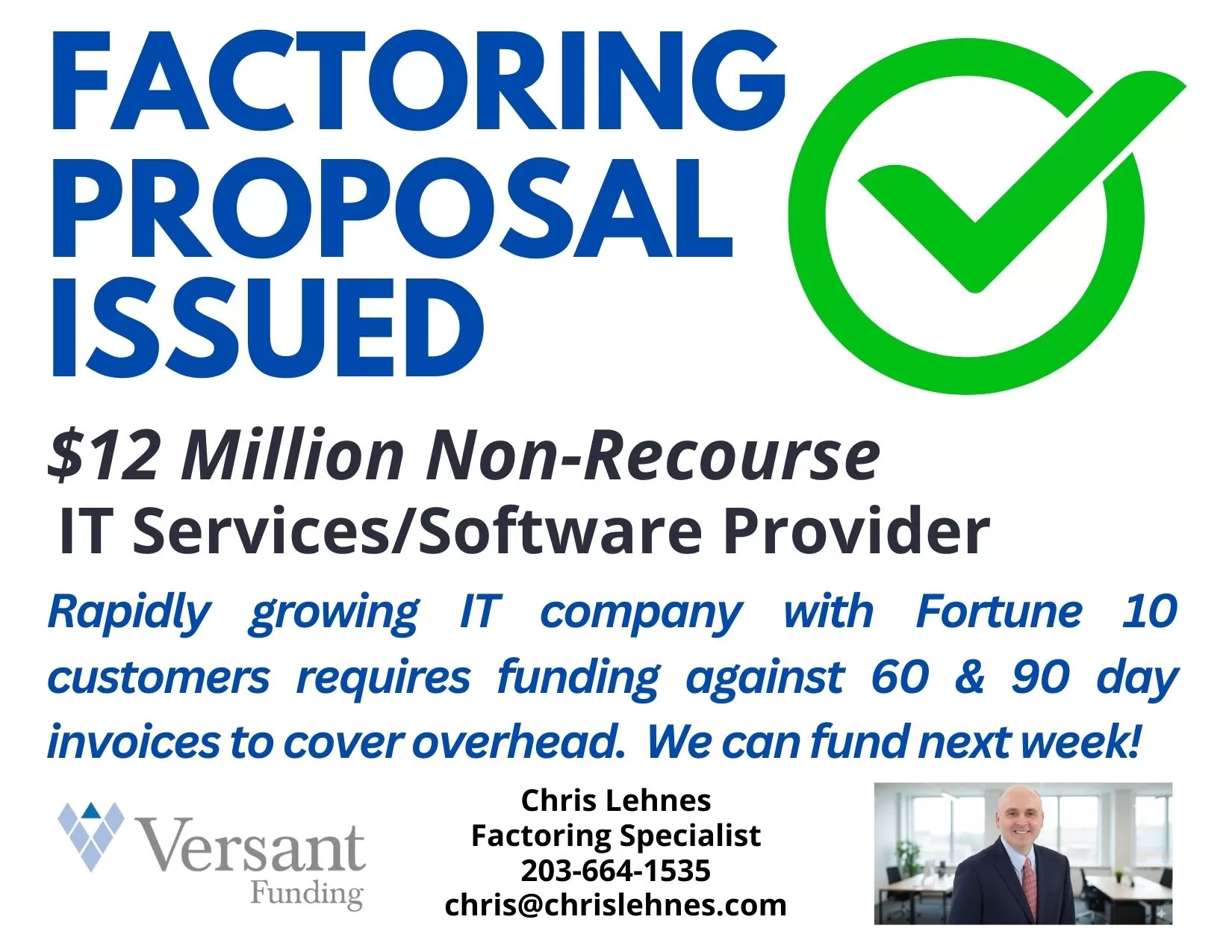

Rapidly growing SaaS company with Fortune 10 customers requires funding against 60 & 90 day invoices to cover overhead. We can fund next week!

(October 16, 2025) Versant Funding LLC is pleased to announce that it has funded a $2.5 Million non-recourse factoring facility to a company that provides software and consulting services to major multinational companies.
The factoring company this business had relied upon for many years to meet its working capital needs refused to fund against invoices from a few key accounts. The resulting cash shortfall was reducing the company’s ability to service its customers.
“Versant focuses solely on the credit quality of our clients’ customers,” according to Chris Lehnes, Business Development Officer for Versant Funding, and originator of this financing opportunity. “Since the company’s key accounts were financially strong entities, we were willing to factor all their invoices, greatly improving the company’s cashflow and ability to meet customer expectations.”
About Versant Funding: Versant Funding’s custom Non-Recourse Factoring Facilities have been designed to fill a void in the market by focusing exclusively on the credit quality of a company’s accounts receivable. Versant Funding offers non-recourse factoring solutions to companies with B2B or B2G sales from $100,000 to $30 Million per month. All we care about is the credit quality of the A/R. To learn more contact: Chris Lehnes|203-664-1535 | chris@chrislehnes.com
Contact Factoring Specialist, Chris Lehnes
Read more: Press Release: Versant Funds $2.5 Million Factoring to SaaS CompanySoftware as a Service (SaaS) is, in the simplest terms, the delivery of software applications over the internet, on demand, and typically on a subscription basis.1 It represents a fundamental shift in how software is consumed, moving away from the traditional model of purchasing a perpetual license, installing the software on local servers or individual computers (on-premise), and managing all the associated infrastructure and maintenance.
Instead, with SaaS, the software vendor hosts the application and data on their own or a third-party cloud provider’s servers, and customers simply access it via a web browser or a dedicated mobile application.2 This paradigm shift has made software far more accessible, scalable, and cost-effective, fueling the digital transformation of businesses across every sector.
To understand why SaaS is so disruptive, one must look at its core technical and business characteristics.
The core characteristic of SaaS is that the software is hosted in the cloud and accessed via an internet connection.3 This eliminates the need for the customer to invest in servers, storage, or operating systems to run the application.4
The technical backbone of most modern SaaS applications is the multi-tenant architecture.8 This is the key element that makes the model efficient and scalable.
In a multi-tenant environment, a single instance of the software application and its underlying infrastructure serves multiple customers (tenants).9 While all customers share the same application, their data and customizations are logically isolated and secured, preventing one customer from accessing another’s information.10
In the SaaS model, the provider manages the entire technology stack, taking the burden of IT management off the customer.12 This includes:
The advantages of adopting SaaS solutions have driven their massive global proliferation, moving beyond just simple tools to mission-critical enterprise systems.
The shift from CapEx to OpEx is perhaps the most significant benefit for small and medium-sized businesses.
Implementing a new SaaS application can often be done in hours or days, not the months required for traditional on-premise software.19 Users simply log in via a web URL. This rapid deployment allows businesses to realize value almost instantly.20
SaaS applications are built on scalable cloud infrastructure.21 If a customer needs to add 100 new users or dramatically increase their storage, the vendor handles the backend resource allocation seamlessly.22 The customer never has to worry about hitting an infrastructure bottleneck.
In the on-premise world, major software updates (versions 1.0 to 2.0) often occurred years apart. With SaaS, the vendor constantly deploys minor, incremental updates and new features, ensuring the customer is always using the most advanced and secure version of the product.23
SaaS is the most customer-facing layer of the three main cloud service models, often referred to as the “As-a-Service” trilogy.24 The difference lies in how much of the technology stack the customer manages versus the cloud provider.
| Model | What is it? | Customer Manages | Provider Manages | Examples |
| SaaS | Software Application | Nothing (just the application’s data) | All of it: Application, Data, Runtime, Servers, Networking, etc. | Salesforce, Google Workspace, Microsoft 365, Zoom, Dropbox |
| PaaS | Platform for building/running apps | Application code and data | Operating System, Runtime, Middleware, Servers, Networking | Google App Engine, AWS Lambda, Heroku |
| IaaS | Infrastructure (virtual hardware) | Operating System, Applications, Data | Servers, Storage, Networking, Virtualization | Amazon Web Services (EC2), Microsoft Azure (VMs), Google Compute Engine |
SaaS is akin to a fully furnished, serviced apartment: you simply move in and use the appliances. PaaS is like renting the building structure and utilities, but you’re responsible for furnishing and decorating. IaaS is like renting the empty land and laying the foundation for a structure you’ll build and manage entirely yourself.
The subscription model of SaaS necessitates tracking a distinct set of financial and operational metrics, which are crucial for evaluating a company’s health and growth potential.25
The financial goal for a healthy SaaS business is to have a CLV that significantly outweighs the CAC, typically a ratio of 3:1 or better, supported by a low churn rate.
SaaS traces its roots back to the 1960s concept of time-sharing, but the modern model truly began with the founding of Salesforce.com in 1999, which popularized the delivery of enterprise applications entirely over the web via a multi-tenant architecture.31
Today, SaaS dominates major software categories, including:
The future of SaaS is increasingly integrated with emerging technologies:
In conclusion, Software as a Service is more than just a software delivery method; it is a business model and a technological philosophy that has democratized access to powerful computing tools.37 By transferring the complexity of IT management to the vendor and enabling a flexible, subscription-based financial structure, SaaS has become the essential foundation upon which the modern, globally distributed, and agile digital economy operates.
SaaS companies are often challenged to obtain the working capital needed to continue to innovate, increase revenue and expand their customer base, but raising equity prematurely can unnecessarily dilute founder’s equity.
By factoring, SaaS companies get quick access to the funds needed to leverage their technology for success without giving up equity.
Accounts Receivable Factoring
We are a great match for businesses with traits such as:
Contact me today to learn if your Software client is a factoring fit.
In an increasingly digital world, small businesses face immense pressure to remain competitive, agile, and efficient. Fortunately, Software as a Service (SaaS) has emerged as a transformative solution, offering access to powerful tools and platforms without the need for heavy infrastructure or extensive IT staff. From customer relationship management to accounting and collaboration, SaaS empowers small businesses to streamline operations, reduce costs, and scale effectively. This article explores how small businesses can leverage SaaS to improve efficiency across various facets of their operations.
Software as a Service (SaaS) is a cloud-based model that delivers software applications over the internet. Unlike traditional software, which requires installation and maintenance on individual machines, SaaS applications are hosted remotely and accessed via web browsers. This eliminates the need for on-premise infrastructure and provides real-time access to data and tools.
Key Characteristics of SaaS:
Popular examples of SaaS include Google Workspace, Salesforce, QuickBooks Online, and Slack. These platforms are designed to help businesses manage workflows, communicate effectively, and enhance customer relationships
One of the most appealing aspects of SaaS for small businesses is its affordability. Traditional software often requires a significant upfront investment for licenses, hardware, and IT support. SaaS, by contrast, operates on a subscription model, allowing businesses to pay a manageable monthly or annual fee. This model significantly reduces capital expenditures and allows for predictable budgeting.
Moreover, SaaS providers handle updates, maintenance, and security, further reducing the need for an in-house IT team.
As businesses grow, their software needs evolve. SaaS platforms are inherently scalable, allowing small businesses to upgrade their plans or add users without major disruptions. Whether a company is hiring new employees or expanding into new markets, SaaS solutions can be adjusted to match the pace of growth.
With SaaS, employees can access work-related applications from anywhere with an internet connection. This flexibility supports remote work and enables teams to collaborate across locations. In the wake of the COVID-19 pandemic, the ability to work from home has become essential for business continuity.
SaaS applications often come with APIs and integration capabilities, allowing them to connect with other tools and platforms. This interoperability reduces manual data entry and streamlines workflows. For example, a CRM tool can be integrated with email marketing software to automate customer outreach based on user behavior.
Leading SaaS providers invest heavily in security protocols to protect customer data. These measures typically exceed what small businesses could afford on their own. Features such as encryption, multi-factor authentication, and regular backups are standard in many SaaS offerings.
SaaS applications are typically user-friendly and require minimal setup. This means small businesses can implement new tools quickly and start seeing benefits immediately. Many SaaS providers also offer training resources and customer support to assist with onboarding.
CRM systems help businesses manage interactions with current and potential customers. SaaS-based CRMs like Salesforce, HubSpot, and Zoho CRM provide a centralized platform to track leads, sales, and customer communications.
Efficiency Gains:
SaaS accounting platforms such as QuickBooks Online, Xero, and FreshBooks simplify bookkeeping, invoicing, and financial reporting. These tools reduce the need for manual data entry and help ensure compliance with tax regulations.
Efficiency Gains:
Platforms like Trello, Asana, Monday.com, and ClickUp facilitate task management and team collaboration. These tools allow small businesses to track progress, assign responsibilities, and communicate effectively.
Efficiency Gains:
SaaS marketing tools such as Mailchimp, ActiveCampaign, and Hootsuite enable small businesses to execute marketing campaigns with minimal effort. These platforms often include features like email automation, social media scheduling, and customer analytics.
Efficiency Gains:
SaaS solutions for HR, like Gusto, BambooHR, and Zenefits, simplify employee onboarding, time tracking, benefits administration, and payroll processing.
Efficiency Gains:
Platforms like Shopify, Square, and WooCommerce provide small businesses with end-to-end solutions for online and in-store sales. These systems integrate inventory management, sales reporting, and customer insights.
Efficiency Gains:
Tools like DocuSign, Adobe Acrobat Sign, and PandaDoc allow businesses to manage contracts and obtain electronic signatures securely.
Efficiency Gains:
While general-purpose SaaS platforms offer broad utility, industry-specific tools provide tailored functionality to meet niche requirements.
Before selecting a SaaS solution, small businesses should assess their pain points and define clear objectives. This ensures that the chosen software aligns with actual business needs and priorities.
Factors to consider when choosing a SaaS provider include:
Businesses must understand how their data is stored, who has access, and what compliance standards the provider follows (e.g., GDPR, HIPAA). A thorough review of the provider’s security policies is essential.
Choose SaaS tools that integrate with existing systems. This reduces data silos and improves overall efficiency. API availability and third-party integrations should be part of the selection criteria.
Even the best software is only as effective as its users. Provide comprehensive training to ensure that staff can utilize the tools efficiently. Many SaaS providers offer tutorials, webinars, and support resources.
Track key performance indicators (KPIs) to measure the impact of SaaS tools on business operations. Common metrics include productivity, cost savings, customer satisfaction, and revenue growth.
Employees may be hesitant to adopt new tools. Overcome this by involving them early in the selection process and highlighting the benefits of the new system.
With thousands of SaaS products on the market, it can be difficult to choose the right one. Focus on specific business needs and prioritize platforms with a proven track record.
Using too many SaaS tools can lead to higher costs and overlapping functionality. Regularly audit your subscriptions to eliminate redundancy and consolidate where possible.
Transitioning from legacy systems to SaaS platforms can involve complex data migration. Work with vendors who offer migration support and test the new system thoroughly before going live.
SaaS tools require a stable internet connection. Ensure that your business has reliable connectivity and consider offline-access features where necessary.
A small digital marketing agency struggled to manage client communication and track leads. After implementing HubSpot CRM, they automated follow-ups, centralized contact data, and improved client retention by 25%.
A family-run retail store adopted QuickBooks Online to replace manual bookkeeping. This move reduced accounting errors by 40% and saved over 10 hours per week in administrative work.
A remote design firm used Trello and Slack to coordinate projects across multiple time zones. These tools allowed them to manage deadlines more effectively and reduce project delivery times by 30%.
An e-commerce startup used Mailchimp to automate their email campaigns. By segmenting their audience and using A/B testing, they increased their email open rates by 20% and sales by 15% in three months.
The SaaS market is poised for continued growth, with innovations such as artificial intelligence (AI), machine learning (ML), and advanced analytics reshaping how businesses operate. Future SaaS tools will offer even more automation, predictive insights, and personalization.
Emerging Trends:
As these tools become more accessible, small businesses will be better equipped to compete with larger enterprises.
SaaS offers small businesses an unparalleled opportunity to improve efficiency, reduce costs, and scale operations. From CRM and accounting to marketing and HR, SaaS tools provide the agility and functionality that modern businesses need to thrive. By selecting the right solutions, integrating them effectively, and fostering a culture of continuous improvement, small businesses can harness the full potential of SaaS and position themselves for sustained success.
As technology continues to evolve, staying informed and adaptable will be key. Small businesses that embrace SaaS not only survive in a competitive marketplace but also unlock new avenues for innovation and growth.
Factoring: Fast Cash for Software as a Service -SaaS
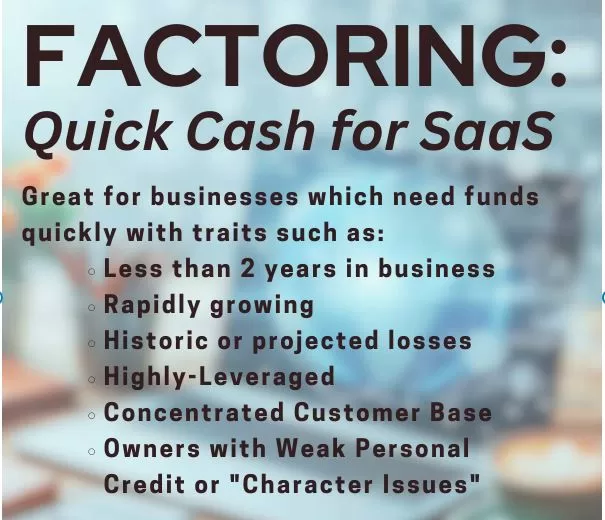
| SaaS Companies are often challenged to obtain the working capital needed to continue to innovate, increase revenue and expand their customer base. By factoring, SaaS companies get quick access to the funds needed to leverage their technology for success. Accounts Receivable Factoring $100,000 to $30 Million Quick AR Advances No Long-Term Commitment Non-recourse Funding in about a week We are a great match for businesses with traits such as: Less than 2 years old Negative Net Worth Losses Customer Concentrations Weak Credit Character Issues Contact me today to learn if your Software client is a factoring fit. Chris Lehnes 203-664-1535 chris@chrislehnes.com A recent Software Proposal |
Obtain cash against outstanding invoices in about a week.
Connect with Factoring Specialist, Chris Lehnes on LinkedIn