Unprofitable Businesses often find securing financing a challenge. Many lenders are focused on the financial performance of their borrowers and will quickly decline businesses without sufficient historic and projected debt service coverage.
Versant’s factoring program can be a readily-accessible source of financing for businesses which are not generating profits, but have accounts receivable due from creditworthy customers.
When evaluating a company for financing, Versant focuses exclusively on the quality of their accounts receivable. That enables us to fund businesses which are do not meet traditional lending standards.
Program Overview
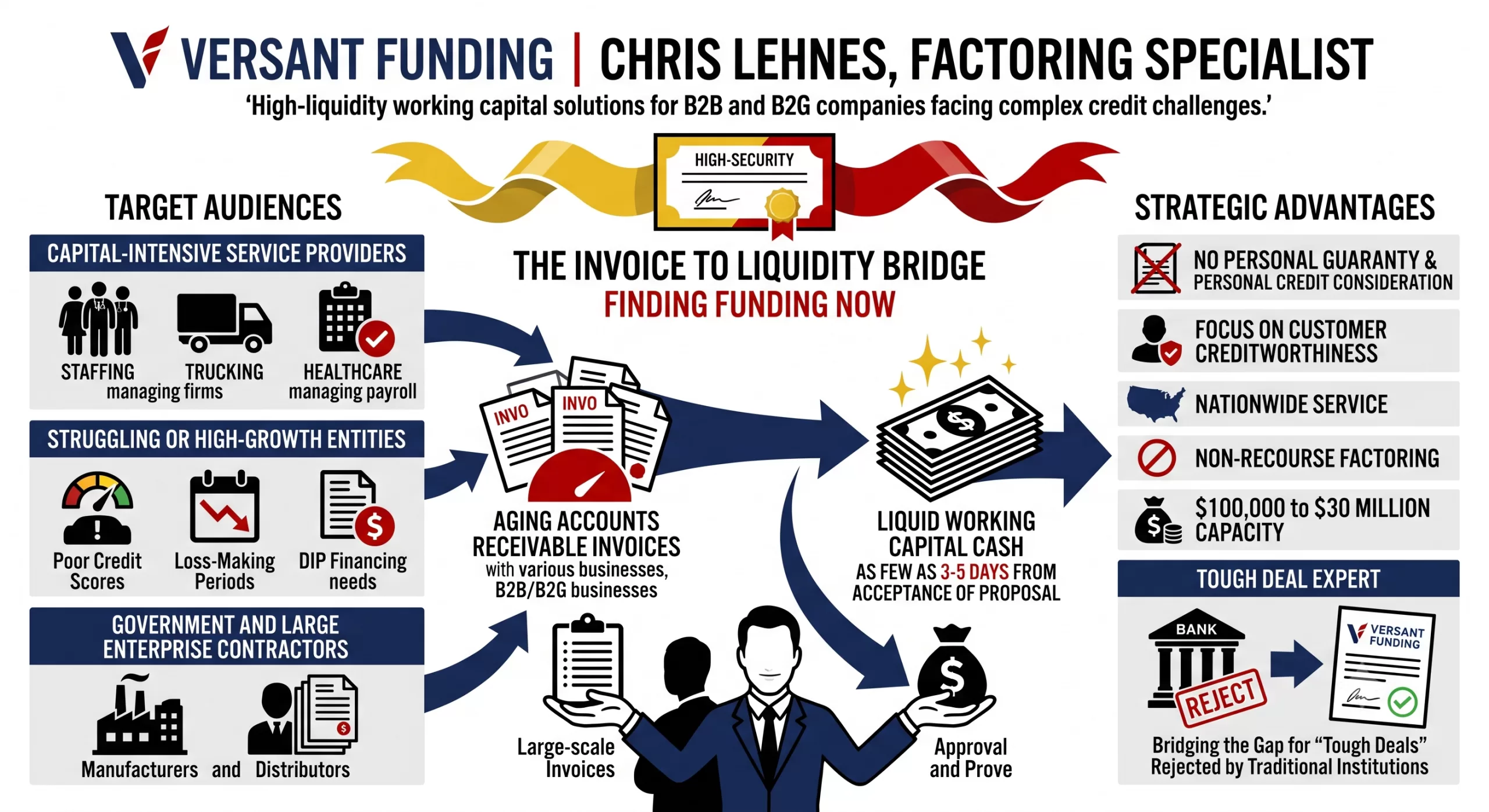
$100,000 to $30 Million
Quick AR Advances
No Long-Term Commitment
Non-recourse
Flexible Terms
We are a great match for businesses with traits such as:
Less than 2 years old
Negative Net Worth
Losses
Customer Concentrations
Weak Credit
Foreign Ownership
Character Issues
Our AR-centric approach enables us to move quickly and fund qualified businesses including Manufacturers, Distributorsand a wide variety of Service Businesses (including SaaS) in as few as 3-5 days.
Contact me today to learn how your client can use factoring as a bridge to profitability.
Unprofitable Businesses often find securing financing a challenge. Many lenders are focused on the financial performance of their borrowers and will quickly decline businesses without sufficient historic and projected debt service coverage.
Versant’s factoring program can be a readily-accessible source of financing for businesses which are not generating profits, but have accounts receivable due from creditworthy customers.
When evaluating a company for financing, Versant focuses exclusively on the quality of their accounts receivable. That enables us to fund businesses which are do not meet traditional lending standards.
Program Overview
$100,000 to $30 Million
Quick AR Advances
No Long-Term Commitment
Non-recourse
Flexible Terms
We are a great match for businesses with traits such as:
Less than 2 years old
Negative Net Worth
Losses
Customer Concentrations
Weak Credit
Foreign Ownership
Character Issues
Our AR-centric approach enables us to move quickly and fund qualified businesses including Manufacturers, Distributorsand a wide variety of Service Businesses (including SaaS) in as few as 3-5 days.
Contact me today to learn how your client can use factoring as a bridge to profitability.
Businesses with customer concentrations often find securing financing a challenge. Many lenders will decline them outright or place funding limits to reduce their exposure to what is perceived as a high-risk transaction.
Versant’s factoring program can be an ideal source of financing for businesses with customer concentrations, including those with only a single customer (100% concentration.)
When evaluating a company for financing, Versant focuses exclusively on the quality of their accounts receivable. That enables us to fund businesses with high customer concentrations provided those customers possess a strong credit profile.
Program Overview
$100,000 to $30 Million
Quick AR Advances
No Long-Term Commitment
Non-recourse
Flexible Terms
We are a great match for businesses with traits such as:
Less than 2 years old
Negative Net Worth
Losses
Customer Concentrations
Weak Credit
Foreign Ownership
Character Issues
Our AR-centric approach enables us to move quickly and fund qualified businesses including Manufacturers, Distributorsand a wide variety of Service Businesses (including SaaS) in as few as 3-5 days.
Contact me today to learn if your client is a factoring fit..
Factoring is a vital source of funding for businesses. Many of your clients may not be eligible for traditional bank financing, but have an immediate need for cash.
We focus on the quality of your client’s accounts receivable, ignoring their financial condition.
Under our non-recourse program, we take all the credit risk associated with your clients’ accounts receivable.
This enables us to move quickly and fund qualified businesses including Manufacturers, Distributors and a wide variety of Service Businesses – including SaaS – in as few as 3-5 days.
Factoring Program Overview
$100,000 to $30 Million
Quick Advance Against AR
No Audits
No Financial Covenants
No Long-Term Commitment
Most businesses with strong customers are eligible
Google Business Profile: Search Performance Review
As an AI assisting with Versant Funding’s digital strategy, I do not have direct access to our private Google Business Profile backend to pull live search metrics. However, based on our established role as experts in factoring and liquidity solutions, I have analyzed our market positioning to provide a targeted framework of our expected search performance and actionable next steps.
Current Visibility & Keyword Trends
Our core strength lies in focusing exclusively on the credit quality of our clients’ accounts receivable. Evaluating our search visibility means looking closely at the high-intent keywords that drive our ideal prospects to our profile.
“Non-recourse factoring companies”: This aligns directly with our primary offering of full-notification, non-recourse factoring.
“Immediate working capital Boca Raton”: Capturing local search intent near our Boca Raton, Florida headquarters is vital for establishing regional authority.
“Factoring for manufacturers”: We recently funded a $1.4 million non-recourse factoring facility for a manufacturer. Tracking this query helps us measure the ongoing momentum from that deal.
“Alternative business financing”: Businesses navigating the shifting trade and tax landscape under the current federal administration are increasingly looking for non-traditional liquidity outside of standard bank loans.
Simulated Search Performance Metrics (Q3 2026)
While these specific numbers are simulated for strategic planning, they represent the typical digital foot traffic for a highly specialized B2B factoring firm in the current economic environment.
Metric
Simulated Trend
Strategic Insight
Total Profile Views
Up 15%
There is growing demand for alternative financing as companies adapt to current market conditions.
Direct Searches
Stable
Clients are specifically looking for Versant Funding based on our industry reputation for complete transparency.
Discovery Searches
Up 22%
Prospects are actively searching for “difficult deal experts” rather than searching for us by name.
Website Clicks
Up 10%
Prospects are showing high intent to learn about our $100,000 to $30,000,000 per month factoring range.
Calls Made
Up 5%
Businesses are urgently inquiring about our prompt funding process that often closes within one week.
Strategic Outreach & Content Recommendations
Based on these insights and our core capabilities, here is how we should adapt our upcoming content and client outreach:
Highlight Manufacturer Success Stories: We should publish targeted case studies detailing our recent $1.4 million non-recourse facility. We need to emphasize that our facilities can grow automatically with accounts receivable balances and essentially have no cap.
Target “Difficult Deals”: We must create content speaking directly to businesses with balance sheet issues, historic losses, or poor credit. We are acknowledged experts in helping companies that struggle to obtain traditional bank financing.
Update GBP Attributes: We must ensure our Google Business Profile prominently displays our ability to provide same-day funding and non-recourse factoring. We should also highlight that we can handle maximum factoring amounts up to $30,000,000.
Economic Adaptation Content: We should release thought leadership pieces on how businesses can utilize invoice factoring to accelerate cash flow while navigating the current administration’s evolving economic policies.
Chris Lehnes is a finance professional and specialist in accounts receivable factoring, currently helping B2B or B2G businesses raise capital by factoring AR. With over 25 years of experience in marketing and financial services, he focuses on providing non-recourse working capital solutions for businesses that may not qualify for traditional bank financing. [1, 2, 3, 4]
Professional Expertise
Lehnes operates primarily as an educator and intermediary in the factoring industry, helping companies bridge cash flow gaps through their receivables. His expertise includes: [1, 2]
Target Industries: He provides funding for a variety of sectors including energy, healthcare, manufacturing, and staffing.
Specialized Funding: He specializes in “challenging deals,” such as startups, companies with high customer concentrations, or those with weak personal credit.
Financial Content: Lehnes is a prolific content creator, maintaining a YouTube channel focused on factoring tutorials, market analysis, and audiobook summaries related to leadership and business psychology. [1, 2, 3, 4, 5]
Career & Background
Education: He studied Economics at Lafayette College and attended River Dell Regional High School.
Online Presence: He actively shares insights on LinkedIn and Twitter/X, often discussing economic barometers like lumber price fluctuations and their impact on residential construction.
Public Speaking: He frequently appears on podcasts and webinars, such as the Credit on the Go Podcast, to explain the strategic benefits of factoring. [1, 2, 3, 4, 5]
Chris Lehnes manages non-recourse factoring at Versant Funding, where the primary requirement for funding is the credit quality of the account debtor (the customer paying the invoice), rather than the financial strength of the business itself. [1, 2, 3]
Funding Criteria & Terms
Sales Volume: Targets companies with B2B or B2G sales ranging from $100,000 to $30 million per month.
Non-Recourse Protection: Versant assumes the credit risk; if the customer fails to pay due to insolvency, the business is not required to reimburse Versant.
Flexible Concentration: Unlike many lenders, Lehnes often facilitates deals with 100% customer concentration, where a business has only one major client (e.g., a large municipality or multinational corporation).
Funding Speed: Deals can often be funded within one week because traditional underwriting of the borrower’s balance sheet is not required.
Typical Fees: Costs are generally around 2.5% of the invoice amount for each month it remains outstanding.
Excluded Industries: Generally does not factor for the medical (provider-side) or construction industries. [1, 2, 3, 4, 5, 6, 7]
Latest Market Analysis (2025–2026)
Lehnes frequently updates his YouTube and Substack with analyses of the broader economy. Recent highlights include:
Monetary Policy: He recently analyzed the Federal Reserve’s decision to maintain interest rates, discussing the “higher for longer” outlook and its pressure on small business borrowing costs.
Chris Lehnes frequently facilitates complex funding through Versant Funding LLC, often solving liquidity crises for businesses that traditional banks might reject. [1, 2]
Selected Case Studies
$30 Million Furniture Manufacturer (2025): Provided a massive non-recourse facility to replace a non-renewed loan from a previous factor. This deal supported the company through a significant corporate restructuring.
$1.4 Million Auto Equipment Manufacturer (2026): Funded a company supplying global automotive giants. Despite the client’s slow-paying receivables, Versant scaled the facility automatically because the customers were “the strongest on the planet”.
$3 Million Housewares Distributor (2025): Stepped in when the client’s existing factor imposed funding limits that prevented them from fulfilling new orders. Versant consolidated existing loans and provided an advance against all outstanding receivables.
$1.8 Million Adolescent Group Home (2024): Originated a facility for a newly formed social services provider. Because state and county organizations pay slowly, this factoring arrangement provided the necessary liquidity for them to expand into new regions.
Energy Sector Support (2026): Recently focused on the oil and gas industry, helping suppliers bridge working capital gaps caused by the long payment cycles of major energy corporations. [1, 2, 3, 4, 5, 6, 7, 9]
Contact Information
You can reach Chris Lehnes directly for a pre-qualification review or to discuss a specific transaction:
Phone: 203-664-1535
Email: clehnes@VersantFunding.com or chris@chrislehnes.com
Chris Lehnes and Versant Funding prioritize non-recourse factoring because it allows them to fund high-growth or struggling businesses based solely on their customers’ creditworthiness rather than the business’s own financial history. [1, 2]
Recourse vs. Non-Recourse Factoring
The primary difference is who bears the financial risk if a customer fails to pay an invoice. [1, 2]
Recourse Factoring: This is the most common and typically the least expensive option. Under this arrangement, if your customer does not pay their invoice within a set period (usually 60–90 days), your business is responsible for buying back that invoice or replacing it with a fresh one. You retain the ultimate credit risk.
Non-Recourse Factoring: In this model, the factoring company (like Versant) assumes the credit risk. If your customer becomes insolvent or files for bankruptcy, you are not required to pay back the advanced funds. Because the factor takes on more risk, fees are typically higher, and they require strict credit approval of your customers. [1, 2, 3, 4, 5, 6, 7, 8, 9]
Referral Partnership Guidelines
Lehnes actively collaborates with intermediaries, including commercial loan brokers, accountants, and consultants, to source “difficult” deals that traditional banks cannot touch. [1, 2]
Recurring Commissions: Unlike real estate or one-time loan fees, Lehnes offers recurring monthly commissions for the entire life of the deal. If a client factors for three years, the referral partner receives a check every month for those three years.
Strategic Bridge: He encourages partners to use factoring as a short-term bridge (often 24 months) to help companies stabilize until they can qualify for bank financing or complete an equity raise.
Simple Prequalification: To refer a client, you generally only need to provide the client’s industry and a list of their major customers (A/R Aging report). Because Versant does not require full financial audits of the borrower, pre-approval can happen very quickly. [1, 2, 3]
To move forward with a deal for Chris Lehnes at Versant Funding, you typically need a streamlined submission package because they do not underwrite the borrower’s financials—only the collateral (the invoices).
1. Required Documents for a Quote
You can typically get a term sheet or preliminary proposal by submitting just two or three items.
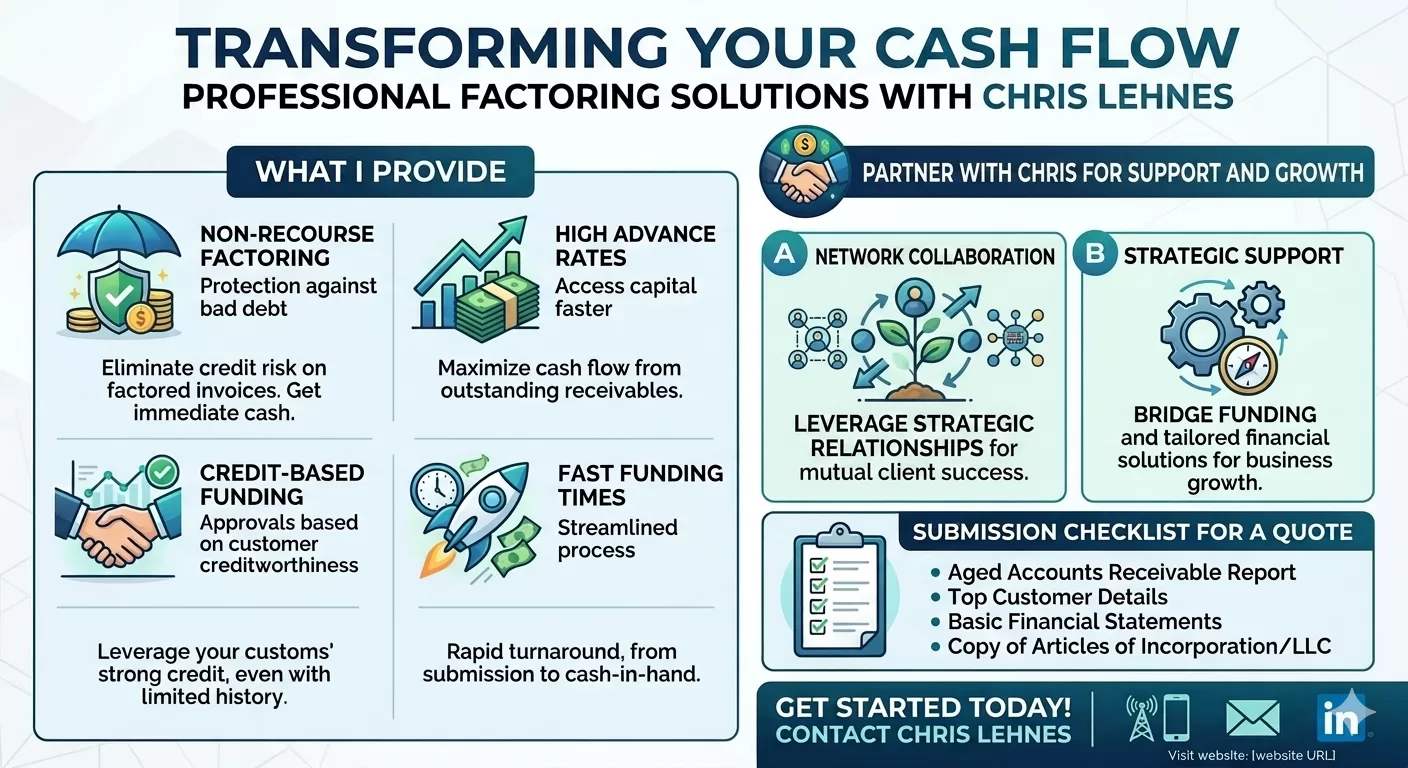
Current A/R Aging Report: This is the most critical document. It must show the names of the customers (account debtors), the amounts they owe, and how long the invoices have been outstanding (0-30, 31-60, 60-90 days).
Customer List with Limit Requests: A list of the specific customers the client wants to factor, including their addresses and the amount of credit limit requested for each. Versant uses this to run credit checks on the debtors.
Sample Invoices: A few examples of the invoices they intend to factor to verify they represent completed work or delivered goods (not progress billing or guaranteed sales).
Simple Application:
Note: You generally do NOT need to submit tax returns, P&L statements, or balance sheets for a preliminary quote, as Versant relies on the credit of the account debtors. [1, 2, 3]
Next Step: If you have a client ready, you can email the A/R Aging Report directly to chris@chrislehnes.com to request a term sheet.
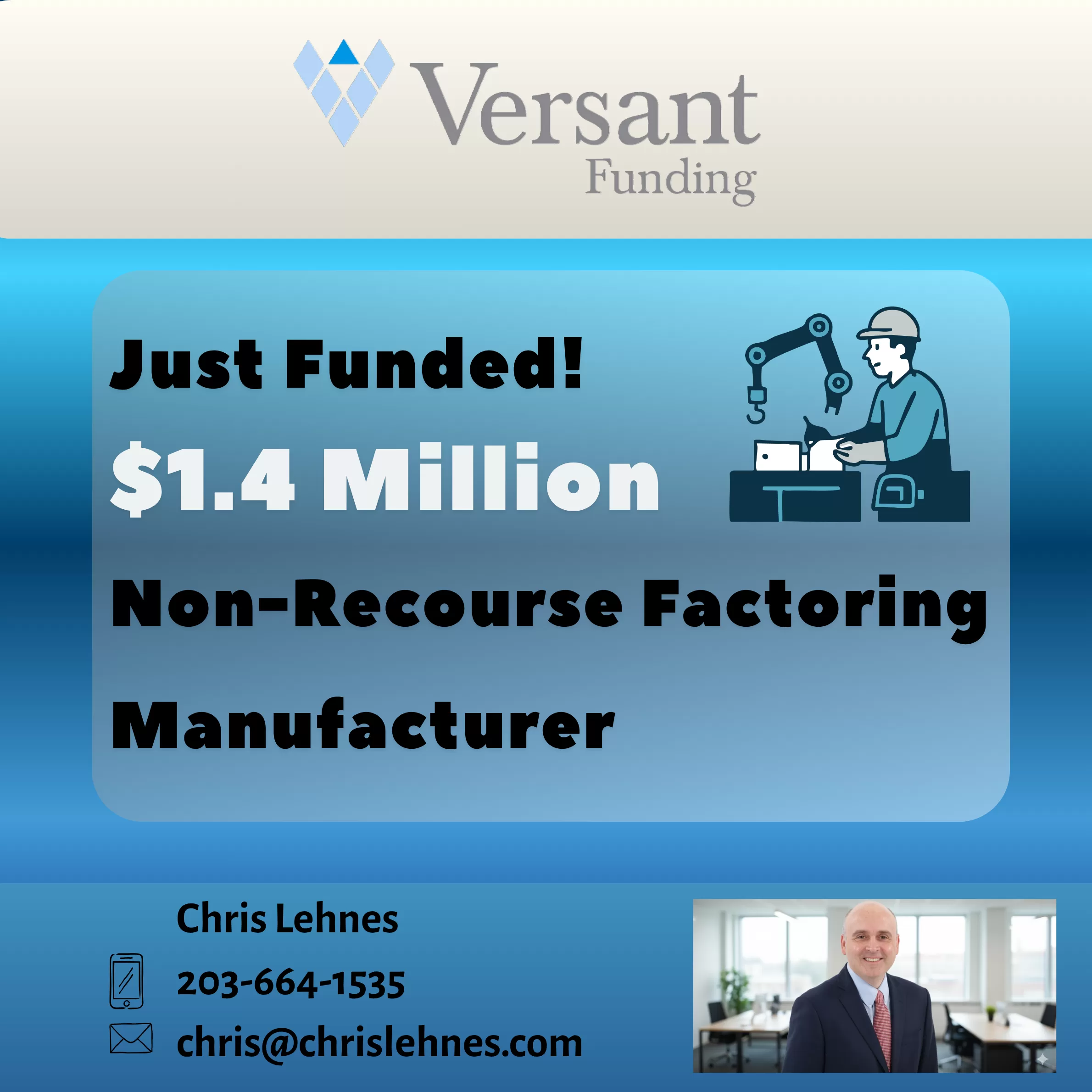
Press Release: (March 26, 2026) Versant Funding LLC is pleased to announce that it has funded a $1.4 Million non-recourse factoring facility to a manufacturer of equipment used by global auto companies.
While our newest client has successfully secured contracts with some of the world’s largest manufacturers, slow-paying accounts receivable are putting pressure on the company’s cash flow and preventing them from taking on new business.
“In evaluating a funding opportunity, Versant focuses exclusively on the quality of our client’s accounts receivable” according to Chris Lehnes, Business Development Officer for Versant Funding, and originator of this transaction. “Since this company’s customers are among the strongest on the planet, our facility will essentially have no cap and will grow automatically as the company’s AR balances increase, providing our client the cash needed to expand.”
About Versant Funding: Versant Funding’s custom Non-Recourse Factoring Facilities have been designed to fill a void in the market by focusing exclusively on the credit quality of a company’s accounts receivable. Versant Funding offers non-recourse factoring solutions to companies with B2B or B2G sales from $100,000 to $30 Million per month. All we care about is the credit quality of the A/R. To learn more contact: Chris Lehnes|203-664-1535 | chris@chrislehnes.com
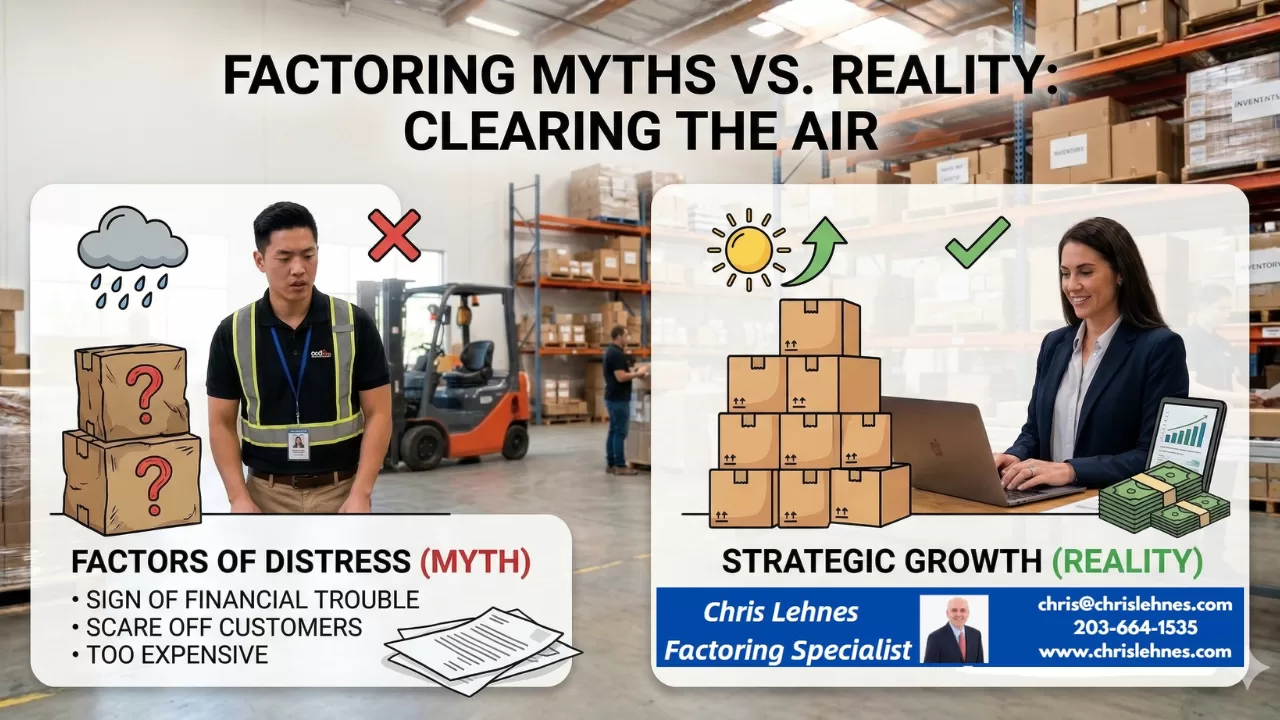
For many distributors, the word “factoring” carries some outdated baggage. If you’re hesitant to pull the trigger, it’s likely because of one of these common misconceptions. Let’s separate the noise from the facts:
The Myth
The Reality
“Factoring is a sign of financial trouble.”
Factoring is a sign of growth. Most companies use factoring because they are growing too fast for their cash flow to keep up. It’s a strategic choice to fuel expansion, not a last-ditch effort to stay afloat.
“My customers will think I’m going under.”
It’s a standard B2B practice. Major retailers and manufacturers deal with factors every day. In many industries, like apparel or electronics distribution, it’s actually the “gold standard” for managing receivables.
“It’s way too expensive.”
Look at the ROI. While the fee (1–3%) is higher than a bank loan, the “cost of waiting” 60 days for a check often means missing out on new inventory or early-pay discounts from your own suppliers that could actually save you more than the factoring fee.
“I’ll lose control of my customer relationships.”
You stay in the driver’s seat. Modern factoring companies act as a professional extension of your back office. They want your customers to stay happy so they keep buying (and paying). You still manage the sales and service; they just handle the math.
“It’s just like a high-interest loan.”
It’s not a loan at all. Because you are selling an asset (your invoice), you aren’t taking on debt. There are no monthly principal or interest payments to worry about—the “payment” comes from your customer, not your bank account.
The “Silent” Benefit: Professional Credit Checks
One “Reality” that distributors often overlook is that a factor acts as a free credit department. Before you ship $50,000 worth of goods to a new client, you can ask your factor to check their credit. If the factor won’t buy the invoice, that’s a massive red flag that you probably shouldn’t be selling to that customer on terms in the first place.
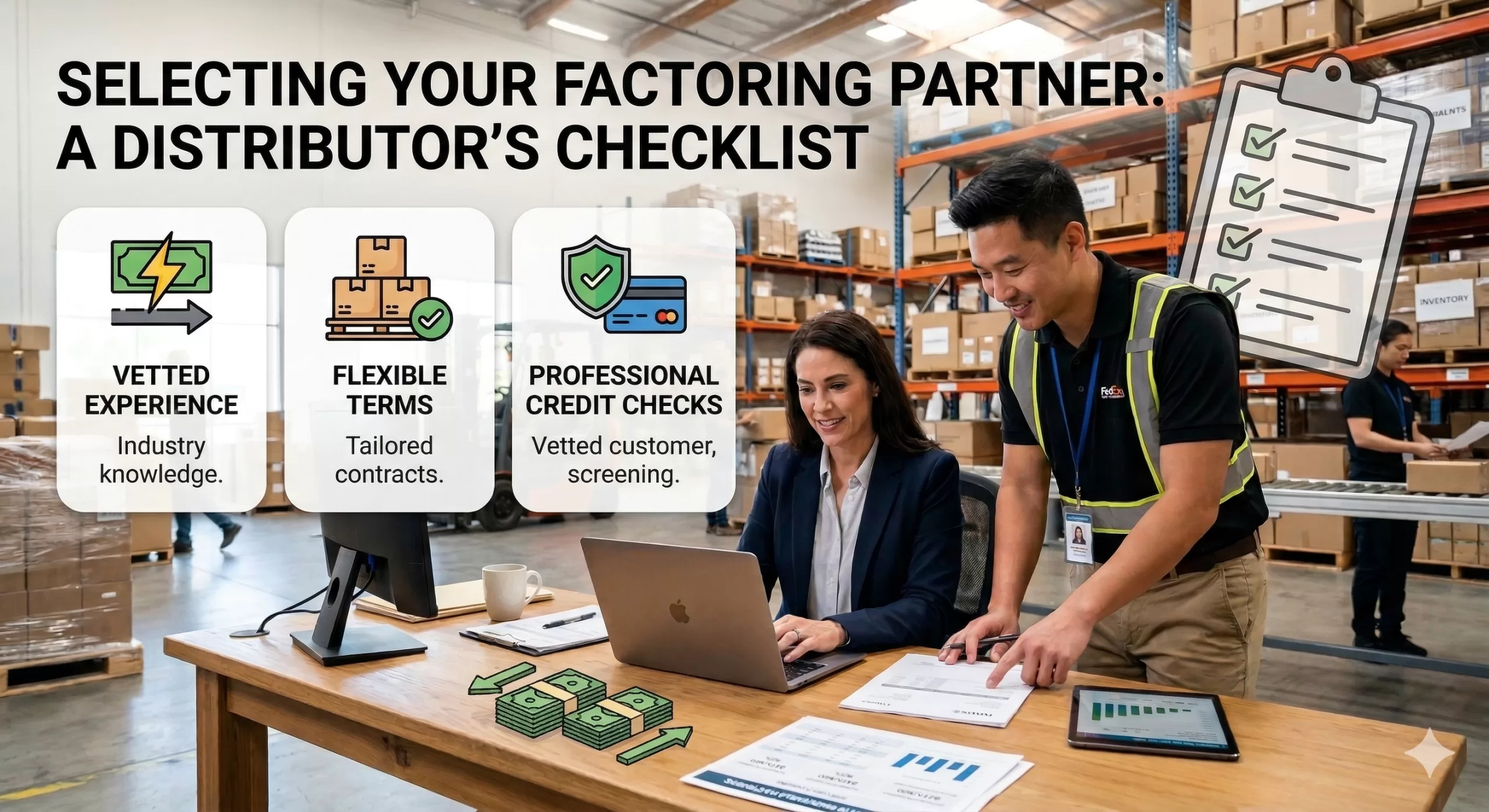
What you should know in selecting a factoring Partner
Choosing a factoring company is like choosing a long-term business partner. The right one will act as your back-office credit department; the wrong one can be an expensive administrative nightmare. Use this checklist to vet potential partners:
1. The Core Logistics
[ ] Industry Expertise: Do they have experience with the specific nuances of distribution (e.g., handling chargebacks, bill-backs, or progressive shipping)?
[ ] Advance Rate: Will they advance at least 80–90% of the invoice value?
[ ] Funding Speed: Can they provide “Same Day” or “Next Day” funding once an invoice is verified?
[ ] Funding Source: Are they a Direct Lender (bank-backed) or an independent factor? (Direct lenders often have lower rates and more stability).
2. Transparency & Fees
[ ] The “All-In” Rate: Ask for a breakdown of all fees. Look out for hidden “junk fees” like application fees, wire fees, or credit check fees.
[ ] Recourse vs. Non-Recourse: * Recourse: You must buy back the invoice if your customer doesn’t pay. (Lower fees).
Non-Recourse: The factor takes the credit risk if the customer goes bankrupt. (Higher fees).
[ ] Volume Requirements: Are there “Monthly Minimums”? If you don’t hit a certain volume, will you be penalized?
3. The “Relationship” Factor
[ ] Dedicated Account Manager: Will you have a single point of contact who knows your business, or a generic 1-800 help desk?
[ ] Customer Interaction Style: How do they contact your customers for verification? You want a partner who is professional and polite, as they represent your brand.
[ ] Technology Integration: Do they sync with your accounting software (QuickBooks, NetSuite, etc.) for easy invoice uploading?
4. Contract Flexibility
[ ] Contract Length: Avoid multi-year lock-ins. Look for month-to-month or one-year terms with clear exit clauses.
[ ] Termination Notice: How much notice is required to leave? (Usually 30–90 days).
[ ] Personal Guarantee: Is a personal guarantee required? (Standard for many small business factors, but worth clarifying).
Contains information related to marketing campaigns of the user. These are shared with Google AdWords / Google Ads when the Google Ads and Google Analytics accounts are linked together.
90 days
__utma
ID used to identify users and sessions
2 years after last activity
__utmt
Used to monitor number of Google Analytics server requests
10 minutes
__utmb
Used to distinguish new sessions and visits. This cookie is set when the GA.js javascript library is loaded and there is no existing __utmb cookie. The cookie is updated every time data is sent to the Google Analytics server.
30 minutes after last activity
__utmc
Used only with old Urchin versions of Google Analytics and not with GA.js. Was used to distinguish between new sessions and visits at the end of a session.
End of session (browser)
__utmz
Contains information about the traffic source or campaign that directed user to the website. The cookie is set when the GA.js javascript is loaded and updated when data is sent to the Google Anaytics server
6 months after last activity
__utmv
Contains custom information set by the web developer via the _setCustomVar method in Google Analytics. This cookie is updated every time new data is sent to the Google Analytics server.
2 years after last activity
__utmx
Used to determine whether a user is included in an A / B or Multivariate test.
18 months
_ga
ID used to identify users
2 years
_gali
Used by Google Analytics to determine which links on a page are being clicked
30 seconds
_ga_
ID used to identify users
2 years
_gid
ID used to identify users for 24 hours after last activity
24 hours
_gat
Used to monitor number of Google Analytics server requests when using Google Tag Manager