
Company requires a quick factoring infusion of cash through the end of Q4. We will quickly advance against AR with cooperation of their senior lender.

Company requires a quick factoring infusion of cash through the end of Q4. We will quickly advance against AR with cooperation of their senior lender.
In this third book in the Extreme Ownership trilogy, a retired fighter pilot and TOPGUN instructor, now serving as the Chief Development Officer at Echelon Front, teaches listeners the importance of leadership and how to implement it. The Need to Lead invokes the classic Top Gun movie quote. It is also an undeniable truth that author Dave Berke experienced as a Marine Corps officer, fighter pilot, TOPGUN instructor, ground combat leader, husband, and father. This book, based on his experiences and teachings, helps listeners be better leaders and understand that leadership is a universal requirement for success, no matter the environment. Every person needs to lead in order to succeed.
By adopting the right leadership mindsets and behaviors, we gain the capacity to solve problems, support the people around us, and amend our mistakes. How do we develop these necessary skills? By embracing the principles imparted to Berke from each humbling moment in the 1) EVERYONE IS A From the CEO to the most junior employee, everyone at every level, is a leader. Leadership isn’t about rank, title, position, or function. The more people see themselves as leaders, the more they want to contribute to the team’s success. 2) LEADERSHIP EXISTS IN EVERY Leadership is often viewed as an attribute relevant to our professional lives, but it exists in every capacity, it applies in every situation. The same behaviors should guide us as parents, spouses, family members, and friends of all kinds. 3) EVERY PROBLEM WE FACE IS A LEADERSHIP The problems we confront at work aren’t caused by external factors. They are caused by our failure to lead. Our child’s behavior isn’t just a function of their age and tendencies; it’s about us as parents. If a lack of leadership is the problem, and good leadership is the solution, then how we lead becomes the most critical factor affecting the outcome. 4) LEADERSHIP IS A Good leaders aren’t simply born. Leadership can be learned, which means every single person in the world can get better at it if they choose. This book is their guide. Through compelling stories from TOPGUN training and combat to the boardroom and at home, Berke gives listeners the necessary tools to succeed..
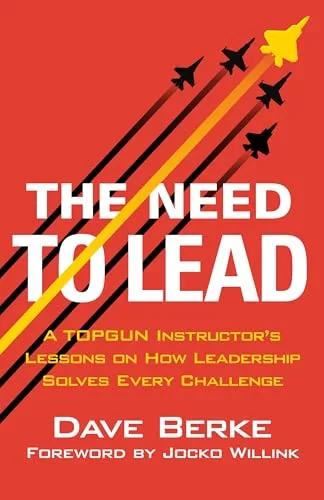
This document synthesizes the core leadership principles, mindsets, and actions detailed in Dave Berke’s The Need to Lead. The central thesis posits that leadership is not a function of rank or title but a universal and necessary skill for success in any endeavor, from the battlefield to the boardroom to the family home. The framework is built upon four foundational beliefs: 1) everyone is a leader, 2) leadership applies in every capacity of life, 3) every problem is a leadership problem, and 4) leadership is a skill that can be learned and improved.
The analysis is divided into two parts. Part I: The Mindsets of a Good Leader examines the internal frameworks required for effective leadership. Key mindsets include recognizing that all problems stem from a lack of leadership, making humility the most critical attribute to counteract a destructive ego, fighting the constant threat of complacency, developing detachment as a “superpower” for clear decision-making, and understanding that the pursuit of constant improvement is superior to the myth of perfection.
Part II: The Actions of a Good Leader details the external behaviors that manifest from these mindsets. These actions include taking “Extreme Ownership” for all outcomes, especially preemptively; listening more than talking to build trust and gather information; embracing and leading through change to avoid stagnation; consistently putting the team’s success ahead of individual recognition; and preparing the team to thrive in the leader’s absence, which is the ultimate measure of leadership success. Each principle is illustrated through personal anecdotes from a distinguished career as a Marine Corps fighter pilot, TOPGUN instructor, and ground combat leader.
The leadership philosophy presented is built upon four core beliefs codified at the leadership consultancy Echelon Front. These beliefs assert that leadership is a universal requirement and a learnable skill applicable to every facet of life.
Effective leadership begins with cultivating a specific set of internal mindsets that govern perception, attitude, and reaction. These mindsets are often counterintuitive to natural human tendencies.
A core tenet is that leaders must reject passivity and the “it is what it is” mentality. When faced with challenges, a leader’s responsibility is to act, even when circumstances feel beyond control, to exert influence and shape the outcome.
Ego, while a source of self-worth, becomes an enemy when unchecked. It prevents leaders from accepting blame, admitting ignorance, and listening to others. Humility is the essential counterbalance that enables learning, growth, and team cohesion.
Complacency is a distinct threat that emerges when success seems imminent. It is a contentedness to a fault, causing a leader to drop their guard, overlook risks, and fail to follow through, snatching defeat from the jaws of victory.
Effective leaders must be able to detach from their own emotions, ego, and perspective to see situations clearly and make rational decisions. This is not about being aloof, but about gaining control over internal reactions that cloud judgment.
The demand for perfection is counterproductive. It creates a culture where team members hide small mistakes to avoid criticism. These hidden errors accumulate and eventually lead to catastrophic failure.
The mindsets of a leader are manifested through a set of disciplined, external actions. These behaviors build trust, empower teams, and drive success.
Leaders must accept ultimate responsibility for everything that happens under their purview. Taking “Extreme Ownership” destroys excuses and grants the leader the control needed to solve problems.
While traditional leadership is associated with talking and giving orders, the most overlooked and effective leadership behavior is listening. Talking less and listening more demonstrates care, builds trust, and allows a leader to gather critical information.
While it is human nature to resist change because it is uncomfortable and unpredictable, the ability to innovate and adapt is vital for the survival and success of any individual or organization.
A leader’s success is a direct result of the team’s work. Therefore, a good leader subordinates their own ego and deflects credit and praise to the team.
The ultimate measure of a leader’s success is how well their team can perform and thrive in their absence. A leader’s duty is to develop other leaders and build a resilient organization that is not dependent on any single individual.
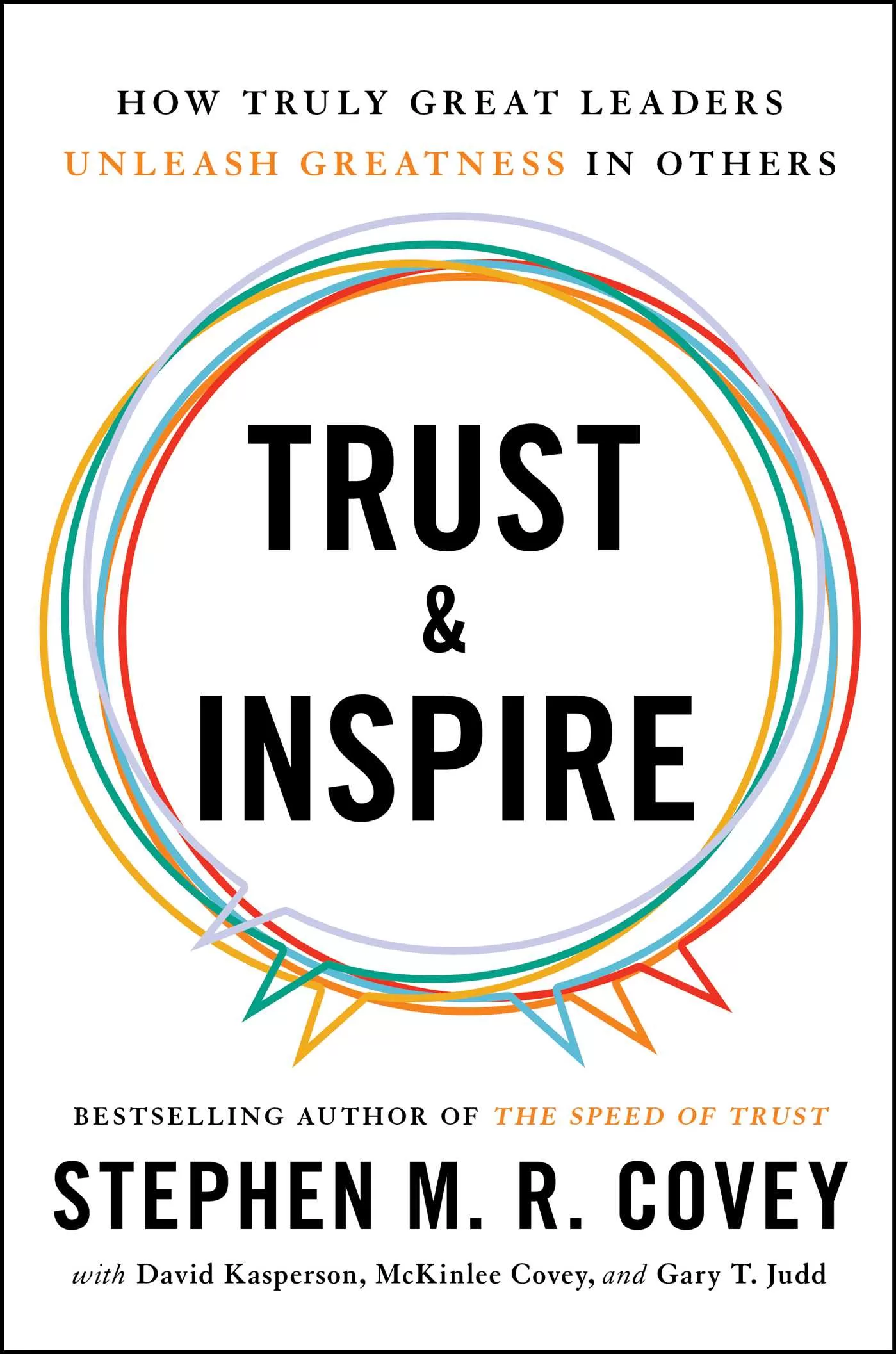
The core principles of the “Trust & Inspire” leadership model, is presented as an essential paradigm shift from the traditional “Command & Control” style. The central argument is that while the world, the nature of work, and the workforce have fundamentally changed, prevailing leadership styles have not, creating a significant gap between organizational potential and performance.
The obsolete Command & Control model, even in its more modern “Enlightened” form, is transactional, focuses on compliance, and manages people as resources to be controlled. This approach is increasingly ineffective in an era defined by five key emerging forces: rapid global change, the shift to collaborative knowledge work, the decentralization of the workplace, a diverse workforce with new expectations, and the expansion of individual choice.
The Trust & Inspire model offers a relevant, transformational alternative. It is a people-centered approach rooted in the belief that individuals possess inherent greatness and potential. This model operates through three core responsibilities, or “Stewardships”:
Ultimately, the Trust & Inspire framework is positioned as the most effective means to meet the two epic imperatives of the modern era: winning in the workplace by creating a high-trust culture that attracts and retains talent, and winning in the marketplace by fostering the collaboration and innovation necessary for relevance and success.
The foundational premise is that a profound disconnect exists between the demands of the modern world and the prevailing leadership methodologies. While organizations face immense pressure to produce more for less, the vast majority of the workforce possesses far more talent and creativity than their jobs require or allow them to contribute. This gap is a direct result of clinging to an outdated leadership paradigm.
The traditional leadership style, “Command & Control,” is a relic of the industrial age. It operates from a paradigm of position and power, treating people as things to be managed efficiently. Its core tools are containment, coercion, and compliance, often through “carrot-and-stick” motivation. While this model has been refined into a kinder, gentler “Enlightened Command & Control” that incorporates elements like emotional intelligence and mission statements, its fundamental paradigm of control remains unchanged.
This style is increasingly irrelevant and ineffective for several reasons:
The need for a new leadership model is propelled by five interconnected global shifts:
| Force | Description |
| 1. The Nature of the World Has Changed | The pace and nature of change are unprecedented, driven by disruptive technologies like AI, robotics, and digitization. Human knowledge is now estimated to double every twelve hours, making a “learn-it-all” mindset essential over a “know-it-all” one. |
| 2. The Nature of Work Has Changed | Work is now predominantly knowledge- and service-based, requiring collaboration, innovation, and creativity. The focus has shifted from hands to minds. |
| 3. The Nature of the Workplace Has Changed | The traditional physical office is becoming less relevant. Work is increasingly virtual, hybrid, or globally dispersed, leading to flatter organizational structures that require greater speed and flexibility. |
| 4. The Nature of the Workforce Has Changed | The workforce is more diverse than ever, with up to five generations working together. Younger generations (Millennials, Gen Z) have different expectations, prioritizing purpose and meaningful contribution over just a paycheck. |
| 5. The Nature of Choice Has Changed | Technology has created infinite choice for consumers and employees. The rise of the gig economy and virtual work means top talent has unprecedented options and will choose organizations where they feel trusted, valued, and inspired. |
These five forces create two non-negotiable imperatives for any organization seeking sustained success:
Trust & Inspire is a leadership style based on the belief that people have greatness inside them and that a leader’s job is to unleash that potential. It is a shift from managing people to leading people.
The fundamental difference lies in the leader’s paradigm—their view of people and leadership.
| Aspect | Command & Control | Trust & Inspire |
| Paradigm | Position and Power. Sees people as things/assets. | People and Potential. Sees people as whole individuals. |
| Focus | Managing and controlling people. | Unleashing talent and potential. |
| Motivation | Extrinsic (carrot and stick). | Intrinsic (purpose, meaning, contribution). |
| Outcome | Compliance and coordination. | Commitment and collaboration. |
| Approach | Transactional (efficiency-focused). | Transformational (effectiveness-focused). |
| Mindset | Scarcity (competing for credit/resources). | Abundance (elevating caring over competing). |
| Goal | Get things done. | Get results in a way that grows people. |
| Metaphor | Machinist leveraging resources. | Gardener creating conditions for growth. |
This leadership style flows from five core beliefs that shape a leader’s mindset and subsequent actions.
| Belief | Implication for the Leader’s Job |
| People have greatness inside them. | My job is to unleash their potential, not control them. |
| People are whole people. | My job is to inspire, not merely motivate. |
| There is enough for everyone. | My job is to elevate caring above competing. |
| Leadership is stewardship. | My job is to put service above self-interest. |
| Enduring influence is created from the inside out. | My job is to go first. |
Trust & Inspire leadership is not an abstract theory but a practical framework built on three interdependent stewardships, or core responsibilities.
Modeling is the source of a leader’s credibility and moral authority. It is built on the belief that leaders must “go first” to create enduring influence. People are far more impacted by a leader’s example than their words.
This stewardship moves beyond simply being trustworthy to actively extending trust to others. The primary challenge in leadership is not a lack of trustworthy people, but trustworthy people who do not extend trust.
Inspiration is identified as the new engagement and the quality people most want in a leader. It is a learnable skill that comes from connection.
The “Stewardship Agreement” is a practical tool for operationalizing the Trust & Inspire model. It is a psychological and social contract that clarifies expectations and accountability, shifting the paradigm from manager to coach. It is particularly effective for remote and hybrid work environments.
The text identifies five common mental barriers that prevent leaders from shifting to a Trust & Inspire style, along with solutions for each.
| Barrier | Description | Solution Mindset & Action |
| 1. “This Won’t Work Here” | The belief that one’s specific industry, company, boss, or culture is an exception where Trust & Inspire is not viable. This mindset places the problem “out there.” | Mindset: I am part of the solution. Action: First model the desired behavior within your circle of influence, then mentor others who are inspired by your example and results. |
| 2. Fear (“But What If…”) | Fear of losing control, of failure, of being burned by betrayal, of not getting credit, or of personal inadequacy (“imposter syndrome”). | Mindset: The potential return outweighs the risk. Action: Extend “smart trust” by balancing risk and return, operate with an abundance mentality, and intentionally build personal credibility. |
| 3. “I Don’t Know How to Let Go” | The deep-seated need to control tasks and methods, often stemming from the belief that “if you want something done right, you have to do it yourself.” | Mindset: Failure is the pathway to growth and innovation. Action: Develop a high tolerance for failure, focusing on learning and course correction. Empower people with autonomy over their tasks. |
| 4. “I’m the Smartest One in the Room” | The conscious or unconscious belief that the leader’s ideas are inherently the best, leading them to diminish the contributions of others. | Mindset: I need the strengths of those around me. Action: Become a “multiplier” by practicing humility, listening first to understand, and having a growth mindset for others, not just yourself. |
| 5. “This Is Who I Am” | The belief that one’s leadership style is fixed and unchangeable, a product of a long-standing identity or past successes. | Mindset: I’m the programmer, not the program. Action: Actively “rescript” your leadership style by seeking out new models and mentors. Recognize that past success does not guarantee future relevance. |
Here is a quick description and cover image of book The Multiply Method: Simple Systems for Building a Solid, Sustainable Network Marketing Team written by Sarah Robbins which was published in August 12, 2025. You can read this before The Multiply Method: Simple Systems for Building a Solid, Sustainable Network Marketing Team PDF EPUB full Download at the bottom.

Discover The Multiply Method, Sarah Robbins’ proven system for simplifying network marketing, scaling your team, and creating lasting success–developed from her journey to building a $2 billion annual sales business. Are you ready to take your network marketing business to the next level? As a kindergarten teacher who was uncertain about her future, Sarah Robbins often wondered what she would do if she lost her job. How would she support herself, especially at the height of a recession? Then one day, she received an offer she couldn’t refuse, to join a network marketing adventure. Before she knew it, her part-time side hustle became her full-time career. And based on her many years of experience, she has developed a simple, effective system–one that she’s used to build a business with over $2 billion in annual sales. In this accessible guide, Robbins shares all of the techniques and strategies she uses daily not only in her own company but also with her coaching clients from across every industry. The Multiply Method will show you how Reframe prospecting as inviting to take off the pressure Use conversations as presentations that turn interest into opportunity Close the deal by conquering objections Launch new team members with quick, easy wins Leverage social media in a way that leads clients to you And develop leaders who also multiply. Whether you’re new to network marketing or a seasoned professional, The Multiply Method gives you the tools to simplify your efforts, scale your team, and create a legacy you can be proud of. If you’re ready to unlock your business’s potential, join the countless others who have used this simple system to build extraordinary success. Your breakthrough starts here!
Contact Factoring Specialist, Chris Lehnes
This document provides a comprehensive synthesis of “The Multiply Method,” a book by Sarah Robbins that outlines a framework of simple, replicable systems for building a sustainable network marketing team. The core argument is that success in network marketing is not dependent on personality, pre-existing networks, or salesmanship, but on the consistent implementation of proven, duplicable systems. The method is rooted in authentic relationship-building and leadership development, treating the business model as a form of “pseudo-franchising” where success can be scaled through duplication.
The author’s personal journey serves as a primary case study. After building a sales team that generated over $2 billion in annual sales, the business model was dismantled overnight. Robbins successfully rebuilt a new team faster than the first by applying the exact systems outlined in the book, validating the method’s effectiveness irrespective of the company or circumstances.
The Multiply Method is comprised of ten interconnected systems: Prospecting, Presenting, Closing, Fast Start, Customer Acquisition, Customer Retention, Events, Social Media, Leadership Development, and Team Training. Key strategies include reframing prospecting as the “art of inviting” through a Compliment → Conversation → Connection model, simplifying presentations to a WHY → WHAT → WHO framework, and handling objections with a Feel-Felt-Found technique. The ultimate goal is to create a culture of duplication where leaders multiply other leaders, resulting in exponential and sustainable growth.
Sarah Robbins began her career as a kindergarten teacher during the 2008 recession, facing job insecurity. At her mother’s encouragement, she started a network marketing business part-time. Despite having no systems or upline support, she invested in mentorship and developed her own systematic approach. This led to building a sales team of hundreds of thousands, serving millions of customers, and achieving over $2 billion in annual sales within five years.
A pivotal moment occurred when the company’s model changed, effectively eliminating her team and over 99% of her income overnight. Faced with this monumental loss, Robbins chose to rebuild from the ground up with a new company. This experience became the ultimate test for her systems. She successfully applied the Multiply Method and reached the top of the new company’s compensation plan in her first full month, proving the method’s principles are universal and not company-dependent. This journey reinforces the core message that success is rooted in strategy, leadership, and authentic relationships, not just the product or pay plan.
The central thesis of “The Multiply Method” is that network marketing operates like a “pseudo-franchise” model, but without the high overhead costs of traditional franchises. Success is achieved not through individual charisma or unique skills, but by replicating simple, effective systems that anyone can follow.
The method is a comprehensive framework broken down into ten essential systems designed to build and scale a network marketing business.
| System | Core Function | Key Objective |
| 1. Prospecting | The “art of inviting” people into the business. | To generate leads and start conversations by finding potential customers and partners. |
| 2. Presenting | Turning interest into opportunity through authentic conversations. | To share the product and business opportunity in a clear, professional, and replicable way. |
| 3. Closing | Guiding prospects through the decision-making process. | To overcome objections and enroll new customers, consultants, or connectors. |
| 4. Fast Start | Onboarding new team members for immediate success. | To launch new distributors effectively, helping them earn their first paycheck and promotion. |
| 5. Customer Acquisition | Building a strong, customer-centric business base. | To attract, engage, and enroll loyal customers who are excited about the products. |
| 6. Customer Retention | Keeping customers engaged and reordering. | To create lifelong advocates through consistent follow-up, encouraging reorders, referrals, and upgrades. |
| 7. Events | Accelerating growth through virtual and in-person experiences. | To showcase the product, opportunity, and community in an impactful, experiential way. |
| 8. Social Media | Attracting ideal clients through strategic online content. | To generate an endless stream of organic leads by providing value and sparking curiosity. |
| 9. Leadership Development | Creating leaders who multiply other leaders. | To transform the organization by duplicating leadership, which is the “real gold” of the business. |
| 10. Team Training & Communication | Building a unified culture of duplication. | To hold the team together with consistent training and communication systems that are stress-free. |
Prospecting is positioned not as selling, but as making connections. Top earners are universally great prospectors who prioritize people over product and relationship over revenue.
Compliment → Conversation → Connection
Effective presentations are short, conversational, and focused on the prospect. The core system avoids scripts in favor of a simple, three-part story.
WHY → WHAT → WHO
Closing is a systematic process to guide an interested prospect to a decision.
Identify Interest → Provide Information + Share Next Steps → Follow Up + EnrollA strong start is critical for new distributor success and retention. The system focuses on four key areas.
Events are a cornerstone of the method for both launching new distributors and ongoing team growth. They maximize time and create an experiential environment.
A healthy business is built on a large base of happy customers, who are the best brand ambassadors and potential future distributors.
Recommendation → Validation → Enrollment
The social media strategy focuses on attracting leads organically by providing value rather than direct selling.
Recommendation → Validation → Enrollment system.Duplication is the key to sustainable, long-term success. A three-tiered training system is proposed to develop leaders at every level.
Culture is described as “the glue that holds the team together” through all seasons of business. It is built on two pillars: Communication and Community.
The book has received endorsements from several prominent figures in business and network marketing:
A government shutdown, defined as a lapse in federal appropriations, is frequently framed as a political skirmish in Washington D.C. Yet, its financial reverberations are immediately and intensely felt across the nation, striking at the heart of the U.S. economy: its small businesses. Comprising over 33 million firms and responsible for generating two-thirds of net new jobs, the small business ecosystem is the engine of American enterprise.
However, this vital sector is uniquely fragile when faced with political paralysis. A shutdown creates immediate, cascading, and disproportionate negative effects on small businesses, necessitating proactive recovery strategies from both the private and public sectors. This analysis details the mechanics of this damage—from frozen payments and suspended loans to depressed consumer spending—and outlines the essential steps small businesses must take to recover, mitigate future risk, and advocate for systemic protection.
The moment a shutdown is triggered, the consequences for small businesses that interact directly with the federal apparatus are sudden, severe, and measurable.
For the large segment of small businesses that operate as federal contractors, the shutdown delivers a direct financial shock:
Small businesses rely heavily on the federal government for capital access, a lifeline that is severed during a shutdown.
For firms in regulated industries, the shutdown acts as an involuntary stop sign.
The government shutdown rapidly produces a secondary layer of damage through channels far removed from D.C., primarily through reduced consumer spending and heightened market uncertainty.
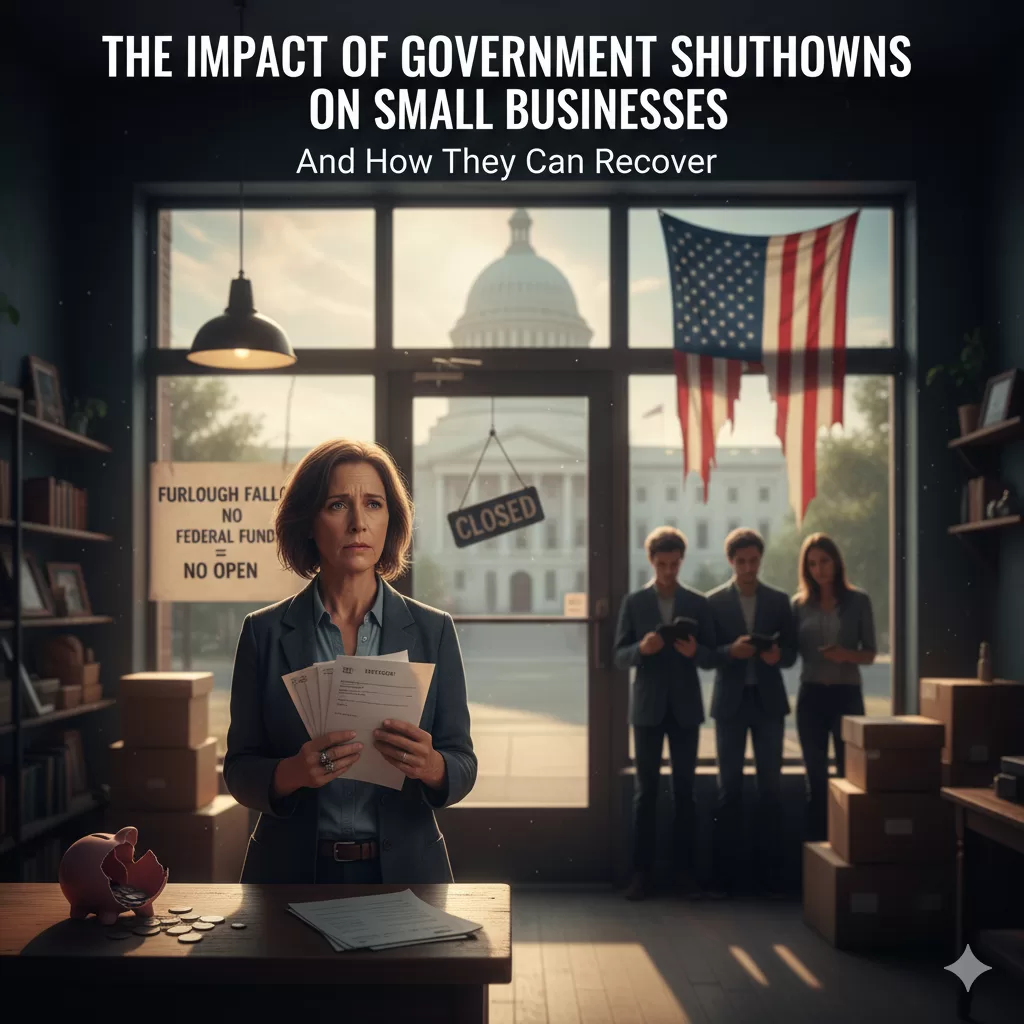
The largest secondary impact stems from the sudden loss of income for hundreds of thousands of federal employees and non-essential contractors.
A shutdown injects volatility into financial and capital markets, altering the risk assessment for small businesses.
Small businesses rely on accurate, timely federal data to make strategic decisions. A shutdown halts the release of critical economic intelligence.
The non-financial impacts inflict deep stress on owners and staff, often determining the long-term viability of the business.
The recovery phase demands proactive management, aggressive financial triage, and a fundamental reassessment of business risk.
Upon reopening, businesses must move swiftly and meticulously:
The most effective strategy is to ensure the business is never again so vulnerable to political instability.
Small business owners must leverage their collective voice to push for legislative reform.
The resilience of the small business sector is severely tested by government shutdowns. These events are not merely political theatre; they are systemic economic disruptions that destroy cash flow, erode consumer confidence, and inflict severe psychological stress on owners and employees. The 35-day shutdown of 2018-2019 provided undeniable proof that the small business community bears a disproportionate burden of political gridlock.
While recovery demands aggressive financial triage and meticulous documentation, the long-term solution lies in diversification and structural preparedness. Policymakers must recognize that failure to fund critical economic functions, even temporarily, causes an outsized and destructive ripple effect. Ensuring the continuity of SBA lending and contractor payments must be treated as a matter of essential economic stability, insulating the national engine of job creation from political gridlock.
Contact Factoring Specialist, Chris Lehnes
More Than a Headline: 5 Ways a Government Shutdown Silently Cripples Main Street America
1.0 Introduction: Beyond the Beltway Drama
When the federal government shuts down, the news cycle often frames it as a distant political battle confined to Washington D.C. Yet, its financial reverberations are immediately and intensely felt across the nation, striking directly at the heart of the U.S. economy: its small businesses, the very engine of American enterprise responsible for creating two-thirds of all net new jobs.
This vital sector is uniquely and disproportionately vulnerable to the consequences of political paralysis. A shutdown creates an immediate cascade of damage that extends far beyond federal employees, impacting entrepreneurs and local economies nationwide. Here are the five most significant and surprising ways this political gridlock cripples small businesses, proving the damage is far more widespread than a headline can capture.
2.0 The Shutdown’s Ripple Effect: 5 Surprising Impacts on Small Business
2.1 Takeaway 1: The Instant Cash Flow Apocalypse
For the thousands of small businesses operating as federal contractors, a government shutdown triggers an immediate financial shock. During the 35-day shutdown of 2018-2019, an estimated 90% of federal contractor invoices went unpaid. This instantly converts reliable accounts receivable into dead weight, thrusting companies with thin margins into a severe cash flow crisis. Revenue doesn’t just get delayed—it stops entirely, as agencies issue formal “stop-work orders.” Major sources of small business contracting, like the Department of Defense (DOD) and NASA, halt the award of new projects, freezing the entire procurement pipeline and forcing owners into devastating choices, such as whether to miss payroll or attempt to retain highly skilled talent without any pay.
2.2 Takeaway 2: The $2 Billion Weekly Freeze on Ambition
A shutdown severs a critical lifeline for small businesses seeking to grow: access to capital. The Small Business Administration (SBA) is forced to suspend its flagship 7(a) and 504 loan guarantee programs. During the 2018-2019 shutdown, this stoppage was estimated to have frozen approximately $2 billion in small business financing per week. This freeze also extends to Economic Injury Disaster Loan (EIDL) applications, harming businesses already reeling from natural disasters and compounding their crisis. This number represents more than just money on hold; it signifies crippled expansion plans, delayed hiring, and stalled innovation for entrepreneurs across the country who suddenly find their ambitions on indefinite hold.
2.3 Takeaway 3: The Economic Paralysis Spreads Far From D.C.
The financial damage quickly spreads through the “Furlough Effect.” When approximately 800,000 federal workers missed two full paychecks during the extended shutdown, they were forced to drastically cut back on consumer spending. The impact on local economies was immediate and severe. Small restaurants and shops near federal hubs and businesses dependent on National Park Service tourists reported revenue declines of 50% or more. This secondary impact demonstrates how deeply intertwined Main Street is with government operations, even for businesses with no direct federal contracts.
2.4 Takeaway 4: It Puts New Ventures on Indefinite Hold
The impact extends beyond money, creating a regulatory and licensing paralysis that acts as an involuntary stop sign for new ventures. Consider a small craft brewery that has developed a new product but is waiting on a permit from the Alcohol and Tobacco Tax and Trade Bureau (TTB). When the government shuts down, the TTB closes. The brewery cannot legally bottle and sell its new product, killing entrepreneurial momentum. This specific example shows how a shutdown can delay the opening of new breweries, wineries, and distilleries entirely unrelated to government contracting, freezing the very spirit of enterprise.
2.5 Takeaway 5: The Hidden Human Cost for Owners and Employees
Beyond the financial statements, a shutdown inflicts deep psychological and operational strains. The uncertainty can trigger a “talent exodus,” as highly skilled employees leave for more stable private-sector work rather than risk prolonged layoffs. At the same time, owners are forced to take extreme personal risks to keep their businesses afloat. During the 2019 shutdown, many small business owners dependent on federal contracts revealed they had liquidated personal retirement accounts or taken out home equity loans simply to cover their company’s payroll. Finally, the inability to fulfill contracts due to stop-work orders causes lasting damage to a business’s reputation, risking lost goodwill and exclusion from future opportunities.
3.0 Conclusion: From Crisis to Resilience
Government shutdowns are not political theatre; they are systemic economic disruptions that inflict deep, lasting, and disproportionate damage on the nation’s primary job creators. While the immediate aftermath requires financial triage, the long-term solution for businesses lies in strategic preparation, including diversifying their client base and building robust emergency funds.
The 35-day shutdown of 2018-2019 provided undeniable proof that the small business community bears a disproportionate burden of political gridlock.
This repeated cycle of crisis demands a systemic solution, forcing policymakers to answer a fundamental question. It underscores the urgent need to protect the bedrock of the American economy from political instability. How can we insulate essential economic functions, like SBA lending and contractor payments, from future political gridlock to protect the engine of our economy?
A government shutdown, or a lapse in federal appropriations, inflicts immediate, severe, and disproportionate harm on the U.S. small business sector—an ecosystem of over 33 million firms responsible for generating two-thirds of net new jobs. The financial repercussions extend far beyond political centers, creating a cascade of negative effects that destabilize this vital engine of the American economy.
The 35-day shutdown of 2018-2019 serves as definitive proof of this vulnerability, where an estimated $2 billion in small business financing was frozen per week due to the suspension of Small Business Administration (SBA) loan processing. During this period, over 90% of federal contractor invoices went unpaid, thrusting thousands of firms into a cash flow crisis. The shutdown’s impact is multifaceted, manifesting as direct financial shocks, indirect economic downturns, and severe operational strains.
Key Impacts Include:
Recovery requires immediate financial triage, proactive creditor negotiation, and meticulous documentation for future claims. However, long-term survival hinges on strategic diversification to reduce reliance on federal revenue (capping it at 60-70%) and building a robust emergency cash reserve of 3-6 months. Ultimately, the analysis advocates for systemic reform through legislation that would “wall off” critical economic functions, such as SBA loan processing and contractor payments, from political appropriations battles to ensure national economic stability.
——————————————————————————–
Government shutdowns are systemic economic disruptions that deliver measurable damage through direct, indirect, and operational channels. The small business sector is uniquely fragile and bears a disproportionate burden of the consequences of political gridlock.
The most immediate consequences are felt by businesses that interact directly with the federal government for contracts, financing, or regulatory approval.
| Impact Area | Mechanism of Harm | 2018-2019 Shutdown Case Data |
| Freeze on Federal Contracts | Delayed Payments: Reliable accounts receivable become financial dead weight, creating an instant cash flow crisis for contractors operating on thin margins. <br> Stop-Work Orders: Agencies halt ongoing contract work, stopping all revenue streams and forcing difficult staffing decisions. | Over 90% of federal contractor invoices went unpaid, causing thousands of small contractors to miss payroll. The DOD and NASA halted all non-essential contract awards. |
| Suspension of Financial Support | SBA Loan Stoppage: The suspension of the SBA’s 7(a) and 504 loan guarantee programs cuts off a critical lifeline for capital access. <br> Disaster Loan Delays: The processing of Economic Injury Disaster Loan (EIDL) applications is frozen. | The SBA stopped all new loan processing, freezing an estimated $2 billion in small business financing per week, crippling nationwide expansion plans. |
| Regulatory Paralysis | Permit and License Delays: Businesses in regulated industries cannot proceed with new products or operations. <br> Trade Complications: Furloughed personnel cause delays in customs clearances and inspections, creating supply chain disruptions. | The closure of the Alcohol and Tobacco Tax and Trade Bureau (TTB) created a significant backlog, delaying the opening of new breweries, wineries, and distilleries. |
The shutdown’s impact quickly radiates outward, depressing the broader economy through reduced spending, market volatility, and a loss of critical data.
Beyond the financial metrics, a shutdown imposes severe non-financial burdens that can determine a business’s long-term viability.
Recovery from a government shutdown requires a combination of immediate financial triage and long-term strategic adjustments to mitigate future risk.
Once government operations resume, small businesses must act swiftly and methodically to stabilize their finances and restart operations.
The most effective strategy is to build a business model that is fundamentally less vulnerable to political instability.
To prevent future economic damage, small business owners are encouraged to advocate for legislative reforms that insulate core economic functions from political gridlock. The central proposal is the “Wall Off” principle, which calls for legislation that grants “Excepted Status” to critical, non-political economic functions. This would ensure their continuity during a lapse in appropriations.
The two most critical functions to be shielded are:
Treating the continuity of these functions as a matter of essential economic stability is paramount to protecting the national engine of job creation.
“AI Value Creators” presents a compelling argument that the current generative AI era represents a pivotal “Netscape moment”—a point of technological democratization that is not merely an opportunity but an economic imperative for businesses and governments alike. The central thesis is that sustained growth in a world of declining populations and expensive capital can only be achieved through massive productivity gains, for which AI is the primary catalyst.
The document advocates for a fundamental strategic shift from a +AI mindset (adding AI to existing processes) to an AI+ approach (reimagining business with an AI-first strategy). The ultimate goal is to become an AI Value Creator, an organization that leverages an AI platform to tune foundation models with its unique, proprietary data. This is identified as the only sustainable competitive advantage in a future where generic models will commoditize.
Success in this new era is defined by a core formula: AI Success = Foundation Models + Data + Governance + Use Cases. Navigating the inherent tension between progress and risk requires balancing the paradox that responsibility and disruption must coexist. This balance is achieved through a combination of Leadership, widespread Skills development, and a commitment to Openness (in platforms, data, and community). Organizations are urged to act with urgency, view AI as a value generator rather than a cost center, and begin their journey with safe, internal automation projects to build experience and confidence.

——————————————————————————–
The emergence of generative AI is framed as a “Netscape moment,” an analogy to the 1994 debut of the first web browser which made the internet tangible, personal, and accessible to the masses.
+AI to AI+A core argument is the necessity of a profound mental model shift for organizations to thrive. This involves moving beyond simply incorporating AI into current operations and instead rebuilding processes around AI’s capabilities.
+AI Mentality (The Past): This is the common approach of adding AI to existing business processes. While AI adoption has doubled in the last five years, most organizations remain in this mode, which limits potential gains.AI+ Mentality (The Future): This is an “AI first” strategy. It involves reimagining and creating entirely new workflows that leverage AI from the ground up. The document asserts that “the companies that adopt an AI+ mentality today… will be the winners of today’s Netscape moment.”+AI to AI+.
AI+ state.The document outlines three primary modes of AI consumption, drawing a critical distinction between passively using AI and actively creating unique value with it. The latter is presented as the only path to long-term differentiation.
| Consumption Model | Description | Status | Key Considerations |
| Baked into Software | AI is embedded in off-the-shelf products (e.g., Grammarly, Adobe Photoshop). | AI User | Sets a new, higher baseline for productivity but offers no competitive differentiation, as it is available to everyone. |
| API Call to a Model | An application calls an external, third-party generative AI service (e.g., ChatGPT). | AI User | A viable approach, but entails significant risks: the model is an opaque black box; data privacy is a concern; the organization has no control over training data or governance; and value is disproportionately extracted by the service provider. |
| AI Platform Approach | An organization uses a platform with tools to access, customize, and deploy various models (open source and proprietary) using its own data. | AI Value Creator | The most comprehensive and recommended model. It allows the business to create and accrue unique value, maintain control over data and governance, and build defensible, proprietary AI assets. |
“The only sustainable competitive advantage will come from your data… the only AI that is differentiated in value from any other model for your business will be the AI that is further trained, steered, or tuned to your data on your business problems.”
To ensure AI projects deliver tangible business value, a pragmatic two-dimensional framework for classification and strategy is proposed.
Agentic AI is highlighted as a major breakthrough and the next frontier in enterprise productivity. Unlike task-oriented AI, agents are goal-oriented and autonomous.
Chapter 3 argues that AI adoption is not a choice but a necessity for economic survival and growth, based on current macroeconomic trends.
Responsibility and disruption must coexist.
The document concludes with a set of actionable principles for organizations embarking on their generative AI journey.
Contact Factoring Specialist Chris Lehnes

This study guide is designed to review and reinforce the core concepts presented in the initial chapters of AI Value Creators. It includes a short-answer quiz to test comprehension, suggested essay questions for deeper analysis, and a glossary of essential terms.
Instructions: Answer the following questions in 2-3 sentences, drawing exclusively from the provided source material.
——————————————————————————–
——————————————————————————–
Instructions: The following questions are designed for longer-form, analytical responses. Use the source material to construct a comprehensive argument for each prompt.
——————————————————————————–
| Term | Definition |
| +AI | The world of adding AI to existing business processes, as opposed to an AI-first approach. |
| Acumen | As used in “Data Acumen,” it refers to “skills related to putting data to work to help your business become data driven.” |
| Adaptable (AI) | The ability of an AI to not only perform multiple tasks but also handle different use cases it wasn’t originally trained for. |
| Agentic AI / AI Agents | A program in which the flow logic is defined and controlled by the AI (an LLM) itself. Agents are goal-oriented, capable of planning and executing future actions without explicit guidance to achieve a desired outcome. |
| AI+ | An “AI first” mentality where companies train their people and put technology into production with AI as the foundation, reimagining new workflows. |
| AI Ladder (Rebooted) | A reframed guiding strategy for the generative AI era that is built with AI in mind from the first rung, not as the destination. It guides organizations from data operations toward automating and replacing workflows with AI and agentic workflows. |
| AI Value Creator | An entity that uses an AI platform to build its own AI solutions by fine-tuning foundation models with proprietary data, thereby creating and accruing unique business value. |
| AI User | An entity that consumes AI when it is “baked into” off-the-shelf software or by prompting someone else’s model via an API call. |
| Foundation Model (FM) | Large-scale, deep neural networks trained on broad data that can be easily adapted to perform various downstream tasks for which they were not originally designed. LLMs are a type of FM. |
| Generalizable (AI) | The ability of an AI to perform well across a wide range of tasks and domains, often with little to no task-specific tuning. |
| High-dimensional space | A state where data has so many dimensions (features or attributes) that it is hard for humans to visualize. |
| Information Architecture (IA) | A platform that allows an organization to collect, organize, protect, govern, and store data, as well as build and govern generative AI models. The authors state, “You can’t have AI without an IA.” |
| Large Language Model (LLM) | A type of foundation model that powers many generative AI programs. It is described as a “large number guessing model” that uses math to connect data points and predict sequences. |
| Netscape Moment | A transformative moment when a technology is democratized and becomes tangible and personable for everyone, leading to widespread innovation and permanent changes in society. |
| Parameters | In the context of an LLM, parameters represent the overall knowledge of the model. A higher number of parameters generally means the model can perform more tasks. |
| Prompt | The input, typically in natural language, given to an LLM to elicit a response or “completion.” |
| Self-supervised learning | A type of frictionless learning where a model is trained on large amounts of unlabeled data by masking sections of the input and learning to predict the missing parts. |
| Shifting Left | A concept, originating from software development, of capturing defects or problems earlier in a cycle to make them less costly. The authors broaden it to mean using AI to reduce expenses, injuries, illness, and rote tasks. |
| Shifting Right | The ideation of new business models or a pivotal strategic move to transform an industry, often in response to technological change. |
| Supervised Learning | A traditional AI training method that requires humans to manually annotate large datasets, a process described as expensive, error-prone, and time-consuming. |
| Transfer Learning | The ability of an AI model to apply information and skills it has learned about in one situation to another, different situation. |
The holiday now known as Veterans Day, celebrated annually on November 11th, stands as a profound testament to the American commitment to its armed forces. It is a day dedicated to honoring all living and deceased military veterans who have served in the United States Armed Forces during wartime or peacetime. The history of this national holiday is not static; it is a narrative of evolution, reflecting the nation’s changing relationship with its military, transforming from a celebration of peace at the end of “the war to end all wars” into a universal commemoration of service.
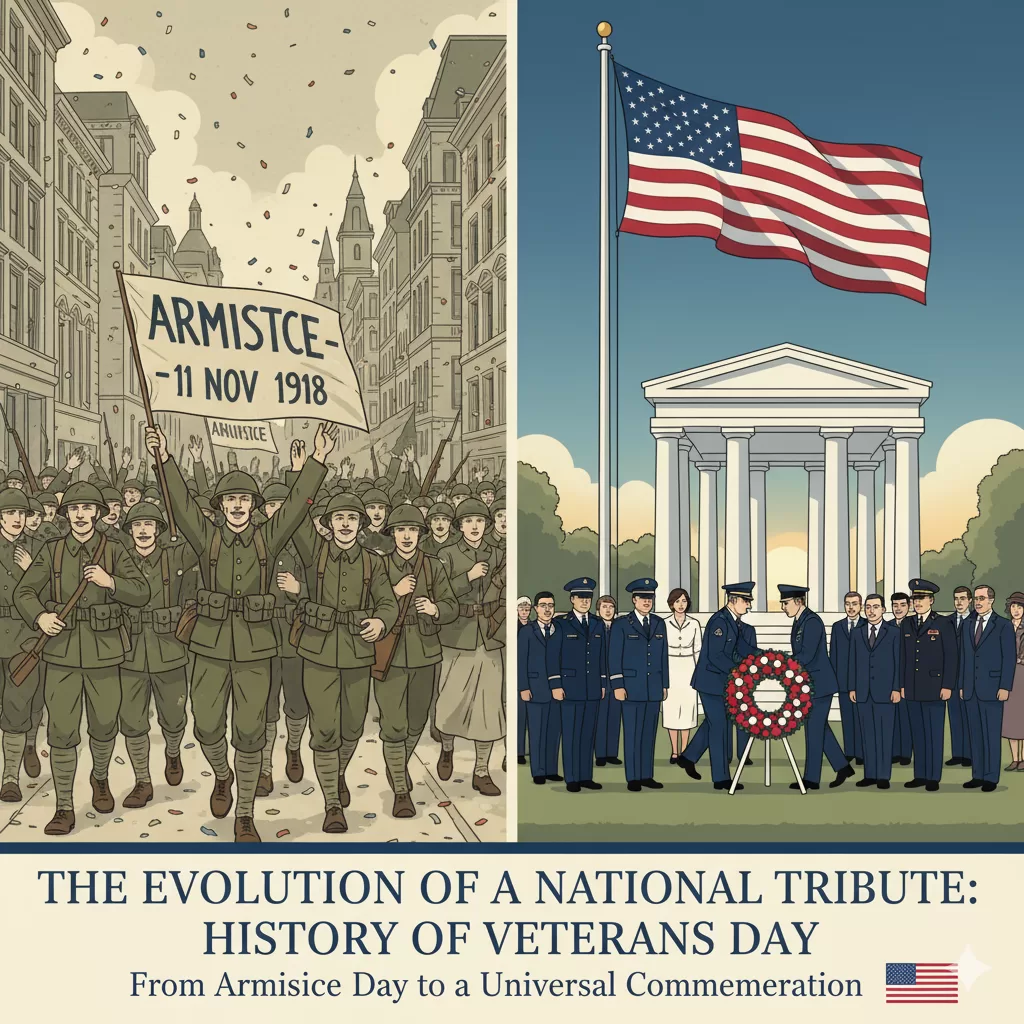
The journey from Armistice Day to Veterans Day is a chronicle of remembrance, legislative action, and enduring patriotism, rooted in a single, historically significant moment: the cessation of hostilities that ended World War I.
The foundation of Veterans Day lies in the signing of the armistice that brought an end to the brutal fighting of World War I.
The pivotal date is November 11, 1918. The armistice, a temporary cessation of hostilities between the Allied nations and Germany, went into effect at the “eleventh hour of the eleventh day of the eleventh month.” While the Treaty of Versailles, the official peace treaty, was signed seven months later on June 28, 1919, November 11th was universally accepted as the symbolic end of the Great War.
In the United States and Allied countries, the news sparked spontaneous, joyous celebrations. However, the initial jubilation quickly gave way to a solemn realization of the immense sacrifice. The war had cost the lives of over 116,000 Americans, and millions more worldwide. The impulse to remember, to honor the dead, and to celebrate the hard-won peace became immediate and widespread.
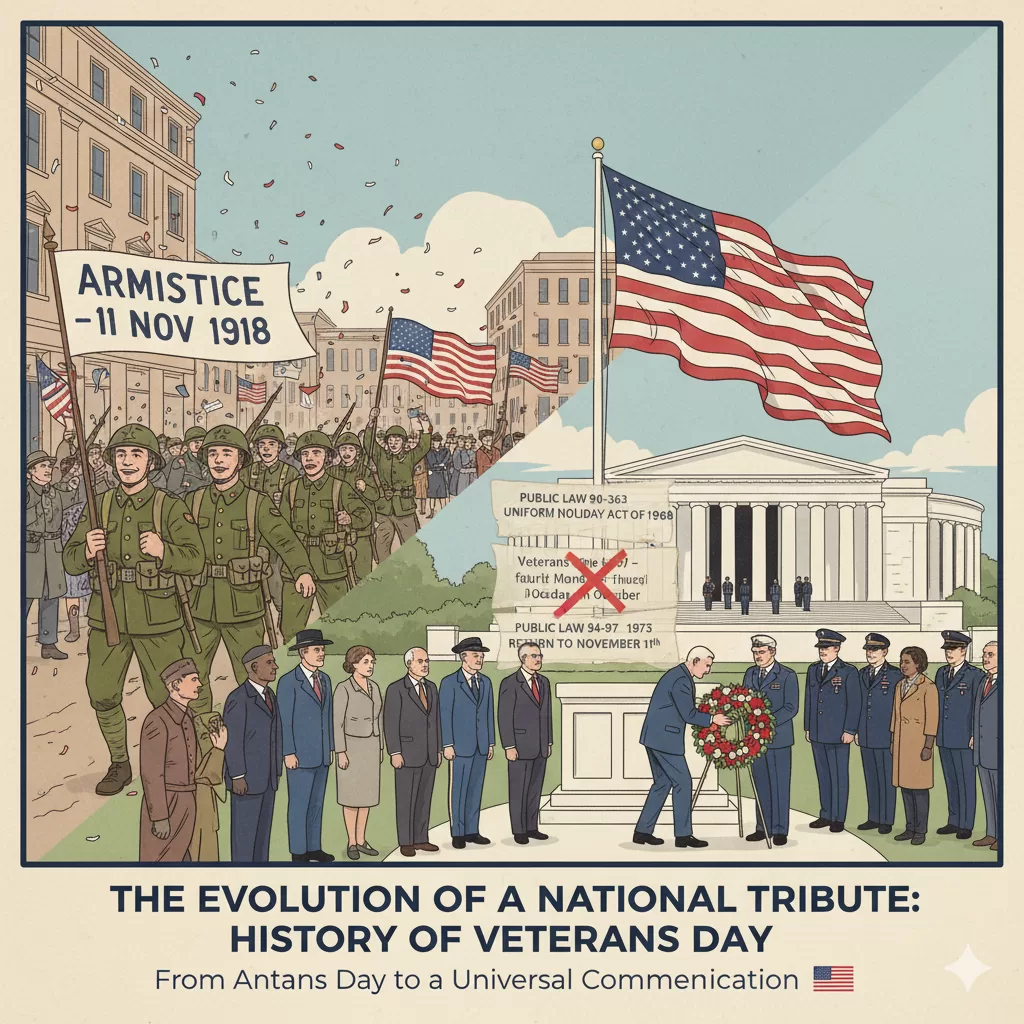
The first official commemoration took place one year later. On November 11, 1919, President Woodrow Wilson proclaimed the first Armistice Day. His words set the initial tone for the observance:
“To us in America, the reflections of Armistice Day will be filled with solemn pride in the heroism of those who died in the country’s service and with gratitude for the victory, both because of the thing from which it has freed us and because of the opportunity it has given America to show her sympathy with peace and justice in the councils of the nations.”
Wilson’s vision for the day included parades, public meetings, and a brief two-minute suspension of all business activities starting at 11:00 a.m. The focus was dual: solemn pride in heroism and dedication to the cause of world peace.
A crucial national tradition began in 1921, further cementing November 11th as a day of national reverence. On this date, an unknown American soldier from World War I was interred in the newly created Tomb of the Unknowns at Arlington National Cemetery.
Similar ceremonies had already occurred in France (at the Arc de Triomphe) and the United Kingdom (at Westminster Abbey). The American ceremony, attended by President Warren G. Harding, became the focal point for the nation’s tribute to its war dead, forever linking the sacred site of the Tomb with the Armistice Day commemoration. Congress also declared November 11, 1921, a legal federal holiday for the purpose of honoring all those who participated in the war.
The observance of Armistice Day continued to grow throughout the 1920s, a decade marked by an idealistic hope for an era of lasting global peace.
On June 4, 1926, the U.S. Congress formally recognized the end of World War I and passed a concurrent resolution. This resolution requested that the President of the United States issue annual proclamations calling for the observance of November 11th with appropriate ceremonies. It further stated that the anniversary should be “commemorated with thanksgiving and prayer and exercises designed to perpetuate peace through good will and mutual understanding between nations.”
Twelve years later, Armistice Day achieved its highest legislative status up to that point. A Congressional Act approved on May 13, 1938, officially made the 11th of November a legal Federal holiday. The act explicitly stated it was a day to be “dedicated to the cause of world peace and to be thereafter celebrated and known as ‘Armistice Day’.”
At this point, the holiday was explicitly dedicated to honoring the veterans of World War I. The core tradition was established: a moment of silence at 11 a.m., parades, and public orations focused on the themes of peace and the sacrifice of “The Great War” generation.
The optimistic hope that WWI would be “the war to end all wars” was tragically dashed with the outbreak of World War II in 1939 and the subsequent Korean War (1950–1953). The United States soon had millions of new veterans from multiple conflicts, and the name “Armistice Day” no longer accurately reflected the nation’s veteran population.
The push to expand the holiday began with a World War II veteran, Raymond Weeks of Birmingham, Alabama. Weeks organized a “National Veterans Day” celebration in 1947, which included a parade and festivities intended to honor all veterans. Weeks continued to lead this celebration annually and is today widely recognized as the “Father of Veterans Day.”
He and other veterans service organizations, such as the American Legion and Veterans of Foreign Wars (VFW), began lobbying Congress to broaden the focus of the federal holiday.
The efforts came to fruition in 1954. The 83rd Congress, recognizing the need to honor veterans from both World War II and the Korean War, amended the Act of 1938. They officially struck out the word “Armistice” and inserted “Veterans.”
President Dwight D. Eisenhower, a veteran and Supreme Commander of Allied Expeditionary Force in World War II, signed the legislation on June 1, 1954, making November 11th a day to honor American veterans of all wars. Later that year, on October 8, 1954, President Eisenhower issued the first Veterans Day Proclamation, encouraging citizens to join in the common purpose of appropriately and universally observing the anniversary.
For over a decade, Veterans Day continued to be celebrated on its traditional, historically significant date of November 11th. However, a desire for administrative uniformity and economic stimulation led to a controversial change.
In 1968, Congress passed the Uniform Monday Holiday Act (Public Law 90-363). The intent of this legislation was to ensure three-day weekends for federal employees by moving four national holidays—Washington’s Birthday, Memorial Day, Columbus Day, and Veterans Day—to be celebrated on a Monday.
Veterans Day was moved to the fourth Monday in October, with the change set to take effect in 1971.
The first Veterans Day celebrated under the new law, on October 25, 1971, was met with significant confusion and widespread disapproval. It quickly became clear that the historical and patriotic significance of November 11th—the exact “eleventh hour”—was too deeply ingrained in the national memory to be casually changed for convenience.
Many states refused to comply and continued to celebrate the holiday on November 11th. Veterans service organizations, the military community, and the general public overwhelmingly advocated for a return to the original date.
Recognizing the strength of this popular sentiment and the historical importance of the date, President Gerald R. Ford signed Public Law 94-97 on September 20, 1975, which returned the annual observance of Veterans Day to its original date of November 11th, beginning in 1978. Veterans Day has been observed on November 11th ever since, regardless of the day of the week it falls upon.
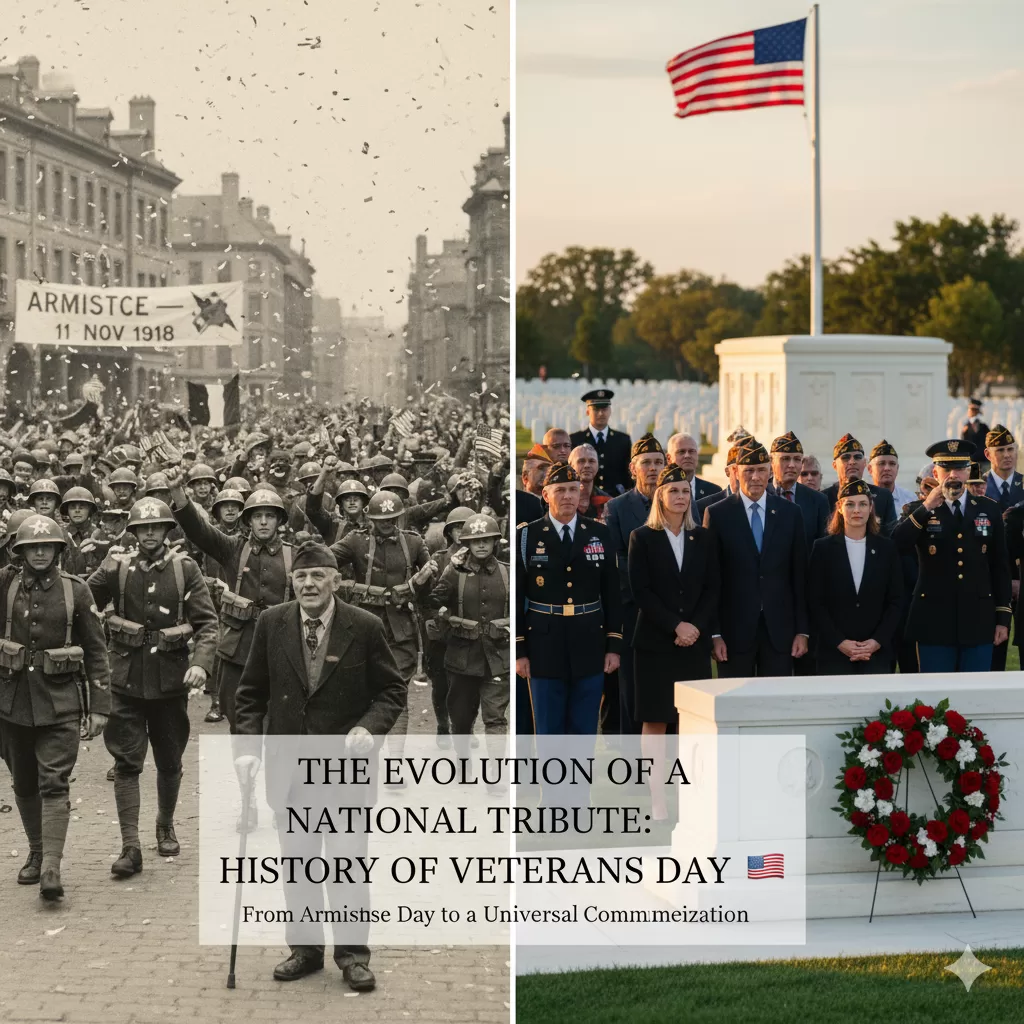
Today’s observance of Veterans Day carries forward the traditions of Armistice Day while encompassing the scope of a broader, modern tribute.
The focal point for the official, national ceremony remains the Tomb of the Unknowns at Arlington National Cemetery. Every Veterans Day, at 11:00 a.m. EST, a combined color guard representing all military services executes “Present Arms” at the Tomb. A presidential wreath is laid, and the bugler plays Taps, symbolizing the nation’s profound respect and gratitude for its war dead and, by extension, all veterans. The rest of the ceremony takes place in the Memorial Amphitheater, where various military and government officials give addresses.
Across the United States, celebrations include parades, community ceremonies, and memorial services. These local events are a direct link to the original Armistice Day tradition of public meetings and celebratory marches. Many feature marching bands, active duty service members, and, most importantly, veterans of every generation.
A crucial distinction between Veterans Day and Memorial Day is their focus. Memorial Day (the last Monday in May) is dedicated to honoring those who died in military service. Veterans Day is a day to honor all American veterans—living and deceased—for their patriotism, love of country, and willingness to serve and sacrifice for the common good.
This distinction shapes contemporary celebrations, which often include:
The history of Veterans Day is a rich and moving narrative, one that begins with a moment of hopeful peace on a battlefield in France and evolves to encompass the service of millions across a century of conflicts. From a day dedicated to the Great War’s “Doughboys” to a universal celebration of all American veterans, the holiday on November 11th remains one of the most significant dates on the national calendar. It stands not only as a day of remembrance for the past but as an active acknowledgment of the commitment and sacrifice of all those who have worn the uniform of the United States Armed Forces.
Julia Austin’s After the Idea is a comprehensive guide to building and scaling a startup with intention. The book argues that long-term success hinges not on the initial idea alone, but on a deliberate, holistic approach to building the business. This is structured around four foundational pillars:
Product, People, Operations, and Working at Scale.
The central thesis is that founders must move beyond a narrow focus on building and fundraising to intentionally design their company’s culture, operational processes, and strategic vision from the outset. Key takeaways include the critical importance of deep “discovery work” to validate a problem before building a solution, treating the selection of a cofounder as a serious “courtship,” and embedding a strong, inclusive culture as the bedrock of the organization. The text provides actionable frameworks for navigating the often-overlooked but vital operational functions of legal, finance, and go-to-market strategy. Finally, it addresses the complex challenges of growth, including the founder’s transition from doer to leader, managing team dynamics at scale, and navigating exits while prioritizing mental health. The author draws extensively from personal experiences at successful startups like Akamai, VMware, and DigitalOcean, as well as from the journeys of her students and coaching clients, to provide a fact-dense, practical roadmap for entrepreneurs.
——————————————————————————–
The first pillar establishes that while building a product is easier than ever, building the right thing for the right people is the most difficult and critical challenge. A failure to deeply understand the problem and the target customer is a primary reason for startup failure, with 35% of failures attributed to a lack of product-market fit (PMF).
The book advocates for moving beyond simple interviews and landing pages, which gauge interest rather than intent, to more robust experimentation.
——————————————————————————–
This pillar argues that the people—from cofounders to the first hires—are a startup’s most important asset. Neglecting the human aspects of the business is a common and fatal error.
The decision to have a cofounder is one of the most critical a founder will make. The relationship is compared to a marriage, requiring a deliberate and thoughtful “courtship” to ensure alignment.
——————————————————————————–
This section covers the “mundane but important” operational activities that are essential for survival and scale. Underestimating their importance is a common mistake that can lead to failure.
Fundraising is framed as a necessary tool (“fuel for the speedboat”), not the ultimate goal.
——————————————————————————–
The final pillar addresses the challenges that arise as a startup moves from a small, nimble team to a larger, more complex organization.
409A valuations The fair market value of the common stock of a private company as valued by a third-party appraiser. Startups need 409A valuations to grant employees stock options on a tax-free basis.
A/B test Testing two versions of a hypothesis to understand which fits better with the intended audience.
Acquihire When a venture is sold to a larger entity for its team and not for its products or services. This occasionally includes its intellectual property as well, although usually just for “parts” and integrated into the purchaser’s products.
Annual recurring revenue (ARR) The amount of revenue a business will garner per year.
Beachhead The starting market from where you are in a good strategic position to capture adjacent markets.
Business-to-business (B2B) A venture that creates products or services that solve problems for other businesses.
Business-to-consumer (B2C) A venture that creates products or services that solve problems for consumers.
Buyer persona Not always the user of the solution, they hold the purse strings. This persona is most common in B2B businesses. For example, the head of HR may buy a candidate-tracking system for their recruiters.
Conversion rate The average number of conversions per ad or other sales interaction, shown as a percentage. Conversion rate is calculated by simply taking the number of conversions and dividing that by the number of interactions that can be tracked to a conversion during the same time period.
Customer acquisition cost (CAC) Measures how much an organization spends to acquire new customers. It is the total cost of sales and marketing efforts, as well as property or equipment, needed to convince a customer to buy a product or service.
Directly responsible individual (DRI) The person who is ultimately responsible for a decision or making sure a project or task is completed.
Direct-to-consumer (DTC) A business that sells its products directly to consumers, typically online through its websites or mobile applications.
Diverge<>converge exercise Breaking down a thinking process into two phases: divergence and convergence. In the divergence phase, generate ideas to broaden possibilities, and in the convergence phase, eliminate or streamline the ideas to converge on the best solution.
Equity dilution A decrease in the percentage of ownership that existing shareholders have in a company. It occurs when a company issues new shares of stock to investors, which increases the total number of outstanding shares. This means that each existing shareholder’s percentage of ownership is reduced.
Fear of missing out (FOMO) A slang term referring to anxiety that an exciting or interesting event may currently be happening elsewhere, often aroused by social media posts.
Hypothesis testing Validating assumptions to make informed decisions about potential solutions.
Ideal customer profile (ICP) Detailed description of the persona that will most benefit from your product.
Initial public offering (IPO) A private company selling shares of its stock to the public for the first time. Also known as “going public.”
Legal redlining A process of reviewing and editing legal documents, such as contracts, by making markings to indicate changes. The term comes from the practice of using a red pen to make annotations, but other colors or annotations can be used in digital documents.
Lifetime value (LTV) A metric that estimates how much revenue a customer will generate for a business over the course of their relationship. Also known as customer lifetime value (CLV or CLTV) or lifetime customer value (LCV).
Minimum viable product (MVP) The most basic solution a business can offer to begin to iterate with its target personas.
Net promoter score (NPS) A metric that measures customer loyalty and satisfaction. It’s calculated by asking customers how likely they are to recommend a company or product to a friend or colleague on a scale of 0 to 10.
Pivot A strategic decision to change a startup’s direction or focus in response to market conditions, experiments, or other external factors. It involves making significant adjustments to the business model, product offering, target market, or overall strategy.
Product-market fit (PMF) When customers are buying, using, and telling others about the company’s product in numbers large enough to sustain that product’s growth and profitability.
Product roadmap An outline of the vision, priorities, and progress of a product over the foreseeable future.
RACI model A managerial tool that helps define roles and responsibilities in a project or process.
Release Making an enhancement/modification of a product available to customers.
Restructuring A strategic company decision that can involve layoffs. A startup may restructure to become more efficient and cut costs or to change or eliminate functions and roles to make room for new hires.
Software as a service (SaaS) A type of software delivery and licensing in which software is accessed online via a subscription, rather than bought and installed on individual computers.
Stock option A form of equity compensation that allows someone to buy a specific number of shares at a preset price.
Strike price The price employees will pay to purchase a share of your startup’s stock when they exercise a stock option.
Target persona A fictional archetype(s) a business builds its solution for.
Total addressable market (TAM) The market segment that will potentially buy a product or service.
Upselling Persuading an existing customer to buy products/services over and above what they are currently purchasing.
User experience (UX) A user’s perception of utility, ease, and efficiency of a product.
Willingness to pay (WTP) The maximum amount a user is ready to pay for an offering.
Word of mouth (WOM) A marketing strategy that encourages consumers to share positive experiences with a product or service with others.
Consumer Sentiment worsened in November, new data showed, as persistent price increases and an extended government stoppage weigh on sentiment.
“With the federal government shutdown dragging on for over a month, consumers are now expressing worries about potential negative consequences for the economy,” said Joanne Hsu, the survey’s director at the University of Michigan.
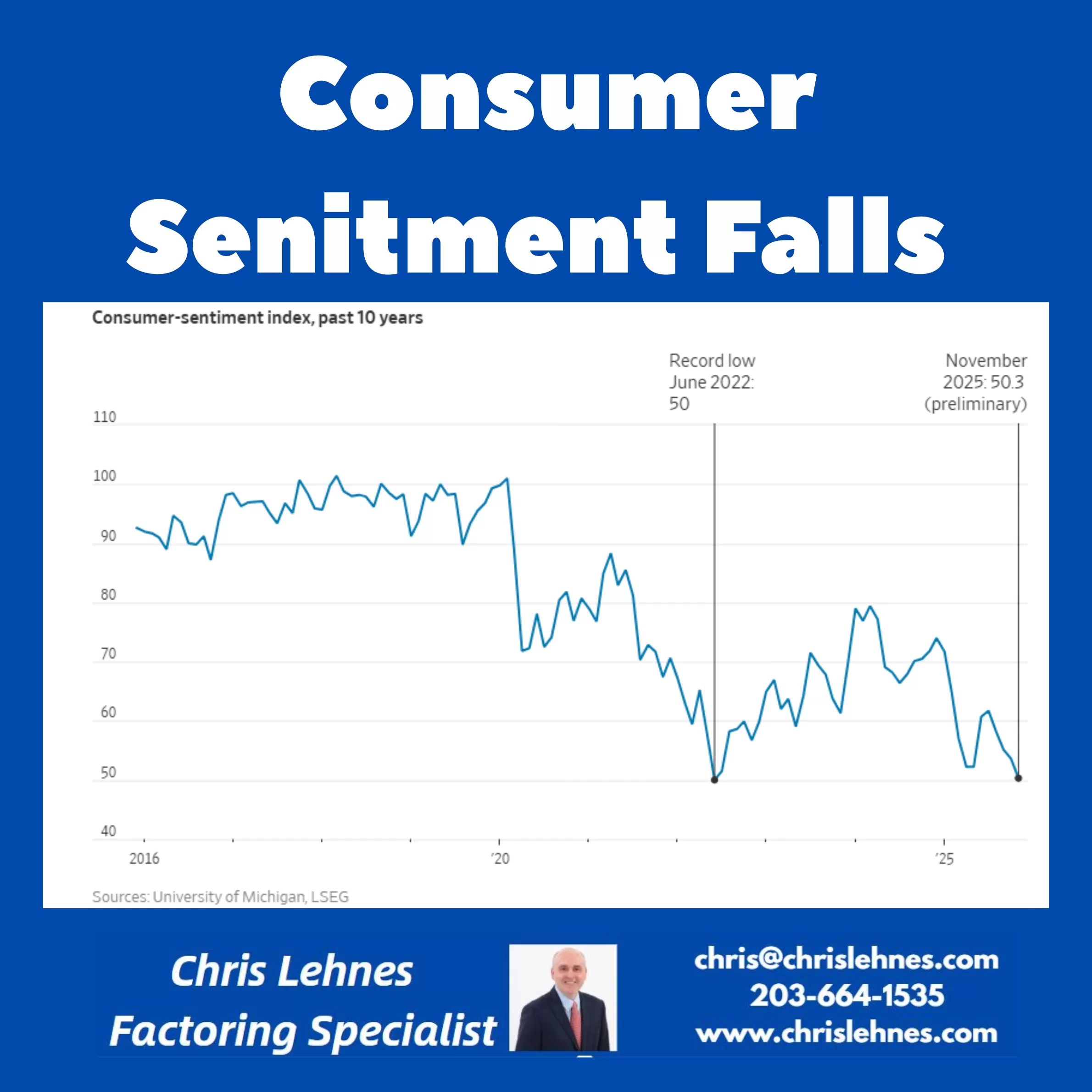
The survey’s headline index fell to 50.3 in November, from 53.6 last month, based on preliminary responses.
Analysts polled by The Wall Street Journal were expecting a milder decline to 53.
The reading suggests consumer sentiment has dropped below the lows it hit in the spring, after President Trump first rolled out steep new global tariffs.
It is now just slightly above the record trough hit in 2022, amid a historic bout of inflation. Fuller end-of-month data could show a different result, however.
Bad news for the economy: American consumer sentiment took a sharp, unexpected dive in November, driven by lingering concerns over persistent price increases and the drawn-out government shutdown.
“With the federal government shutdown dragging on for over a month, consumers are now expressing worries about potential negative consequences for the economy,” said Joanne Hsu, director of the University of Michigan survey.
This drop wasn’t just a slight dip—it was a significant slide. The survey’s headline index plummeted to 50.3 in November from 53.6 the previous month (based on preliminary responses). This was a much steeper fall than financial analysts expected, who had polled by The Wall Street Journal were bracing for a milder 53.0 reading.
Why this is alarming: The new reading suggests consumer sentiment has now fallen below the spring lows recorded when President Trump first introduced steep new global tariffs. Critically, it is now sitting just above the record low hit in 2022 during the height of historic inflation.
The takeaway? Shoppers are feeling the pain, and uncertainty is at a critical level. While fuller end-of-month data could paint a slightly different picture, this preliminary data is a clear warning sign for economic growth.
This book synthesizes the core principles of “upstream thinking,” a framework for preventing problems rather than reacting to them. The central thesis is that society is disproportionately focused on downstream responses—addressing crises, emergencies, and failures after they occur. An upstream approach, conversely, involves proactively identifying and dismantling the systems that cause these problems in the first place. This shift is impeded by three primary barriers: Problem Blindness, the failure to see a problem or the belief that it is inevitable; Lack of Ownership, a mindset where those capable of fixing a problem believe it is not their responsibility; and Tunneling, a state of scarcity (of time, money, or bandwidth) that forces short-term, reactive thinking and precludes long-term planning. Successful upstream interventions require leaders to unite diverse teams, identify high-leverage points within complex systems, establish early warning signals, and secure funding for outcomes that are often invisible—the absence of problems. The analysis reveals that effective upstream work is not about finding a single “magic pill” solution but about creating data-rich “scoreboards” that enable continuous learning and systems-level change.
——————————————————————————–
The core concept of upstream thinking is captured in a public health parable: two friends rescuing an endless stream of drowning children from a river, until one goes upstream “to tackle the guy who’s throwing all these kids in the water.” This metaphor distinguishes between downstream actions, which react to problems, and upstream efforts, which aim to prevent them.
The further one moves upstream, the more complex, ambiguous, and slower the solutions become, but the potential for massive and long-lasting good increases significantly. An intervention can exist at many points along a spectrum; for example, swim lessons are further upstream than life preservers in preventing drowning.
The travel website Expedia provides a clear illustration of a successful upstream intervention.
Despite the clear benefits of prevention, societal efforts are overwhelmingly skewed toward reaction.
The contrast between U.S. and Norwegian healthcare spending illustrates the consequences of a downstream focus. While both nations spend a similar percentage of GDP on total health (combining formal healthcare with “social care” like housing, food, and childcare), their allocation is radically different.
| Spending Metric | United States | Norway |
| Spending Ratio (Upstream:Downstream) | For every 1** spent downstream, the U.S. spends roughly **1 upstream. | For every 1** spent downstream, Norway spends roughly **2.50 upstream. |
| Focus | World leader in downstream, high-tech treatments (e.g., knee replacements, cancer treatment). | Focus on upstream support systems (e.g., free prenatal/delivery care, 49 weeks of paid parental leave, guaranteed high-quality daycare, free college). |
| Health Outcomes | 34th in infant mortality, 29th in life expectancy, 21st in stress levels. | 5th in infant mortality, 5th in life expectancy, 1st in stress levels. |
The data suggests the U.S. is not necessarily spending “too much” on health, but that its allocation is radically different from its peers, prioritizing expensive cures over cost-effective prevention.
Despite the logic of prevention, several powerful forces consistently push individuals and organizations downstream.
Problem blindness is the belief that negative outcomes are natural, inevitable, or out of one’s control. It is treating a solvable problem like the weather.
This barrier exists when the people or groups best positioned to solve a problem declare, “That’s not mine to fix.” This can result from fragmented responsibilities, self-interest, or a perceived lack of legitimacy.
When experiencing scarcity of time, money, or mental bandwidth, people adopt “tunnel vision.” They stop long-term planning and focus solely on managing the immediate crisis, which prevents upstream thinking.
Successfully navigating the barriers requires addressing a series of fundamental questions.
Upstream work is fundamentally collaborative, requiring leaders to “surround the problem” with all the necessary stakeholders.
Lasting upstream work must culminate in systems change, altering the “water” we swim in so that better outcomes happen by default.
In complex systems, the challenge is finding the right lever. This requires getting “proximate” to the problem.
Early warning signals provide the time and maneuvering room to prevent a problem or blunt its impact.
Success in upstream work is often the absence of a negative event, making it hard to measure. This reliance on proxy measures can lead to “ghost victories”—superficial successes that cloak underlying failure.
To avoid ghost victories, leaders should use paired measures (balancing quantity with quality, as CPS did with graduation rates and ACT scores) and “pre-game” how measures could be misused.
Upstream interventions tinker with complex systems and can create unintended negative consequences, known as the “cobra effect.”
Funding prevention is notoriously difficult because success is invisible and payment models are designed for reaction.
Upstream thinking can also be applied to one-off, improbable, or unpreventable threats.
The principles of upstream thinking can be applied by individuals to solve personal and organizational problems.
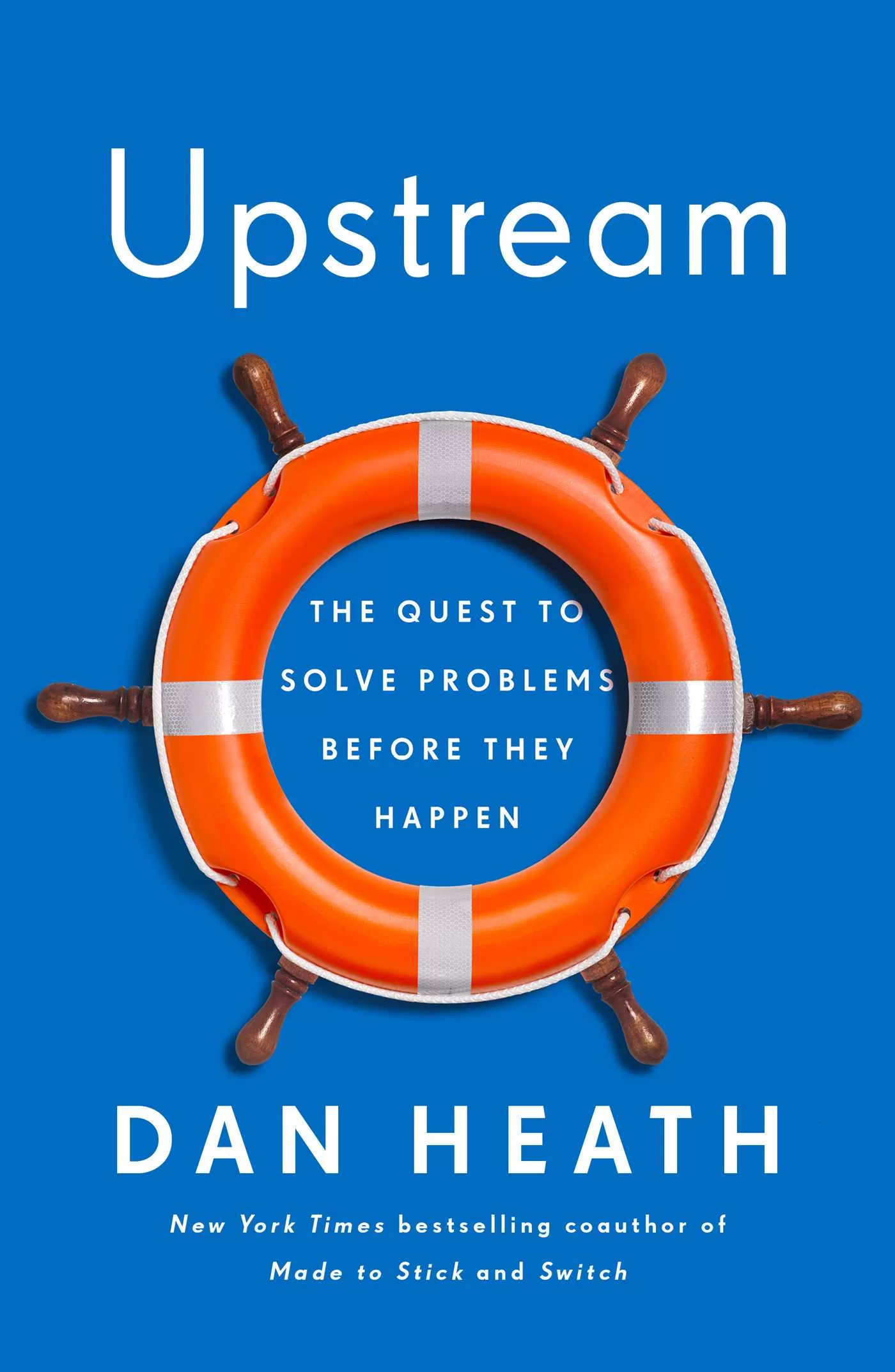
Instructions: Answer the following questions in two to three sentences, drawing exclusively from the information provided in the source context.
Instructions: The following questions are designed to provoke deeper thought and synthesis of the concepts presented in the text. Formulate a detailed response for each, citing specific examples and arguments from the source material.
| Term | Definition |
| Accountable Care Organization (ACO) | A model where a group of primary care doctors are incentivized by Medicare to keep their patient population healthy and out of the hospital, sharing in the savings generated from prevented hospital visits. |
| Backward Contamination | The contamination of Earth by a returning spaceship, potentially carrying destructive alien life. |
| Becoming a Man (BAM) | A program for at-risk youth in Chicago that uses group mentoring and cognitive behavioral therapy (CBT) to help young men learn to manage anger and impulsivity. |
| By-Name List | A real-time, regularly updated census of a specific population (e.g., all homeless veterans in a city), used by collaborative teams to coordinate services and track progress on an individual basis. |
| Capitation | A healthcare payment model where providers are paid a flat, risk-adjusted fee per person to take care of all their health needs, incentivizing prevention and cost-effectiveness. |
| Cobra Effect | An unintended consequence where an attempted solution to a problem makes the problem worse. |
| Coordinated Entry | A system where a single point of entry is established for people seeking a service (like housing for the homeless), allowing for thoughtful prioritization based on vulnerability rather than a “first-come, first-served” basis. |
| Data for the Purpose of Learning | A model where real-time data is provided to frontline workers (e.g., teachers, nurses) to help them learn, adapt, and improve their own work, as opposed to “data for the purpose of inspection.” |
| Data for the Purpose of Inspection | A model where data is used by superiors to hold subordinates accountable for hitting targets, which can create pressure to “game” the metrics. |
| Downstream Actions | Efforts that react to problems once they have already occurred, such as rescuing a drowning child, answering a customer complaint, or performing emergency surgery. |
| Forward Contamination | The contamination of another planet with organisms from Earth during space exploration. |
| Freshman On-Track (FOT) | A metric developed for Chicago Public Schools that predicts a student’s likelihood of graduation based on two factors: completing five full-year course credits and not failing more than one semester of a core course during freshman year. |
| Functional Zero | A state achieved when the number of people experiencing a problem (e.g., homelessness) is lower than the system’s proven monthly capacity to solve that problem for new cases. |
| Ghost Victory | A superficial success that cloaks an underlying failure. This can happen when short-term measures are misaligned with the long-term mission, when success is mistakenly attributed to one’s own efforts, or when the measures themselves become the mission in a way that undermines the work. |
| Housing First | A strategy for addressing homelessness that prioritizes getting people into housing as the first step, providing a stable foundation from which they can then address other issues like substance abuse or unemployment. |
| Inattentional Blindness | A phenomenon where careful attention to one task leads people to miss important information that is unrelated to that task, such as radiologists missing a gorilla in a CT scan. |
| Lack of Ownership | A barrier to upstream thinking where the parties who are capable of addressing a problem declare, “That’s not mine to fix.” |
| Paired Measures | A management principle of balancing a quantity-based metric with a quality-based metric to avoid a situation where improving one undermines the other (e.g., pairing “square feet cleaned” with “quality spot-checks”). |
| Problem Blindness | A barrier to upstream thinking characterized by the belief that negative outcomes are natural, inevitable, or out of one’s control. |
| Psychological Standing | The sense of legitimacy people feel they have to protest or take action on a problem, which is often tied to whether they feel personally affected by the issue. |
| Social Care | A term for upstream spending on health, covering areas that keep people healthy such as housing, pensions, and childcare support. |
| Tunneling | A third barrier to upstream thinking, caused by scarcity (of time, money, or bandwidth), where people adopt tunnel vision and focus only on short-term, reactive problem-solving, abandoning long-term planning. |
| Upstream Efforts | Efforts intended to prevent problems before they happen or, alternatively, to systematically reduce the harm caused by those problems. Upstream work is characterized by systems thinking. |
| Wrong Pocket Problem | A situation that hinders funding for prevention, where the entity that bears the cost of an intervention does not receive the primary financial benefit, which is instead scattered across many other “pockets.” |
Contact Factoring Specialist, Chris Lehnes