
As the Federal Open Market Committee (FOMC) wraps up its final meeting of 2025 today, all eyes are on the 2:00 PM EST announcement. With the U.S. economy cooling and the labor market showing signs of strain, speculation is high that a Fed Cut in rates is imminent.
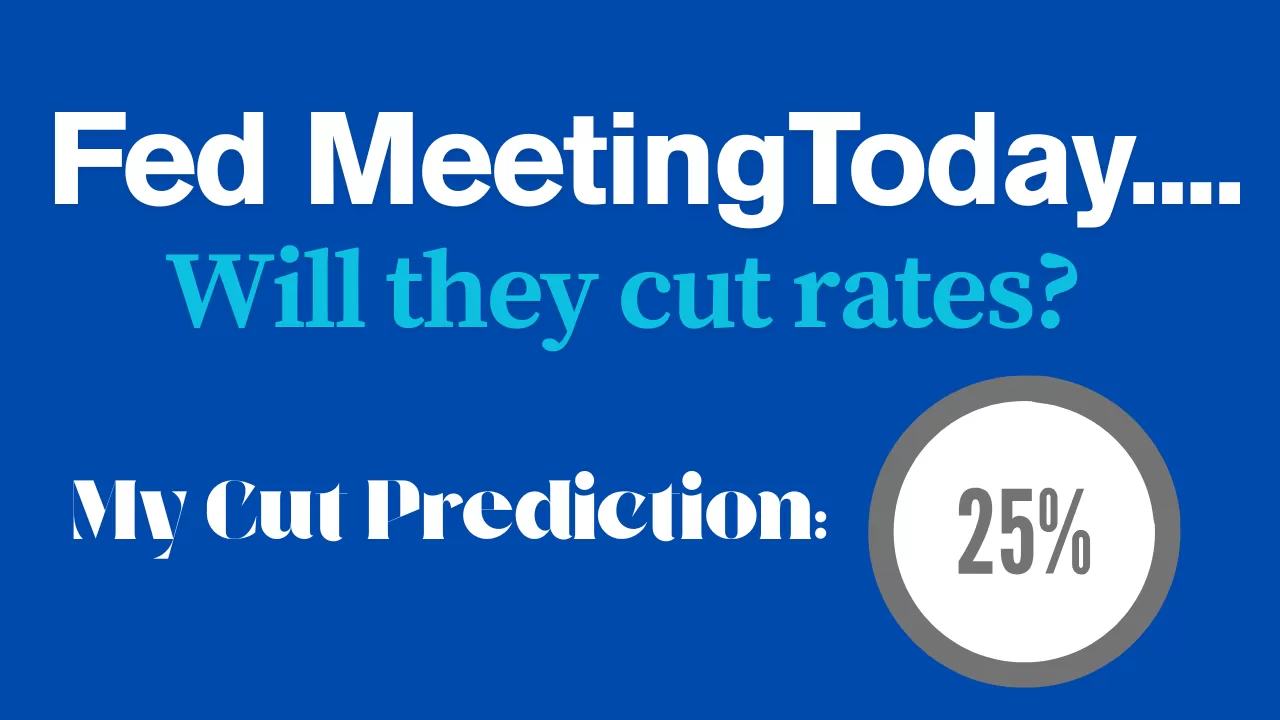
Here is a breakdown of the current predictions, the economic data driving the decision, and what odds makers are betting on.
The Consensus: A “December Cut” is Highly Likely
Market watchers are overwhelmingly pricing in a 25-basis-point (0.25%) rate cut.
According to the CME FedWatch Tool, which tracks trading in federal funds futures, there is currently an 87% probability that the Fed will lower the target range to 3.50%–3.75%. This would mark the third consecutive rate reduction, following cuts in September and October, signaling a definitive shift from fighting inflation to supporting the labor market.
Key Factors the Fed is Weighing
The Fed’s “dual mandate” requires it to balance stable prices with maximum employment. For the first time in years, the risks have shifted from overheating inflation to a cooling jobs market.
1. The Cooling Labor Market (The Primary Driver) The unemployment rate has ticked up to 4.4%, a figure that has caught the attention of Fed Chair Jerome Powell. While historically low, the steady rise suggests that high interest rates are finally biting into corporate hiring. Job growth has slowed, and layoffs in sensitive sectors have increased. The Fed is keen to avoid a “hard landing” where unemployment spikes uncontrollably.
2. Sticky but Manageable Inflation Inflation hasn’t disappeared, but it is no longer the five-alarm fire it was two years ago. The latest PCE (Personal Consumption Expenditures) data places headline inflation around 2.7%–2.9%, with core inflation hovering near 2.8%. While this is still above the Fed’s 2% target, it is trending in the right direction, giving the central bank “air cover” to cut rates to support jobs without immediately reigniting price hikes.
3. Economic Growth (GDP) GDP growth has moderated to an annualized rate of roughly 1.8%–2.0%. This suggests the economy is slowing down but not crashing—the definition of the elusive “soft landing.” A rate cut now is viewed as insurance to keep this momentum from stalling out completely in early 2026.
The “Wild Card”: A Divided Committee
Despite the high odds of a cut, this meeting is not without tension. Reports suggest the FOMC is sharply divided.
- ** The Doves (Cut Now):** Worried that waiting too long will cause a recession. They argue that with inflation falling, real interest rates are effectively rising, tightening financial conditions more than intended.
- The Hawks (Pause/Hold): Concerned that cutting rates too quickly could cause inflation to flare up again, especially given that the economy is still growing.
Because of this division, the language in today’s statement will be just as important as the rate decision itself. Investors should look for clues about a “pause” in January. Many analysts believe the Fed may cut today but signal a skip in the next meeting to assess the impact of recent cuts.
What to Watch For
- 2:00 PM EST: The official statement and decision. Look for the “dot plot” (Summary of Economic Projections) to see where officials expect rates to be at the end of 2026.
- 2:30 PM EST: Chair Jerome Powell’s press conference. His tone regarding the “balance of risks” will move markets. If he sounds more worried about jobs than inflation, it will confirm that the easing cycle has further to go.
Bottom Line
While nothing is guaranteed until the gavel falls, the smart money is on a 0.25% cut today. The Fed likely views the rising unemployment rate as a warning light it cannot ignore, making a rate reduction the prudent move to secure a soft landing for 2026.
| Category | Case for a Rate Cut (The “Doves”) | Case for Holding Steady (The “Hawks”) |
| Labor Market | Rising Risks: Unemployment has climbed to 4.4%. Doves argue that high rates are now doing unnecessary damage to hiring. | Hidden Strength: Some argue the job market is “normalizing” after the post-pandemic surge rather than collapsing. |
| Inflation | Progress Made: While at 2.8%, inflation is down significantly from its peak. High “real” rates (inflation vs. interest) are overly restrictive. | Sticky Prices: Inflation remains above the 2% target. Rate cuts could embolden businesses to keep prices high or raise them. |
| Economic Growth | Growth is Slowing: GDP growth has dipped toward 1.8%. A cut acts as “insurance” to prevent a recession in 2026. | Consumer Resilience: High durable goods spending suggests the economy is not yet in need of a stimulus. |
| Market Impact | Easing the Burden: Lower rates would provide immediate relief for credit card holders and small businesses facing high debt costs. | Asset Bubbles: Cutting too soon could overheat the stock and housing markets, leading to a boom-bust cycle. |
Contact Factoring Specialist, Chris Lehnes
Updated 5:00pm EST 12/10/25 After Fed Decision:
The Federal Reserve has decided to cut the benchmark interest rate by 25 basis points (0.25%).
This move lowers the target range for the federal funds rate to 3.50% to 3.75%. This is the third consecutive rate cut this year and was made in light of elevated inflation and a weakening labor market.
Here are the key takeaways from the announcement and Chair Jerome Powell’s press conference:
✂️ Key Interest Rate Decision
- The Cut: The Federal Open Market Committee (FOMC) voted to lower the target range for the federal funds rate by 25 basis points to 3.50%–3.75%.
- The Vote: The decision was not unanimous, recording a 9:3 ratio of votes.
- One member (Stephen I. Miran) preferred a larger, 50-basis-point cut.
- Two members (Austan D. Goolsbee and Jeffrey R. Schmid) preferred no change, keeping the rate steady.
🎙️ Key Quotes and Context from Chair Powell
Powell’s remarks focused on the shifting balance of risks and the current policy stance:
- Rationale for the Cut:“With today’s decision, we have lowered our policy rate three-quarters of a percentage point over our last three meetings. This further normalization of our policy stance should help stabilize the labor market while allowing inflation to resume its downward trend toward 2% once the effects of tariffs have passed through.”
- The Dual Mandate Challenge: Powell acknowledged the difficulty of balancing the Fed’s two goals (maximum employment and price stability):”In the near term, risks to inflation are tilted to the upside and risks to employment to the downside—a challenging situation… We have one tool. It can’t do both of those—you can’t address both of those at once.”
- Forward Guidance (What’s Next): The Fed indicated a cautious, data-dependent approach moving forward:”In considering the extent and timing of additional adjustments to the target range for the federal funds rate, the Committee will carefully assess incoming data, the evolving outlook, and the balance of risks.” When asked about a pause, Powell suggested the policy rate is now close to the “neutral” level: He indicated that the Fed’s benchmark rate is now likely somewhere close to the “neutral” level… which certainly indicates that he won’t be in a hurry to extend the string of cuts the Fed has made in recent months.
- Economic Outlook and Projections (“Dot Plot”): The latest projections indicated a divided committee on future cuts.
- The median Fed official is penciling in one rate cut for next year (2026), which is a more cautious outlook than some market expectations.
- The Fed projects inflation (based on its preferred gauge) to ease to 2.4% by the end of 2026.
Based on the immediate market data and analyst reactions following the 2:00 PM announcement, here is how the decision is impacting mortgage rates and the stock market.
🏠 Impact on Mortgage Rates
The Verdict: Rates may hold steady or even tick up slightly, despite the Fed cutting rates.
- Counter-Intuitive Movement: It often surprises borrowers, but mortgage rates do not move 1-for-1 with the Fed’s rate. Mortgage rates track the 10-year Treasury yield, which actually rose today (hitting roughly 4.21%).
- Why? The market had already “priced in” this cut weeks ago. Investors are now looking ahead to 2026. Because the Fed signaled a slower pace for future cuts (a “hawkish cut”), bond markets reacted by pushing long-term yields higher.
- Forecast: Experts expect 30-year fixed mortgage rates to hover in the low-to-mid 6% range for now. A significant drop below 6% is unlikely until investors see clearer signs that inflation is permanently defeated.
📈 Impact on the Stock Market
The Verdict: A “Santa Claus Rally” is likely, but 2026 looks choppier.
- Immediate Reaction: The S&P 500 and Dow Jones both rose following the news, pushing close to all-time highs. The market “got what it wanted”—a cut to support the economy without panic.
- Sector Watch:
- Small Caps (Russell 2000): Often benefit most from rate cuts as they rely more on floating-rate debt.
- Tech & Growth: Continued to show strength, though valuations remain high.
- 2026 Outlook: The Fed’s “dot plot” shows they plan to slow down, potentially cutting rates only once in 2026. This is fewer cuts than Wall Street hoped for, which suggests the “easy money” rally might face headwinds early next year as recession risks are still on the table (J.P. Morgan analysts cite a 35% recession probability for 2026).
| Area | Short-Term Forecast (Dec ’25) | Why? |
| Mortgage Rates | Steady / Slight Rise | The cut was already priced in; long-term bond yields are rising. |
| Stocks | Bullish (Rally) | The “soft landing” narrative is intact; investors are relieved. |
| Savings Accounts | Slight Drop | High-yield savings rates will drop almost immediately by ~0.25%. |