
Economist were optimistic…no more.
Middle East War Will Slow Global Economic Growth. The global economy, which had shown surprising resilience through early 2026, is now facing a significant “speed bump.” In its latest World Economic Outlook released today, April 14, 2026, the International Monetary Fund (IMF) warned that the escalating conflict in the Middle East—specifically the war involving Iran—has halted global momentum and forced a downgrade of growth projections.
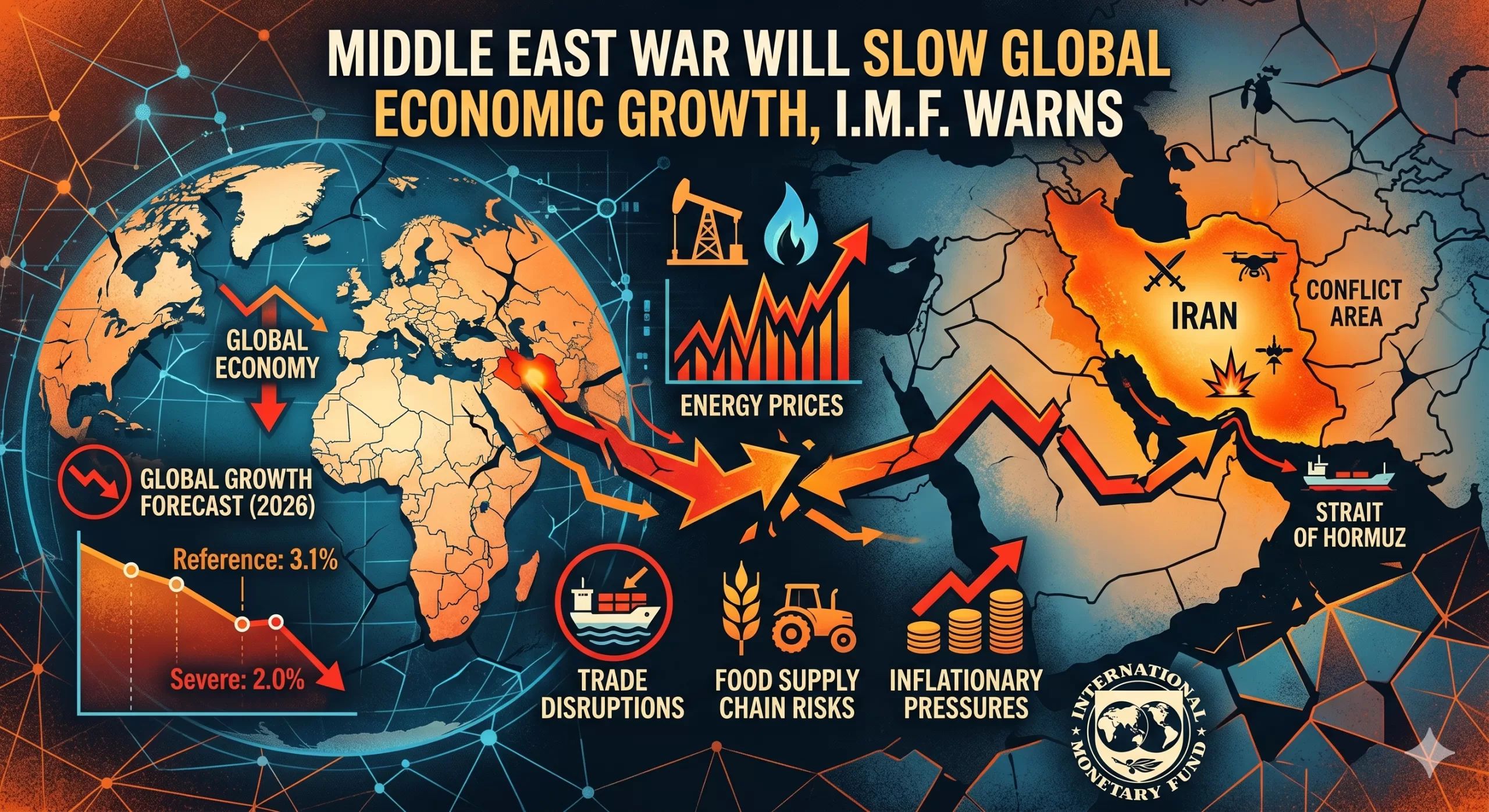
The Numbers: A Downward Shift
Just months ago, economists were optimistic that a tech-driven productivity boom and easing inflation would lead to a “soft landing.” However, the IMF has now lowered its 2026 global growth forecast to 3.1%, down from the 3.3% projected in January.
| Scenario | 2026 Growth Forecast | Key Drivers |
| Reference (Current) | 3.1% | Short-lived conflict, oil averages $82/bbl |
| Adverse | 2.5% | Prolonged disruption, oil stays at $100 |
| Severe | 2.0% | Extended war, oil spikes to $110+ |
The “Strait” Jacket on Energy
The primary engine of this slowdown is the volatility in energy markets. The closure of the Strait of Hormuz in March 2026—a chokepoint for 20% of the world’s oil and significant LNG volumes—sent Brent crude surging past $120 per barrel.
While prices have recently fluctuated around $98, the damage to supply chains is extensive. The IMF notes that:
- Inflation is Rebounding: Global inflation expectations for 2026 have been revised up to 4.4%.
- Fertilizer Shortages: With 20-30% of global fertilizer exports passing through the region, agricultural costs are rising, threatening food security in import-reliant nations.
- Trade Disruptions: Maritime insurance premiums have skyrocketed, and major shipping routes are being rerouted, adding weeks to delivery times for consumer goods.
The Risk of a “Close Call” Recession
IMF Chief Economist Pierre-Olivier Gourinchas described the current situation as a pivot point. While the “Reference Scenario” assumes the war remains contained, a “Severe Scenario” could see growth drop to 2%—a level the IMF considers a global recession. This has only happened four times since 1980.
Central banks, which were expected to begin cutting interest rates this spring, may now be forced to keep rates “higher for longer” to combat the energy-driven inflationary spike.
“War in the Middle East has halted the global momentum we saw at the start of the year. The risks are now firmly tilted to the downside.”
— Pierre-Olivier Gourinchas, IMF Chief Economist
Looking Ahead
The path forward depends entirely on the duration of the hostilities. If a ceasefire holds and energy production in the Persian Gulf normalizes by mid-year, the IMF believes the global economy can avoid a total contraction. However, for emerging markets and developing economies, the impact is expected to be twice as severe as that on advanced nations, potentially undoing years of post-pandemic recovery.
How Middle East conflict impacts global trade
This video provides an expert breakdown of how regional instability specifically pressures global trade routes and food supplies.