IEEPA Tariffs – Monumental Impact of Supreme Court on Tariff Policy

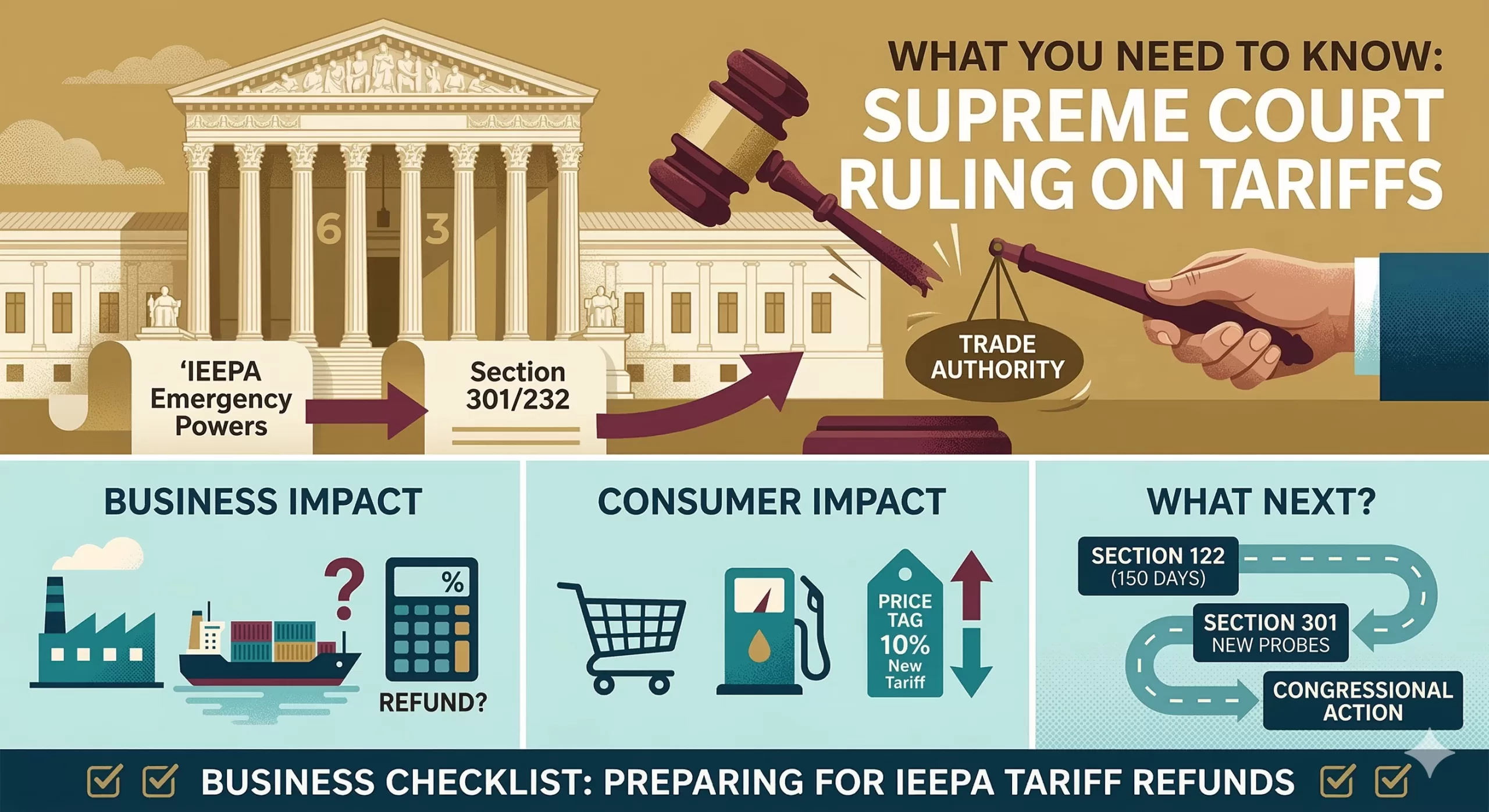
In a landmark decision that has reshaped the landscape of IEEPA Tariffs and American trade policy, the Supreme Court recently issued a ruling in Learning Resources, Inc. v. Trump. The 6-3 decision struck down a series of sweeping tariffs, delivering a significant blow to the administration’s use of emergency powers to regulate the economy.

If you’re a business owner, importer, or simply a consumer wondering why prices are shifting again, here is everything you need to know about this historic ruling about IEEPA Tariffs and what comes next.
IEEPA Tariffs - Monumental Impact of Supreme Court on Tariff Policy

The Heart of the Case: IEEPA Tariffs vs. The Taxing Power

The central question before the Court was whether the International Emergency Economic Powers Act (IEEPA) of 1977 gives the President the authority to impose tariffs.

The administration had used IEEPA to levy “reciprocal tariffs” and “trafficking tariffs” on products from China, Canada, and Mexico, arguing that trade imbalances and border security issues constituted a national emergency. However, the Supreme Court ruled that:

  • Tariffs are Taxes: Chief Justice John Roberts, writing for the majority, emphasized that the power to tax—which includes tariffs—belongs exclusively to Congress under Article I of the Constitution.
  • “Regulate” is not “Tax”: The Court held that IEEPA’s authority to “regulate importation” does not mean the President can unilaterally set tax rates
  • The Major Questions Doctrine: The Court applied this principle, stating that if Congress intended to delegate such massive economic power to the Executive Branch, it would have said so clearly and explicitly.

“The Framers did not vest any part of the taxing power in the Executive Branch,” wrote Chief Justice Roberts.


What Happens to the Money? The Refund “Mess”

One of the most pressing questions for businesses is the status of the billions of dollars already collected. Since 2025, the government has gathered an estimated $133 billion to $200 billion in IEEPA-based tariffs.

  • Court of International Trade (CIT) Action: Following the Supreme Court ruling, the CIT has ordered U.S. Customs and Border Protection (CBP) to begin preparing for a massive refund process.
  • The “Mess” Factor: Justice Brett Kavanaugh noted in his dissent that issuing these refunds will be a “mess.” It remains unclear exactly how and when businesses will see that money returned, as the Supreme Court did not provide a specific roadmap for the refund process

The Administration’s Pivot: Section 122 and 301

If you thought this ruling meant the end of tariffs, think again. Within hours of the decision, the administration began moving to alternative legal authorities:

  1. Section 122 (Trade Act of 1974): The President implemented a temporary 10% global baseline tariff under this law. However, this power is limited to 150 days and a maximum rate of 15% unless Congress intervenes.
  2. Section 301 Investigations: The U.S. Trade Representative (USTR) has launched new investigations into “structural excess capacity” and “forced labor” in countries like China and Mexico. These could lead to new, more legally “durable” tariffs in the coming months.
  3. Section 232 Still Stands: Tariffs on steel and aluminum, which rely on a different national security statute, were not affected by this specific ruling and remain in place.

What This Means for You

For Businesses and Importers

The immediate relief from IEEPA tariffs is a win, but it is replaced by a new 10% surcharge under Section 122. You should:

  • Audit your entries: Identify which tariffs you paid were based on IEEPA to prepare for potential refund claims.
  • Stay Flexible: The trade environment remains volatile as the administration shifts its legal strategy to avoid future Court losses.

For Consumers

While the invalidation of billions in tariffs sounds like a price drop is coming, the introduction of the new 10% global tariff may offset those savings. Economists expect “trade-weighted” average tariff rates to remain higher than historical norms through 2026.


Summary of Key Impacts

FeatureIEEPA Tariffs (Struck Down)Section 122 Tariffs (New)
Legal StatusUnconstitutional/InvalidCurrently Active
Current Rate0% (Effective Feb 20, 2026)10% (Effective Feb 24, 2026)
DurationN/A150 Days (Expires July 24, 2026)
RefundsLikely, but process is TBDNo

The Supreme Court has drawn a firm line in the sand regarding the separation of powers. While the President still has significant tools to influence trade, the era of “unbounded” emergency tariffs appears to be over.

Contact Factoring Specialist Chris Lehnes to learn how you can gain early access to tariff refunds
Avoiding Pitfalls: Common Mistakes CPAs Make on Their Own Tax Returns

Certified Public Accountants (CPAs) are revered for their expertise in navigating complex tax codes and financial regulations. However, when it comes to their own tax returns, even the most seasoned professionals can fall prey to common pitfalls. In this article, we delve into some of the most prevalent mistakes CPAs make on their personal tax returns, shedding light on why they occur and offering practical tips to avoid them. Avoiding Pitfalls: Common Mistakes CPAs Make on Their Own Tax Returns .

Avoiding Pitfalls: Common Mistakes CPAs Make on Their Own Tax Returns

1. Overlooking Deductions and Credits:

Despite their extensive knowledge of tax laws, CPAs may inadvertently overlook potential deductions and credits available to them on their own tax returns. With busy schedules and numerous clients to attend to, CPAs may neglect to take advantage of tax-saving opportunities such as business expenses, retirement contributions, or education credits. To mitigate this risk, CPAs should approach their personal tax returns with the same diligence and attention to detail they apply to client engagements, thoroughly reviewing eligibility criteria for deductions and credits and seeking guidance from colleagues or tax professionals if needed.

2. Failing to Keep Accurate Records:

Maintaining accurate financial records is paramount for CPAs, both professionally and personally. However, amidst the demands of running their own practices or managing client accounts, CPAs may neglect to keep meticulous records of income, expenses, and other financial transactions. Incomplete or disorganized recordkeeping can lead to errors, discrepancies, and audit risks on personal tax returns. To avoid this pitfall, CPAs should implement robust recordkeeping systems, leverage technology solutions for tracking expenses and receipts, and establish regular routines for reconciling financial accounts.

3. Underestimating Self-Employment Taxes:

CPAs who are self-employed or operate their own practices may underestimate the impact of self-employment taxes on their personal tax liabilities. Unlike employees who have taxes withheld from their paychecks, self-employed individuals are responsible for paying both the employer and employee portions of Social Security and Medicare taxes, commonly known as self-employment taxes. Failure to adequately plan for and budget for self-employment taxes can result in unexpected tax bills and cash flow challenges. CPAs should proactively estimate their self-employment tax obligations, set aside funds for tax payments, and explore tax planning strategies to minimize tax liabilities.

4. Ignoring State and Local Tax Obligations:

While CPAs may be well-versed in federal tax laws, they may overlook state and local tax obligations that apply to their personal situations. State income taxes, property taxes, and local business taxes can vary widely depending on jurisdiction, requiring careful attention and compliance. CPAs should familiarize themselves with the tax laws and filing requirements in their state of residence and any other jurisdictions where they conduct business or own property. Seeking guidance from state and local tax experts or leveraging tax preparation software tailored to specific jurisdictions can help ensure compliance and minimize audit risks.

5. Neglecting Retirement Planning:

CPAs, like many professionals, may delay or neglect retirement planning amidst the demands of their careers and financial responsibilities. Failing to prioritize retirement savings can have long-term consequences, impacting financial security in retirement and tax planning strategies. CPAs should assess their retirement goals and develop comprehensive retirement plans that incorporate tax-efficient savings vehicles such as IRAs, 401(k) plans, and SEP-IRAs. Maximizing retirement contributions, taking advantage of employer matching contributions, and exploring tax-deferred investment options can help CPAs build a solid foundation for retirement while optimizing tax benefits.

Conclusion: Learning from Mistakes to Enhance Tax Compliance

Navigating the complexities of personal tax returns can pose challenges even for seasoned CPAs. By acknowledging common mistakes and implementing proactive strategies to address them, CPAs can enhance tax compliance, minimize audit risks, and optimize tax savings on their own tax returns. By prioritizing accurate recordkeeping, staying informed about tax laws and regulations, and seeking guidance from tax professionals when needed, CPAs can lead by example and set a high standard for tax compliance and financial stewardship in their personal and professional lives.

Learn more about accounts receivable factoring

Connect with Factoring Specialist, Chris Lehnes on LinkedIn