Non-Recourse Factoring Proposal Issued – $5 Million – Textiles
Company won a new account requiring 90 day payment terms, causing a cash crunch. Versant will factor only this customer’s AR, allowing 100% customer concentration!
Accounts Receivable Factoring $100,000 to $30 Million Quick AR Advances No Long-Term Commitment Non-recourse Funding in about a week
We are a great match for businesses with traits such as: Less than 2 years old Negative Net Worth Losses Customer Concentrations Weak Credit Character Issues
Chris Lehnes | Factoring Specialist | 203-664-1535 | chris@chrislehnes.com
Starting and growing a small business involves wearing many hats—from marketer and sales manager to bookkeeper and HR director. But one role you should never try to fill yourself without the right expertise is that of legal counsel. The legal landscape for small businesses is complex, and mistakes can be costly. Whether you are forming a new business, drafting contracts, navigating labor laws, or facing litigation, having the right attorney can make or break your venture.
This comprehensive guide will walk you through everything you need to know about choosing a small business attorney, including when you need one, what kind of lawyer to look for, how to vet candidates, and how to build a long-term, cost-effective relationship that benefits your business at every stage.
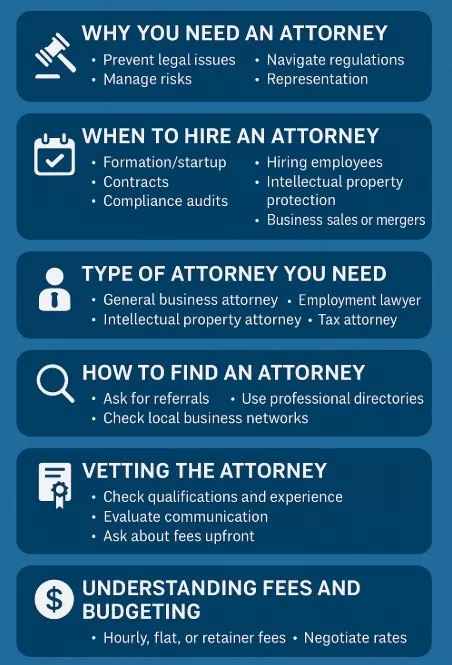
Chapter 1: Why Every Small Business Needs an Attorney
1.1 Preventing Problems Before They Start
Most legal issues that cripple small businesses could have been prevented with timely advice from a competent attorney. From selecting the right business structure to crafting strong contracts and protecting intellectual property, proactive legal planning saves time and money.
1.2 Navigating Compliance and Regulation
Every industry has its own web of regulations—some federal, some state, and others local. An attorney helps you stay compliant with employment laws, environmental regulations, tax codes, and industry-specific rules.
1.3 Managing Risk
An experienced business attorney doesn’t just solve problems—they help you anticipate and reduce the legal risks that come with growth, hiring, expansion, and partnerships.
1.4 Representation in Disputes
If you’re ever sued—or if you need to enforce your own rights—a lawyer ensures your interests are protected. Litigation is costly, and having a trusted attorney from the outset can significantly improve outcomes.
Chapter 2: When to Hire an Attorney
2.1 Formation and Startup Phase
When launching your business, you’ll need legal help deciding whether to form a sole proprietorship, LLC, S-Corp, or C-Corp. Each has different implications for liability, taxation, and operational flexibility.
2.2 Drafting or Reviewing Contracts
Every vendor agreement, lease, partnership agreement, and employment contract your business enters into has legal implications. An attorney can draft, review, and negotiate these documents to your advantage.
2.3 Hiring Employees
Employment law is one of the trickiest areas for small businesses. A lawyer ensures your hiring practices, employee handbooks, and termination procedures comply with local and federal laws.
2.4 Intellectual Property Protection
If your business has a unique product, brand, or technology, legal protection through patents, trademarks, and copyrights is crucial.
2.5 Compliance Audits
As you grow, routine legal checkups ensure you’re not inadvertently breaking laws—especially in areas like taxes, zoning, data privacy, and ADA compliance.
2.6 Business Sales, Mergers, or Acquisitions
If you’re buying another company, selling yours, or taking on investors, legal guidance is essential in structuring the deal, conducting due diligence, and drafting legal documents.
Chapter 3: What Type of Attorney Do You Need?
3.1 General Business Attorney
For most small businesses, a general business attorney is sufficient. They can advise on structure, contracts, compliance, and routine disputes.
3.2 Specialized Attorneys
Depending on your industry or situation, you may also need:
Employment lawyers – for HR issues
Intellectual property attorneys – for patents and trademarks
Tax attorneys – for complex tax strategies
Litigation attorneys – for lawsuits
Real estate attorneys – for lease or property issues
Franchise lawyers – if you’re buying into or selling a franchise
3.3 Law Firms vs. Solo Practitioners
Larger law firms often offer a one-stop shop for various legal needs, but they may come with higher rates. Solo attorneys or small firms often provide more personalized service and flexibility for growing businesses.
Chapter 4: How to Find a Business Attorney
4.1 Start With Referrals
Ask other business owners, especially in your industry, who they use and recommend. Word-of-mouth remains one of the most reliable ways to find trustworthy professionals.
4.2 Use Professional Directories
Sites like Martindale-Hubbell, Avvo, and the American Bar Association’s directory allow you to search by specialty, location, and ratings.
4.3 Local Business Networks
Your Chamber of Commerce, local Small Business Development Center (SBDC), or networking groups often maintain lists of business-friendly attorneys.
4.4 Legal Incubator Programs
If you’re on a tight budget, check out local law school incubators or nonprofit programs that offer affordable legal help to startups and small businesses.
Chapter 5: How to Vet an Attorney
5.1 Check Qualifications and Experience
Ensure your candidate is licensed in your state and has significant experience working with businesses similar to yours. Ask:
How long have you been practicing business law?
Do you specialize in working with small businesses?
Have you handled issues like mine before?
5.2 Understand Their Approach
A good attorney explains the law in plain language and works collaboratively to solve problems. Avoid lawyers who talk down to you or seem focused only on billable hours.
5.3 Evaluate Communication
Timely communication is essential. Ask how the attorney typically communicates with clients, how quickly they respond, and whether they’ll be your main point of contact.
5.4 Ask About Fees Up Front
Transparent pricing is critical. Understand:
Hourly vs. flat fees
Retainer agreements
Billing increments (e.g., 6 minutes vs. 15 minutes)
What services are included (and excluded)
Chapter 6: Interviewing a Prospective Attorney
6.1 Prepare a List of Questions
During your first consultation, ask:
Have you worked with clients in my industry?
What legal issues do you foresee for my business?
How do you prefer to work with small business clients?
How do you structure your fees?
6.2 Red Flags to Watch For
Be cautious of attorneys who:
Guarantee specific outcomes
Rush you into agreements
Can’t explain things clearly
Avoid questions about pricing or experience
6.3 Ask for References
Speak with other clients to get a sense of the attorney’s working style, reliability, and problem-solving skills.
Chapter 7: Understanding Legal Fees and Budgeting
7.1 Types of Billing Structures
Hourly Billing – Traditional model; costs can vary widely depending on complexity.
Flat Fees – Common for routine work like business formation or drafting contracts.
Retainers – An upfront payment that gives you ongoing access to legal services.
Contingency Fees – Rare in business law; typically used in litigation cases.
7.2 Negotiating Rates
Don’t be afraid to ask about discounts for startups or small businesses, especially for ongoing work or bundled services.
7.3 Budgeting for Legal Services
Make legal fees a line item in your budget. Think of it as an insurance policy against future issues. Skimping on legal costs today can cost much more later.
Chapter 8: Building a Long-Term Relationship
8.1 Treat Your Attorney Like a Partner
Keep your attorney informed about major business decisions. The earlier they’re involved, the more they can help you avoid problems.
8.2 Maintain Clear Communication
Establish expectations around communication frequency, updates, and billing. Schedule regular check-ins, especially as your business grows.
8.3 Review and Update Legal Documents
Set an annual review schedule for contracts, policies, and compliance documents to ensure everything stays current with laws and regulations.
Chapter 9: Alternatives and Online Legal Services
9.1 When Online Platforms Make Sense
Services like LegalZoom or Rocket Lawyer can be useful for basic tasks like:
LLC formation
Basic contracts
Trademark filings
But they don’t replace personalized legal advice for complex issues or disputes.
9.2 Knowing When to Upgrade
Once you hit certain growth milestones—employees, IP concerns, out-of-state business—you’ll benefit from tailored legal guidance.
Chapter 10: Case Studies and Lessons Learned
10.1 Case Study: The Bakery That Didn’t Trademark Its Brand
A local bakery opened to much fanfare but didn’t file a trademark for its name. Two years later, a larger company expanded into their market with the same name and a registered trademark. The bakery had to rebrand, losing goodwill and incurring major costs.
Lesson: A small investment in legal help early on could have protected their identity.
10.2 Case Study: The Contractor Who Used Generic Contracts
A general contractor downloaded a free online contract template. It didn’t include specific payment terms or state-specific clauses. A dispute with a client over payment escalated into a lawsuit he lost due to a weak contract.
Lesson: Contracts should be customized to your business, your jurisdiction, and your industry.
10.3 Case Study: The Retailer Who Delayed Hiring a Lawyer
A small e-commerce retailer hired employees but didn’t set up proper employment policies. After a wrongful termination suit, they spent thousands settling a case that could have been prevented with the right legal foundation.
Lesson: Consult a lawyer before you expand or hire.
Conclusion
Choosing an attorney for your small business is not a one-size-fits-all decision. It requires careful thought, research, and a willingness to treat your legal counsel as an ongoing strategic partner rather than a last resort. With the right attorney, you not only protect yourself from costly mistakes—you also empower your business to grow more confidently and sustainably.
Think of a good business lawyer not as an expense but as a vital investment in the long-term success of your venture.
Quick Checklist: How to Choose a Small Business Attorney
✅ Determine your specific legal needs
✅ Ask for referrals from other business owners
✅ Research attorneys using online directories and reviews
✅ Verify credentials and relevant experience
✅ Interview several candidates
✅ Ask clear questions about pricing
✅ Start with a small project to test compatibility
Father’s Day is a special occasion dedicated to honoring and appreciating the role of fathers and father figures in society. While it may not carry the commercial weight or global consistency of Mother’s Day, Father’s Day is nonetheless a significant cultural event across many nations. Its origins are both grassroots and institutional, involving personal stories, religious influences, national traditions, and evolving societal values.
In this comprehensive article, we explore the rich history behind Father’s Day, trace its emergence in various parts of the world, examine how different cultures celebrate it, and consider its significance in the modern era. As we navigate through time and across continents, we see that while the celebration of fathers may differ in expression, the underlying sentiment remains universally heartfelt: gratitude, respect, and love for those who have taken on the role of a father.
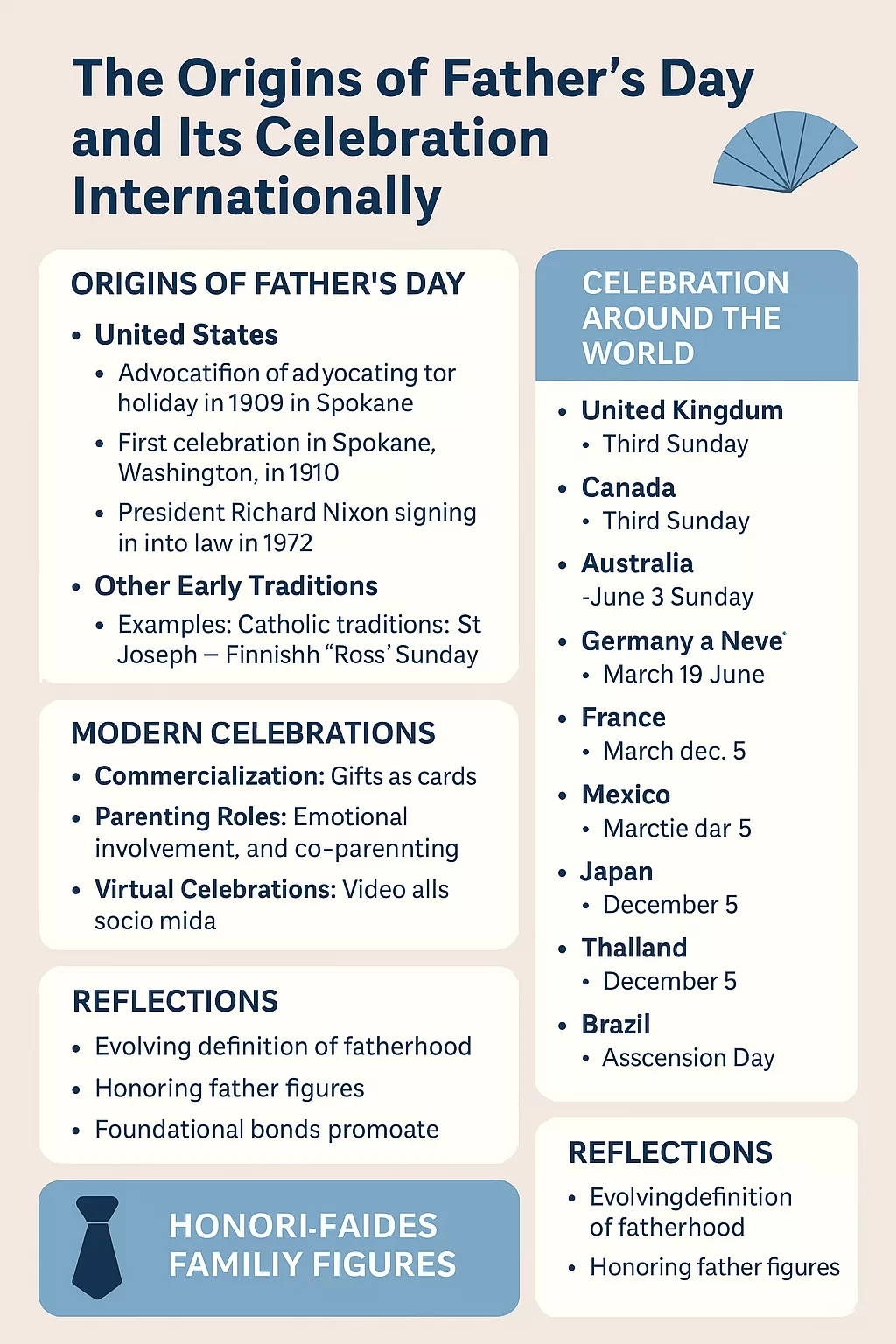
Chapter 1: The Origins of Father’s Day in the United States
Early Inspirations
The concept of setting aside a day to honor fathers originated in the United States during the early 20th century. One of the most widely accepted origin stories centers around Sonora Smart Dodd, a woman from Spokane, Washington. In 1909, after hearing a sermon about Mother’s Day, Dodd was inspired to create a similar holiday to honor fathers.
Sonora’s father, William Jackson Smart, was a Civil War veteran and a single parent who raised six children on his own after the death of his wife. Dodd wanted to recognize the selfless and enduring commitment of fathers like her own. She proposed the idea to local religious leaders and government officials, and her efforts bore fruit the following year.
The First Father’s Day Celebration
The first official Father’s Day was celebrated in Spokane on June 19, 1910. The date was chosen to coincide with Dodd’s father’s birth month. Local churches participated by holding sermons in honor of fatherhood, and community-wide activities encouraged families to spend the day together.
Despite the successful local observance, Father’s Day did not immediately gain national recognition. Skepticism abounded, with critics questioning the need for such a holiday, and commercial interests were wary of fully endorsing it without a precedent for profitable returns.
Federal Recognition
It would take several decades for Father’s Day to achieve federal recognition. President Calvin Coolidge supported the idea in 1924 but did not issue a national proclamation. The holiday gained more traction during World War II, as honoring fathers became tied to patriotism and support for the troops.
In 1966, President Lyndon B. Johnson issued the first presidential proclamation designating the third Sunday in June as Father’s Day. However, it wasn’t until 1972 that President Richard Nixon signed it into law as a permanent national holiday. This move cemented Father’s Day into the American calendar, ensuring its annual celebration.
Chapter 2: The Evolution of Father’s Day Traditions in the U.S.
Commercialization and Consumerism
Once officially recognized, Father’s Day began to evolve into a commercially significant holiday. Greeting card companies, retailers, and advertisers capitalized on the occasion, promoting products ranging from ties and cologne to tools and electronics. Though often criticized for becoming overly commercialized, this trend also helped raise awareness of the holiday and encouraged more widespread observance.
Shifting Roles and Representation
As societal norms have changed, so too has the meaning of Father’s Day. In earlier generations, fathers were often seen primarily as providers and disciplinarians. Modern interpretations of fatherhood emphasize emotional involvement, co-parenting, mentorship, and nurturing roles.
Today, Father’s Day is an opportunity not only to honor biological fathers but also stepfathers, grandfathers, foster fathers, adoptive fathers, and any individual who has played a paternal role in someone’s life.
Chapter 3: Celebrating Father’s Day Around the World
United Kingdom
In the UK, Father’s Day is celebrated on the third Sunday of June, mirroring the U.S. tradition. The holiday gained popularity in the post-World War II era and has since become a well-established observance. British families typically give cards, gifts, and enjoy meals together to show appreciation.
Canada
Similar to the United States and the UK, Canada celebrates Father’s Day on the third Sunday of June. The holiday is widely recognized, with family barbecues, homemade gifts from children, and special outings being common traditions.
Australia and New Zealand
Down under, Father’s Day is celebrated on the first Sunday of September. The reason for the different date is not definitively known, though it likely stems from commercial and cultural scheduling differences. Australians and New Zealanders observe the holiday with similar traditions—gifts, cards, and family-centered activities.
Germany
Germany celebrates a version of Father’s Day known as Vatertag on Ascension Day, which occurs 40 days after Easter. The day is a public holiday and often sees groups of men engaging in hikes or wagon-pulling adventures while enjoying food and beer. Though different from the family-oriented American version, it is rooted in historical customs and has evolved into a unique cultural experience.
France
In France, Fête des Pères is celebrated on the third Sunday in June, introduced in 1952 by a lighter manufacturer hoping to promote its products as Father’s Day gifts. Over time, it became a national observance, with children creating handmade cards and gifts, and families celebrating together.
Mexico
Father’s Day in Mexico, or Día del Padre, is celebrated on the third Sunday in June. While not as widely celebrated as Mother’s Day, it has been gaining popularity. Children often participate in school events and races organized to honor fathers, and families typically enjoy festive meals.
Japan
Father’s Day in Japan, or Chichi no Hi, is celebrated on the third Sunday in June. Gifts such as sake, sweets, and clothing are popular, and children often present handmade crafts. The day is viewed as a chance to express gratitude and respect.
Thailand
Thailand celebrates Father’s Day on December 5, the birthday of King Bhumibol Adulyadej, who was highly revered and considered the father of the nation. People honor their fathers and wear yellow, the king’s color. Ceremonial acts and community service are common, blending personal and national reverence.
Brazil
In Brazil, Father’s Day or Dia dos Pais is celebrated on the second Sunday in August. The date was selected to honor St. Joachim, the father of the Virgin Mary. Family gatherings and expressions of appreciation mark the occasion.
Chapter 4: Religious and Cultural Influences
Catholic Traditions
In some predominantly Catholic countries, Father’s Day is linked to Saint Joseph, the earthly father of Jesus Christ. March 19, St. Joseph’s Day, is observed as a feast day in countries like Italy, Spain, and Portugal. This version of Father’s Day carries a religious tone and often includes mass and family meals.
Islamic Perspectives
Islamic culture traditionally does not have a designated Father’s Day, but fathers are highly respected figures in Muslim societies. In some countries with large Muslim populations, the Western-style Father’s Day is gaining traction, particularly in urban and more secularized settings.
Hindu and East Asian Influence
In Hindu culture, the concept of Pitru Paksha involves honoring deceased ancestors and can be seen as a spiritual acknowledgment of paternal figures, though it’s not a direct equivalent of Father’s Day. In China, Father’s Day was once celebrated on August 8, but today it is more commonly observed in line with international norms.
Chapter 5: Father’s Day in the Age of Digital Connectivity
Virtual Celebrations
With the advent of global communication and social media, Father’s Day has transcended borders. Families separated by distance now use technology like video calls, social media shoutouts, and digital gifts to celebrate the day together.
Fatherhood in the 21st Century
Modern fatherhood is marked by evolving gender roles, the rise of stay-at-home dads, and a growing appreciation for emotional intelligence. Campaigns to recognize paternity leave and equitable parenting further emphasize the importance of father figures in child development and household dynamics.
Representation in Media
Popular culture plays a crucial role in shaping perceptions of fatherhood. From sitcoms to dramas, depictions of fathers have evolved from stern providers to multifaceted characters who nurture, guide, and learn alongside their children.
Chapter 6: Criticisms and Controversies
Commercialization Concerns
As with many holidays, some criticize Father’s Day for becoming overly commercialized. Critics argue that the original spirit of honoring parental influence is diluted by the pressure to buy gifts or spend money on extravagant experiences.
Inclusivity and Representation
Others raise concerns about the holiday’s implications for children without fathers or those from non-traditional families. However, many schools and institutions are now broadening the definition of Father’s Day to include uncles, mentors, grandparents, and other male role models.
Chapter 7: The Enduring Importance of Father’s Day
Despite its varied expressions and occasional criticisms, Father’s Day endures because of its deeply human appeal. It serves as a moment to reflect on the importance of guidance, stability, encouragement, and love offered by father figures.
From the humble beginnings of Sonora Smart Dodd’s campaign to the global celebration it is today, Father’s Day reflects how societies evolve while still valuing foundational relationships. Whether with a handmade card, a heartfelt hug, or a shared memory, the act of honoring fathers continues to bring families together.
Conclusion
Father’s Day is more than just a date on the calendar. It is a symbol of the deep gratitude we hold for the men who shape our lives through strength, compassion, and support. Its global variations show that the role of a father is honored in diverse and beautiful ways, whether through solemn rituals, festive meals, or adventurous outings.
As we continue to redefine family and expand our understanding of parental roles, Father’s Day serves as both a tradition and a compass—reminding us of the foundational bonds that guide us through life. Wherever and however it is celebrated, Father’s Day is a universal tribute to the mentors, protectors, and heroes we call Dad.
For many small businesses, a temporary closure due to an unforeseen disaster can spell financial ruin. Whether it’s a fire, flood, cyberattack, or pandemic-related shutdown, the inability to operate—especially without a steady stream of revenue—can lead to permanent closure. One solution that is often considered is business interruption insurance.
This form of insurance helps replace lost income and covers operating expenses if your business is forced to shut down temporarily. But is it right for every small business? In this article, we’ll explore the pros and cons of purchasing business interruption insurance, and whether it’s a wise investment or an unnecessary expense.
Table of Contents
What Is Business Interruption Insurance?
How It Works
Common Perils Covered
What It Typically Doesn’t Cover
Pros of Business Interruption Insurance
Income Protection
Employee Retention
Business Continuity
Helps with Loan Repayment
Protection from Uncontrollable Events
Cons of Business Interruption Insurance
High Premium Costs
Complex Claims Process
Limited Coverage Scope
Waiting Periods
Exclusions in Pandemics and Civil Unrest
Industry-Specific Considerations
Case Studies: Success and Failure Stories
Evaluating Whether Your Business Needs It
How to Choose a Policy
Alternatives to Business Interruption Insurance
Final Thoughts
1. What Is Business Interruption Insurance?
Business interruption insurance, also known as business income insurance, is a type of policy that compensates a business for income lost during events that cause a suspension of operations. It is often part of a Business Owner’s Policy (BOP) or added as a rider to a commercial property policy.
Rather than covering physical damage to property, like traditional insurance, it addresses lost income and operational expenses during downtime.
2. How It Works
Let’s say a restaurant suffers a kitchen fire and must close for three months for repairs. While property insurance may cover the cost of rebuilding, business interruption insurance would cover the revenue the restaurant loses during the closure. It may also cover:
Rent or lease payments
Employee wages
Taxes
Loan payments
Relocation expenses (if needed)
Payouts are typically based on historical revenue and expense figures.
3. Common Perils Covered
Policies may vary, but most standard business interruption policies cover income losses resulting from:
Fire
Storm damage
Vandalism
Equipment failure
Power outages (under specific conditions)
Natural disasters (when tied to physical damage)
Cyberattacks (if specified)
Note that coverage is often triggered only if physical damage occurs that leads to a disruption of operations.
4. What It Typically Doesn’t Cover
Understanding what’s not covered is crucial. Standard exclusions often include:
Earthquakes and floods (unless separately insured)
Communicable diseases (e.g., COVID-19) without specific riders
Power outages not caused by insured damage
Utility failures off-premises
Government shutdowns
Losses due to poor business decisions
Always read the fine print, as each policy varies widely in scope.
5. Pros of Business Interruption Insurance
a. Income Protection
The most obvious advantage is the ability to maintain revenue. For many small businesses with limited cash reserves, one disaster could cause a long-term financial crisis. Business interruption insurance can cover:
Lost net income
Operating costs
Ongoing fixed costs (e.g., rent)
b. Employee Retention
Maintaining payroll during downtime can be difficult. Coverage ensures you can retain skilled staff even when operations are paused. This reduces costly rehiring and retraining when business resumes.
c. Business Continuity
Insurance allows your business to maintain continuity even when faced with catastrophic events. Whether you need to set up a temporary location or invest in new technology post-disaster, the policy may help absorb those costs.
d. Helps with Loan Repayment
Loan obligations don’t disappear during a business interruption. Income coverage can help ensure you stay current with lenders, preserving your credit and business reputation.
e. Protection from Uncontrollable Events
No matter how well a business is managed, disasters can strike without warning. Business interruption insurance provides peace of mind and a financial safety net.
6. Cons of Business Interruption Insurance
a. High Premium Costs
Premiums for business interruption insurance can be significant, especially for businesses in high-risk industries or locations. The cost is typically based on:
Industry type
Business location
Revenue
Claim history
For cash-strapped small businesses, the cost may outweigh the perceived benefits.
b. Complex Claims Process
Filing a claim isn’t always straightforward. Business owners must:
Provide extensive financial documentation
Prove the extent of lost income
Demonstrate that the event fits within the policy’s parameters
This often requires professional help from accountants or attorneys, adding more costs.
c. Limited Coverage Scope
Many business owners mistakenly believe all disruptions are covered. But many policies only pay out for losses directly tied to physical damage. If your business is closed due to a power grid failure or nearby event (but no property damage), the policy may not apply.
d. Waiting Periods
Policies often include a waiting period—the number of hours or days a business must be closed before coverage begins. If your closure is brief, you may not qualify for reimbursement at all.
e. Exclusions in Pandemics and Civil Unrest
The COVID-19 pandemic revealed a major gap: most insurers excluded communicable diseases. Likewise, business interruptions from protests, curfews, or political unrest may not be covered unless specifically stated in the policy.
7. Industry-Specific Considerations
Retail
Retailers reliant on foot traffic and perishable goods benefit most. A temporary closure could mean complete inventory loss and customer defection.
Food and Beverage
Restaurants are particularly vulnerable to fires, health-code closures, and utility disruptions. Business interruption insurance can be vital.
Tech and SaaS
While these businesses may not suffer from physical damage, they may be impacted by cyberattacks or server failures. Many standard policies don’t cover these events.
Manufacturing
A broken supply chain or equipment failure can grind production to a halt. Business interruption insurance helps keep contracts and payroll on track.
8. Case Studies: Success and Failure Stories
Case 1: Bakery Fire Recovery
A family-owned bakery in New Jersey suffered a severe fire and had to close for five months. Thanks to business interruption insurance, they covered wages, relocated temporarily, and resumed operations without losing market share.
Case 2: COVID-19 Denials
Thousands of small businesses filed claims due to pandemic-related closures. Most were denied, as communicable disease exclusions applied. A well-known Chicago restaurant sued their insurer but lost in court, highlighting a significant gap in coverage.
Case 3: Flood Exclusion
A furniture retailer in Houston shut down for two months after a flood. Despite having business interruption insurance, they received no payout—flood damage was excluded unless separately insured.
9. Evaluating Whether Your Business Needs It
Here are some questions to guide your decision:
Can your business afford to shut down for 1–3 months with no income?
How dependent is your revenue on physical location or inventory?
Do you have a disaster recovery or business continuity plan?
Are you in a high-risk area (storms, floods, crime)?
Do you have access to emergency funding or credit lines?
If your answer to several of these is “no,” you may want to consider coverage.
10. How to Choose a Policy
a. Assess Risk Exposure
Conduct a risk analysis based on your industry, location, and operations. Identify the most likely threats and their potential cost.
b. Understand Coverage Options
Look for:
Named perils vs. all-risk coverage
Inclusion of extra expenses
Optional riders for cyber events, civil unrest, or pandemics
Time limits and maximum benefit caps
c. Work with a Knowledgeable Agent
A specialized commercial insurance broker can help tailor the policy to your business’s needs and ensure you understand all exclusions and fine print.
d. Review Regularly
Your business will evolve. So should your insurance. Reassess annually to ensure your policy still fits your current situation.
11. Alternatives to Business Interruption Insurance
If coverage feels too expensive or limited, consider:
Emergency Savings Fund
Set aside 3–6 months of operating expenses in a liquid account.
SBA Disaster Loans
The U.S. Small Business Administration offers low-interest disaster loans for qualified businesses.
Line of Credit
Maintain an open line of credit for emergency cash flow.
Self-Insuring
Larger or more financially stable businesses may opt to absorb potential losses themselves.
12. Final Thoughts
Business interruption insurance is not a one-size-fits-all solution. For some small businesses, especially those in disaster-prone areas or industries reliant on physical assets, it may be a lifeline. For others, the cost, exclusions, and complexity may outweigh the benefits.
Ultimately, the decision comes down to your business’s risk tolerance, cash reserves, and reliance on uninterrupted operations. Whether or not you purchase a policy, having a robust business continuity plan is essential.
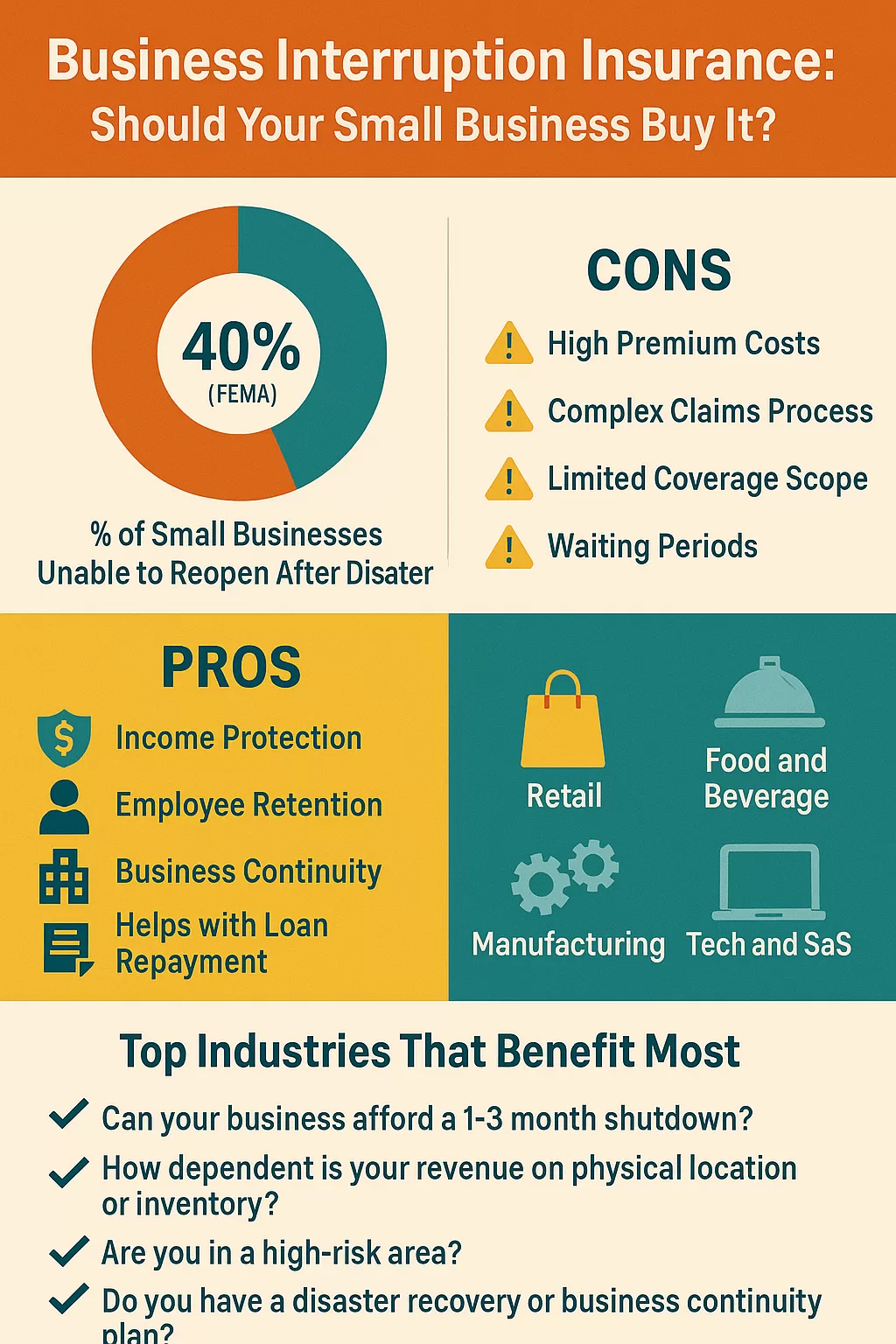
Infographic Suggestion (for Visual Use):
Title: Business Interruption Insurance: Should Your Small Business Buy It?
Sections:
Pie chart: % of small businesses unable to reopen after disaster (FEMA stat: 40%)
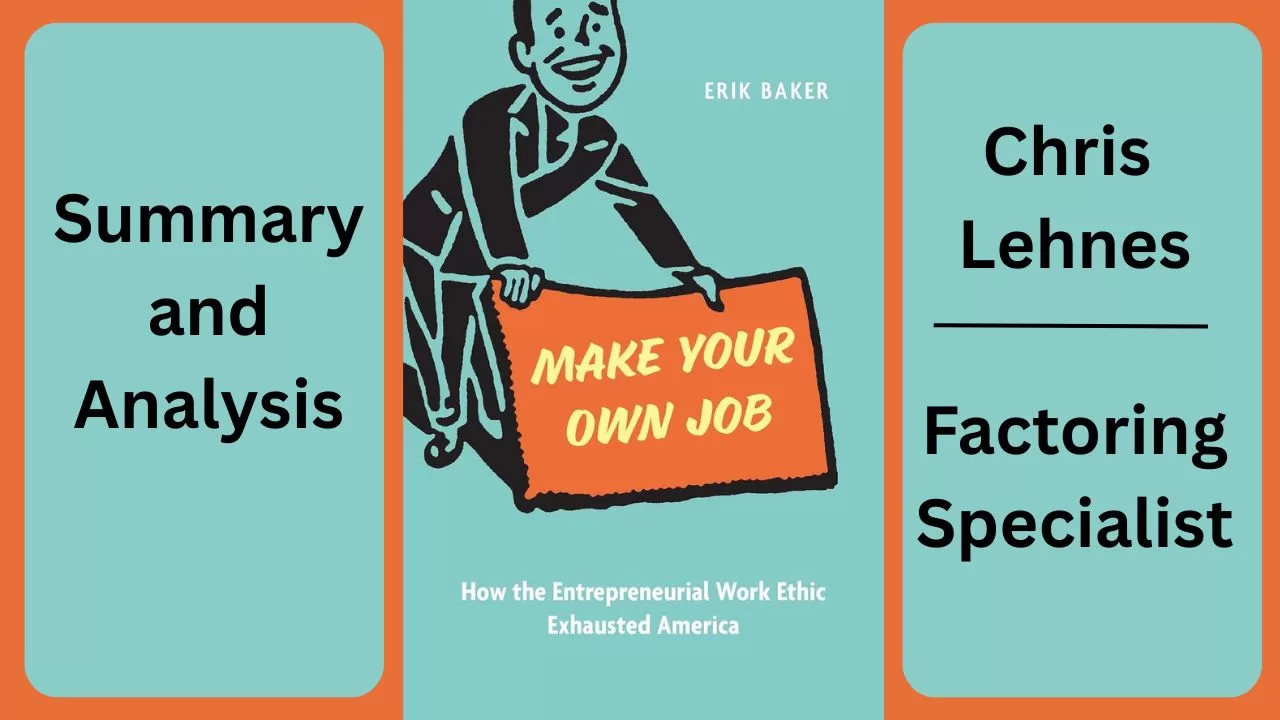
I. The Genesis of Entrepreneurial Authority and its Contradictions (Early 20th Century)
Make Your Own Job: The early 20th century saw the emergence of a distinct entrepreneurial authority, often rooted in the “personality” of the firm’s leader, while simultaneously grappling with the rise of bureaucratic structures and the influence of new psychological and philosophical movements.
Personality as Corporate Policy: Business executives began to frame the success of a firm through the “personality” of its founder or head. A. Montgomery Ward noted that the “primary personality of business… influences every employee, stimulates every manager, creates duplication of each good idea upon the broadest plane until each part of the great combination is enjoying the best that each other part has.” This quasi-mystical language linked the leader’s individual dynamism to the collective success of the enterprise. Make Your Own Job.
Ford’s Charismatic and Violent Authority: Henry Ford exemplifies this personal authority, which, despite a “Sociological Department” for surveillance and moral enforcement, ultimately relied on a “methodical brutality” enforced by deputies like Harry Bennett. Ford’s hiring question, “Can you shoot?”, highlights his intolerance for “any rival governing force in his firm besides his own personal dynamism.” This illustrates a tension between nascent bureaucracy and raw personal power. Make Your Own Job
New Thought and the Cultivation of Success: The “New Thought” philosophy played a significant role in shaping success ideals. It emphasized mental work, imagination, and willpower as keys to achievement. Marcus Garvey, a prominent Black leader, was a “voracious” reader of New Thought, believing that “industrial and commercial expansion and conquest” was “the new thought, the new hope” for Black racial greatness. Napoleon Hill, a notorious “con man” of the era, popularized a secularized version of New Thought, claiming a fabricated relationship with Andrew Carnegie to dispense his “law of success,” which highlighted “imagination” as the source of “IDEAS” (always capitalized for “quasi-supernatural valence”).
Early Economic and Management Theories: Economists like Werner Sombart, Joseph Schumpeter, and Frank Knight contributed to understanding the “entrepreneur function.” Schumpeter defined the entrepreneur by their role in “creative destruction,” while Knight emphasized the entrepreneur’s function in bearing “risk, uncertainty, and profit.” Early management theory, influenced by figures like Frederick Winslow Taylor (Taylorism) and Walter Dill Scott, focused on scientific management and personnel psychology, aiming to optimize worker efficiency and motivation.
II. The Great Depression and the Reconceptualization of Entrepreneurialism
The economic upheaval of the Great Depression compelled a re-evaluation of entrepreneurialism, presenting it as a dynamic solution to widespread joblessness and economic stagnation, even as it challenged traditional notions of work.
Direct Selling as a Dynamic Island: In a period of economic stagnation, direct-selling companies like Avon (California Perfume Company – CPC) thrived, portraying their salesforce (predominantly female) as resourceful and independent. Avon literature framed selling as “a laudable act of feminine social service, not merely a business opportunity,” enabling women to “make new friends, minister to those in need of a friend, and help others to get on a better financial footing.” This reconceptualized direct selling as acceptable “women’s work” that provided dynamism amidst the Depression.
“Executives” as Entrepreneurs: William T. Grant, a chain-store magnate, adapted the entrepreneurial image to describe his store managers as “independent businessmen” rather than “mere employees.” He argued that managers were “executives—not clerks—and when they have left our organization they have proved able to successfully operate their own store,” contrasting them with clerks whose “initiative” and “ingenuity” had “atrophied from underuse.” This shifted the perception of a corporate role towards an entrepreneurial one.
The Appeal of Self-Help: The Depression gave a “new jolt of life” to secularized New Thought in advice writing. Napoleon Hill’s populist message, emphasizing “specialized knowledge” and “IDEAS” over traditional academic education, resonated with professionals facing precarity, offering a “change of heart but not of vocation.”
III. Democratic Leadership, Development, and Post-War Entrepreneurialism
The post-war era saw entrepreneurial principles integrated into concepts of democratic leadership and national/international development, often blurring the lines between public and private sectors.
Social Entrepreneurship and Regional Development: David E. Lilienthal, the principal director of the Tennessee Valley Authority (TVA), presented the agency as a model of “democratic” development, relying on “grass roots” private initiative. He viewed development as a “change… in the way men think, and so thinking, act,” fostering qualities like “resourcefulness,” “inventiveness,” and “pride of workmanship” in workers, making them “better equipped for a modern, industrial, capitalist economy.” Lilienthal later coined the term “social entrepreneurs” for leaders operating at the intersection of public and private sectors.
Private Business Partnerships in Wartime and Development: The Roosevelt administration’s approach to economic mobilization for World War II relied heavily on private business partnerships, with Secretary of War Henry Stimson explaining, “If you are going to try and go to war, or to prepare for war, in a capitalist country, you have to let business make money out of the process or business won’t work.” This precedent extended to New Deal programs like the Reconstruction Finance Corporation (RFC) under Jesse H. Jones, emphasizing cooperation with local business executives.
Entrepreneurship and International Development: Post-WWII, American social scientists, particularly at Harvard Business School, extensively researched entrepreneurship’s role in the “modernization” and “Westernization” of “Third World” nations. David McClelland’s work on “achievement motivation” became central, suggesting that individuals could “literally rewrite their personalities to become more entrepreneurial” through psychological interventions like modified Thematic Apperception Tests (TAT). This approach emphasized “cultural transformation” and “human factors” over purely economic methods.
Corporate Entrepreneurship (“Intrapreneurship”): Within large corporations, the concept of “simulated decentralization” (Peter Drucker) and “simulated entrepreneurship” (Tom Peters and Robert Waterman) emerged, aiming to foster entrepreneurial spirit internally. Companies like 3M, with its “venture teams,” were lauded for allowing employees to act as entrepreneurs within the organizational structure, contributing to successful products like the Post-It Note.
IV. The Modern Entrepreneur and the “Entrepreneurial Work Ethic”
The late 20th and early 21st centuries saw the entrepreneur elevated to a cultural icon, particularly within conservative ideology, influencing the perception of work and individual responsibility.
The “Founding Father” Entrepreneur: Ray Kroc, McDonald’s CEO, cultivated a personal mythology as the “Founding Father” of McDonald’s, embodying “entrepreneurship, his competitiveness, his integrity.” Despite not inventing the core business model, Kroc’s relentless ambition to make McDonald’s an “American institution” solidified his image as the true entrepreneur. This reinforced a “masculinism historically associated with the ‘entrepreneur’ concept into a potent family metaphor.”
Small-Town Entrepreneurship and Decentralization: Sam Walton, founder of Wal-Mart, epitomized entrepreneurial success through his strategy of targeting underserved small towns and promoting internal “proprietorship” among his managers. His “Store Within A Store” program provided department managers with profit data and incentive pay, giving them “the pride of proprietorship even if they weren’t fortunate enough to go to college or be formally trained in business.”
Social Entrepreneurship and Microfinance: Muhammad Yunus, founder of Grameen Development Bank, became a global celebrity for his “microfinance” model, providing small loans to women in the Global South. Yunus proudly declared himself a “social entrepreneur,” asserting that “Microcredit institutions are powerful because they are not about charity for the poor, but are based on business principles.” This discourse suggested that poverty could be eradicated through market mechanisms, blurring the line between social good and profit-making. The concept gained significant traction, especially during the Clinton era, with initiatives like the Good Faith Fund in Arkansas, patterned on Grameen.
The Ambiguity of the “Gig Worker” and the Entrepreneurial Work Ethic: The “entrepreneurial work ethic” pervades contemporary understanding of labor, particularly in the “gig economy.” Taxi drivers are presented as “enduring symbols” of this ambiguity: are they “factory workers, doing a clearly defined job on behalf of a boss, or… like entrepreneurs, managing themselves, jockeying for customers, making their own jobs?” The sources suggest that this perception thrives “most in times and places when workers feel unable to answer this question as definitively” as the character Damani in Your Driver Is Waiting, who identifies politically as a worker. The prevailing message is that it’s “a spectrum that every worker sits on, and where they are located depends more on their attitude and the attitude of their managerial leaders than on the material facts of their job.”
In conclusion, the entrepreneurial ideal has evolved from a charismatic leader’s personal dynamism to a pervasive work ethic that shapes individual identity and societal approaches to economic development and social welfare. It has been adapted and reinterpreted across various historical contexts, consistently emphasizing individual initiative, imagination, and a “can-do” spirit, often blurring the lines between traditional employment, self-employment, and corporate structures, and sometimes obscuring the underlying material realities of work.
Entrepreneurialism and the American Workforce: A Study Guide
Quiz
Instructions: Answer each of the following questions in 2-3 sentences, drawing upon the provided source material.
What was the purpose of Ford’s “Sociological Department,” and how did it relate to Henry Ford’s personal authority?
How did Marcus Garvey connect New Thought philosophy to his vision for the Universal Negro Improvement Association (UNIA)?
Explain A. Montgomery Ward’s perspective on “personality in business” and its influence within a firm.
Why was L.J. Henderson’s interest in Vilfredo Pareto alarming to some, as noted by Arthur Schlesinger Jr.?
How did the California Perfume Company (Avon) frame direct selling as “women’s work” during the Depression era?
Describe Napoleon Hill’s background and his alleged connection to Andrew Carnegie, as presented in the text.
What did Henry Luce value most that made Peter Drucker decline his job offer at Time-Life, despite its perks?
How did David E. Lilienthal, as head of the TVA, describe the relationship between individual development and regional development?
Explain Sam Walton’s “Store Within A Store” program at Wal-Mart and its intended effect on department managers.
How did Muhammad Yunus, the founder of Grameen Bank, reconcile the business principles of microfinance with its goal of combating poverty?
Answer Key
Ford’s “Sociological Department” rigorously surveilled workers to ensure adherence to standards like thrift and sobriety, with offenders risking disqualification from the “five-dollar-day” plan. While it routinized some of Ford’s charisma, other enforcers like Harry Bennett directly sharpened his personal authority through brutal discipline, highlighting Ford’s intolerance for rival governing forces.
Marcus Garvey, a voracious reader of New Thought, saw its cosmic bent suiting his temperament as a messianic figure. He explicitly announced “industrial and commercial expansion and conquest” as “the new thought, the new hope” of the twentieth century, believing it would lay the foundation for Black racial greatness.
A. Montgomery Ward viewed the “primary personality of business” as the firm’s founder or head, whose name represents its policy. He believed this leader’s “personality” mystically influenced every employee, stimulated managers, and facilitated the broad duplication of good ideas throughout the organization.
L.J. Henderson’s conversion to Vilfredo Pareto’s ideas was alarming to figures like Arthur Schlesinger Jr. because Pareto had accepted a senatorship from Mussolini. This association linked Pareto’s theories, and by extension Henderson’s enthusiasm for them, with fascism and right-wing political ideologies.
CPC literature framed Avon selling as a laudable act of feminine social service, beyond just a business opportunity. Women were encouraged to exploit female social networks for sales, with testimonials emphasizing making new friends, ministering to those in need, and helping others achieve financial footing, thus making direct selling acceptable “women’s work” during the Depression.
Napoleon Hill was a notorious con man who spent much of the early 20th century on the run for various fraudulent schemes. His “greatest con” was fabricating a relationship with Andrew Carnegie, claiming Carnegie had revealed the secret to success to him, though this meeting almost certainly never occurred.
Peter Drucker declined Henry Luce’s job offer at Time-Life because, despite the obvious perks, a job there with its aversion to individual bylines and homogenizing house style would cost him “the thing he valued most: his ability to be a public personality.”
Lilienthal believed the TVA’s fundamental role was to propagate a new intellectual and spiritual orientation among Appalachian valley-dwellers toward personal and economic development. He argued that building dams not only provided new skills but also fostered “resourcefulness,” “inventiveness,” and “pride of workmanship,” thereby fusing individual and regional growth.
Sam Walton’s “Store Within A Store” program provided department managers with data on their individual department’s profit margins and sales volume. It also offered incentive pay based on performance, aiming to give managers “the pride of proprietorship” even without formal business training, thereby converting them into entrepreneurs within the larger Wal-Mart structure.
Muhammad Yunus reconciled business principles with combating poverty by framing Grameen Bank not as a charity, but as a fully solvent business operating on “business principles.” He argued that microcredit institutions are powerful because they can cover costs and don’t rely on long-term subsidies, thus promoting entrepreneurship while being self-sustaining.
Essay Questions
Analyze how the concept of “personality” evolved in early twentieth-century business thought, contrasting A. Montgomery Ward’s quasi-mystical view with Dale Carnegie’s emphasis on cultivating a “self that was worth selling.”
Discuss the role of direct selling, particularly by companies like Avon, in reshaping perceptions of “women’s work” and entrepreneurial opportunity during the Great Depression. How did this challenge or reinforce existing economic and gender norms?
Compare and contrast the approaches to discipline and control of the workforce at Ford Motor Company under Henry Ford and Harry Bennett with the management strategies promoted by figures like Peter Drucker and Edwin Land at Polaroid. What do these differences reveal about evolving ideas of corporate authority and employee relations?
Examine the influence of “New Thought” philosophy on different figures discussed in the text, such as Marcus Garvey and Napoleon Hill. How did this philosophy inform their respective visions of success, leadership, and social change, despite their disparate goals and methods?
The text introduces the concept of the “democratic entrepreneur” through figures like David E. Lilienthal and later applies it to the “gig economy.” Discuss how this concept bridges the public and private sectors, and how the “entrepreneurial work ethic” is depicted as both a solution to and a symptom of economic precarity in various historical contexts.
Glossary of Key Terms
Entrepreneurial Work Ethic: A cultural and economic philosophy emphasizing individual initiative, self-reliance, and innovation in the pursuit of economic success. It suggests that individuals, rather than solely relying on traditional employment structures, should “make their own jobs” and take responsibility for their own economic well-being.
New Thought: A spiritual and philosophical movement popular in the late 19th and early 20th centuries that emphasized the power of positive thinking, mental attitudes, and willpower to influence one’s material reality and achieve success. It often had a “cosmic bent” and influenced self-help literature.
Sociological Department (Ford): A department at Ford Motor Company responsible for rigorously surveilling workers to ensure adherence to standards of thrift, hygiene, sobriety, and sexual propriety. It could disqualify offenders from eligibility for Ford’s lucrative “five-dollar-day” compensation plan.
Five-Dollar-Day: Henry Ford’s compensation plan that offered significantly higher wages to workers, but with the condition that they abided by certain moral and behavioral standards, monitored by the Sociological Department.
Personality in Business: An early 20th-century concept that attributed the success and character of a firm to the “personality” of its founder or leader, seen as influencing and stimulating every aspect of the organization.
Vilfredo Pareto: An Italian sociologist and economist whose ideas were influential, particularly among some right-wing intellectuals. His work, such as The Mind and Society, discussed social systems and elites.
California Perfume Company (CPC/Avon): A direct-selling company that empowered its predominantly female salesforce during the Depression by framing direct selling as an acceptable form of “women’s work” centered on exploiting female social networks and offering social service.
Napoleon Hill: A controversial self-help author and con man who popularized the “science of success” in the early 20th century. He is known for fabricating a relationship with Andrew Carnegie and for his books emphasizing the power of “imagination” and “IDEAS.”
Specialized Knowledge (Hill): A concept introduced by Napoleon Hill, emphasizing practical, entrepreneurial knowledge and “IDEAS” as more valuable for navigating industrially mature capitalism than traditional, college-educated professional knowledge.
David E. Lilienthal: The principal director of the Tennessee Valley Authority (TVA) who presented the agency as an example of “democratic” development, focusing on “grass roots” private initiative and fostering a new intellectual and spiritual orientation towards personal and economic development.
Social Entrepreneur/Social Entrepreneurship: A term coined by David E. Lilienthal and later popularized by others like Muhammad Yunus and Jeffrey Skoll, referring to leaders or ventures that straddle the line between public and private sectors, aiming to achieve social good through business principles and entrepreneurial methods.
Tennessee Valley Authority (TVA): A federal agency presented as a model of democratic development, emphasizing regional and individual development through infrastructure projects, private business partnerships, and the cultivation of new skills and values among residents.
Georges F. Doriot: A Harvard Business School professor and champion of entrepreneurial leadership, known for building men and companies by seeking out “creative men with the vision of things to be done” and emphasizing “imagination as well as incentive.”
Edwin Land: The founder of Polaroid, who envisioned a company where employees worked as a “family” towards shared objectives and aimed to implement “management by objectives” and profit-sharing plans to foster individual management.
David McClelland: A psychologist known for his work on “achievement motivation” and its connection to entrepreneurship and economic development, particularly in “Third World” nations. He developed training programs to help individuals cultivate entrepreneurial personalities.
Thematic Apperception Test (TAT): A psychological test, modified by McClelland, where subjects create stories about ambiguous photographs. McClelland used it to identify and teach “achievement thinking,” claiming individuals could “rewrite their personalities” to become more entrepreneurial.
Muhammad Yunus: A Bangladeshi economist and founder of Grameen Bank, known for pioneering “microfinance” – providing small, high-interest loans to the poor (primarily women) to start “microbusinesses.” He was a proud “social entrepreneur.”
Microfinance: A system of providing small loans, financial services, and sometimes training to low-income individuals or groups, typically in developing countries, to help them start or expand small businesses and alleviate poverty.
Ray Kroc: The entrepreneur who expanded McDonald’s into a global franchise empire. He cultivated a personal mythology as the “Founding Father” of McDonald’s, emphasizing his entrepreneurial drive, patriotism, and paternal authority, despite not having founded the original restaurant or its core system.
Sam Walton: The founder of Wal-Mart, who emphasized “ordinary people” joining together to accomplish extraordinary things. He implemented programs like “Store Within A Store” to decentralize management and instill an entrepreneurial mindset in department managers.
Store Within A Store (Wal-Mart): A Wal-Mart program that provided department managers with data on their department’s profit margins and sales volume and offered incentive pay based on performance. It aimed to give managers “the pride of proprietorship” and convert them into internal entrepreneurs.
Simulated Decentralization (Drucker)/Simulated Entrepreneurship (Peters & Waterman): Management concepts advocating for structuring divisions or internal operations of large corporations as functionally independent business units, sometimes with internal markets and simulated pricing systems, to foster entrepreneurial behavior within bureaucratic organizations.
Gig Economy: An economic system characterized by temporary, flexible jobs where individuals are hired for short-term tasks or projects, often through online platforms, leading to an ambiguous status for workers as neither traditional employees nor fully independent entrepreneurs.
Taylorism (Scientific Management): A management theory developed by Frederick Winslow Taylor, focusing on optimizing efficiency and productivity through systematic analysis of workflows, standardization of tasks, and close supervision of workers.
Should Your Small Business Have a Key-Person Life Insurance Policy in Place?
For most small businesses, success is often tied to a handful of people—or even a single individual—who plays a pivotal role in day-to-day operations, strategic decision-making, or customer relationships. The sudden loss of that person, whether through death or disability, could be devastating. It might halt production, disrupt operations, damage client relationships, or even bring the business to a grinding halt. Should you consider key-person life insurance ?
This is where key-person life insurance becomes an essential tool in your small business risk management strategy. Unlike traditional life insurance that benefits a family, key-person life insurance is purchased by a business to safeguard against the financial fallout that would follow the loss of a critical team member.
This article provides a comprehensive analysis of what key-person life insurance is, how it works, and why your small business should strongly consider having a policy in place.
Chapter 1: What Is Key-Person Life Insurance?
Definition and Basics
Key-person life insurance is a policy that a business takes out on an essential employee—often an owner, founder, or senior manager. The business owns the policy, pays the premiums, and is the beneficiary. If the key person dies or becomes incapacitated, the insurance payout goes to the business to help mitigate the financial impact.
Common Roles That Qualify as Key Persons
Founders or co-founders
CEOs or senior executives
Top salespeople
Product developers or technical leaders
Sole owners or partners
Individuals with critical customer or vendor relationships
Policy Mechanics
Owner: The business
Insured: The key person
Beneficiary: The business
Purpose: Provide financial protection to keep the company afloat during transition or until a replacement is found
Chapter 2: Why Key-Person Insurance Matters for Small Businesses
High Risk of Dependency
Many small businesses are disproportionately dependent on a few individuals. Unlike large corporations with layers of management and institutional systems, small businesses often rely on personal relationships and individual expertise.
Business Continuity and Stability
Key-person insurance provides a financial cushion to:
Cover losses in revenue
Manage transition costs
Recruit and train a replacement
Pay off debts
Prevent default on contracts
Offer stability to investors and creditors
Protecting Stakeholder Interests
Without a plan in place, the death or incapacitation of a key person could:
Jeopardize loan agreements
Frighten investors
Cause client attrition
Lead to business closure
Chapter 3: Financial Scenarios Where Key-Person Insurance Helps
Scenario 1: Revenue Shock
If a business depends on one person for most of its revenue—say a rainmaking salesperson or a celebrity chef—their loss could lead to a sudden drop in income. Insurance proceeds can fill the revenue gap temporarily.
Scenario 2: Debt Repayment
A bank loan might have been issued with the understanding that a key person is running the business. If that person dies, lenders may call in the loan. Insurance proceeds can be used to settle these debts.
Scenario 3: Cost of Replacement
Recruiting a high-level replacement could cost tens or even hundreds of thousands of dollars in salary, headhunter fees, and onboarding time. Key-person insurance can fund this process without draining operational capital.
Scenario 4: Ownership Buyouts
In partnerships, key-person insurance is often tied to a buy-sell agreement, allowing the surviving partner to purchase the deceased’s share from their estate. This avoids legal conflicts and ensures business continuity.
Chapter 4: How Much Coverage Does a Small Business Need?
Determining the Coverage Amount
There is no one-size-fits-all approach, but several methods help determine the right coverage:
Multiple of Salary: Often 5–10 times the key person’s annual compensation.
Contribution to Profits: Estimate how much revenue the individual is responsible for.
Replacement Cost: Assess how much it would cost to replace the person, including recruitment and training.
Outstanding Debt: Coverage sufficient to settle existing liabilities.
Customizing for Your Business
Consider:
Industry-specific risks
Ease or difficulty of replacement
Existing contingency plans
Business lifecycle stage (start-up vs mature)
Chapter 5: Choosing the Right Policy Type
Term Life Insurance
Lower cost
Provides coverage for a set number of years (e.g., 10 or 20)
Best for small businesses with temporary needs
Whole Life Insurance
More expensive
Covers the insured for their entire life
Has a cash value component that can be borrowed against
Useful for long-term buy-sell agreements
Riders and Add-Ons
Disability rider: Provides benefits if the key person becomes disabled, not just if they die
Accelerated benefit rider: Grants access to the death benefit in the event of terminal illness
Chapter 6: Tax Implications of Key-Person Insurance
Premiums
Not tax-deductible as a business expense if the company is the beneficiary
Death Benefits
Generally not taxable income to the business
Exceptions may apply if the business fails to meet IRS notification and consent requirements
Use in Succession Planning
In some cases, key-person insurance can be integrated into estate planning or succession strategy, particularly in family-owned businesses.
Chapter 7: The Application Process
Underwriting Requirements
Medical examination of the insured
Financial documentation of the business
Proof of insurable interest
Consent Is Mandatory
The insured person must sign a consent form acknowledging that the policy is being taken out on them and that they are aware of the business being the beneficiary.
Policy Management
Keep documentation in your business continuity file
Periodically review policy needs as the business grows or changes
Chapter 8: Alternatives and Supplements to Key-Person Insurance
Cross-Purchase Agreements
Used among business partners, each partner takes out a policy on the others. Upon death, proceeds are used to buy the deceased partner’s share from their estate.
Business Continuity Plans
Insurance is just one part of risk management. Other measures include:
Documenting critical processes
Training backups
Diversifying client and vendor relationships
Retention Strategies
Investing in employee retention through incentives, equity, and career development helps reduce dependency on any single individual.
Chapter 9: Real-World Examples
Case Study 1: The Solopreneur Agency
A marketing agency dependent on its founder for sales and strategy saw its revenue collapse after his unexpected passing. Without key-person insurance, the business couldn’t meet payroll and closed within three months.
Case Study 2: Tech Start-Up With a Safety Net
A tech start-up insured its CTO for $1 million. When the CTO died in a car accident, the funds allowed them to recruit a new technical lead, cover project delays, and avoid breaking contractual obligations.
Case Study 3: Partnership Buyout Made Simple
Two co-owners of a plumbing business had cross-purchase key-person policies. When one died unexpectedly, the surviving partner used the death benefit to buy out the deceased’s share, avoiding probate disputes and keeping the company running.
Chapter 10: Key Questions to Ask Before Buying
Who are the true key people in your business?
What would it cost the business to lose them tomorrow?
How long would it take to find a replacement?
Can your business survive a revenue gap of several months?
What do lenders or investors expect regarding continuity planning?
Chapter 11: How to Talk to Your Team About It
Transparency and Sensitivity
Let the insured know the purpose of the policy and reassure them that it’s not a replacement for personal life insurance, but a strategic business decision.
Benefits to the Insured
Shows recognition of their value
Enhances job security
May include options for converting the policy later into personal coverage
Chapter 12: Potential Drawbacks and Considerations
Premium Costs
Some small businesses might find even term policies burdensome during lean periods. Consider options like annual renewable terms to manage costs.
Employee Morale
If only one person is insured, others might feel undervalued. Balance this with recognition programs and communication.
Complexity of Use
Policies must be integrated into overall business planning. Funds should be earmarked for specific use, not general spending.
Chapter 13: The Role of Advisors
Who to Involve
Insurance brokers
Legal counsel (for buy-sell agreements)
Accountants (for tax implications)
Financial planners
Periodic Reviews
As your business grows, reevaluate:
The amount of coverage
Who is considered a key person
Policy structure and type
Conclusion: The Strategic Importance of Key-Person Insurance
For small businesses, the loss of a key person can be existential. Unlike larger firms that can absorb such shocks, small businesses often lack the depth of personnel and capital to weather these storms.
Key-person life insurance is not just a precaution—it’s a strategic decision that reflects foresight, risk management, and a commitment to long-term viability. While it requires upfront investment, the peace of mind and financial safety net it provides far outweigh the cost.
If your business relies heavily on the talents, relationships, or decision-making of one or two people, you owe it to yourself, your employees, your clients, and your investors to consider key-person insurance. It’s not just about protecting a person—it’s about protecting everything you’ve built.
Title: How the China Trade Deal Announced Today Will Impact Small Businesses
Introduction to impact of China Trade Deal
Today, the U.S. and China reached a tentative trade agreement that marks a significant, albeit partial, development in their ongoing economic standoff. This new arrangement preserves existing tariffs—55% on Chinese imports and 10% on U.S. exports—while introducing limited concessions on rare-earth minerals and export controls. The agreement provides minimal relief for most small businesses, which have borne the brunt of the past several years of tariff-induced uncertainty. This article will explore in detail the contents of the deal, assess its implications for various sectors of the small business community, and offer strategic recommendations for adaptation.
Part 1: Understanding the New U.S. – China Trade Deal
The June 11, 2025 deal between the United States and China was framed more as a temporary stabilization than a comprehensive resolution. Here are the key elements:
Tariffs Remain Largely Intact: The U.S. will maintain approximately 55% tariffs on a wide range of Chinese imports. China will reciprocate with 10% tariffs on American goods. The structure formalizes what had become the status quo over the last year.
Rare-Earth Concession: China agreed to issue six-month export licenses for rare-earth materials essential to U.S. electronics, automotive, and defense sectors.
Relaxation of Non-Tariff Measures: Export controls were modestly loosened, and restrictions on student visas for Chinese nationals have been relaxed, which may ease the climate for academic and professional exchange.
While headlines emphasized “agreement,” the reality is that the deal provides only narrow, conditional relief and does little to roll back the broader tariff architecture hurting American small enterprises.
Part 2: Current Landscape for Small Businesses & China
Before assessing the implications of the deal, it is important to understand the pressures already being experienced by small businesses:
Increased Supply Costs: Retailers, manufacturers, and e-commerce sellers reliant on imports have been particularly hard-hit by increased tariffs. The removal of the $800 “de minimis” exemption meant sudden cost spikes for previously low-tariff goods.
Planning Uncertainty: The unpredictability of trade negotiations has left small business owners unable to make informed decisions about inventory, pricing, or expansion.
Disrupted Cash Flow: Delays at ports and sudden changes in pricing structures have left many businesses with overstocked, overpriced inventory they cannot move.
Reduced Competitiveness: Higher input costs mean many small businesses can no longer compete with large corporations that have deeper reserves or more diversified supply chains.
Consumer Backlash: Price increases are alienating customers and diminishing brand loyalty for many small retailers.
Part 3: Sector-by-Sector Analysis – China
Let’s examine how this deal will impact different segments of the small business ecosystem.
Manufacturing
Impact: Moderate Relief.
For small manufacturers reliant on rare-earth materials, the six-month export licenses offer temporary breathing room. Sectors like electronics, defense subcontracting, and advanced manufacturing may see modest improvements in supply chain consistency.
Risks: The time-bound nature of the licenses makes long-term planning difficult. Any lapse in licensing will reintroduce chaos.
E-Commerce
Impact: Minimal to Negative.
Online sellers, particularly those importing fashion, gadgets, or toys, were previously protected by the de minimis exemption. With this gone and no rollback in tariffs, they are squeezed between rising costs and customer expectations for low prices.
Risks: Many sellers may exit the market or shift operations overseas.
Brick-and-Mortar Retail
Impact: Negative.
Stores relying on imported goods—from housewares to ethnic food supplies—will see no cost reduction. Without major economies of scale, small shops must raise prices or reduce product offerings.
Risks: Reduced foot traffic, lower profit margins, and possible closures.
Agriculture & Food Processing
Impact: Negligible.
Most food exports to China still face tariffs. While larger producers may negotiate their way through, small-scale farms and specialty producers face pricing disadvantages.
Risks: Loss of export competitiveness, oversupply in domestic markets.
Professional Services (Consulting, Legal, Educational)
Impact: Potentially Positive.
The easing of visa and academic restrictions may stimulate demand for consulting, education services, and cross-border partnerships.
Risks: Benefits are slow-moving and depend on broader geopolitical stabilization.
Part 4: What the Deal Does Not Address
Despite media attention, the deal sidesteps many of the deeper structural issues affecting small businesses:
No De-escalation Timeline: There is no roadmap for reducing tariffs further or restoring exemptions.
Temporary Nature of Relief: Six-month licenses are not sufficient for meaningful strategic planning.
No Domestic Support Programs: There is no corresponding federal relief for small firms affected by the tariffs.
No Infrastructure for Adaptation: Programs to help small businesses retool supply chains or go digital are still lacking.
No Harmonization of Standards: Differing regulations and standards continue to limit the ability of small businesses to export efficiently.
Part 5: Strategic Recommendations for Small Businesses and China
In light of these dynamics, small businesses must adopt proactive strategies:
1. Supply Chain Diversification
Identify suppliers in countries not subject to high tariffs. Consider nearshoring options such as Mexico, Canada, or domestic production where feasible.
2. Product Portfolio Optimization
Evaluate which products are most impacted by tariffs. Shift focus to less import-dependent or higher-margin offerings.
3. Financial Planning and Resilience
Engage in scenario planning. Consider factoring, SBA loans, or trade finance to stabilize cash flow in periods of uncertainty.
4. Advocacy and Alliances
Join trade associations or local chambers of commerce to advocate for small business interests in ongoing trade negotiations.
5. Customer Communication
Be transparent about price increases or product changes. Position your business as responsive and honest rather than reactive.
6. Digital Adaptation
Invest in e-commerce platforms, CRM tools, and logistics software to increase operational efficiency and customer engagement.
Part 6: The Broader Economic Picture
Small businesses are not isolated from macroeconomic trends. The deal may create the following broader conditions:
Improved Investor Confidence: Markets may respond positively to even temporary stability, which could ease borrowing conditions.
Inflation Management: Stabilizing trade could assist the Federal Reserve in maintaining inflation at the current 2.4% level.
Employment Outlook: Clarity in trade policy may encourage cautious hiring, particularly in sectors such as logistics, warehousing, and small-scale manufacturing.
However, these benefits are conditional and unevenly distributed. Without deeper structural reforms, the new agreement is unlikely to generate a large-scale recovery for the small business sector.
The June 11, 2025 U.S.-China trade agreement is a temporary truce rather than a resolution. While it introduces some modest benefits—particularly for manufacturing reliant on rare-earth minerals—it does little to ease the pain felt by the majority of small businesses still grappling with high tariffs, uncertain supply chains, and squeezed profit margins. Strategic adaptation, political advocacy, and operational resilience will be the keys to survival in this persistently volatile landscape. Until a more comprehensive agreement is reached, small businesses must continue to plan for instability and seize whatever limited advantages the current deal affords.
Briefing Document: Impact of the New U.S.-China Trade Deal on Small Businesses
Date: June 11, 2025 Source: Excerpts from “How the China Trade Deal Will Impact Small Businesses” by Chris Lehnes, Factoring Specialist
This briefing document summarizes the key themes, ideas, and facts presented in Chris Lehnes’ article “How the China Trade Deal Announced Today Will Impact Small Businesses,” published on June 11, 2025. The article assesses the implications of the new U.S.-China trade agreement for various small business sectors and offers strategic recommendations for adaptation.
1. Executive Summary: A “Temporary Stabilization” Not a “Comprehensive Resolution”
The recently announced U.S.-China trade agreement on June 11, 2025, is primarily described as a “temporary stabilization” rather than a significant breakthrough or “comprehensive resolution.” The deal maintains the “status quo” of existing high tariffs (55% on Chinese imports to the U.S. and 10% on U.S. exports to China), offering “minimal relief for most small businesses.” While it introduces limited concessions regarding rare-earth minerals and a relaxation of some non-tariff measures, it largely fails to address the deeper structural issues that have burdened small enterprises.
2. Key Elements of the New Trade Deal
The article highlights the following specific components of the June 11, 2025 agreement:
Tariffs Remain Largely Intact: “The U.S. will maintain approximately 55% tariffs on a wide range of Chinese imports. China will reciprocate with 10% tariffs on American goods.” This formalizes the existing tariff structure.
Rare-Earth Concession: China has agreed to “issue six-month export licenses for rare-earth materials essential to U.S. electronics, automotive, and defense sectors.”
Relaxation of Non-Tariff Measures: There has been a “modest loosening” of export controls and a relaxation of “restrictions on student visas for Chinese nationals,” which may “ease the climate for academic and professional exchange.”
Lehnes emphasizes that despite headlines, the deal offers “only narrow, conditional relief and does little to roll back the broader tariff architecture hurting American small enterprises.”
3. Current Landscape for Small Businesses: Pre-Existing Pressures
Before the deal, small businesses were already facing significant challenges due to the ongoing trade tensions:
Increased Supply Costs: Retailers, manufacturers, and e-commerce sellers dependent on imports “have been particularly hard-hit by increased tariffs.” The removal of the “$800 ‘de minimis’ exemption meant sudden cost spikes for previously low-tariff goods.”
Planning Uncertainty: “The unpredictability of trade negotiations has left small business owners unable to make informed decisions about inventory, pricing, or expansion.”
Disrupted Cash Flow: “Delays at ports and sudden changes in pricing structures have left many businesses with overstocked, overpriced inventory they cannot move.”
Reduced Competitiveness: “Higher input costs mean many small businesses can no longer compete with large corporations that have deeper reserves or more diversified supply chains.”
Consumer Backlash: “Price increases are alienating customers and diminishing brand loyalty for many small retailers.”
4. Sector-by-Sector Impact Analysis
The deal’s impact varies significantly across different small business sectors:
Manufacturing:Moderate Relief. Businesses reliant on rare-earth materials will experience “temporary breathing room” from the six-month export licenses. However, the “time-bound nature of the licenses makes long-term planning difficult.”
E-Commerce:Minimal to Negative. Online sellers previously protected by the “de minimis” exemption are now “squeezed between rising costs and customer expectations for low prices,” with many potentially having to “exit the market or shift operations overseas.”
Brick-and-Mortar Retail:Negative. Stores relying on imported goods “will see no cost reduction” and must “raise prices or reduce product offerings,” leading to “reduced foot traffic, lower profit margins, and possible closures.”
Agriculture & Food Processing:Negligible. Most food exports still face tariffs, making it difficult for “small-scale farms and specialty producers [to] face pricing disadvantages” and risk “loss of export competitiveness, oversupply in domestic markets.”
Professional Services (Consulting, Legal, Educational):Potentially Positive. The easing of visa and academic restrictions “may stimulate demand for consulting, education services, and cross-border partnerships,” though benefits are “slow-moving.”
5. What the Deal Does Not Address
The article identifies several critical omissions in the new agreement:
No De-escalation Timeline: “There is no roadmap for reducing tariffs further or restoring exemptions.”
Temporary Nature of Relief: “Six-month licenses are not sufficient for meaningful strategic planning.”
No Domestic Support Programs: “There is no corresponding federal relief for small firms affected by the tariffs.”
No Infrastructure for Adaptation: “Programs to help small businesses retool supply chains or go digital are still lacking.”
No Harmonization of Standards: “Differing regulations and standards continue to limit the ability of small businesses to export efficiently.”
6. Strategic Recommendations for Small Businesses
Given the persistent volatility, Lehnes advises small businesses to adopt proactive strategies:
Supply Chain Diversification: “Identify suppliers in countries not subject to high tariffs. Consider nearshoring options such as Mexico, Canada, or domestic production where feasible.”
Product Portfolio Optimization: “Evaluate which products are most impacted by tariffs. Shift focus to less import-dependent or higher-margin offerings.”
Financial Planning and Resilience: “Engage in scenario planning. Consider factoring, SBA loans, or trade finance to stabilize cash flow.”
Advocacy and Alliances: “Join trade associations or local chambers of commerce to advocate for small business interests.”
Customer Communication: “Be transparent about price increases or product changes.”
Digital Adaptation: “Invest in e-commerce platforms, CRM tools, and logistics software to increase operational efficiency.”
7. Broader Economic Picture and Conclusion
While the deal may lead to “improved investor confidence” and potentially assist with “inflation management” (currently at 2.4%), these benefits are “conditional and unevenly distributed.” The article concludes that “without deeper structural reforms, the new agreement is unlikely to generate a large-scale recovery for the small business sector.”
In essence, the June 11, 2025 U.S.-China trade agreement is a “temporary truce rather than a resolution.” Small businesses must continue to “plan for instability and seize whatever limited advantages the current deal affords.”
U.S.-China Trade Deal and Small Businesses: A Comprehensive Study Guide
I. Overview of the New U.S.-China Trade Deal (June 11, 2025)
Nature of the Agreement: A tentative, partial development aimed at temporary stabilization rather than a comprehensive resolution of economic tensions.
Tariff Structure:U.S. tariffs on Chinese imports: Approximately 55% (largely maintained).
China tariffs on U.S. exports: 10% (largely reciprocated).
Formalizes the status quo of the past year.
Key Concessions:Rare-Earth Materials: China to issue six-month export licenses for rare-earth materials vital to U.S. electronics, automotive, and defense sectors.
Non-Tariff Measures: Modest loosening of export controls and relaxation of student visa restrictions for Chinese nationals.
Overall Impact: Provides narrow, conditional relief and does little to roll back the broader tariff architecture impacting American small enterprises.
II. Current Landscape for Small Businesses Pre-Deal
Increased Supply Costs: Tariffs have significantly raised costs for retailers, manufacturers, and e-commerce sellers relying on imports. The removal of the $800 “de minimis” exemption exacerbated this.
Planning Uncertainty: Unpredictability of trade negotiations hinders informed decision-making on inventory, pricing, and expansion.
Disrupted Cash Flow: Delays at ports and sudden pricing changes lead to overstocked, overpriced inventory.
Reduced Competitiveness: Higher input costs make it difficult for small businesses to compete with large corporations with deeper reserves or diversified supply chains.
Consumer Backlash: Price increases alienate customers and diminish brand loyalty.
III. Sector-by-Sector Analysis of Deal Impact
Manufacturing:Impact: Moderate Relief. Temporary breathing room from six-month rare-earth export licenses for sectors like electronics, defense subcontracting, and advanced manufacturing.
Risks: Time-bound licenses make long-term planning difficult; potential reintroduction of chaos if licenses lapse.
E-Commerce:Impact: Minimal to Negative. No rollback of tariffs, and the removed de minimis exemption continues to squeeze online sellers.
Risks: Many sellers may exit the market or shift operations overseas.
Brick-and-Mortar Retail:Impact: Negative. No cost reduction for stores reliant on imported goods; must raise prices or reduce offerings without economies of scale.
Agriculture & Food Processing:Impact: Negligible. Most food exports to China still face tariffs; small-scale producers face pricing disadvantages.
Risks: Loss of export competitiveness, oversupply in domestic markets.
Professional Services (Consulting, Legal, Educational):Impact: Potentially Positive. Easing of visa and academic restrictions may stimulate demand for cross-border services and partnerships.
Risks: Benefits are slow-moving and contingent on broader geopolitical stabilization.
IV. What the Deal Does NOT Address
No De-escalation Timeline: Lacks a roadmap for further tariff reduction or exemption restoration.
Temporary Nature of Relief: Six-month licenses are insufficient for meaningful strategic planning.
No Domestic Support Programs: Absence of federal relief for small firms affected by tariffs.
No Infrastructure for Adaptation: Lacks programs to help small businesses retool supply chains or digitalize operations.
No Harmonization of Standards: Differing regulations continue to limit efficient small business exports.
V. Strategic Recommendations for Small Businesses
Supply Chain Diversification: Identify suppliers in low-tariff countries, consider nearshoring (Mexico, Canada), or domestic production.
Product Portfolio Optimization: Shift focus to less import-dependent or higher-margin offerings.
Financial Planning and Resilience: Engage in scenario planning, explore factoring, SBA loans, or trade finance to stabilize cash flow.
Advocacy and Alliances: Join trade associations or chambers of commerce to advocate for small business interests.
Customer Communication: Be transparent about price increases or product changes.
Digital Adaptation: Invest in e-commerce platforms, CRM tools, and logistics software.
Inflation Management: Could assist the Federal Reserve in maintaining inflation at 2.4%.
Employment Outlook: Clarity may encourage cautious hiring in logistics, warehousing, and small-scale manufacturing.
Overall Conclusion: The agreement is a temporary truce. Without deeper structural reforms, it’s unlikely to generate a large-scale recovery for the small business sector. Strategic adaptation and resilience are key to survival.
Quiz: U.S.-China Trade Deal Impact on Small Businesses
Instructions: Answer each question in 2-3 sentences.
What is the primary characteristic of the June 11, 2025, U.S.-China trade agreement, as described in the source?
How do the tariffs on Chinese imports and U.S. exports compare after the new deal?
Which specific material did China agree to issue export licenses for, and which U.S. sectors benefit?
Before the deal, what was a significant financial pressure on small businesses due to trade policies, specifically mentioned as being “gone”?
Why is the impact of the deal on the E-Commerce sector described as “Minimal to Negative”?
What is the primary risk for small manufacturers despite the temporary relief they might experience from the deal?
Beyond tariffs, what crucial aspect related to trade policy did the deal not address, which is vital for small business planning?
Name two specific strategic recommendations provided for small businesses to adapt to the current trade landscape.
How might the new trade deal indirectly impact broader investor confidence, according to the article?
What type of businesses within the “Professional Services” sector are expected to see a potentially positive impact from the deal?
Answer Key
The June 11, 2025, U.S.-China trade agreement is characterized as a tentative, partial development that offers temporary stabilization rather than a comprehensive resolution. It formalizes existing tariffs and provides only narrow, conditional relief.
After the new deal, the U.S. will maintain approximately 55% tariffs on a wide range of Chinese imports, while China will reciprocate with 10% tariffs on American goods. This structure largely formalizes the status quo of the past year.
China agreed to issue six-month export licenses for rare-earth materials. This concession is essential to U.S. electronics, automotive, and defense sectors, offering them temporary breathing room.
Before the deal, the removal of the $800 “de minimis” exemption was a significant financial pressure on small businesses, causing sudden cost spikes for previously low-tariff imported goods. This removal particularly affected retailers and e-commerce sellers.
The impact on the E-Commerce sector is “Minimal to Negative” because the deal did not roll back tariffs, and the prior protection offered by the de minimis exemption is gone. This leaves online sellers squeezed between rising costs and customer expectations for low prices, potentially forcing them to exit the market.
The primary risk for small manufacturers, despite the temporary relief from rare-earth licenses, is the time-bound nature of these licenses. This makes long-term planning difficult, as any lapse in licensing will reintroduce chaos and supply chain instability.
Beyond tariffs, the deal did not address a crucial aspect related to trade policy for small business planning: the lack of a de-escalation timeline. There is no roadmap for further reducing tariffs or restoring exemptions, leaving businesses with continued uncertainty.
Two strategic recommendations for small businesses are Supply Chain Diversification, which involves identifying suppliers in low-tariff countries or considering nearshoring, and Financial Planning and Resilience, which includes engaging in scenario planning and exploring financing options like SBA loans.
The new trade deal might indirectly impact broader investor confidence positively, as markets may respond to even temporary stability. This improved confidence could potentially ease borrowing conditions for businesses.
Businesses within the “Professional Services” sector, such as consulting, legal, and educational services, are expected to see a potentially positive impact. This is due to the easing of visa and academic restrictions, which may stimulate demand for cross-border partnerships and services.
Essay Format Questions
Analyze the primary characteristics of the June 11, 2025, U.S.-China trade agreement. Discuss how its “tentative” and “partial” nature distinguishes it from a comprehensive resolution, and explain the implications of maintaining existing tariff structures.
Evaluate the varying impacts of the new trade deal across different small business sectors (Manufacturing, E-Commerce, Brick-and-Mortar Retail, Agriculture & Food Processing, Professional Services). Why do some sectors experience “moderate relief” while others face “minimal to negative” consequences?
The article highlights several critical issues that the trade deal does not address. Discuss at least three of these unaddressed issues and explain how their omission continues to pose significant challenges for small businesses.
Propose a comprehensive strategic plan for a hypothetical small business (e.g., an e-commerce gadget seller or a small electronics manufacturer) based on the recommendations provided in the source. Justify how each chosen strategy directly addresses the specific challenges this business faces due to the current trade landscape.
Discuss the broader economic picture presented in the article. To what extent does the temporary stability offered by the deal contribute to “improved investor confidence,” “inflation management,” and a positive “employment outlook,” and what are the limitations or conditionalities of these benefits?
Glossary of Key Terms
Tariffs: Taxes imposed by a government on imported or exported goods. In this context, used by the U.S. and China to control trade flows.
Rare-Earth Materials: A group of 17 chemical elements essential for the production of high-tech devices, including electronics, electric vehicles, and defense systems. China is a dominant producer.
Export Controls: Government regulations that restrict or prohibit the export of certain goods, technologies, or services to specific destinations or entities.
De Minimis Exemption ($800): A U.S. Customs and Border Protection regulation that allowed imported goods valued at $800 or less to enter the country duty-free and with minimal formal entry procedures. Its removal significantly increased costs for many small businesses.
Supply Chain Diversification: The strategy of sourcing materials, components, or finished goods from multiple suppliers in different geographic locations to reduce reliance on a single source or region and mitigate risks.
Nearshoring: The practice of relocating business processes or production to a nearby country, often sharing a border or region, to reduce costs while maintaining geographical proximity.
Factoring: A financial transaction where a business sells its accounts receivable (invoices) to a third party (a “factor”) at a discount in exchange for immediate cash. Used to stabilize cash flow.
SBA Loans: Loans guaranteed by the U.S. Small Business Administration, designed to help small businesses access capital for various purposes, often with more favorable terms than traditional bank loans.
Trade Finance: Financial products and services that facilitate international trade and commerce, typically involving banks or financial institutions providing credit, guarantees, or insurance to mitigate risks for importers and exporters.
CRM Tools (Customer Relationship Management): Software systems designed to manage and analyze customer interactions and data throughout the customer lifecycle, with the goal of improving business relationships with customers and assisting in customer retention and sales growth.
Inflation Management: Actions taken by central banks or governments to control the rate at which prices for goods and services are rising, often targeting a specific inflation rate to maintain economic stability.
Leveraging SaaS to Boost Efficiency in Small Businesses
Small Businesses and SaaS
In an increasingly digital world, small businesses face immense pressure to remain competitive, agile, and efficient. Fortunately, Software as a Service (SaaS) has emerged as a transformative solution, offering access to powerful tools and platforms without the need for heavy infrastructure or extensive IT staff. From customer relationship management to accounting and collaboration, SaaS empowers small businesses to streamline operations, reduce costs, and scale effectively. This article explores how small businesses can leverage SaaS to improve efficiency across various facets of their operations.
What is SaaS?
Software as a Service (SaaS) is a cloud-based model that delivers software applications over the internet. Unlike traditional software, which requires installation and maintenance on individual machines, SaaS applications are hosted remotely and accessed via web browsers. This eliminates the need for on-premise infrastructure and provides real-time access to data and tools.
Key Characteristics of SaaS:
Subscription-based pricing
Cloud-hosted and accessible via the internet
Automatic updates and maintenance
Scalability and flexibility
Cross-device compatibility
Popular examples of SaaS include Google Workspace, Salesforce, QuickBooks Online, and Slack. These platforms are designed to help businesses manage workflows, communicate effectively, and enhance customer relationships
Benefits of SaaS for Small Businesses
1. Cost Efficiency
One of the most appealing aspects of SaaS for small businesses is its affordability. Traditional software often requires a significant upfront investment for licenses, hardware, and IT support. SaaS, by contrast, operates on a subscription model, allowing businesses to pay a manageable monthly or annual fee. This model significantly reduces capital expenditures and allows for predictable budgeting.
Moreover, SaaS providers handle updates, maintenance, and security, further reducing the need for an in-house IT team.
2. Scalability and Flexibility
As businesses grow, their software needs evolve. SaaS platforms are inherently scalable, allowing small businesses to upgrade their plans or add users without major disruptions. Whether a company is hiring new employees or expanding into new markets, SaaS solutions can be adjusted to match the pace of growth.
3. Accessibility and Remote Work Enablement
With SaaS, employees can access work-related applications from anywhere with an internet connection. This flexibility supports remote work and enables teams to collaborate across locations. In the wake of the COVID-19 pandemic, the ability to work from home has become essential for business continuity.
4. Integration and Automation
SaaS applications often come with APIs and integration capabilities, allowing them to connect with other tools and platforms. This interoperability reduces manual data entry and streamlines workflows. For example, a CRM tool can be integrated with email marketing software to automate customer outreach based on user behavior.
5. Enhanced Security
Leading SaaS providers invest heavily in security protocols to protect customer data. These measures typically exceed what small businesses could afford on their own. Features such as encryption, multi-factor authentication, and regular backups are standard in many SaaS offerings.
6. Rapid Deployment and Ease of Use
SaaS applications are typically user-friendly and require minimal setup. This means small businesses can implement new tools quickly and start seeing benefits immediately. Many SaaS providers also offer training resources and customer support to assist with onboarding.
Key Areas Where SaaS Enhances Efficiency
1. Customer Relationship Management (CRM)
CRM systems help businesses manage interactions with current and potential customers. SaaS-based CRMs like Salesforce, HubSpot, and Zoho CRM provide a centralized platform to track leads, sales, and customer communications.
Efficiency Gains:
Automated follow-ups and reminders
Real-time sales analytics
Improved customer segmentation and targeting
Enhanced customer service through shared data access
2. Accounting and Finance
SaaS accounting platforms such as QuickBooks Online, Xero, and FreshBooks simplify bookkeeping, invoicing, and financial reporting. These tools reduce the need for manual data entry and help ensure compliance with tax regulations.
Efficiency Gains:
Real-time financial tracking
Automated invoice generation and reminders
Seamless bank integration
Easy collaboration with accountants and financial advisors
3. Project Management and Collaboration
Platforms like Trello, Asana, Monday.com, and ClickUp facilitate task management and team collaboration. These tools allow small businesses to track progress, assign responsibilities, and communicate effectively.
Efficiency Gains:
Centralized task and project tracking
Integrated communication channels
Time tracking and deadline management
Improved accountability and transparency
4. Marketing and Sales Automation
SaaS marketing tools such as Mailchimp, ActiveCampaign, and Hootsuite enable small businesses to execute marketing campaigns with minimal effort. These platforms often include features like email automation, social media scheduling, and customer analytics.
Efficiency Gains:
Automated email workflows
Audience segmentation
Social media management from a single dashboard
Performance analytics and A/B testing
5. Human Resources and Payroll
SaaS solutions for HR, like Gusto, BambooHR, and Zenefits, simplify employee onboarding, time tracking, benefits administration, and payroll processing.
Efficiency Gains:
Automated payroll and tax filing
Self-service portals for employees
Centralized employee records
Compliance tracking and reporting
6. E-commerce and Point of Sale (POS)
Platforms like Shopify, Square, and WooCommerce provide small businesses with end-to-end solutions for online and in-store sales. These systems integrate inventory management, sales reporting, and customer insights.
Efficiency Gains:
Seamless online store setup
Integrated payment processing
Inventory and order tracking
Marketing and SEO tools
7. Document Management and eSignatures
Tools like DocuSign, Adobe Acrobat Sign, and PandaDoc allow businesses to manage contracts and obtain electronic signatures securely.
Efficiency Gains:
Faster document turnaround
Secure and compliant digital signature solutions
Template creation and reuse
Reduced reliance on physical paperwork
Industry-Specific SaaS Solutions
While general-purpose SaaS platforms offer broad utility, industry-specific tools provide tailored functionality to meet niche requirements.
1. Healthcare
Practice management: Kareo, SimplePractice
Telehealth: Doxy.me, Amwell
2. Retail
Inventory management: Vend, Lightspeed
POS systems: Clover, Shopify POS
3. Legal Services
Case management: Clio, MyCase
Billing and time tracking: TimeSolv, Bill4Time
4. Real Estate
CRM and listing management: BoomTown, Follow Up Boss
Document signing and storage: Dotloop, DocuSign
5. Construction
Project management: Procore, Buildertrend
Estimating and bidding: CoConstruct, JobNimbus
Strategies for Successful SaaS Implementation
1. Identify Business Needs
Before selecting a SaaS solution, small businesses should assess their pain points and define clear objectives. This ensures that the chosen software aligns with actual business needs and priorities.
2. Evaluate Vendors
Factors to consider when choosing a SaaS provider include:
Pricing and contract terms
Features and scalability
User reviews and case studies
Customer support and onboarding services
3. Ensure Data Security and Compliance
Businesses must understand how their data is stored, who has access, and what compliance standards the provider follows (e.g., GDPR, HIPAA). A thorough review of the provider’s security policies is essential.
4. Plan for Integration
Choose SaaS tools that integrate with existing systems. This reduces data silos and improves overall efficiency. API availability and third-party integrations should be part of the selection criteria.
5. Train Employees
Even the best software is only as effective as its users. Provide comprehensive training to ensure that staff can utilize the tools efficiently. Many SaaS providers offer tutorials, webinars, and support resources.
6. Monitor Performance
Track key performance indicators (KPIs) to measure the impact of SaaS tools on business operations. Common metrics include productivity, cost savings, customer satisfaction, and revenue growth.
Common Challenges and How to Overcome Them
1. Resistance to Change
Employees may be hesitant to adopt new tools. Overcome this by involving them early in the selection process and highlighting the benefits of the new system.
2. Overwhelming Choice
With thousands of SaaS products on the market, it can be difficult to choose the right one. Focus on specific business needs and prioritize platforms with a proven track record.
3. Subscription Creep
Using too many SaaS tools can lead to higher costs and overlapping functionality. Regularly audit your subscriptions to eliminate redundancy and consolidate where possible.
4. Data Migration Issues
Transitioning from legacy systems to SaaS platforms can involve complex data migration. Work with vendors who offer migration support and test the new system thoroughly before going live.
5. Dependence on Internet Connectivity
SaaS tools require a stable internet connection. Ensure that your business has reliable connectivity and consider offline-access features where necessary.
Case Studies
Case Study 1: Boosting Productivity with a CRM
A small digital marketing agency struggled to manage client communication and track leads. After implementing HubSpot CRM, they automated follow-ups, centralized contact data, and improved client retention by 25%.
Case Study 2: Streamlining Accounting Processes
A family-run retail store adopted QuickBooks Online to replace manual bookkeeping. This move reduced accounting errors by 40% and saved over 10 hours per week in administrative work.
Case Study 3: Enhancing Team Collaboration
A remote design firm used Trello and Slack to coordinate projects across multiple time zones. These tools allowed them to manage deadlines more effectively and reduce project delivery times by 30%.
Case Study 4: Automating Marketing for Growth
An e-commerce startup used Mailchimp to automate their email campaigns. By segmenting their audience and using A/B testing, they increased their email open rates by 20% and sales by 15% in three months.
The Future of SaaS for Small Businesses
The SaaS market is poised for continued growth, with innovations such as artificial intelligence (AI), machine learning (ML), and advanced analytics reshaping how businesses operate. Future SaaS tools will offer even more automation, predictive insights, and personalization.
Emerging Trends:
AI-powered chatbots and customer service
Predictive analytics for sales and marketing
Workflow automation across departments
Industry-specific microservices
As these tools become more accessible, small businesses will be better equipped to compete with larger enterprises.
Conclusion
SaaS offers small businesses an unparalleled opportunity to improve efficiency, reduce costs, and scale operations. From CRM and accounting to marketing and HR, SaaS tools provide the agility and functionality that modern businesses need to thrive. By selecting the right solutions, integrating them effectively, and fostering a culture of continuous improvement, small businesses can harness the full potential of SaaS and position themselves for sustained success.
As technology continues to evolve, staying informed and adaptable will be key. Small businesses that embrace SaaS not only survive in a competitive marketplace but also unlock new avenues for innovation and growth.
Introduction – Food Producers need working capital too
In the fast-paced and highly competitive food production industry, maintaining adequate working capital is not just a financial strategy but a critical necessity. Food producers often operate on thin margins, face seasonal demand fluctuations, and must manage a complex supply chain that includes perishable inventory. To stay agile and responsive, they need reliable and flexible access to cash. One financial tool that has emerged as particularly useful in addressing these challenges is accounts receivable factoring.
Accounts receivable factoring allows businesses to convert their outstanding invoices into immediate cash. For food producers, this can mean the difference between seizing a growth opportunity or missing it, between meeting payroll or delaying production. This article explores how food producers can use accounts receivable factoring to meet their working capital needs, examining the mechanics of factoring, its benefits and drawbacks, and how to strategically integrate it into a broader financial strategy.
1. Understanding Working Capital in the Food Production Industry
Working capital refers to the difference between a company’s current assets and current liabilities. It represents the liquidity available to a business for day-to-day operations. In the food production industry, working capital is vital for purchasing raw materials, paying labor, managing transportation, and investing in production equipment.
Common challenges food producers face include:
Seasonal cash flow issues: Demand for food products can be seasonal, affecting revenue cycles.
Perishable inventory: Food producers must move products quickly, and delays in payment can create cash flow bottlenecks.
Extended payment terms: Large retailers and distributors often impose long payment cycles, sometimes up to 90 days.
2. What is Accounts Receivable Factoring?
Accounts receivable factoring, often simply referred to as factoring, is a financial transaction where a business sells its outstanding invoices to a third party (a factoring company) at a discount. The factor then assumes the responsibility of collecting the invoice payment from the customer.
Key Components of Factoring:
Advance Rate: Typically 70% to 90% of the invoice value is advanced to the business upfront.
Reserve: The remainder is held until the invoice is paid, minus the factor’s fees.
Fees: Usually include a discount fee (interest) and possibly administrative fees.
There are two main types of factoring:
Recourse Factoring: The business retains the risk if the customer fails to pay.
Non-Recourse Factoring: The factor assumes the risk of non-payment.
3. Benefits of Factoring for Food Producers
3.1 Immediate Access to Cash Factoring turns invoices into cash within 24 to 48 hours, enabling food producers to respond quickly to operational needs.
3.2 Improved Cash Flow Management By smoothing out cash flow irregularities, factoring helps food producers plan and budget more effectively.
3.3 Flexibility and Scalability Factoring grows with sales. As a food producer issues more invoices, they can factor more receivables, aligning financing with business growth.
3.4 No Additional Debt Factoring is not a loan; it doesn’t appear as a liability on the balance sheet. This preserves credit ratings and borrowing capacity.
3.5 Outsourced Collections The factoring company often takes on the role of collecting payments, saving administrative time and effort.
4. Practical Application in the Food Production Sector
4.1 Meeting Seasonal Demand A fruit canning company may face high production costs during harvest season but won’t receive payments from distributors for 60 days. Factoring their invoices ensures they have the cash to pay suppliers and seasonal workers.
4.2 Managing Supply Chain Costs A bakery supplying national grocery chains may need to pay flour suppliers and logistics providers upfront. Factoring their receivables from the grocery chains allows continuous operations without debt.
4.3 Funding Expansion A frozen food producer landing a new contract with a supermarket chain can use factoring to fund increased production without waiting 90 days for the supermarket to pay.
5. Selecting a Factoring Partner
Choosing the right factoring company is critical. Food producers should consider:
Industry experience: Some factors specialize in food and beverage and understand the unique cash flow patterns.
Fee structure: Transparent and competitive pricing is essential.
Customer service: Good support can smooth the transition and ongoing relationship.
Reputation: References and reviews can offer insights into reliability.
6. Risks and Considerations
6.1 Cost Factoring can be more expensive than traditional financing. It’s important to compare costs and ensure margins can absorb the fees.
6.2 Customer Relationships The factor communicates with customers for collections. Ensure the factor treats customers professionally to preserve relationships.
6.3 Dependence Over-reliance on factoring without a broader financial strategy can lead to challenges. It should be one tool among many.
6.4 Contract Terms Some factoring agreements include lock-in periods or minimum volume commitments. Businesses must review terms carefully.
7. Integrating Factoring into a Financial Strategy
7.1 Strategic Use Use factoring to manage peak seasons or bridge specific gaps rather than as a permanent solution.
7.2 Combine with Other Tools Factoring can complement lines of credit, inventory financing, or equipment leasing to create a balanced working capital strategy.
7.3 Monitor Metrics Track the cost of factoring relative to the benefits—e.g., increased sales, timely payroll, supplier discounts from faster payments.
8. Regulatory and Ethical Considerations
Food producers must ensure compliance with industry regulations. Factoring does not absolve a company of its responsibilities:
Transparency: Be upfront with customers about the factoring arrangement.
Data Security: Ensure the factor adheres to data protection standards.
9. Case Studies
Case Study 1: Organic Dairy Producer An organic dairy company supplying health food stores across the country used factoring to meet growing demand. With 60-day payment terms from clients, they faced a cash crunch. Factoring enabled them to invest in new cows and expand production without debt.
Case Study 2: Small Snack Manufacturer A startup snack brand received a large order from a national chain. Lacking the capital to fulfill the order, they used factoring to fund production and delivery. The move helped them scale and build credibility.
Case Study 3: Family-Owned Produce Distributor This business faced extended payment terms from supermarkets. Factoring their invoices provided consistent cash flow, helping them pay farmers promptly and negotiate better supplier terms.
10. Future Outlook and Trends
The factoring industry is evolving, with digital platforms offering quicker and more transparent services. For food producers, this means:
Faster approvals
Lower costs due to fintech competition
Integration with accounting software
More flexible terms
Sustainability and ethical sourcing trends may also influence factoring policies, as lenders consider Environmental, Social, and Governance (ESG) factors.
Conclusion
In the dynamic landscape of food production, where timely access to capital can make or break operations, accounts receivable factoring offers a practical and powerful solution. While it may not replace traditional financing or internal cash flow management, it serves as an effective complement. By converting receivables into working capital, food producers can maintain liquidity, scale operations, and weather the seasonal and market-driven fluctuations inherent in the industry.
With careful selection of a factoring partner, clear understanding of the costs, and strategic integration into broader financial planning, factoring can be a game-changer for food producers striving to thrive in a competitive and capital-intensive environment
“Be the Unicorn” by William Vanderbloemen presents a data-driven manual for achieving unusual success and becoming “mythically valuable, successful, and irreplaceable.” Based on over thirty thousand long-format interviews conducted by Vanderbloemen Search Group, the book identifies twelve “teachable habits” practiced by the most successful individuals, referred to as “Unicorns.” The core premise is that while some aspects of success are innate, there are clear, actionable ingredients that can be learned and cultivated. The author, drawing on his unique background in divinity and executive search, emphasizes the importance of “human skills” over solely technical or algorithmic prowess.
This briefing will focus on several key habits detailed in the provided excerpts: The Fast, The Solver, The Anticipator, The Prepared, The Self-Aware, The Curious, The Connected, The Likable, The Productive, and The Purpose-Driven.
II. Core Concepts and Themes
The overarching theme is that “Unicorns” are individuals who possess a unique combination of teachable human skills that allow them to stand out and achieve exceptional success. These skills are not merely theoretical but are backed by extensive data from real-world observations and interviews.
Key Themes:
Data-Driven Approach: The book’s insights are derived from “hard data” collected over 30,000+ long-format interviews, identifying commonalities among top-tier talent.
Teachable Habits: Success is not just about innate talent; it’s about cultivating specific, learnable habits. The foreword states, “William Vanderbloemen has not only studied successful people, he has unlocked the teachable habits they practice that make them successful.”
Human Skills over Technical Skills: The author argues that “It’s human skills that make the difference, not the formulas and algorithms that can be programmed.” His background as a pastor, rather than an MBA, is presented as an asset in understanding people.
Irreplaceability: Cultivating these habits allows individuals to become “uniquely valuable” and “irreplaceable.”
Mindset and Action: Many of the habits require a shift in mindset (e.g., solution-focused, curious, humble) coupled with disciplined action.
III. Detailed Review of Key “Unicorn” Habits
The excerpts detail several of the twelve habits. Here’s a breakdown of the most important ideas and facts for each:
1. The Fast
Definition: Being able to respond quickly and discern what needs an immediate response versus what does not. It’s about decisiveness, not saying “yes” to everything.
Key Idea: “Acting fast isn’t always in our nature, especially when we’re afraid.” Our brains are wired for caution and procrastination due to evolutionary reasons (limbic system winning over prefrontal cortex).
Important Fact: The word “procrastinate” comes from the Latin “crastina,” meaning “tomorrow.”
Cultivation:Making quick response time a company value and incentivizing it.
Setting quick, achievable deadlines.
Discerning between “distractions” and “opportunities” (e.g., an opportunity “gets you closer to your goals” and “Your whole brain agrees on it”).
Avoiding overthinking: “Overthinking makes you safer, right? You’re more likely to get the right answer or work out all the possible scenarios if you overthink. ‘Thinking’ is valuable. Overthinking is not.”
Example: Blake Mycoskie (Toms shoes founder) who “let speed guide him, propelling him from one opportunity to the next.” Lin-Manuel Miranda, who “doesn’t appear to overthink things. Rather, he trusts himself to do what’s right or what will work and then he does it.”
Testimony: Patrice M. states, “Make a decision! Quickly gather the information necessary to make a decision, knowing that we will never have all; we’ll never know everything. Be decisive. Commit and move forward.”
2. The Solver
Definition: Individuals who focus on finding solutions rather than dwelling on problems or complaining.
Key Idea: “People are either on the problem side of the equation, or they are on the solution side.” Solving is better when done with a group. “Never use I when you could use we.”
Important Fact: Dale Carnegie’s first rule of winning friends and influencing people is “Don’t criticize, condemn, or complain.”
Cultivation:“Come with a solution”: When presenting a problem, also offer a potential solution (even if not perfect or feasible). “The solution doesn’t have to be perfect.”
Recognize if a problem “really needs to be solved.” Not everything does.
Encourage humility and lifelong learning.
Rebrand “problems” as “possibilities.”
Example: Kevin Plank (Under Armour founder) who “decided to solve the problem” of uncomfortable cotton athletic wear. Jennifer Garner, who “has always projected a cheery, collaborative image” in co-parenting.
Testimony: Hanna S. says, “Complaining and stressing never help a situation… I try to focus on the next step or the solution to get things done.” Dustin L. adds, “If I see a problem, I need to come up with a solution.”
3. The Anticipator
Definition: Individuals who can “see around the corner” and predict future outcomes by thinking ahead and studying patterns.
Key Idea: “If you want to know the future, just study the past. Humans are incredibly cyclical.” Our brains are naturally wired for prediction to ensure survival.
Cultivation:Practice solving with the end in mind.
Encourage reading and learning history.
Coach “thinking things through.”
Example: Chess grandmasters who think many moves ahead, and Aaron Rodgers, who “doesn’t look for the open player when he makes a pass… He thinks about the desired outcome.”
4. The Prepared
Definition: Being in a “state of readiness in mind and body to do your duty” by thinking things out beforehand.
Key Idea: “Better to be overprepared than underprepared.”
Important Fact: The Scouts’ motto “Be Prepared” emphasizes readiness and foresight.
Cultivation: Continuously preparing and learning, even from unexpected sources like video games.
5. The Self-Aware
Definition: Knowing one’s own weaknesses and strengths, understanding one’s position in a conversation, and adjusting accordingly.
Key Idea: “Knowing your strengths will allow you to position yourself for the win.” Self-awareness also serves to help individuals know what environments or roles are a good fit for them.
Cultivation:Humility: “When you’re vulnerable and humble, you’re opening yourself up to the possibility that maybe you don’t have it all figured out. This is a good thing.”
Trust others and ask for feedback about blind spots: “The fastest way to achieve better self-awareness is also the hardest. You have to trust others to tell you your blind spots.”
Know your limits and “know when to push them.”
Example: Lynsi Snyder (CEO of In-N-Out Burger), whose self-awareness helped her navigate personal and business challenges. Mariano Rivera, who knew he could “protect the Yankees’ lead” as a closer. Eric, the pastor, who was self-aware enough to define the ideal circumstances for his next role.
Testimony: Scott W. explains that knowing his tendency to overanalyze helps him “push myself to action long before I feel fully educated on the subject.”
6. The Curious
Definition: Having an innate desire to learn and understand, asking questions, and listening with genuine interest.
Key Idea: “A person without curiosity may as well be dead.” Curiosity “breeds empathy and humility.”
Cultivation:Ask questions: “The important thing is not to stop questioning.”
Listen actively and empathetically, striving to understand “why they hold it” if someone has a different view.
“Stay humble”: “You need humility if you’re going to be curious.”
Example: Bill Rosenzweig (founder of The Republic of Tea), who combined various disciplines driven by his curiosity about “the psychology of experience.” President Bill Clinton, who “insisted on turning the conversation back to me” to show curiosity about the author.
Testimony: Tim S. views curiosity as “both a choice and a skill that requires practice,” helping him be “less defensive and combative.”
7. The Connected
Definition: Individuals who build and nurture relationships, give more than they take, and use their influence to help others.
Key Idea: “A true network of connected people is not a hierarchy; it’s a web.” Trust and respect are foundational to strong connections.
Cultivation:“Give more than you take, and follow through”: “If you develop a reputation for being a taker, you’ll soon have no connections.”
“Pay it forward”: Use connections to help others further their goals.
“Always begin with the end in mind. Develop your vision and work backward.”
Example: Keith Ferrazzi, a networking expert who transformed relationships into a science. Michael J. Fox, who built a vast network to advance Parkinson’s research.
8. The Likable
Definition: Being perceived as approachable, trustworthy, and pleasant, stemming from confidence rather than people-pleasing.
Key Idea: “Likability trumps competency almost every time.” Being likable “builds a goodwill bank that allows you to make mistakes with less risk.”
Important Distinction: Popularity (“social dominance, influence, and aggression”) is different from likability (“emotionally well-adjusted and less aggressive”).
Cultivation:“Stop talking. Listening will get you further.”
“Remember that a person’s name is, to that person, the sweetest and most important sound in any language.”
Treating everyone with kindness and respect, especially those in service roles (“waiter test”). “I don’t trust anyone who’s nice to me but rude to the waiter. Because they would treat me the same way if I were in that position.” (Muhammad Ali quote)
“Knowing when not to talk is just as important as knowing when to talk.”
Using “secondhand compliments” to amplify good feelings.
“Stay humble”: “When I walk into a room, it’s never about me; it’s about others. It should never be ‘Here I am!’ Instead, it’s ‘There you are!’”
Ask open-ended questions and show genuine interest.
“Do the work” by investing time in learning about others and remembering details.
Avoid appearing desperate to be liked; “be yourself but a little bit better.”
Example: Jamie Kern Lima (IT Cosmetics founder), whose vulnerability and relatability connected her with viewers. Keanu Reeves, known for his consistent kindness, generosity, and humility.
Testimony: Kristopher B. states, “If you get results but blow all your goodwill on the way, the second you make a mistake (and we all do!) people will pounce on you. Likability builds a goodwill bank.”
9. The Productive
Definition: Consistently producing products, services, or businesses, focusing on outputs and leveraging systems for efficiency.
Key Idea: “It’s not what you do once in a while that changes your life. It’s what you do consistently.”
Cultivation:Focus on consistency and output.
Utilize systems and tools (e.g., to-do lists, energy management).
Example: Sir Richard Branson, who “never stopped being productive, even when he could have,” creating over four hundred companies. Martha Stewart, known for her prolific output across various ventures.
10. The Purpose-Driven
Definition: Individuals whose actions are guided by a clear “why” or mission, often driven by a desire to help others.
Key Idea: “If there is not a why or a purpose, all is meaningless. True fulfillment is in the why.” “Purpose comes from within.”
Cultivation:“Ask the why question over and over again for every decision.”
“Check in with your purpose regularly” to re-center goals.
“Let your purpose do the work”: allow purpose to guide decisions and actions, leading to unified teams and thriving organizations.
Observe others who model purpose-driven lives.
Example: Reshma Saujani (Girls Who Code founder), driven by a mission to address gender inequality in tech. Leymah Gbowee, who led nonviolent peace movements in Liberia through her deep purpose.
Testimony: Rudy L. shared that discovering and intentionally living his purpose “magnified” his results. William B. emphasizes: “We need to know why we exist—why we are, why we are here, what our purpose is—and then we need to organize and work together to accomplish our why.”
IV. Conclusion
“Be the Unicorn” provides a compelling argument that exceptional success is attainable through the intentional cultivation of specific “human skills” and habits. By focusing on responsiveness, solution-oriented thinking, foresight, preparedness, self-awareness, curiosity, building genuine connections, likability, consistent productivity, and a strong sense of purpose, individuals can distinguish themselves and achieve remarkable outcomes in their careers and lives. The book positions these habits not as abstract ideals, but as concrete, data-backed pathways to becoming “mythically valuable.”
Be the Unicorn: A Study Guide to Data-Driven Habits
Quiz: Short-Answer Questions
What is the core premise of William Vanderbloemen’s “Be the Unicorn” regarding success? The core premise is that while some keys to success are unteachable, there are specific, data-driven habits practiced by unusually successful individuals (Unicorns) that can be learned. This book aims to be a manual for readers to cultivate these teachable habits and become irreplaceable.
How did William Vanderbloemen gather the data for this book? William Vanderbloemen gathered data from over thirty thousand long-format interviews conducted during executive talent searches performed by his company, Vanderbloemen. His team analyzed these interviews to identify commonalities among the most successful candidates.
What does “The Fast” habit entail, and what is a common challenge to practicing it? “The Fast” habit means being responsive and discerning quickly what needs an immediate response. A common challenge is fear, as acting fast often involves being first, which comes with risks and uncertainty, something our brains are wired to avoid for safety.
Explain the distinction between a “distraction” and an “opportunity” as presented in the context of being “The Fast.” A distraction doesn’t get you closer to your goals and takes more time/money/resources than it’s worth, often getting a “heck yes” from the limbic system. An opportunity, conversely, moves you closer to your goals, has the whole brain’s agreement, and yields results worth the sacrifices.
What is the essence of “The Solver” habit, and why is collaboration often preferred for it? “The Solver” habit involves focusing on finding solutions to problems rather than dwelling on the problems themselves. Collaboration is preferred because, despite a higher risk of error, solving is generally more effective and comprehensive when done with a group, leveraging diverse perspectives.
How does the book suggest cultivating a “Solver mentality” in a team setting? To cultivate a Solver mentality, the book suggests encouraging humility and lifelong learning, celebrating Solver victories, and asking staff to bring solutions (even imperfect ones) to every meeting. It also advises rebranding “problems” as “possibilities” to shift mindset.
Describe “The Self-Aware” habit and how it benefits individuals in their careers. “The Self-Aware” habit involves knowing one’s strengths, weaknesses, and how one is perceived by others. This benefits individuals by allowing them to position themselves for success, make better career choices, and understand how to overcome personal tendencies like procrastination.
What is the “fastest way to achieve better self-awareness,” according to the text? The fastest, albeit hardest, way to achieve better self-awareness is to trust others to tell you your blind spots. This involves actively seeking feedback and being open to adjusting based on that input, even if it’s not always easy to hear.
What is the key difference between “popularity” and “likability” as defined in the book? Popularity is associated with social dominance, influence, and aggression, where popular people “push and shove.” Likability, however, is linked to emotional well-adjustment and less aggression, with likable people tending to “welcome and unify.”
Why does the book emphasize the importance of “stopping talking” and “listening” in cultivating likability? Stopping talking and listening are emphasized for likability because genuinely listening makes others feel important and heard, building relational capital. It allows for deeper understanding, fostering trust, loyalty, and grace, and demonstrating respect for the other person’s perspective.
Quiz Answer Key
What is the core premise of William Vanderbloemen’s “Be the Unicorn” regarding success? The core premise is that while some keys to success are unteachable, there are specific, data-driven habits practiced by unusually successful individuals (Unicorns) that can be learned. This book aims to be a manual for readers to cultivate these teachable habits and become irreplaceable.
How did William Vanderbloemen gather the data for this book? William Vanderbloemen gathered data from over thirty thousand long-format interviews conducted during executive talent searches performed by his company, Vanderbloemen. His team analyzed these interviews to identify commonalities among the most successful candidates.
What does “The Fast” habit entail, and what is a common challenge to practicing it? “The Fast” habit means being responsive and discerning quickly what needs an immediate response. A common challenge is fear, as acting fast often involves being first, which comes with risks and uncertainty, something our brains are wired to avoid for safety.
Explain the distinction between a “distraction” and an “opportunity” as presented in the context of being “The Fast.” A distraction doesn’t get you closer to your goals and takes more time/money/resources than it’s worth, often getting a “heck yes” from the limbic system. An opportunity, conversely, moves you closer to your goals, has the whole brain’s agreement, and yields results worth the sacrifices.
What is the essence of “The Solver” habit, and why is collaboration often preferred for it? “The Solver” habit involves focusing on finding solutions to problems rather than dwelling on the problems themselves. Collaboration is preferred because, despite a higher risk of error, solving is generally more effective and comprehensive when done with a group, leveraging diverse perspectives.
How does the book suggest cultivating a “Solver mentality” in a team setting? To cultivate a Solver mentality, the book suggests encouraging humility and lifelong learning, celebrating Solver victories, and asking staff to bring solutions (even imperfect ones) to every meeting. It also advises rebranding “problems” as “possibilities” to shift mindset.
Describe “The Self-Aware” habit and how it benefits individuals in their careers. “The Self-Aware” habit involves knowing one’s strengths, weaknesses, and how one is perceived by others. This benefits individuals by allowing them to position themselves for success, make better career choices, and understand how to overcome personal tendencies like procrastination.
What is the “fastest way to achieve better self-awareness,” according to the text? The fastest, albeit hardest, way to achieve better self-awareness is to trust others to tell you your blind spots. This involves actively seeking feedback and being open to adjusting based on that input, even if it’s not always easy to hear.
What is the key difference between “popularity” and “likability” as defined in the book? Popularity is associated with social dominance, influence, and aggression, where popular people “push and shove.” Likability, however, is linked to emotional well-adjustment and less aggression, with likable people tending to “welcome and unify.”
Why does the book emphasize the importance of “stopping talking” and “listening” in cultivating likability? Stopping talking and listening are emphasized for likability because genuinely listening makes others feel important and heard, building relational capital. It allows for deeper understanding, fostering trust, loyalty, and grace, and demonstrating respect for the other person’s perspective.
Essay Format Questions
“Be the Unicorn” argues that certain habits are “teachable keys to success.” Discuss how the author uses a combination of real-world case studies (e.g., Blake Mycoskie, Kevin Plank, Jamie Kern Lima) and data-driven observations from his executive searches to support this claim. Analyze the effectiveness of this dual approach in persuading the reader that these habits are indeed cultivable.
The concept of “Unicorns” implies individuals who are “mythically valuable” and “irreplaceable.” Select three of the habits discussed in the excerpts (e.g., The Fast, The Solver, The Self-Aware, The Curious, The Likable) and explain how cultivating each of these specific habits contributes to an individual becoming “irreplaceable” in a professional setting. Provide examples from the text for each habit chosen.
The book frequently touches upon the interplay between human nature (e.g., brain’s evolution, limbic system) and the cultivation of “Unicorn” habits. Analyze how William Vanderbloemen addresses the psychological barriers to adopting habits like “The Fast” or “The Solver.” What strategies does he suggest to overcome these innate tendencies?
“Likability” is presented as a crucial “Unicorn” trait, with the author stating, “likability trumps competency almost every time.” Discuss the various facets of likability as presented in the text, including the distinction between likability and people-pleasing or popularity. How does the book suggest one can authentically cultivate likability, and what are the stated benefits of doing so in both personal and professional contexts?
Humility is a recurring theme across several “Unicorn” habits, including Self-Awareness and Curiosity. Discuss the role of humility in developing at least two different Unicorn traits. How does the author illustrate the importance of humility in fostering growth, learning, and stronger relationships, and what are the potential pitfalls of a lack of humility in these areas?
Glossary of Key Terms
Unicorn: In the context of this book, an unusually successful, mythically valuable, and irreplaceable individual who stands out from their peers. The term refers to people exhibiting specific, data-driven habits.
The Fast: A Unicorn habit characterized by responsiveness, quick decision-making, and discerning what requires immediate action. It emphasizes speed without sacrificing discernment.
The Solver: A Unicorn habit focused on identifying and implementing solutions to problems rather than dwelling on complaints or the problems themselves. It often encourages a “we” mentality and collaboration.
The Anticipator: A Unicorn habit involving the ability to foresee future outcomes by studying patterns, history, and understanding potential consequences. It’s about thinking ahead and planning with the end in mind.
The Prepared: A Unicorn habit signifying a state of readiness in mind and body, having thought out situations beforehand to know the right thing to do at the right moment. It involves anticipating potential challenges and having plans in place.
The Self-Aware: A Unicorn habit denoting a deep understanding of one’s own strengths, weaknesses, motivations, and impact on others. It involves humility, seeking feedback, and knowing personal limits.
The Curious: A Unicorn habit characterized by a thirst for knowledge, asking questions, and listening with genuine interest to understand different perspectives and ideas. It fosters empathy and humility.
The Connected: A Unicorn habit centered on building and nurturing strong, reciprocal relationships and networks. It emphasizes giving more than taking and leveraging connections to help others and further collective goals.
The Likable: A Unicorn habit defined by qualities that make an individual appealing, easy to get along with, and trusted by others. It is distinct from popularity or people-pleasing and is built on authenticity, humility, and genuine interest in others.
The Productive: A Unicorn habit characterized by consistently producing valuable output, managing energy, and effectively prioritizing tasks to achieve significant results. It emphasizes tangible outcomes over mere activity.
The Purpose-Driven: A Unicorn habit involving a clear understanding of one’s fundamental “why” or mission, which guides decisions, actions, and overall direction. It provides meaning and motivation, often leading to a magnified impact.
Limbic System: The “pleasure center” of the brain, often referenced in the text as a reason for procrastination, as it tends to win over the prefrontal cortex (the planning part).
Prefrontal Cortex: The “planning part” of the brain, which often struggles against the limbic system, particularly in the context of instant gratification and procrastination.
Secondhand Compliments: A powerful tool for cultivating likability, involving telling someone something positive that another person said about them. This amplifies good feelings and builds relational equity.
“Waiter Test”: A social litmus test, mentioned in the context of likability, where how a person treats service staff (e.g., a waiter) is indicative of their true character and how they might treat others in less powerful positions.
Contains information related to marketing campaigns of the user. These are shared with Google AdWords / Google Ads when the Google Ads and Google Analytics accounts are linked together.
90 days
__utma
ID used to identify users and sessions
2 years after last activity
__utmt
Used to monitor number of Google Analytics server requests
10 minutes
__utmb
Used to distinguish new sessions and visits. This cookie is set when the GA.js javascript library is loaded and there is no existing __utmb cookie. The cookie is updated every time data is sent to the Google Analytics server.
30 minutes after last activity
__utmc
Used only with old Urchin versions of Google Analytics and not with GA.js. Was used to distinguish between new sessions and visits at the end of a session.
End of session (browser)
__utmz
Contains information about the traffic source or campaign that directed user to the website. The cookie is set when the GA.js javascript is loaded and updated when data is sent to the Google Anaytics server
6 months after last activity
__utmv
Contains custom information set by the web developer via the _setCustomVar method in Google Analytics. This cookie is updated every time new data is sent to the Google Analytics server.
2 years after last activity
__utmx
Used to determine whether a user is included in an A / B or Multivariate test.
18 months
_ga
ID used to identify users
2 years
_gali
Used by Google Analytics to determine which links on a page are being clicked
30 seconds
_ga_
ID used to identify users
2 years
_gid
ID used to identify users for 24 hours after last activity
24 hours
_gat
Used to monitor number of Google Analytics server requests when using Google Tag Manager