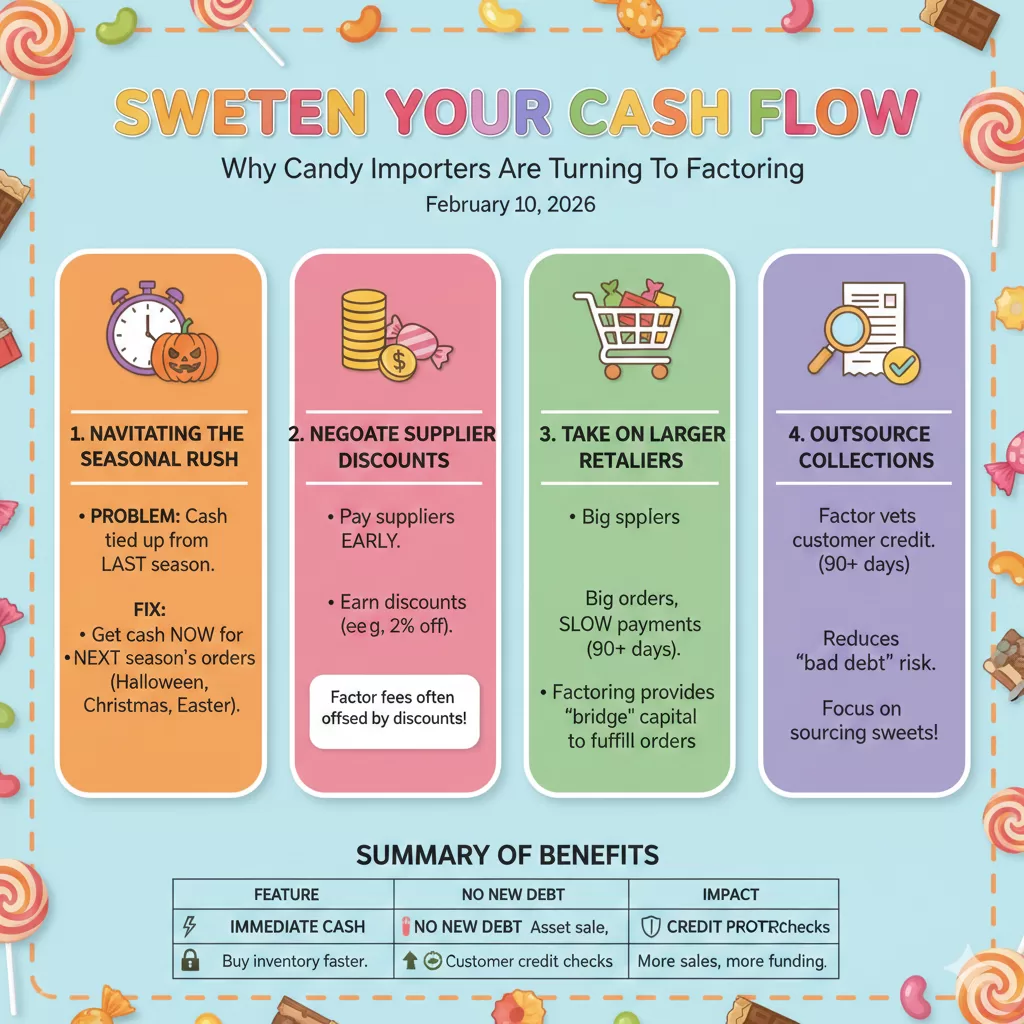
How Small Businesses can use Factoring as Bridge Financing

How Small Businesses can use Factoring as Bridge Financing

In the world of small business operations, managing cash flow can often be one of the biggest challenges. Business owners frequently find themselves in situations where they need immediate working capital to cover expenses, purchase inventory, pay employees, or invest in growth—long before customers pay their invoices. In such scenarios, accounts receivable factoring emerges as a powerful financial tool that can act as bridge financing, helping businesses stay afloat and even thrive.

In the world of small business operations, managing cash flow can often be one of the biggest challenges. Business owners frequently find themselves in situations where they need immediate working capital to cover expenses, purchase inventory, pay employees, or invest in growth—long before customers pay their invoices. In such scenarios, accounts receivable factoring emerges as a powerful financial tool that can act as bridge financing, helping businesses stay afloat and even thrive.

This article explores the concept of accounts receivable factoring, how it works, the benefits and risks, and why it can serve as an effective bridge financing solution for small businesses.


Understanding Accounts Receivable Factoring

Accounts receivable factoring, often simply referred to as “factoring,” is a financial transaction in which a business sells its accounts receivable (unpaid customer invoices) to a third party, known as a factor, at a discount. In return, the business receives immediate cash—typically 70% to 90% of the invoice value—while the factor takes on the responsibility of collecting payment from the customers.

How It Works

The factoring process generally follows these steps:

  1. Invoice Generation: A business provides goods or services to its customers and issues invoices, usually with payment terms of 30, 60, or 90 days.
  2. Sale to Factor: Instead of waiting for the invoice to be paid, the business sells the receivable to a factoring company.
  3. Advance Payment: The factoring company pays a portion of the invoice value upfront—known as the advance rate.
  4. Collection: The factor then collects the payment directly from the customer.
  5. Remainder Payment: Once the customer pays the invoice in full, the factor remits the remaining balance to the business, minus a factoring fee (typically 1% to 5%).

Bridge Financing Defined

Bridge financing refers to a short-term funding solution used to cover immediate cash flow needs until a business secures more permanent financing or receives expected income. It’s often used to “bridge the gap” between a financial need and a future event, such as:

  • Collecting on outstanding invoices
  • Receiving a bank loan
  • Closing a round of equity investment
  • Selling an asset or property

Bridge financing is crucial in time-sensitive situations and often carries higher costs or stricter terms due to the short-term risk for lenders.


Why Small Businesses Need Bridge Financing

Small businesses often experience erratic cash flows. Even profitable enterprises can run into short-term liquidity crunches. Here are some common scenarios where bridge financing is necessary:

  • Seasonal businesses ramping up for a busy season but needing cash to buy inventory.
  • Service providers waiting 30–90 days for customer payments while needing to pay employees weekly.
  • Manufacturers needing funds to cover production costs before receiving payment for completed goods.
  • Startups between investment rounds but needing funds to sustain operations.

For many small businesses, traditional loans or lines of credit may not be available, especially if they have limited credit history or lack collateral. This is where accounts receivable factoring can fill the void.


How Accounts Receivable Factoring Serves as Bridge Financing

Accounts receivable factoring fits the definition of bridge financing because it offers immediate liquidity based on income that is expected in the near future. Here’s how factoring acts as a bridge:

1. Accelerating Cash Flow

When a business issues an invoice with net 30, 60, or 90-day terms, the funds are essentially locked up for that duration. Factoring unlocks that value immediately, allowing the business to maintain operations or capitalize on opportunities without waiting.

2. Providing Short-Term Relief

Factoring provides funding until longer-term solutions are realized. For example, a business awaiting a loan approval can use factoring to maintain cash flow in the interim. Once the loan is secured, the business can rely less on factoring.

3. No New Debt Incurred

Bridge loans often come with interest and increase the business’s debt burden. Factoring, on the other hand, is not a loan—it’s a sale of assets. This makes it a particularly attractive option for businesses that want to preserve their balance sheets.

4. Flexibility and Scalability

Unlike bank loans with rigid terms, factoring is inherently flexible. The more invoices a business generates, the more capital it can access. This makes it an ideal bridge for growing businesses scaling their operations.


Advantages of Using Factoring as Bridge Financing

1. Quick Access to Cash

Factoring companies can often approve applications and release funds within a few days. This speed is critical in time-sensitive scenarios where traditional financing may take weeks or months.

2. Improved Cash Flow Management

By converting receivables into immediate cash, businesses can better plan and manage their operational expenses without delays.

3. No Credit Score Requirements

Factoring is based on the creditworthiness of a business’s customers—not the business itself. This makes it viable for new or struggling businesses with strong accounts receivable.

4. Support for Growth Opportunities

If a business receives a large new order but lacks the funds to fulfill it, factoring can provide the necessary capital. This allows businesses to say “yes” to growth rather than turning down opportunities due to cash constraints.

5. Outsourced Collections

Some factoring arrangements include credit checks and collections, saving the business time and resources in chasing down payments.


Disadvantages and Considerations

While factoring offers many benefits, it’s not without downsides. Business owners should consider the following:

1. Cost

Factoring fees can range from 1% to 5% or more per month. Over time, this can be more expensive than traditional financing.

2. Customer Perception

Some customers may view factoring negatively, especially if they are contacted by the factoring company. This can affect customer relationships if not handled properly.

3. Qualification Requirements

Not all invoices are eligible. Factoring companies typically only accept invoices from creditworthy customers, which may limit the amount of capital available.

4. Loss of Control

With non-recourse factoring, the factor assumes the risk of non-payment. However, with recourse factoring, the business must repay the advance if the customer fails to pay—introducing additional risk.


Types of Factoring Arrangements

Understanding the different types of factoring is important when considering it as bridge financing.

1. Recourse vs. Non-Recourse

  • Recourse Factoring: The business is liable if the customer doesn’t pay the invoice. This is cheaper but riskier.
  • Non-Recourse Factoring: The factor assumes the risk of non-payment, but charges higher fees.

2. Spot Factoring vs. Full-Service Factoring

  • Spot Factoring: The business factors a single invoice or a few invoices on a one-time basis.
  • Full-Service Factoring: The business enters into a long-term relationship with the factor, often factoring all receivables.

3. Disclosed vs. Undisclosed Factoring

  • Disclosed: The customer is informed that the invoice has been sold to a factor.
  • Undisclosed: The customer pays the business, which then remits payment to the factor (also known as invoice discounting).

Use Cases: Real-World Examples of Bridge Financing with Factoring

Example 1: A Seasonal Retailer

A toy store generates most of its revenue during the holiday season. In the fall, the business needs to order large quantities of inventory. Since customer invoices from previous sales are still unpaid, the retailer sells them to a factoring company and receives immediate funds to stock up. By December, customer payments are in, and the business is flush with cash again—making factoring a perfect seasonal bridge.

Example 2: A Construction Company

A small construction firm wins a contract to build a commercial property but needs to pay subcontractors and buy materials upfront. Bank financing is unavailable due to limited credit history. The company factors its receivables from a previous job, receives 85% of the invoice value in cash, and uses it to fund the new project while awaiting customer payment.

Example 3: A Tech Startup

A software development company with several corporate clients faces a funding gap between seed and Series A investment rounds. Though it has solid contracts and invoices pending payment in 60 days, it lacks cash for payroll and rent. Factoring those receivables helps the startup survive the interim without taking on high-interest loans or diluting equity.


When Factoring Is the Right Bridge Financing Option

Factoring may be a strategic bridge financing option if:

  • You have a predictable flow of accounts receivable.
  • Your customers are creditworthy and pay on time.
  • You need funds quickly to cover essential operations or fulfill new business.
  • You want to avoid additional debt or can’t qualify for a bank loan.
  • You are in a high-growth or seasonal industry that demands immediate working capital.

Selecting a Factoring Partner

Not all factoring companies are created equal. When choosing a partner, small businesses should consider:

  • Reputation and Experience: Choose a factor with industry experience and positive reviews.
  • Fee Structure: Understand all costs, including advance rate, factoring fee, and any hidden charges.
  • Recourse Terms: Know who is responsible in case of customer non-payment.
  • Flexibility: Can you factor only the invoices you choose?
  • Customer Service: Will the factor treat your customers professionally and protect your relationships?

Conclusion

Accounts receivable factoring is a powerful and flexible tool for small businesses facing short-term cash flow challenges. As a form of bridge financing, it offers quick access to working capital without the burden of debt or the wait for customer payments. While it comes at a cost and involves handing over some control, the benefits—especially for businesses with steady receivables and creditworthy customers—can far outweigh the downsides.

In an economic landscape where agility is often the key to survival and success, factoring can be the bridge that helps small businesses cross from financial uncertainty to stability and growth.

Contact Factoring Specialist, Chris Lehnes

Accounts Receivable Factoring
$100,000 to $30 Million
Quick AR Advances
No Long-Term Commitment
Non-recourse
Funding in about a week

We are a great match for businesses with traits such as:
Less than 2 years old
Negative Net Worth
Losses
Customer Concentrations
Weak Credit
Character Issues

Chris Lehnes | Factoring Specialist | 203-664-1535 | chris@chrislehnes.com

Spot Factoring – Obtain Cash Against a Single Invoice

Is your client experiencing a working capital shortfall, unable to meet immediate funding needs for essential expenditures. With Spot Factoring, they can quickly obtain funding against a single invoice, providing vital liquidity without ongoing factoring obligations.

Spot Factoring - Obtain Cash Against a Single Invoice

Program Overview

We fund tough deals:

  • Losses
  • Rapidly Growing
  • Highly Leveraged
  • Customer Concentrations
  • Out-of-favor Industries
  • Weak Personal Credit
  • Character Issues

In about a week, we provide qualified businesses the funds to meet working capital needs.

Contact me today to learn if your client is a fit.

Chris Lehnes
203-664-1535
chris@chrislehnes.com
A Recent Spot Factoring Deal

Factoring: Working Capital to Survive a Summer of Tariffs

Factoring: Working Capital to Survive a Summer of Tariffs

Are supply chain disruptions causing your clients to become hungry for working capital going into the summer months?

Factoring: Working Capital to Survive a Summer of Tariffs

Our non-recourse factoring program can quickly advance against Accounts Receivable to provide the funds needed to help absorb the impact of tariffs on all of America’s trading partners.

Factoring Program Overview:

We specialize in challenging deals :

  • New Businesses
  • Fast-Growing
  • Leveraged Balance Sheets
  • Reporting Losses
  • Customer Concentrations
  • Weak Personal Credit
  • Character Issues

Contact me today to learn if your client can use factoring to survive a summer of tariffs.

Factoring Specialist | Chris Lehnes | 203-664-1535 | chris@chrislehnes.com

Key Themes and Ideas:

  • The Problem: Supply chain disruptions and the impact of tariffs on “America’s trading partners” are creating a need for working capital among businesses.
  • The Solution: Factoring, specifically non-recourse factoring, is presented as a method to quickly acquire needed funds.
  • Mechanism: The factoring program involves advancing funds against a company’s accounts receivable.
  • Target Audience: The program is suitable for Manufacturers, Distributors, and most Service Businesses.
  • Flexibility and Accessibility: The program is designed to be flexible, with no long-term commitments, and is particularly focused on helping businesses facing challenges that might make traditional financing difficult.

Most Important Ideas/Facts:

  • Factoring as a Response to Tariffs: The core argument is that factoring can help businesses “absorb the impact of tariffs” by providing necessary working capital.
  • Non-Recourse Factoring: The program specifically offers non-recourse factoring, which means the factor assumes the risk of non-payment by the client’s customers. This is a significant point for businesses concerned about customer creditworthiness.
  • Range of Funding: The program offers funding from “$100,000 to $30 Million,” indicating it can cater to a variety of business sizes.
  • Focus on “Challenging Deals”: Lehnes explicitly specializes in and lists several types of “challenging deals” that they are willing to consider. This is a key differentiator and suggests the program is aimed at businesses that may not qualify for conventional loans.
  • Quick Access to Funds: The phrasing “quickly advance against Accounts Receivable” implies that accessing funds through this program is a relatively fast process.

Supporting Quotes:

  • “Are supply chain disruptions causing your clients to become hungry for working capital going into the summer months?” (Highlights the problem)
  • “Our non-recourse factoring program can quickly advance against Accounts Receivable to provide the funds needed to help absorb the impact of tariffs…” (Presents the solution and its mechanism)
  • “No Long-Term Commitments” (Emphasizes program flexibility)
  • “We specialize in challenging deals:” followed by a list of specific difficulties (Highlights the target demographic and program focus)
  • “…use factoring to survive a summer of tariffs.” (Reinforces the program’s purpose in the context of the prevailing economic climate)

Further Considerations:

While the source is brief, it effectively communicates the value proposition of Lehnes’ factoring program for businesses under pressure from tariffs and supply chain issues. It specifically targets companies facing financial or operational challenges, positioning factoring as an alternative funding source when traditional options may be unavailable. The emphasis on “non-recourse” is a crucial selling point for potential clients. The document is primarily promotional and would require further inquiry to understand the specific terms, fees, and application process.

Factoring: Working Capital to Survive a Summer of Tariffs Study Guide

Quiz

  1. What specific financial challenge facing clients does this article highlight as a potential reason to consider factoring?
  2. What type of factoring program is specifically mentioned in the article?
  3. What is the range of funding typically offered by this factoring program?
  4. Does this factoring program require long-term commitments?
  5. What types of businesses are listed as potential candidates for factoring?
  6. What specific types of “challenging deals” does this factoring specialist claim to handle?
  7. How can factoring help businesses absorb the impact of tariffs?
  8. What is the primary asset advanced against in this factoring program?
  9. Who is the contact person mentioned for inquiries about factoring?
  10. What is one example of a “challenging deal” related to a company’s financial statements?

Quiz Answer Key

  1. The article highlights supply chain disruptions causing clients to be in need of working capital, particularly going into the summer months.
  2. The article specifically mentions a non-recourse factoring program.
  3. The factoring program typically offers funding ranging from $100,000 to $30 million.
  4. No, this factoring program does not require long-term commitments.
  5. Manufacturers, Distributors, and most Service Businesses are listed as potential candidates.
  6. This specialist claims to handle challenging deals such as new businesses, fast-growing companies, leveraged balance sheets, reporting losses, customer concentrations, weak personal credit, and character issues.
  7. Factoring can help businesses absorb the impact of tariffs by providing quick access to funds advanced against Accounts Receivable.
  8. The primary asset advanced against in this factoring program is Accounts Receivable.
  9. The contact person mentioned for inquiries about factoring is Chris Lehnes.
  10. Reporting Losses is one example of a “challenging deal” related to a company’s financial statements.

Essay Questions

  1. Analyze how supply chain disruptions can create a need for working capital and explain how factoring can address this need, particularly in the context of increased tariffs.
  2. Compare and contrast recourse and non-recourse factoring based on the information provided in the article and discuss the potential advantages of a non-recourse program for businesses facing economic uncertainty.
  3. Discuss the types of businesses that are likely to benefit most from factoring, citing examples from the article, and explain why factoring might be a suitable solution for these specific business models.
  4. Evaluate the significance of a factoring specialist’s willingness and ability to handle “challenging deals.” How does this broaden the potential pool of businesses that can utilize factoring?
  5. Explain the process by which factoring provides working capital to a business, focusing on the role of Accounts Receivable in the transaction and how this differs from traditional forms of financing.

Glossary of Key Terms

  • Factoring: A financial transaction where a business sells its accounts receivable (invoices) to a third party (a factor) at a discount. This provides the business with immediate cash.
  • Working Capital: The difference between a company’s current assets (like cash and accounts receivable) and its current liabilities (like accounts payable). It’s the capital available to a business for its day-to-day operations.
  • Tariffs: Taxes imposed by a government on imported or exported goods. Tariffs can increase the cost of goods and impact supply chains.
  • Supply Chain Disruptions: Events that interrupt the normal flow of goods and services from the point of origin to the point of consumption. This can include issues with production, transportation, or sourcing of materials.
  • Accounts Receivable: Money owed to a business by its customers for goods or services that have been delivered or rendered but not yet paid for.
  • Non-recourse Factoring: A type of factoring where the factor assumes the risk of non-payment by the customer. If the customer fails to pay the invoice, the business that sold the invoice is generally not obligated to repay the factor.
  • Recourse Factoring: A type of factoring where the business that sells the invoice is still responsible for payment if the customer fails to pay. The factor has “recourse” back to the selling business.
  • Leveraged Balance Sheets: A balance sheet where a company has a significant amount of debt relative to its equity.
  • Customer Concentrations: A situation where a large portion of a company’s revenue comes from a small number of customers. This can be a risk if one of those major customers experiences financial difficulties or leaves.

AR Financing up to $30 Million – Factoring for your largest clients

Versant has access to the capital necessary to fund larger factoring transactions than many other funding sources. Large deals!

Versant has access to the capital necessary to fund larger factoring transactions than many other funding sources. Large Deals
Versant has access to the capital necessary to fund larger factoring transactions than many other funding sources.

Factoring Program Overview
$100,000 – $30 Million
Quick AR Advance
No Audits
No Financial Covenants
No Long-Term Commitment
Ideal for Companies with Strong Customers

We excel at LARGE & CHALLENGING deals :
Turnarounds
Historic Losses
Customer Concentrations
Poor Personal
Credit Character Issues

Versant focuses on the quality of your client’s accounts receivable, ignoring their financial condition.

This enables us to move quickly and fund qualified businesses including Manufacturers, Distributors and a wide variety of Service Businesses ( includes SaaS) in as few as 3-5 days.

Contact me today to learn if your client is a factoring fit

Factoring Study Guide – A Primer

Factoring Study Guide – A Primer

Factoring Study Guide - A Primer

Quiz

Instructions: Answer the following questions in 2-3 sentences each.

  1. What is the core function of factoring, and how does it provide working capital for businesses?
  2. Describe the difference between recourse and non-recourse factoring, and what impact does it have on risk for the client and the factor?
  3. How do notification and non-notification factoring differ, and which method is more commonly associated with businesses in weaker financial condition?
  4. What are some common reasons a business might choose to use a factoring facility?
  5. What is Versant’s typical advance rate, and what happens with the remaining percentage of the invoice when it’s paid?
  6. What is Versant’s typical factoring fee structure?
  7. What are the key differences in Versant’s approach compared to other factoring companies?
  8. What types of businesses are a good fit for factoring with Versant Funding?
  9. What are the steps Versant takes when underwriting a potential new client?
  10. What are two industries Versant does not typically factor?

Factoring Study Guide – A Primer

Answer Key

  1. Factoring is the sale of a company’s accounts receivable to a third party (the factor) in order to obtain immediate working capital. This provides businesses with cash flow by turning their invoices into cash, rather than waiting for customer payments.
  2. In recourse factoring, the client is responsible for repaying the advance if their customer does not pay. In non-recourse factoring, the factor assumes the credit risk of non-payment. Non-recourse factoring generally allows businesses in weaker financial situations to be accommodated.
  3. Notification factoring means the client’s customers are notified to pay the factor directly, often with instructions on the invoice. Non-notification factoring allows payments to be made to the client through a lockbox controlled by the factor. Notification factoring is generally better suited for businesses in weaker financial condition.
  4. Businesses might use factoring for project financing, business growth, acquisition financing, bridge financing, meeting working capital needs, taking advantage of supplier discounts, navigating a crisis, or as debtor-in-possession financing.
  5. Versant typically advances up to 75% of the face value of approved receivables. The remaining 25% of the invoice, minus fees, is paid to the client when the receivable is collected.
  6. Versant’s fee is typically 2.5% of the invoice amount for each month (or portion thereof) the receivable is outstanding.
  7. Versant focuses on larger and more complex deals, provides fast service (funding within a week), and assigns an Account Executive to each client. They focus more on the credit quality of the client’s customers, and less on the overall financial strength of the business itself.
  8. Versant is suitable for small to medium-sized businesses with $1-$50 million in annual revenue that need liquidity and may not qualify for traditional bank financing, particularly those with strong customers, even with a weak financial history.
  9. Versant reviews client’s accounts receivable aging, performs a public records search for UCC filings and liens, conducts a credit review of client’s customers, and verifies receivables by calling customers directly.
  10. Versant does not typically factor for the medical and construction industries.

Essay Questions

Factoring Study Guide – A Primer

Instructions: Write a well-organized essay for each question. Your essays should demonstrate your understanding of factoring concepts and your ability to connect these concepts to the source materials.

  1. Discuss the role of factoring as a financing tool for small to medium-sized businesses, comparing and contrasting it with traditional bank financing. Consider factors such as eligibility criteria, speed of funding, and cost.
  2. Explain the benefits of a non-recourse, full-notification factoring facility for a business that is experiencing financial difficulties and how this model operates from initial referral to final payment of the factored invoices.
  3. Analyze the competitive landscape of the factoring industry, discussing the differences between smaller and larger factors and Versant’s unique positioning within that landscape.
  4. Chris Lehnes emphasizes the importance of educating financial intermediaries rather than business owners about factoring. Discuss the reasoning behind this marketing strategy and how it contributes to Versant’s success.
  5. Assess how Versant’s factoring product and approach has proven beneficial for businesses facing various challenging scenarios (including the impacts of COVID-19) and the impact it has on improving their overall profitability.

Factoring Study Guide – A Primer

Accounts Receivable Factoring
$100,000 to $30 Million
Quick AR Advances
No Long-Term Commitment
Non-recourse
Funding in about a week

We are a great match for businesses with traits such as:
Less than 2 years old
Negative Net Worth
Losses
Customer Concentrations
Weak Credit
Character Issues

Chris Lehnes | Factoring Specialist | 203-664-1535 | chris@chrislehnes.com

Funding for Working Capital Shortfalls

Funding for Working Capital Shortfalls

Our accounts receivable factoring program can help businesses meet payroll or other essential obligations in as quick as a week.

Funding for Working Capital Shortfalls
Funding Working Capital Shortfalls

Factoring Program Overview

  • $100,000 to $30 Million
  • Competitive Advance Rates
  • Non-Recourse
  • No Audits
  • No Financial Covenants
  • Most businesses with strong customers eligible

We specialize in difficult deals:

  • Start-ups
  • Weak Balance Sheets
  • Historic Losses
  • Customer Concentrations
  • Poor Personal Credit
  • Character Issues
We focus on the quality of your client’s accounts receivable, ignoring their financial condition. This enables us to move quickly and fund qualified businesses including Manufacturers, Distributors and a wide variety of Service Businesses in as few as 3-5 days. Contact me today to learn if your client is a fit.
  • Beyond the Bank Loan: Using Factoring to Bridge Your Working Capital Gap

Your business is growing. Sales are up, your team is busy, and you just landed another major contract. On paper, you are highly profitable.

Yet, when you look at your bank balance today, the numbers tell a different story. You need to make payroll on Friday, purchase inventory for that new contract by Monday, and cover rent next week.

Funding for Working Capital Shortfalls

The money is “there”—it’s just sitting in your customers’ bank accounts instead of yours.

This is the classic working capital shortfall. It’s the painful gap between delivering your service and actually getting paid for it. In the B2B world, where Net-30, Net-60, or even Net-90 terms are standard, this gap can stifle growth and cause immense stress.

You shouldn’t have to stall your business growth while waiting for clients to pay. Fortunately, there is a proven financial tool designed specifically to bridge this gap: Invoice Factoring.

The Problem: The “Asset Rich, Cash Poor” Trap

Many strong businesses fail not because they lack customers, but because they lack liquidity.

When you offer credit terms to your clients, you are essentially acting as their bank with zero percent interest. While your invoice sits on their desk for 45 days awaiting processing, you still have immediate operational costs.

If you try to go to a traditional bank to bridge this gap, you often face a lengthy application process, demands for years of profitability statements, and rigid collateral requirements. If you need cash this week, a traditional bank loan rarely helps.

The Solution: Invoice Factoring Explained

Invoice factoring (also known as accounts receivable financing) is not a loan. It’s the sale of an asset.

Your unpaid invoices are assets. Factoring allows you to sell those outstanding invoices to a third party (a “factor”) for immediate cash. Instead of waiting weeks or months for payment, you get the majority of the invoice’s value within 24 to 48 hours.

How It Works in 3 Simple Steps:

  1. You Invoice Your Client: You deliver your goods or services as usual and send the invoice to your commercial (B2B) or government customer.
  2. You Receive an Advance: You submit a copy of that invoice to the factoring company. They verify it and deposit a large percentage of the invoice face value (typically 80% to 90%) directly into your bank account, usually within a day.
  3. The Final Settlement: Your customer pays the invoice directly to the factoring company according to their usual terms (e.g., in 45 days). The factor then sends you the remaining balance (the “rebate”), minus a small factoring fee for their service.

Why Growing Businesses Choose Factoring

Factoring is particularly valuable for businesses in industries like staffing, transportation, construction, manufacturing, and professional services. Here is why it often works better than traditional financing for working capital shortfalls:

  • Speed is Everything: The application process is fast, and funding happens within days, not months. When you have a payroll shortfall, speed is non-negotiable.
  • It’s Based on Your Customers’ Credit, Not Yours: Banks look heavily at your credit history. Factors are more interested in the creditworthiness of the customers paying the invoices. This makes it ideal for newer businesses or those with less-than-perfect credit.
  • No Debt on the Balance Sheet: Because it’s an asset sale, it doesn’t typically show up as long-term debt.
  • Unlimited Scalability: The amount of funding grows as your sales grow. The more you invoice creditworthy clients, the more funding you can access. You won’t “max out” a credit line just as you hit a growth spurt.
  • Outsourced Collections: The factoring company often handles the collections process, freeing up your team to focus on generating new business rather than chasing old payments.

Stop Waiting, Start Growing

A working capital shortfall is a speedbump on your road to growth. Don’t let slow-paying customers dictate the pace of your business expansion.

If you have solid B2B customers but shaky cash flow due to payment terms, factoring could be the tool that unlocks the capital you’ve already earned.

Are you tired of the 60-day waiting game? [Link to Contact Page/Consultation Request] Contact us today for a free analysis of how invoice factoring can stabilize your working capital.

Contact Factoring Specialist, Chris Lehnes

Factoring Proposal Issued – $10 Million Non-Recourse – Distributor

Proposal Issued – $10 Million Non-Recourse – Refinance – Distributor

Factoring Proposal Issued - $10 Million - Non Recourse - Distributor
Factoring Proposal Issued – $10 Million – Non Recourse – Distributor

This distributor of equipment has been mandated by lender to reduce exposure. We can fund in a week.

Accounts Receivable Factoring
$100,000 to $30 Million
Quick AR Advances
No Long-Term Commitment
Non-recourse
Funding in about a week

We are a great match for businesses with traits such as:
Less than 2 years old
Negative Net Worth
Losses
Customer Concentrations
Weak Credit
Character Issues

Chris Lehnes | Factoring Specialist | 203-664-1535 | chris@chrislehnes.com

Funding Wholesalers – Quick cash through factoring

Funding Wholesalers
Funding Wholesalers
Funding Wholesalers: Our accounts receivable factoring program can be an essential source of financing for wholesalers which may not qualify for traditional financing, but have a strong customer base.

By factoring, companies get quick access to the funds needed to continue to expand operations.

Accounts Receivable Factoring
$100,000 to $30 Million
No Long-Term Commitment
Non-recourse
Funding in about a week
Spot Factoring Available

We are a great match for businesses with traits such as:
Less than 2 years old
Negative Net Worth
Losses
Customer Concentrations
Weak Credit
Character Issues

We focus on the quality of your client’s accounts receivable, ignoring their financial condition. This enables us to move quickly and fund qualified businesses including Manufacturers, Distributors and a wide variety of Service Businesses (including SaaS) in as few as 3-5 days.

Contact me today to learn if your client is a factoring fit.
Connect with me on LinkedIn

Spot Factoring Proposal Issued – $1,300,000 – Single Invoice from Payroll Company

 Spot Factoring Proposal Issued – $1,300,000 | Single Invoice Due from Payroll Company

Spot Factoring Proposal Issued

This consulting firm has one large invoice due in 30 days, but needs cash now to meet obligations.

Connect with Factoring Specialist, Chris Lehnes

Accounts Receivable Factoring
$100,000 to $30 Million
Quick AR Advances
No Long-Term Commitment
Non-recourse
Funding in about a week

We are a great match for businesses with traits such as:
Less than 2 years old
Negative Net Worth
Losses
Customer Concentrations
Weak Credit
Character Issues

Chris Lehnes | Factoring Specialist | 203-664-1535 | chris@chrislehnes.com

Learn more about accounts receivable factoring

Factoring: Funding for Service Providers

Factoring offering can quickly fund Service Providers (as well as Manufacturers and Distributors) which do not meet traditional lending standards but have good quality accounts receivable outstanding.

Factoring: Funding for Service Providers

Program Overview

  • $100k to $30 Million
  • 75% advance against AR
  • Non-Recourse
  • No Audits or Covenants
  • No Long-Term Commitments
  • Spot Factoring Available
  • Great for bank declines

Think of me for Consultants, Staffing Companies or SaaS clients which need cash to meet their immediate goals.

Contact me at 203-664-1535 or clehnes@chrislehnes.com

Connect with Factoring Specialist, Chris Lehnes on LinkedIn