Middle East War Will Slow Global Economic Growth. The global economy, which had shown surprising resilience through early 2026, is now facing a significant “speed bump.” In its latest World Economic Outlook released today, April 14, 2026, the International Monetary Fund (IMF) warned that the escalating conflict in the Middle East—specifically the war involving Iran—has halted global momentum and forced a downgrade of growth projections.
The Numbers: A Downward Shift
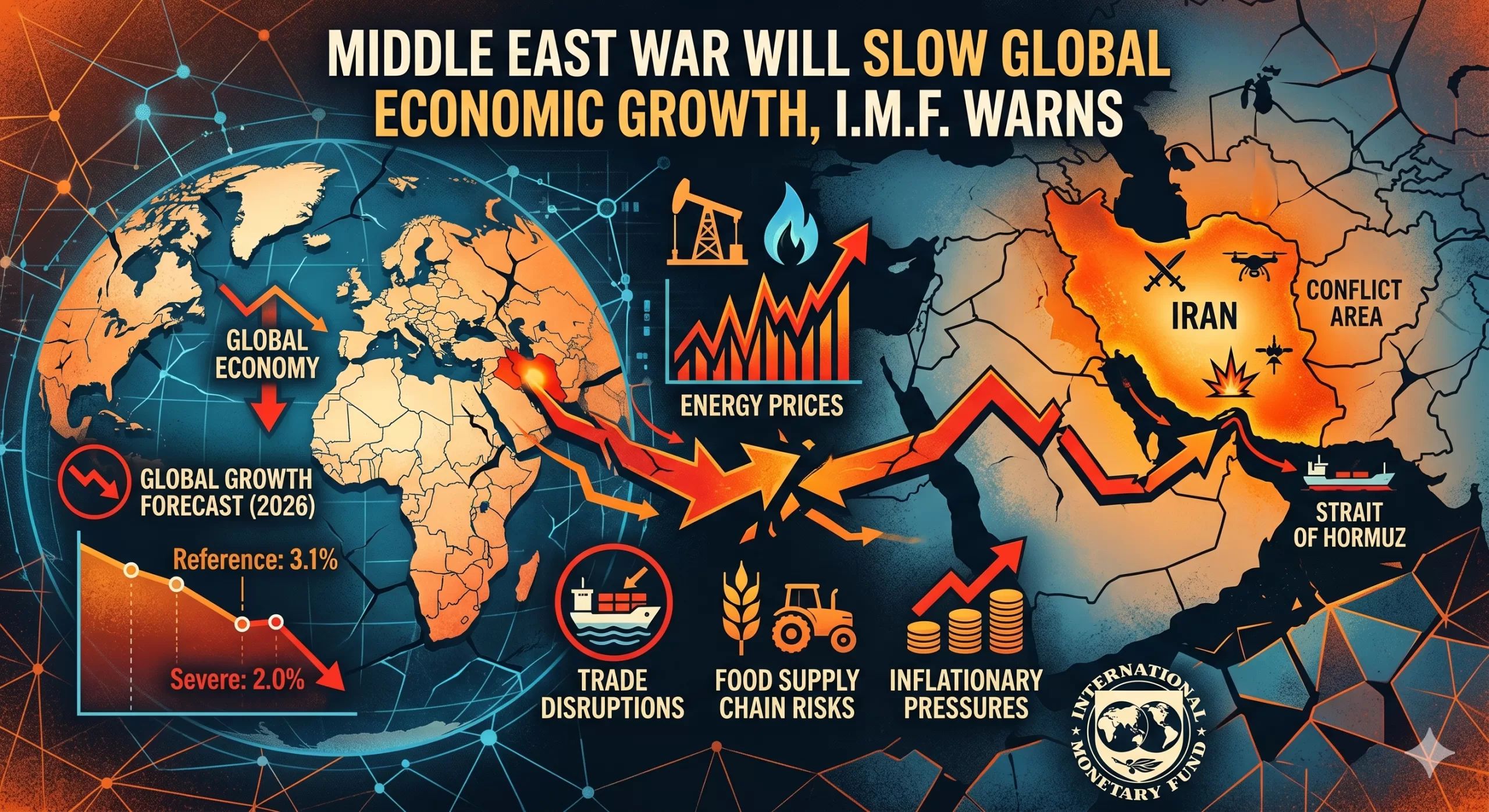
Just months ago, economists were optimistic that a tech-driven productivity boom and easing inflation would lead to a “soft landing.” However, the IMF has now lowered its 2026 global growth forecast to 3.1%, down from the 3.3% projected in January.
Scenario
2026 Growth Forecast
Key Drivers
Reference (Current)
3.1%
Short-lived conflict, oil averages $82/bbl
Adverse
2.5%
Prolonged disruption, oil stays at $100
Severe
2.0%
Extended war, oil spikes to $110+
The “Strait” Jacket on Energy
The primary engine of this slowdown is the volatility in energy markets. The closure of the Strait of Hormuz in March 2026—a chokepoint for 20% of the world’s oil and significant LNG volumes—sent Brent crude surging past $120 per barrel.
While prices have recently fluctuated around $98, the damage to supply chains is extensive. The IMF notes that:
Inflation is Rebounding: Global inflation expectations for 2026 have been revised up to 4.4%.
Fertilizer Shortages: With 20-30% of global fertilizer exports passing through the region, agricultural costs are rising, threatening food security in import-reliant nations.
Trade Disruptions: Maritime insurance premiums have skyrocketed, and major shipping routes are being rerouted, adding weeks to delivery times for consumer goods.
The Risk of a “Close Call” Recession
IMF Chief Economist Pierre-Olivier Gourinchas described the current situation as a pivot point. While the “Reference Scenario” assumes the war remains contained, a “Severe Scenario” could see growth drop to 2%—a level the IMF considers a global recession. This has only happened four times since 1980.
Central banks, which were expected to begin cutting interest rates this spring, may now be forced to keep rates “higher for longer” to combat the energy-driven inflationary spike.
“War in the Middle East has halted the global momentum we saw at the start of the year. The risks are now firmly tilted to the downside.”
— Pierre-Olivier Gourinchas, IMF Chief Economist
Looking Ahead
The path forward depends entirely on the duration of the hostilities. If a ceasefire holds and energy production in the Persian Gulf normalizes by mid-year, the IMF believes the global economy can avoid a total contraction. However, for emerging markets and developing economies, the impact is expected to be twice as severe as that on advanced nations, potentially undoing years of post-pandemic recovery.
A potential armed conflict between the United States and Iran would have global implications—but few discussions consider how such a war would reverberate through America’s economic backbone: its small businesses. While multinational corporations might weather geopolitical storms through diversified assets and global reserves, small businesses, which account for 99.9% of all U.S. businesses and employ over 61 million Americans, are uniquely vulnerable. This article explores the multifaceted ways a U.S.-Iran war could affect small businesses, drawing on historical precedents, economic principles, and sector-specific analyses.
1. Historical and Political Context
To understand the potential impact, we must first explore the complex relationship between the U.S. and Iran. Tensions date back to the 1979 Iranian Revolution and the subsequent hostage crisis. In the decades since, the U.S. has imposed economic sanctions, engaged in cyber warfare, and supported regional rivals like Saudi Arabia and Israel. Iran, meanwhile, has expanded its influence in the Middle East via proxy groups and oil diplomacy.
Key flashpoints include:
The U.S. withdrawal from the Iran nuclear deal (JCPOA) in 2018.
The killing of Iranian General Qassem Soleimani in 2020.
Iranian attacks on commercial tankers and U.S. interests in the region.
These confrontations illustrate how quickly tensions can escalate. While no full-scale war has occurred, the threat of one is ever-present, especially with increasing Israeli-Iranian hostilities and growing regional instability.
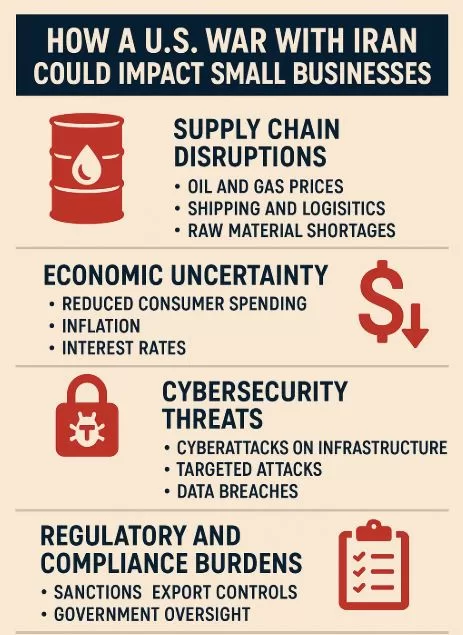
2. Supply Chain Disruptions
a. Oil and Gas Prices
Iran sits on the Strait of Hormuz, through which about 20% of the world’s oil passes. A war could close or restrict this vital chokepoint, sending oil prices skyrocketing.
Impact on Small Businesses:
Transportation-dependent sectors (e.g., trucking, delivery, construction) would see cost spikes.
Retailers would face increased prices for shipped goods.
Restaurant owners and grocers could be affected by the rise in food distribution costs.
b. Shipping and Logistics
Beyond oil, global shipping routes could be affected. Insurance premiums on Middle Eastern shipping lanes would spike, driving up the cost of imported goods.
Affected Businesses:
Import/export companies.
E-commerce retailers dependent on foreign goods.
Wholesalers and manufacturers relying on overseas parts.
c. Raw Material Shortages
Iran is a major producer of petroleum-based products, metals, and agricultural goods. Even businesses not directly linked to Iran could face higher prices as global competition intensifies.
3. Economic Uncertainty and Consumer Confidence
War introduces a climate of fear and hesitation. Stock markets become volatile, inflation surges, and consumers begin tightening their belts.
With rising oil prices and strained supply chains, inflation could rise sharply. The Federal Reserve may raise interest rates to counter inflation, making credit more expensive.
Consequences for Small Businesses:
Increased cost of capital.
More expensive business loans and lines of credit.
Delayed expansion plans and hiring freezes.
4. Labor Market Volatility
A military conflict may require mobilization or extended military presence overseas, directly affecting the labor pool.
a. Deployment of Reservists and Guardsmen
Thousands of reservists—many of whom are small business owners or employees—could be called to duty.
Business Impact:
Staffing shortages.
Disruption of operations in family-run or closely held companies.
b. Decreased Workforce Productivity
Stress, uncertainty, and rising costs can affect employee morale and productivity. Employees with family in the military may take leave or need additional support.
5. Cybersecurity Threats
Iran has invested heavily in cyber capabilities and has previously launched cyberattacks against U.S. banks, infrastructure, and private firms.
a. Cyberattacks on Infrastructure
Attacks on utilities or internet providers can disable core business functions. Power outages, data loss, and communication breakdowns could paralyze operations.
b. Targeted Attacks on Small Businesses
Smaller enterprises, often lacking sophisticated cybersecurity, are easier targets.
Common Threats:
Ransomware.
Phishing scams.
Data breaches.
Necessary Precautions:
Cyber insurance.
Multi-factor authentication.
Routine cybersecurity audits.
6. Regulatory and Compliance Burdens
a. Sanctions and Export Controls
War with Iran would result in a dramatic escalation of economic sanctions. Small businesses engaged in international trade must navigate new compliance rules.
In wartime, industries may see increased federal oversight or even temporary commandeering of supplies (e.g., defense-related manufacturing).
Examples:
Defense Production Act applications.
Mandatory reporting of inventory or raw materials.
7. Regional and Domestic Instability
a. Civil Unrest
Wartime conditions often lead to social and political unrest, particularly in urban areas. Protests, counter-protests, and acts of domestic terrorism may arise.
Business Concerns:
Property damage from riots.
Increased insurance costs.
Reduced foot traffic due to fear or curfews.
b. Anti-Muslim Sentiment and Discrimination
A conflict with Iran, a Muslim-majority nation, could lead to a rise in Islamophobia. Businesses owned by Muslim Americans may face discrimination or violence.
Actions to Consider:
Community outreach.
PR strategies promoting inclusivity.
Coordination with local law enforcement.
8. Industry-Specific Impacts
a. Energy Sector
Winners:
Domestic oil and gas producers.
Renewable energy companies as alternatives.
Losers:
Gas stations, transport companies, and any energy-intensive industries.
b. Manufacturing
Manufacturers dependent on petrochemicals or global supply chains may face surging costs and delays.
c. Agriculture
Increased fuel and fertilizer costs could hurt farmers, which trickles down to grocery stores and food distributors.
d. Retail and Hospitality
Retail sales and travel often decline during wartime, especially if consumer sentiment drops or terrorism fears rise.
Examples:
Drop in international tourism.
Delays in new store openings or renovations.
Losses due to canceled events and bookings.
9. Insurance and Legal Considerations
a. Business Interruption Insurance
Most standard policies do not cover war-related losses. Small business owners must review coverage details closely.
b. Legal Risks
If the government issues emergency orders (e.g., mandatory rationing, requisitions), businesses may be forced into difficult legal terrain.
Risk Mitigation:
Legal counsel reviews of contracts and policies.
Clauses related to force majeure.
10. Government Relief and Response
a. Potential Relief Programs
If war leads to a recession or mass disruptions, federal aid could mirror COVID-era programs like:
Paycheck Protection Program (PPP).
Economic Injury Disaster Loans (EIDL).
But challenges include:
Delayed rollout.
Eligibility confusion.
Competitive application processes.
b. Procurement Opportunities
Defense spending rises during war. Small businesses in construction, logistics, security, and tech may win government contracts.
Tips:
Register with SAM.gov.
Understand FAR (Federal Acquisition Regulations).
Develop relationships with prime contractors.
11. Strategic Responses for Small Businesses
a. Financial Readiness
Build cash reserves.
Lock in fixed-rate loans now.
Diversify revenue streams.
b. Supply Chain Resilience
Source domestically when possible.
Build backup supplier relationships.
Use supply chain monitoring tools.
c. Cyber Preparedness
Implement cybersecurity best practices.
Train employees on phishing awareness.
Partner with managed IT providers.
d. Scenario Planning
Conduct risk assessments.
Develop contingency plans.
Review insurance and legal protections.
Iran War Conclusions
A U.S. war with Iran would usher in economic turbulence, energy shocks, regulatory upheaval, and societal unease—each with direct and indirect consequences for small businesses. From logistics and fuel costs to consumer psychology and cybersecurity, the effects would be widespread and unpredictable.
While small businesses can’t control geopolitical events, they can control their preparedness. By staying informed, adapting quickly, and building resilient business models, small enterprises can navigate even the stormiest geopolitical waters.