Quick cash for small businesses using AR Factoring
Running a small business comes with a host of financial challenges, and cash flow management is often at the top of the list. Many businesses struggle with delayed payments from customers, leading to cash shortages that can hinder operations, payroll, and growth. One effective financial solution to this problem is accounts receivable factoring.
What Is Accounts Receivable Factoring?
A financing method where a business sells its outstanding invoices to a company at a discount. In return, the business receives an immediate cash advance—typically 70% to 90% of the invoice value. Once the customer pays the invoice, the factoring company releases the remaining balance, minus a small fee.
Unlike traditional bank loans, factoring does not create debt on the company’s balance sheet. Instead, it allows businesses to leverage their existing receivables to maintain a steady cash flow.
How Factoring Can Benefit Your Small Business
1. Improved Cash Flow
One of the primary advantages of factoring is that it provides businesses with immediate access to working capital. Instead of waiting 30, 60, or even 90 days for customers to pay their invoices, businesses can convert receivables into cash quickly.
2. Easier Access to Funding
Unlike loans or lines of credit that require extensive financial documentation and strong credit history, factoring is based primarily on the creditworthiness of your customers. This makes it a viable option for startups and small businesses that may not qualify for traditional financing.
3. No Additional Debt
Because factoring involves selling an asset (accounts receivable) rather than borrowing money, it does not add debt to your balance sheet. This keeps financial ratios healthy and preserves borrowing capacity for other needs.
4. Outsourced Accounts Receivable Management
Many factoring companies offer additional services such as credit checks on customers and collections management. This can save small businesses time and effort, allowing them to focus on operations and growth rather than chasing payments.
5. Flexibility and Scalability
Factoring is not a one-size-fits-all solution; businesses can choose which invoices to factor based on their cash flow needs. Moreover, as a company grows and generates more invoices, the amount of funding available through factoring increases, making it a scalable financing option.
Is Factoring Right for Your Business?
Can be a valuable tool for businesses that:
Experience cash flow gaps due to slow-paying customers.
Have a strong volume of receivables from creditworthy clients.
Need fast access to working capital without taking on additional debt.
Want to outsource invoice collection and credit management.
However, it’s important to consider the costs involved. Fees can range from 1% to 5% per month, depending on factors like invoice value, customer creditworthiness, and industry risk. Businesses should compare different factoring companies to find the best terms and ensure that factoring aligns with their financial strategy.
Lastly…
It is a powerful financial tool that can help small businesses bridge cash flow gaps, reduce financial strain, and fuel growth. By leveraging unpaid invoices, businesses can access the capital they need to stay competitive without the burden of debt. For many small business owners, factoring can be the key to maintaining stability and seizing new opportunities in an unpredictable economic landscape.
Accounts Receivable Factoring $100,000 to $30 Million Quick AR Advances No Long-Term Commitment Non-recourse Funding in about a week
We are a great match for businesses with traits such as: Less than 2 years old Negative Net Worth Losses Customer Concentrations Weak Credit Character Issues
Chris Lehnes | Factoring Specialist | 203-664-1535 | chris@chrislehnes.com
The presentation targets individuals who work with businesses that may have difficulty securing traditional financing. The core message is that factoring provides a viable alternative for companies with strong receivables (invoices owed by their customers), especially those who don’t qualify for conventional loans. Key Themes and Concepts: Factoring Defined: Factoring is presented as the sale of a company’s accounts receivable to obtain working capital, not a loan. Versant offers a “non-recourse full notification” program. This means: Sale of Receivables: Versant buys the receivables, taking ownership of the debt owed to the client. Notification: The client’s customers (account debtors) are notified to pay Versant directly. Non-Recourse: Versant assumes the credit risk if the client’s customers fail to pay (except in cases of defective product or service). “We also take on all the credit risk of non-payment of those customers.” Why Factoring? Factoring is positioned as a solution for businesses that are “unbanked” or have been turned down by traditional lenders (banks) and often even by other factoring companies. “All of our clients in person have been turned down by banks and in many cases turned down by other factoring companies.” This typically includes companies that are: New or rapidly growing. Seasonal with fluctuating revenues. Experiencing losses or financial difficulties. Have violated bank covenants. Versant’s Ideal Client: Versant focuses on small to medium-sized companies with revenues between $1 million and $100 million. A key requirement is that their clients have “good, creditworthy” customers (account debtors). “Our analysis is on who our clients are selling to… it’s important to us that our clients customers be strong.” Customers should be corporations, municipalities, or government agencies. Versant avoids medical and construction industries due to their specialized nature. The Factoring Process: Invoice Submission: The client submits invoices to Versant for funding. Verification: Versant verifies the invoices by contacting the customer. Advance: Versant advances 75% of the face value of the invoice to the client. “We’re typically verifying by contacting the customer confirming what the invoice tells us is true and then immediately wiring seventy-five percent of the face value that invoice to our customer” Customer Payment: The client’s customer pays Versant directly. Rebate & Fees: Versant pays the remaining 25% (the “rebate”) to the client, less their fee which accrues at a rate of 2.5% for the first 30 days and .84% for each additional 10 day period thereafter. “When we receive payment well now we fold our client that remaining twenty-five percent we call it the rebate it’s the twenty-five percent we didn’t advance initially when we we funded on that invoice less our fee” Versant’s Competitive Advantages: Flexibility: Versant can handle deals that are too difficult for other factors, including those turned down by banks and other factors. “Versant’s niche is really for the most part deals that can’t get done elsewhere.” Speed: Versant can fund clients very quickly, potentially within five days of introduction if the initial information is accurate. “we can go from an introduction to a client to funding five days later” Personalized Service: Each client is assigned an account executive for personalized support and communication. Technology: Versant provides clients with online access to data about their receivables, promoting better receivables management. Non-Recourse: No personal guarantees are required from the client’s principals, which is a key differentiator from other lenders. “we do not require any financial statements…we do not require personal guarantees” Use of Factoring Proceeds: Factoring can be used for various purposes, including funding projects, fueling growth, capitalizing on inventory discounts, or managing business crises. “we’re not going to monitor we’re not going to track how our clients use the factoring proceeds but it can be any of these these bridge needs” Customer Notification: Versant uses full notification, meaning that the client’s customers are notified to pay Versant directly. Versant argues that it is a normal practice for many companies, especially the large ones that are often their clients’ customers. “factoring just isn’t the red flag that they expect…particularly when a client of ours is selling to one of the big guys…those companies are paying factors like crazy right now” Factoring’s Impact on Profit: Factoring can increase a business’s profits by allowing them to pursue incremental sales that their lack of cash flow might have prevented. “factoring will allow a business to do more revenue than it’s doing today” **podcast created with AI Assistance (https://notebooklm.google)
Instructions: Answer the following questions in 2-3 sentences each.
What is the core function of factoring, and how does it provide working capital for businesses?
Describe the difference between recourse and non-recourse factoring, and what impact does it have on risk for the client and the factor?
How do notification and non-notification factoring differ, and which method is more commonly associated with businesses in weaker financial condition?
What are some common reasons a business might choose to use a factoring facility?
What is Versant’s typical advance rate, and what happens with the remaining percentage of the invoice when it’s paid?
What is Versant’s typical factoring fee structure?
What are the key differences in Versant’s approach compared to other factoring companies?
What types of businesses are a good fit for factoring with Versant Funding?
What are the steps Versant takes when underwriting a potential new client?
What are two industries Versant does not typically factor?
Factoring Study Guide – A Primer
Answer Key
Factoring is the sale of a company’s accounts receivable to a third party (the factor) in order to obtain immediate working capital. This provides businesses with cash flow by turning their invoices into cash, rather than waiting for customer payments.
In recourse factoring, the client is responsible for repaying the advance if their customer does not pay. In non-recourse factoring, the factor assumes the credit risk of non-payment. Non-recourse factoring generally allows businesses in weaker financial situations to be accommodated.
Notification factoring means the client’s customers are notified to pay the factor directly, often with instructions on the invoice. Non-notification factoring allows payments to be made to the client through a lockbox controlled by the factor. Notification factoring is generally better suited for businesses in weaker financial condition.
Businesses might use factoring for project financing, business growth, acquisition financing, bridge financing, meeting working capital needs, taking advantage of supplier discounts, navigating a crisis, or as debtor-in-possession financing.
Versant typically advances up to 75% of the face value of approved receivables. The remaining 25% of the invoice, minus fees, is paid to the client when the receivable is collected.
Versant’s fee is typically 2.5% of the invoice amount for each month (or portion thereof) the receivable is outstanding.
Versant focuses on larger and more complex deals, provides fast service (funding within a week), and assigns an Account Executive to each client. They focus more on the credit quality of the client’s customers, and less on the overall financial strength of the business itself.
Versant is suitable for small to medium-sized businesses with $1-$50 million in annual revenue that need liquidity and may not qualify for traditional bank financing, particularly those with strong customers, even with a weak financial history.
Versant reviews client’s accounts receivable aging, performs a public records search for UCC filings and liens, conducts a credit review of client’s customers, and verifies receivables by calling customers directly.
Versant does not typically factor for the medical and construction industries.
Essay Questions
Factoring Study Guide – A Primer
Instructions: Write a well-organized essay for each question. Your essays should demonstrate your understanding of factoring concepts and your ability to connect these concepts to the source materials.
Discuss the role of factoring as a financing tool for small to medium-sized businesses, comparing and contrasting it with traditional bank financing. Consider factors such as eligibility criteria, speed of funding, and cost.
Explain the benefits of a non-recourse, full-notification factoring facility for a business that is experiencing financial difficulties and how this model operates from initial referral to final payment of the factored invoices.
Analyze the competitive landscape of the factoring industry, discussing the differences between smaller and larger factors and Versant’s unique positioning within that landscape.
Chris Lehnes emphasizes the importance of educating financial intermediaries rather than business owners about factoring. Discuss the reasoning behind this marketing strategy and how it contributes to Versant’s success.
Assess how Versant’s factoring product and approach has proven beneficial for businesses facing various challenging scenarios (including the impacts of COVID-19) and the impact it has on improving their overall profitability.
Accounts Receivable Factoring $100,000 to $30 Million Quick AR Advances No Long-Term Commitment Non-recourse Funding in about a week
We are a great match for businesses with traits such as: Less than 2 years old Negative Net Worth Losses Customer Concentrations Weak Credit Character Issues
Chris Lehnes | Factoring Specialist | 203-664-1535 | chris@chrislehnes.com
New Podcast Episode – Factoring – A Vital Source of Capital for Small Businesses
RSS Error: Retrieved unsupported status code "404"
Small Businesses face numerous challenges, among them is the ability to have access to sufficient working capital to meet the ongoing cash obligations of the business. While this need can be met by a traditional line of credit for businesses which meet all traditional bank lending criteria, many businesses do not meet those standards and require an alternative. One such option is accounts receivable factoring. With factoring, a B2B or B2G business can quickly convert their accounts receivable into cash. Many factoring companies focus exclusively on the credit quality of the customer base and ignore the financial condition of the business and the personal financial condition of the owners. This works well for businesses with traits such as: Losses Rapidly Growing Highly Leveraged Customer Concentrations Out-of-favor Industries Weak Personal Credit Character Issues Listen to this podcast to gain a greater understanding of the types of businesses which can benefit from this form of financing. To learn if you are a fit contact me today:
Instructions: Answer the following questions in 2-3 sentences each.
What is the core function of factoring, and how does it provide working capital for businesses?
Describe the difference between recourse and non-recourse, and what impact does it have on risk for the client and the factor?
How do notification and non-notification differ, and which method is more commonly associated with businesses in weaker financial condition?
What are some common reasons a business might choose to use a factoring facility?
What is Versant’s typical advance rate, and what happens with the remaining percentage of the invoice when it’s paid?
What is Versant’s typical fee structure?
What are the key differences in Versant’s approach compared to other factoring companies?
What types of businesses are a good fit with Versant Funding?
What are the steps Versant takes when underwriting a potential new client?
What are two industries Versant does not typically factor?
Answer Key
Factoring is the sale of a company’s accounts receivable to a third party (the factor) in order to obtain immediate working capital. This provides businesses with cash flow by turning their invoices into cash, rather than waiting for customer payments.
In recourse , the client is responsible for repaying the advance if their customer does not pay. In non-recourse factoring, the factor assumes the credit risk of non-payment. Non-recourse generally allows businesses in weaker financial situations to be accommodated.
Notification means the client’s customers are notified to pay the factor directly, often with instructions on the invoice. Non-notification allows payments to be made to the client through a lockbox controlled by the factor. Notification factoring is generally better suited for businesses in weaker financial condition.
Businesses might use for project financing, business growth, acquisition financing, bridge financing, meeting working capital needs, taking advantage of supplier discounts, navigating a crisis, or as debtor-in-possession financing.
Versant typically advances up to 75% of the face value of approved receivables. The remaining 25% of the invoice, minus fees, is paid to the client when the receivable is collected.
Versant’s fee is typically 2.5% of the invoice amount for each month (or portion thereof) the receivable is outstanding.
Versant focuses on larger and more complex deals, provides fast service (funding within a week), and assigns an Account Executive to each client. They focus more on the credit quality of the client’s customers, and less on the overall financial strength of the business itself.
Versant is suitable for small to medium-sized businesses with $1-$50 million in annual revenue that need liquidity and may not qualify for traditional bank financing, particularly those with strong customers, even with a weak financial history.
Versant reviews client’s accounts receivable aging, performs a public records search for UCC filings and liens, conducts a credit review of client’s customers, and verifies receivables by calling customers directly.
Versant does not typically factor for the medical and construction industries.
Essay Questions
Instructions: Write a well-organized essay for each question. Your essays should demonstrate your understanding of factoring concepts and your ability to connect these concepts to the source materials.
Discuss the role of factoring as a financing tool for small to medium-sized businesses, comparing and contrasting it with traditional bank financing. Consider factors such as eligibility criteria, speed of funding, and cost.
Explain the benefits of a non-recourse, full-notification factoring facility for a business that is experiencing financial difficulties and how this model operates from initial referral to final payment of the factored invoices.
Analyze the competitive landscape of the factoring industry, discussing the differences between smaller and larger factors and Versant’s unique positioning within that landscape.
Chris Lehnes emphasizes the importance of educating financial intermediaries rather than business owners about factoring. Discuss the reasoning behind this marketing strategy and how it contributes to Versant’s success.
Assess how Versant’s product and approach has proven beneficial for businesses facing various challenging scenarios (including the impacts of COVID-19) and the impact it has on improving their overall profitability.
Glossary
Account Debtor: The customer of the factoring client who owes money for goods or services rendered; also sometimes referred to as a “customer client.”
Advance Rate: The percentage of the face value of an invoice that a factor provides to the client upfront.
Bridge Financing: Short-term financing used to cover immediate cash needs while a company transitions to another source of funding or a more stable state.
Client: In factoring, the business that is selling its accounts receivable to a factor; also referred to as “seller of receivables.”
Debtor-in-Possession (DIP) Financing: A type of financing provided to a company undergoing Chapter 11 bankruptcy, enabling them to continue operations.
Discount/Fee: The amount a factor charges for providing financing, often expressed as a percentage of the invoice amount, generally applied monthly (or part thereof) that the invoice is outstanding.
Factor: The financial company that purchases accounts receivable from businesses; also referred to as “purchaser of receivables.”
Factoring Agreement: The legal agreement between a factor and a client outlining the terms and conditions of their relationship, including the fees, term of the agreement, and other obligations.
Factoring Facility: The overall agreement and set-up for the sale of invoices between the client and the factor.
Factoring Volume: The total value of accounts receivable factored, usually expressed in monthly, quarterly, or annual terms.
Full Notification Factoring: A type of factoring where the client’s customers are notified to pay the factor directly.
Non-Notification Factoring: A type of factoring where the client’s customers are not notified of the factoring relationship and continue to pay the client, who in turn, settles with the factor.
Non-Recourse Factoring: A type of factoring where the factor assumes the credit risk of non-payment by the client’s customer.
Performance Guarantee: A guarantee provided by the client to the factor, assuring that the invoiced goods/services were provided correctly and as ordered, not a guarantee of payment for the underlying invoices.
Purchase and Sale Agreement: A contract that documents the sale of a batch of invoices from a client to the factor.
Recourse Factoring: A type of where the client is liable to the factor if their customer fails to pay the invoice.
Rebate: The remaining percentage of an invoice amount (after the initial advance) that is paid to the client by the factor after the customer has paid the invoice (less the factor’s fee).
Receivables: Invoices representing money owed to a company for goods or services delivered but not yet paid for; also referred to as “accounts receivable.”
Accounts Receivable Factoring $100,000 to $30 Million Quick AR Advances No Long-Term Commitment Non-recourse Funding in about a week
We are a great match for businesses with traits such as: Less than 2 years old Negative Net Worth Losses Customer Concentrations Weak Credit Character Issues
Chris Lehnes | Factoring Specialist | 203-664-1535 | chris@chrislehnes.com
Our accounts receivable factoring program can help businesses meet payroll or other essential obligations in as quick as a week.
Funding Working Capital Shortfalls
Factoring Program Overview
$100,000 to $30 Million
Competitive Advance Rates
Non-Recourse
No Audits
No Financial Covenants
Most businesses with strong customers eligible
We specialize in difficult deals:
Start-ups
Weak Balance Sheets
Historic Losses
Customer Concentrations
Poor Personal Credit
Character Issues
We focus on the quality of your client’s accounts receivable, ignoring their financial condition. This enables us to move quickly and fund qualified businesses including Manufacturers, Distributors and a wide variety of Service Businesses in as few as 3-5 days. Contact me today to learn if your client is a fit.
Beyond the Bank Loan: Using Factoring to Bridge Your Working Capital Gap
Your business is growing. Sales are up, your team is busy, and you just landed another major contract. On paper, you are highly profitable.
Yet, when you look at your bank balance today, the numbers tell a different story. You need to make payroll on Friday, purchase inventory for that new contract by Monday, and cover rent next week.
The money is “there”—it’s just sitting in your customers’ bank accounts instead of yours.
This is the classic working capital shortfall. It’s the painful gap between delivering your service and actually getting paid for it. In the B2B world, where Net-30, Net-60, or even Net-90 terms are standard, this gap can stifle growth and cause immense stress.
You shouldn’t have to stall your business growth while waiting for clients to pay. Fortunately, there is a proven financial tool designed specifically to bridge this gap: Invoice Factoring.
The Problem: The “Asset Rich, Cash Poor” Trap
Many strong businesses fail not because they lack customers, but because they lack liquidity.
When you offer credit terms to your clients, you are essentially acting as their bank with zero percent interest. While your invoice sits on their desk for 45 days awaiting processing, you still have immediate operational costs.
If you try to go to a traditional bank to bridge this gap, you often face a lengthy application process, demands for years of profitability statements, and rigid collateral requirements. If you need cash this week, a traditional bank loan rarely helps.
The Solution: Invoice Factoring Explained
Invoice factoring (also known as accounts receivable financing) is not a loan. It’s the sale of an asset.
Your unpaid invoices are assets. Factoring allows you to sell those outstanding invoices to a third party (a “factor”) for immediate cash. Instead of waiting weeks or months for payment, you get the majority of the invoice’s value within 24 to 48 hours.
How It Works in 3 Simple Steps:
You Invoice Your Client: You deliver your goods or services as usual and send the invoice to your commercial (B2B) or government customer.
You Receive an Advance: You submit a copy of that invoice to the factoring company. They verify it and deposit a large percentage of the invoice face value (typically 80% to 90%) directly into your bank account, usually within a day.
The Final Settlement: Your customer pays the invoice directly to the factoring company according to their usual terms (e.g., in 45 days). The factor then sends you the remaining balance (the “rebate”), minus a small factoring fee for their service.
Why Growing Businesses Choose Factoring
Factoring is particularly valuable for businesses in industries like staffing, transportation, construction, manufacturing, and professional services. Here is why it often works better than traditional financing for working capital shortfalls:
Speed is Everything: The application process is fast, and funding happens within days, not months. When you have a payroll shortfall, speed is non-negotiable.
It’s Based on Your Customers’ Credit, Not Yours: Banks look heavily at your credit history. Factors are more interested in the creditworthiness of the customers paying the invoices. This makes it ideal for newer businesses or those with less-than-perfect credit.
No Debt on the Balance Sheet: Because it’s an asset sale, it doesn’t typically show up as long-term debt.
Unlimited Scalability: The amount of funding grows as your sales grow. The more you invoice creditworthy clients, the more funding you can access. You won’t “max out” a credit line just as you hit a growth spurt.
Outsourced Collections: The factoring company often handles the collections process, freeing up your team to focus on generating new business rather than chasing old payments.
Stop Waiting, Start Growing
A working capital shortfall is a speedbump on your road to growth. Don’t let slow-paying customers dictate the pace of your business expansion.
If you have solid B2B customers but shaky cash flow due to payment terms, factoring could be the tool that unlocks the capital you’ve already earned.
Are you tired of the 60-day waiting game? [Link to Contact Page/Consultation Request] Contact us today for a free analysis of how invoice factoring can stabilize your working capital.
Advantages of Accounts Receivable Factoring in Q4 2024
Accounts receivable factoring has long been a strategic financing tool for businesses seeking to improve cash flow and support operational growth. As we approach Q4 2024, the relevance of factoring remains strong due to economic trends, supply chain dynamics, and evolving market demands. Here are the primary advantages of factoring in the current climate:
1. Immediate Access to Cash Flow
Accounts receivable factoring allows businesses to convert outstanding invoices into cash almost immediately, bypassing the usual 30-90 day payment terms. This liquidity is particularly valuable in Q4, as companies often face increased demand, seasonal expenses, or year-end financial obligations.
2. Flexible and Accessible Financing
Unlike traditional loans, factoring does not require a lengthy approval process or stringent credit checks. Instead, funding is based on the creditworthiness of the business’s customers. This makes factoring an attractive option for small and medium-sized enterprises (SMEs) or companies with limited credit history.
3. Support for Supply Chain Stability
With supply chain challenges persisting in many industries, businesses may need to pay suppliers upfront to secure inventory. Factoring bridges the gap, ensuring companies can meet supplier demands without disrupting operations.
4. No Additional Debt
Factoring is not a loan, so businesses do not accumulate debt or face repayment schedules. This is particularly advantageous for companies aiming to maintain a clean balance sheet and optimize their creditworthiness as they plan for the year ahead.
5. Enhanced Focus on Core Operations
By outsourcing invoice management to a factoring company, businesses save time and resources on collections. This allows them to concentrate on growth-oriented activities, such as expanding customer bases, improving products, or streamlining operations.
6. Tailored to Economic Conditions
In Q4 2024, global economic uncertainty continues to shape business environments. Factoring offers an adaptable solution for companies managing fluctuating revenues, ensuring they remain agile in responding to market changes.
7. Strengthened Customer Relationships
Factoring companies often handle collections professionally, reducing tension between businesses and their customers. This preserves positive relationships and supports long-term partnerships. Factoring Activity – Deal Alerts – Q4 2024.
Why Factoring is Crucial in Q4 2024
As businesses navigate the complexities of Q4 2024, including seasonal fluctuations, economic shifts, and competitive pressures, factoring offers a reliable, scalable solution. Whether used as a short-term financing strategy or integrated into long-term financial planning, accounts receivable factoring empowers businesses to seize opportunities and close the year on a strong financial note. Factoring Activity – Deal Alerts – Q4 2024.
Accounts Receivable Factoring $100,000 to $30 Million Quick AR Advances No Long-Term Commitment Non-recourse Funding in about a week
We are a great match for businesses with traits such as: Less than 2 years old Negative Net Worth Losses Customer Concentrations Weak Credit Character Issues
Chris Lehnes | Factoring Specialist | 203-664-1535 | chris@chrislehnes.com
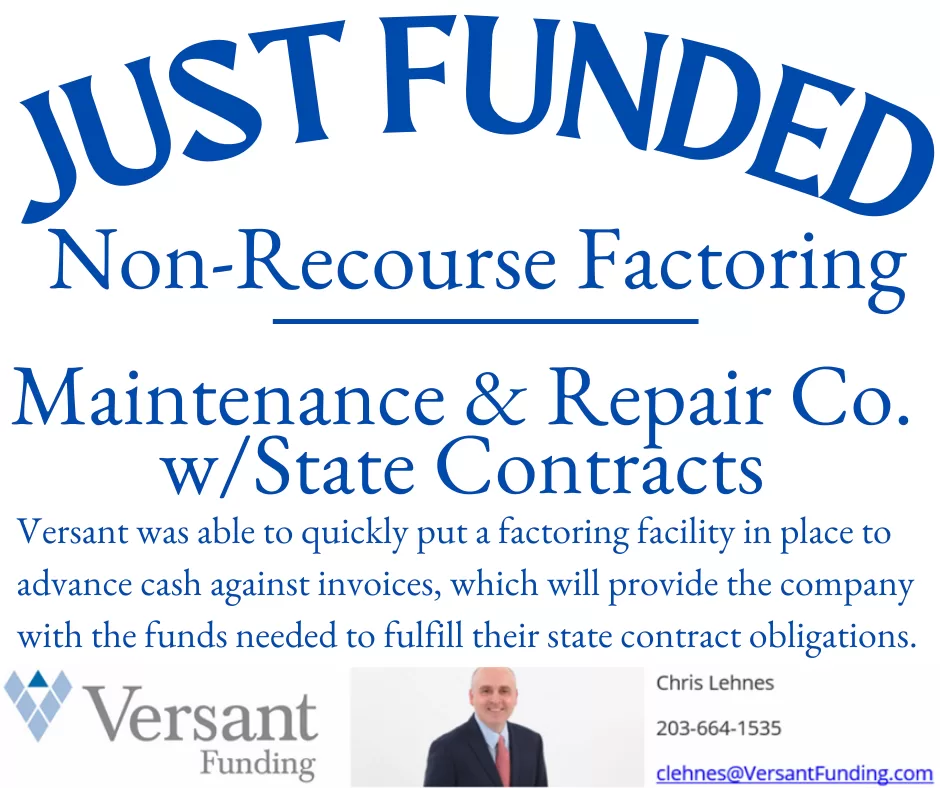
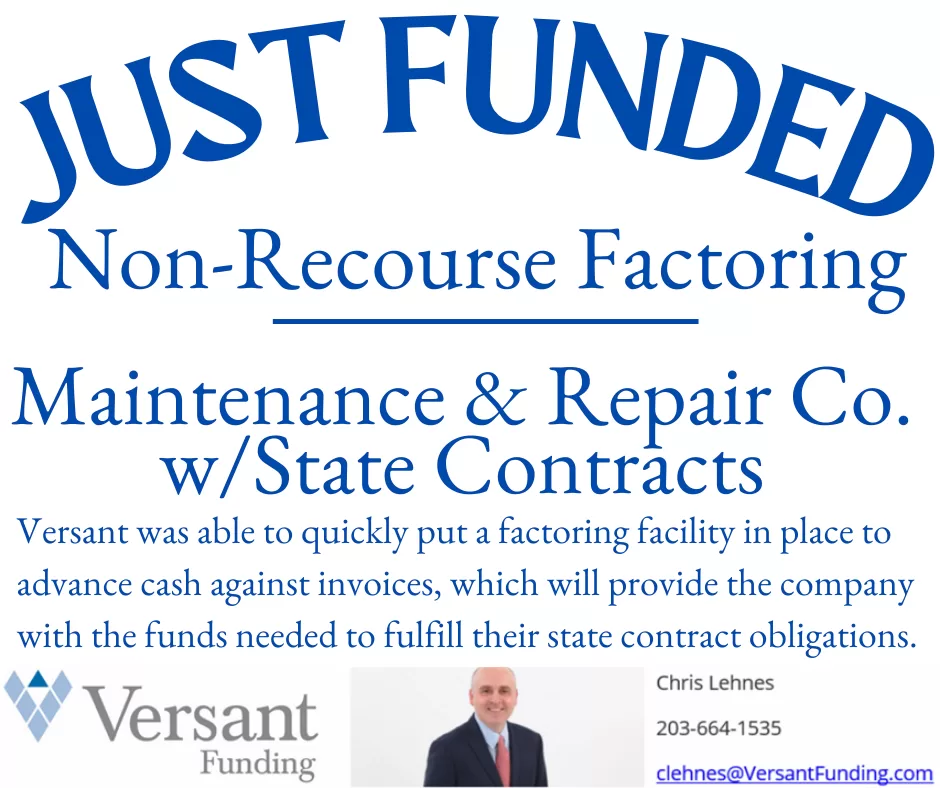
This business has recently won a contract with a state entity which will drastically increase revenues, but also create the need for additional working capital to cover payroll and other overhead expenses. Versant was able to quickly put a factoring facility in place to advance cash against invoices due from the state, which will provide the company with the liquidity needed to fulfill their state contract obligations.
“Versant’s factoring program was a perfect fit for this family-owned business in need of expansion financing,“ according to Chris Lehnes, Business Development Officer for Versant Funding, and originator of this financing opportunity. “Because our approach to factoring focuses solely on the quality of accounts receivable, we were able to provide a facility with no cap which will grow automatically as the A/R balances with the state grow.”
Maintenance & Repair Co.
w/State Contracts
About Versant Funding Press Release
Versant Funding’s custom Non-Recourse Factoring Facilities have been designed to fill a void in the market by focusing exclusively on the credit quality of a company’s accounts receivable. Versant Funding offers non-recourse factoring solutions to companies with B2B or B2G sales from $100,000 to $10 Million per month. All we care about is the credit quality of the A/R. To learn more contact: Chris Lehnes, 203-664-1535, clehnes@chrislehnes.com
Accounts Receivable Factoring $100,000 to $30 Million Quick AR Advances No Long-Term Commitment Non-recourse Funding in about a week
We are a great match for businesses with traits such as: Less than 2 years old Negative Net Worth Losses Customer Concentrations Weak Credit Character Issues
Chris Lehnes | Factoring Specialist | 203-664-1535 | chris@chrislehnes.com

Versant Funds $1.8 Million Non-Recourse Factoring Transaction to Administrator of Adolescent Group Homes – Versant Funds Administrator
(October 14, 2024) Versant Funding LLC is pleased to announce it has funded a $1.8 Million non-recourse factoring transaction to a company which administers group homes for adolescents who are victims of neglect and abuse. Versant Funds Administrator.
Versant Funds $1.8 Million Non-Recourse Factoring Transaction to Administrator of Adolescent Group Homes
This newly formed business has relationships with State and County organizations to house children in need. These entities tend to pay their invoices slowly, putting a financial strain on the business. Versant was able to quickly put a factoring facility in place to advance cash against those invoices, which will provide the company with the liquidity needed to expand into additional counties. Versant Funds Administrator.
“Versant’s offering was an excellent match for this newly formed business in need of growth financing,“ according to Chris Lehnes, Business Development Officer for Versant Funding, and originator of this financing opportunity. “Because our approach to factoring focuses solely on the quality of accounts receivable and does not require an underwriting of our client, we were able to fund this business that would not meet the credit standards of most traditional lenders.”
About Versant Funding
Versant Funding’s custom Non-Recourse Factoring Facilities have been designed to fill a void in the market by focusing exclusively on the credit quality of a company’s accounts receivable. Versant Funding offers non-recourse factoring solutions to companies with B2B or B2G sales from $100,000 to $10 Million per month. All we care about is the credit quality of the A/R. To learn more contact: Chris Lehnes, 203-664-1535, clehnes@chrislehnes.com
Accounts Receivable Factoring $100,000 to $30 Million Quick AR Advances No Long-Term Commitment Non-recourse Funding in about a week
We are a great match for businesses with traits such as: Less than 2 years old Negative Net Worth Losses Customer Concentrations Weak Credit Character Issues
Chris Lehnes | Factoring Specialist | 203-664-1535 | chris@chrislehnes.com
When a large retailer like Saks is slow to pay its accounts payable, it can have significant negative impacts on its small business vendors. Saks’ Slow-Pay of AP Negatively Impacts Vendors.
These impacts can include:
1. Cash Flow Problems
Immediate Financial Strain: Small businesses often operate with limited cash reserves. Delayed payments from a major client like Saks can create cash flow issues, making it difficult for these businesses to cover their own expenses such as payroll, rent, and supplier costs.
Dependency on Payment Timeliness: Small vendors may rely heavily on timely payments to maintain their operations. A delay from a large retailer could mean they struggle to fulfill other orders or pay their own debts, potentially leading to a vicious cycle of financial instability.
Saks’ Slow-Pay of AP Negatively Impacts Vendors
2. Increased Borrowing Costs
Need for Short-Term Financing: To manage their cash flow, small businesses might need to take out loans or use lines of credit, which could come with high-interest rates. The cost of borrowing could eat into their profit margins, making their operations less sustainable.
Damaged Creditworthiness: Frequent delays in receiving payments could harm a small business’s credit rating, as they may miss payments to their own suppliers or lenders.
3. Operational Disruptions
Inability to Invest in Growth: Slow payments might force small vendors to cut back on essential investments in their business, such as upgrading equipment, expanding their product lines, or hiring new staff. This can stifle growth and innovation.
Inventory and Production Issues: Delays in payment might mean that vendors can’t purchase necessary raw materials or components, leading to disruptions in their production processes and delays in fulfilling other orders. Saks’ Slow-Pay of AP Negatively Impacts Vendors
4. Strained Business Relationships
Erosion of Trust: Persistent delays can erode the trust between small vendors and Saks, leading to strained business relationships. Vendors might start prioritizing other customers over Saks, or even refuse to do business with them altogether.
Reputation Damage: If the issue becomes widespread, Saks might develop a reputation for being a slow payer, making it difficult for them to secure favorable terms with other suppliers or vendors. Saks’ Slow-Pay of AP Negatively Impacts Vendors
5. Legal and Compliance Risks
Contractual Disputes: Vendors might seek legal recourse if they believe Saks is violating the terms of their contracts. This could lead to costly litigation and further strain the financial situation of small businesses.
Potential for Bankruptcy: In extreme cases, chronic payment delays could push small vendors into bankruptcy, especially if they rely heavily on Saks as a key customer.
6. Impact on Industry Ecosystem
Supplier Vulnerability: The financial distress of small vendors could ripple through the supply chain, affecting other businesses and potentially leading to supply disruptions for Saks and its competitors.
Market Consolidation: Smaller businesses that can’t withstand the financial strain may be forced out of the market, leading to consolidation where only larger, better-capitalized companies survive. This could reduce competition and innovation in the industry.
Conclusion
The practice of slow payments by a major retailer like Saks can have severe and far-reaching consequences for its small business vendors. It can lead to cash flow problems, increased borrowing costs, operational disruptions, strained relationships, and even legal disputes. For small vendors, maintaining financial stability in the face of delayed payments is crucial, and many may need to seek alternative financing options or diversify their customer base to mitigate these risks.
Funding Food Producers in a Week. Our factoring program can be a vital source of financing for food producers which may not qualify for traditional financing, but have a strong customer base such as those that sell to major grocery chains or distributors.
By factoring, companies get quick access to the funds needed to continue to expand operations.
Accounts Receivable Factoring $100,000 to $30 Million No Long-Term Commitment Non-recourse Funding in about a week Spot Factoring Available
We are a great match for businesses with traits such as: Less than 2 years old Negative Net Worth Losses Customer Concentrations Weak Credit Character Issues
We focus on the quality of your client’s accounts receivable, ignoring their financial condition. This enables us to move quickly and fund qualified businesses including Manufacturers, Distributorsand a wide variety of Service Businesses (including SaaS) in as few as 3-5 days.