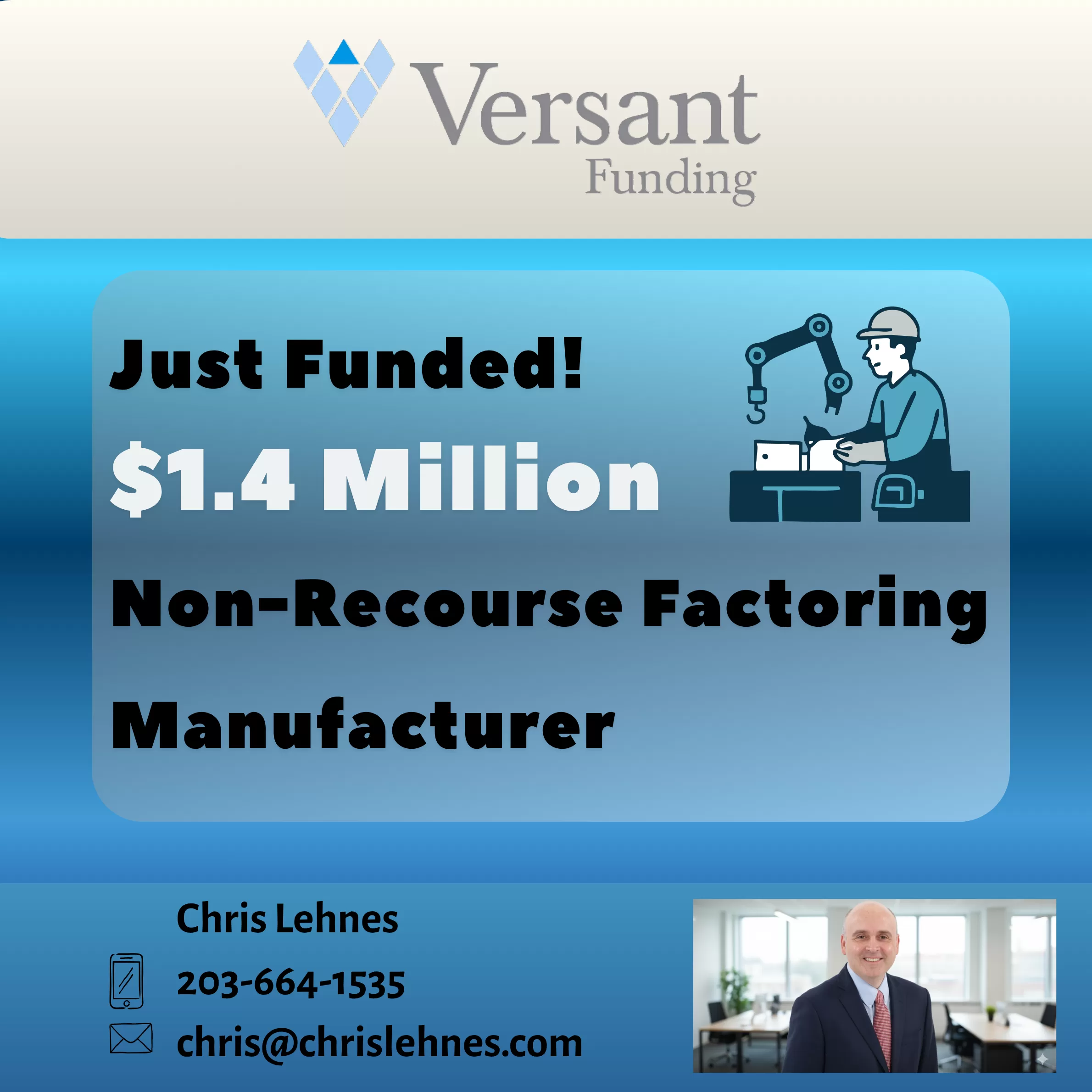
PRESS RELEASE: Versant Funds $1.4 Million Factoring Facility to Manufacturer

Press Release: (March 26, 2026) Versant Funding LLC is pleased to announce that it has funded a $1.4 Million non-recourse factoring facility to a manufacturer of equipment used by global auto companies.

While our newest client has successfully secured contracts with some of the world’s largest manufacturers, slow-paying accounts receivable are putting pressure on the company’s cash flow and preventing them from taking on new business.

“In evaluating a funding opportunity, Versant focuses exclusively on the quality of our client’s accounts receivable” according to Chris Lehnes, Business Development Officer for Versant Funding, and originator of this transaction. “Since this company’s customers are among the strongest on the planet, our facility will essentially have no cap and will grow automatically as the company’s AR balances increase, providing our client the cash needed to expand.”

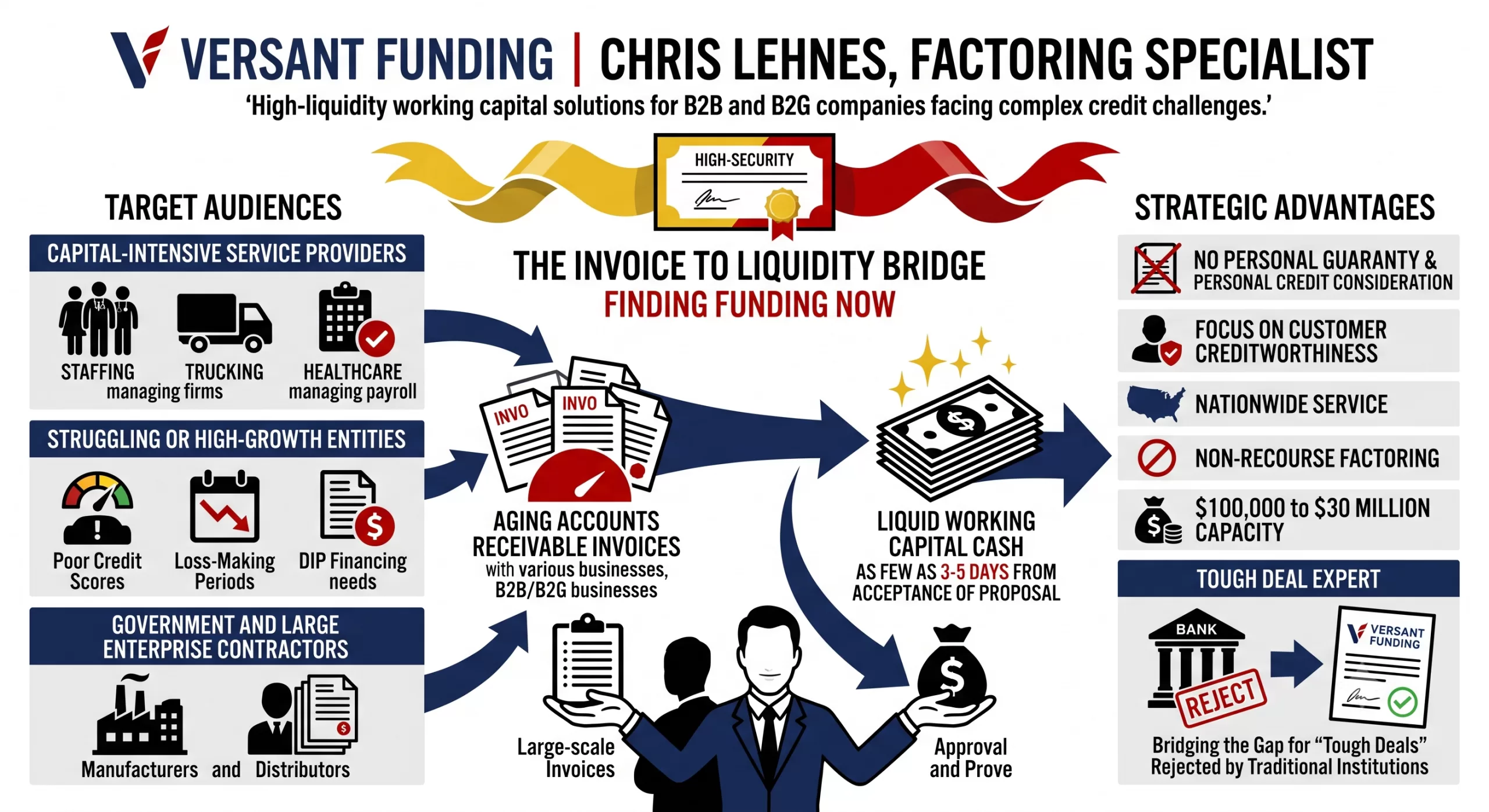
About Versant Funding: Versant Funding’s custom Non-Recourse Factoring Facilities have been designed to fill a void in the market by focusing exclusively on the credit quality of a company’s accounts receivable. Versant Funding offers non-recourse factoring solutions to companies with B2B or B2G sales from $100,000 to $30 Million per month. All we care about is the credit quality of the A/R. To learn more contact: Chris Lehnes|203-664-1535 | chris@chrislehnes.com

ABL Advisor: Versant Funds $1.4MM Non-Recourse Factoring Facility to Manufacturer

ABF Journal: Versant Funding Provides $1.4MM Factoring Facility to Manufacturer

LinkedIn Newsletter: Just Funded! $1.4 Million Non-Recourse Factoring to Manufacturer

Secured Finance Network: Versant Funds $1.4 Million Non-Recourse Factoring Facility to Manufacturer

IFA Commercial Factor: Versant Funds $1.4 Million Non-Recourse Factoring Facility to Manufacturer

CT Turnaround Management Association: Member News – Versant Funds $1.4 Million to Manufacturer

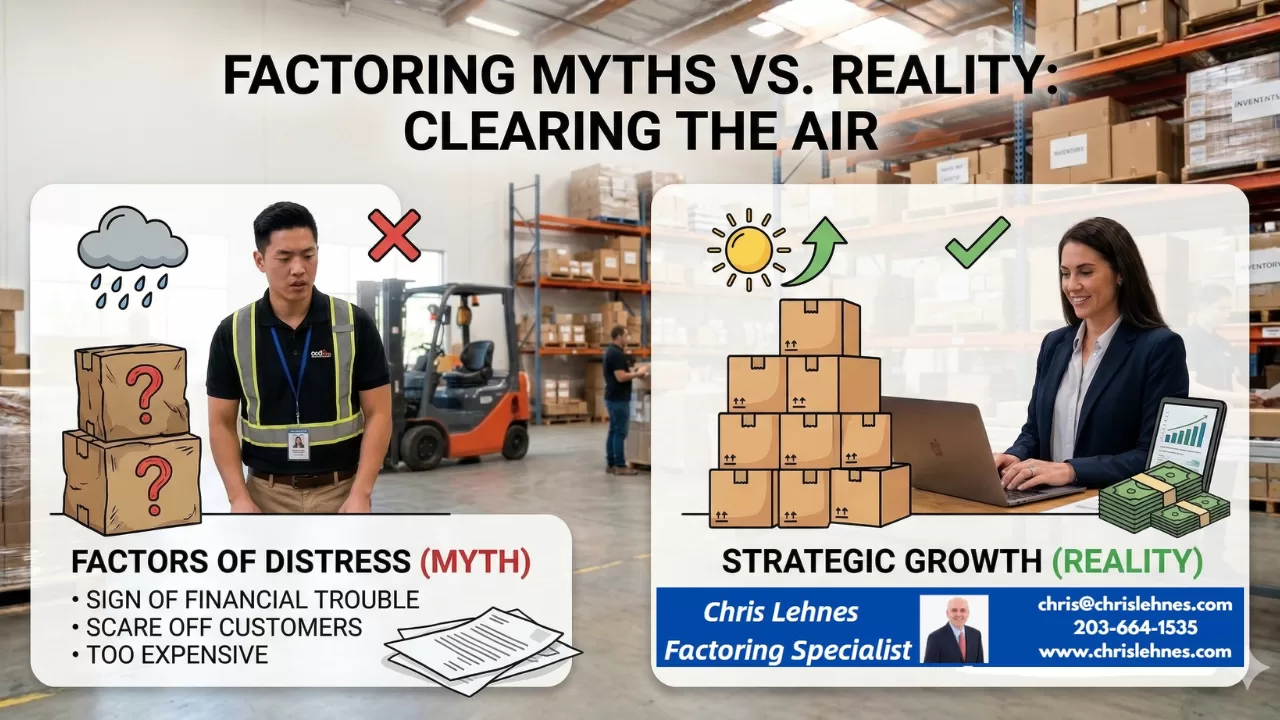
Factoring Myths vs. Reality: Clearing the Air

Factoring Myths vs. Reality: Clearing the Air

For many distributors, the word “factoring” carries some outdated baggage. If you’re hesitant to pull the trigger, it’s likely because of one of these common misconceptions. Let’s separate the noise from the facts:

The MythThe Reality
“Factoring is a sign of financial trouble.”Factoring is a sign of growth. Most companies use factoring because they are growing too fast for their cash flow to keep up. It’s a strategic choice to fuel expansion, not a last-ditch effort to stay afloat.
“My customers will think I’m going under.”It’s a standard B2B practice. Major retailers and manufacturers deal with factors every day. In many industries, like apparel or electronics distribution, it’s actually the “gold standard” for managing receivables.
“It’s way too expensive.”Look at the ROI. While the fee (1–3%) is higher than a bank loan, the “cost of waiting” 60 days for a check often means missing out on new inventory or early-pay discounts from your own suppliers that could actually save you more than the factoring fee.
“I’ll lose control of my customer relationships.”You stay in the driver’s seat. Modern factoring companies act as a professional extension of your back office. They want your customers to stay happy so they keep buying (and paying). You still manage the sales and service; they just handle the math.
“It’s just like a high-interest loan.”It’s not a loan at all. Because you are selling an asset (your invoice), you aren’t taking on debt. There are no monthly principal or interest payments to worry about—the “payment” comes from your customer, not your bank account.

The “Silent” Benefit: Professional Credit Checks

One “Reality” that distributors often overlook is that a factor acts as a free credit department. Before you ship $50,000 worth of goods to a new client, you can ask your factor to check their credit. If the factor won’t buy the invoice, that’s a massive red flag that you probably shouldn’t be selling to that customer on terms in the first place.


Contact Factoring Specialist, Chris Lehnes

Selecting a Factoring Partner: An Helpful Distributor’s Checklist

What you should know in selecting a factoring Partner

Choosing a factoring company is like choosing a long-term business partner. The right one will act as your back-office credit department; the wrong one can be an expensive administrative nightmare. Use this checklist to vet potential partners:

1. The Core Logistics

  • [ ] Industry Expertise: Do they have experience with the specific nuances of distribution (e.g., handling chargebacks, bill-backs, or progressive shipping)?
  • [ ] Advance Rate: Will they advance at least 80–90% of the invoice value?
  • [ ] Funding Speed: Can they provide “Same Day” or “Next Day” funding once an invoice is verified?
  • [ ] Funding Source: Are they a Direct Lender (bank-backed) or an independent factor? (Direct lenders often have lower rates and more stability).

2. Transparency & Fees

  • [ ] The “All-In” Rate: Ask for a breakdown of all fees. Look out for hidden “junk fees” like application fees, wire fees, or credit check fees.
  • [ ] Recourse vs. Non-Recourse: * Recourse: You must buy back the invoice if your customer doesn’t pay. (Lower fees).
    • Non-Recourse: The factor takes the credit risk if the customer goes bankrupt. (Higher fees).
  • [ ] Volume Requirements: Are there “Monthly Minimums”? If you don’t hit a certain volume, will you be penalized?

3. The “Relationship” Factor

  • [ ] Dedicated Account Manager: Will you have a single point of contact who knows your business, or a generic 1-800 help desk?
  • [ ] Customer Interaction Style: How do they contact your customers for verification? You want a partner who is professional and polite, as they represent your brand.
  • [ ] Technology Integration: Do they sync with your accounting software (QuickBooks, NetSuite, etc.) for easy invoice uploading?

4. Contract Flexibility

  • [ ] Contract Length: Avoid multi-year lock-ins. Look for month-to-month or one-year terms with clear exit clauses.
  • [ ] Termination Notice: How much notice is required to leave? (Usually 30–90 days).
  • [ ] Personal Guarantee: Is a personal guarantee required? (Standard for many small business factors, but worth clarifying).

Contact Factoring Specialist, Chris Lehnes

Why Distributors are Embracing AR Factoring

What is Factoring: In the world of distribution, the “growth paradox” is a real headache. You land a massive new retail contract—which is great news—but suddenly you’re shelling out for inventory and shipping costs while your customer sits on a 60- or 90-day payment term.

For many distributors, waiting for those invoices to clear creates a suffocating bottleneck. This is where Accounts Receivable (AR) Factoring comes in. It’s not a loan; it’s a financial tool that turns your unpaid invoices into immediate working capital.


How It Works: The Quick Breakdown

Instead of waiting months for a customer to pay, you sell your outstanding invoices to a “factor” (a specialized financial company).

  1. The Advance: The factor typically advances you 80% to 90% of the invoice value within 24 hours.
  2. The Collection: The factor handles the collection from your customer.
  3. The Rebate: Once the customer pays, the factor sends you the remaining balance, minus a small fee (usually 1–3%).

4 Major Benefits for Distributors

1. Bridge the Inventory Gap

Distributors often have to pay suppliers long before they get paid by their own clients. Factoring provides the liquidity to pay your manufacturers upfront, often allowing you to take advantage of early-payment discounts that can actually offset the cost of the factoring fee itself.

2. Fuel Rapid Scalability

Traditional bank loans are limited by your credit history or collateral. Factoring, however, scales with your sales. The more you sell to reputable customers, the more funding becomes available. It allows you to say “yes” to large orders that you otherwise couldn’t afford to fulfill.

3. Professional Credit Management

Many factoring companies act as an extension of your back office. They perform credit checks on your potential customers, helping you avoid “bad seeds” before you ship a single pallet. This reduces your risk of bad debt and saves your team the awkwardness of making collection calls.

4. No New Debt

Since factoring is the purchase of an asset (your invoice) rather than a loan, it doesn’t show up as debt on your balance sheet. This keeps your debt-to-equity ratio clean, making your business look much healthier to future investors or traditional lenders.


Is It Right For You?

Factoring is particularly powerful if you are:

  • A startup with a thin credit history but blue-chip customers.
  • Experiencing seasonal spikes that drain your cash reserves.
  • Tired of the “waiting game” associated with 30, 60, or 90-day terms.

While there is a cost involved, the ability to reinvest that cash immediately into new inventory or operations often outweighs the fee. In the fast-moving world of distribution, speed is a competitive advantage.

Factoring vs. A Traditional Line of Credit: A Distributor’s Comparison

While both tools solve cash flow problems, they operate very differently. Here is how they stack up for a growing distributor:

FeatureAR FactoringTraditional Bank Line of Credit (LOC)
Funding Limit Based On…The creditworthiness of your customers and your accounts receivable balance.Your business’s credit history, profitability, and your collateral.
Speed of FundingExtremely fast. Setup takes a few days; once active, funding often occurs within 24–48 hours of invoice verification.Slow. The approval process can take weeks or even months.
Debt TypeNot Debt. It is the “asset purchase” of your invoices.Debt. This is a loan that appears as a liability on your balance sheet.
Impact on CreditBoosts Credit Score. It provides cash to pay your suppliers and operational debts on time.Lowers “Available” Credit. Utilizing the full LOC can temporarily lower your score until it’s paid down.
Administrative SupportThe factor often provides credit management and collection services, freeing up your back office.You retain full responsibility for all collections and monitoring customer credit.
ScalabilityUnlimited. As your credit-worthy sales grow, your available funding automatically increases.Capped. Your limit is fixed and requires a re-application process to increase.

Gemini said

Certainly. Here is a comparison table and a section you can drop directly into your blog post.


Factoring vs. A Traditional Line of Credit: A Distributor’s Comparison

While both tools solve cash flow problems, they operate very differently. Here is how they stack up for a growing distributor:

FeatureAR FactoringTraditional Bank Line of Credit (LOC)
Funding Limit Based On…The creditworthiness of your customers and your accounts receivable balance.Your business’s credit history, profitability, and your collateral.
Speed of FundingExtremely fast. Setup takes a few days; once active, funding often occurs within 24–48 hours of invoice verification.Slow. The approval process can take weeks or even months.
Debt TypeNot Debt. It is the “asset purchase” of your invoices.Debt. This is a loan that appears as a liability on your balance sheet.
Impact on CreditBoosts Credit Score. It provides cash to pay your suppliers and operational debts on time.Lowers “Available” Credit. Utilizing the full LOC can temporarily lower your score until it’s paid down.
Administrative SupportThe factor often provides credit management and collection services, freeing up your back office.You retain full responsibility for all collections and monitoring customer credit.
ScalabilityUnlimited. As your credit-worthy sales grow, your available funding automatically increases.Capped. Your limit is fixed and requires a re-application process to increase.

Which One Wins for Distributors?

A bank line of credit is almost always the cheapest form of capital if you can get approved for a large enough limit.

However, for distributors in a hyper-growth phase, or those whose balance sheets don’t match their ambition, AR factoring offers unmatched speed and scalability. It allows you to leverage your customers’ financial strength to fund your own growth.

The Final Verdict: When to Choose Factoring

For a distributor, the choice between factoring and other financing boils down to your growth trajectory and customer base.

A traditional bank line of credit is often the lowest-cost option, but it is also the most rigid. If you have years of steady profitability and a “boring” (predictable) growth curve, the bank is your best friend.

However, AR factoring is the superior choice if:

  • You are growing faster than your cash flow allows: If a sudden 50% increase in orders would actually break your business because you can’t afford the inventory, you need factoring.
  • You have “lumpy” revenue: If you deal with seasonal spikes where you need $500k in October but only $50k in January, the flexibility of factoring is unmatched.
  • Your customers are larger than you: If you are a small distributor selling to giants like Walmart or Amazon, a factor will look at their multi-billion-dollar credit rating to fund you, rather than your own limited history.

Ultimately, factoring isn’t just a way to get paid early—it’s a way to weaponize your accounts receivable to outmaneuver competitors who are still stuck waiting for a check in the mail.

Contact Factoring Specialist, Chris Lehnes

Factoring: Funding the Energy Industry

Our Accounts Receivable Factoring program can quickly meet the working capital needs of businesses in the energy industry.

Versant’s underwriting focus is solely on the quality of a company’s accounts receivable, which enables us to rapidly fund businesses which do not qualify for traditional lending.

Factoring Program Overview

  • $100,000 to $30 Million
  • Non-recourse
  • Flexible Term
  • Ideal for B2B or B2G

We fund challenging deals:

  • Start-ups
  • Losses
  • Highly Leveraged
  • Customer Concentrations
  • Weak Personal Credit
  • Character Issues

In about a week, we can advance against accounts receivable to qualified manufacturers, distributors or service providers in the energy sector.

Contact me today to learn if your client could benefit.

Factoring: Quick Cash to Kick Off the Year

The 2026 Growth Gap: How Accounts Receivable Factoring Fuels Small Business Success

Factoring: Quick Cash to Kick Off the Year: As we move through 2026, the economic landscape for small businesses is defined by a paradox: opportunity is everywhere, but cash is moving slower than ever. While sectors like high-tech manufacturing and professional services are seeing a resurgence, many entrepreneurs find themselves “asset rich but cash poor.”

You’ve landed the big contract, your team is working overtime, and your sales are climbing. Yet, your bank account doesn’t reflect that success because your capital is trapped in Accounts Receivable (AR). If you’re waiting 30, 60, or even 90 days for clients to pay their invoices, you aren’t just waiting for money—you’re waiting to grow.

This is where Accounts Receivable Factoring becomes a strategic engine for your business.


What is AR Factoring in 2026?

Accounts receivable factoring (or invoice factoring) is not a loan. It is the sale of your outstanding invoices to a third party (a “factor”) at a slight discount in exchange for immediate liquidity.

In 2026, the process has been revolutionized by fintech integrations. Most modern factoring platforms now sync directly with your accounting software (like QuickBooks or Xero), allowing for “one-click” funding that can land in your account within 24 hours.

Why Factoring is the “Secret Weapon” for 2026

While traditional bank loans focus on your credit score and years of profitability, factoring focuses on the creditworthiness of your customers. This makes it an ideal solution for:

  • Rapidly Growing Startups: When sales outpace your cash reserves.
  • Seasonal Businesses: Managing the “lumpy” cash flow of peak seasons.
  • Service Providers: Staffing agencies or consultants who must pay employees weekly but get paid by clients monthly.

3 Ways Factoring Helps You Thrive This Year

1. Turn “Net-90” into “Right Now”

The most significant barrier to growth in 2026 is the “Cash Gap.” If you have $100,000 in open invoices, that’s $100,000 you can’t use to buy inventory, hire talent, or pay for digital marketing. Factoring unlocks up to 90-95% of that value immediately, giving you the agility to say “yes” to new opportunities without checking your balance first.

2. Fuel Expansion Without Adding Debt

In an era of “snagflation”—where mild inflation persists alongside a shifting labor market—loading your balance sheet with high-interest debt can be risky. Because factoring is a purchase of assets, it doesn’t show up as a loan. You are simply accelerating the arrival of money you’ve already earned.

3. Outsourced Credit & Collections

Modern factoring companies do more than just provide cash. They often act as your back-office credit department. In 2026, where business bankruptcies are slightly on the rise, having a partner who vets the credit risk of your potential clients is a massive competitive advantage. They handle the collections, freeing you up to focus on your product.


Is it Right for You?

To help you decide, here is a quick comparison of how factoring stacks up against traditional financing in today’s market:

FeatureAR FactoringTraditional Bank Loan
Speed24–48 Hours3–6 Weeks
Approval BasisCustomer’s CreditYour Credit & Collateral
DebtNone (Asset Sale)Increases Liabilities
FlexibilityScales with SalesFixed Credit Limit
Cost1%–5% Service FeeInterest Rate + Fees

Final Thoughts: Don’t Let Your Invoices Hold You Back

In 2026, the winners won’t necessarily be the companies with the biggest ideas, but those with the highest liquidity. AR factoring provides a bridge over the cash flow gaps that sink 82% of small businesses. It turns your hard work into immediate fuel.

Contact Factoring Specialist, Chris Lehnes

https://www.chrislehnes.com/wp-content/uploads/2026/01/Animated_Circle_With_Check_Mark-1.mp4

Factoring Proposal Issued: $12 Million – IT Services/ SaaS

Rapidly growing SaaS company with Fortune 10 customers requires funding against 60 & 90 day invoices to cover overhead. We can fund next week!

Contact Factoring Specialist, Chris Lehnes

Quick Cash for B2B Businesses – Factoring Accounts Receivable

B2B Businesses can obtain funds in as quick as a week backed by their accounts receivable.

https://www.chrislehnes.com/wp-content/uploads/2025/12/Quick-Cash-for-B2B-Businesses-1.mp4

Contact Factoring Specialist, Chris Lehnes

For B2B businesses, accounts receivable (AR) factoring is essentially a tool to accelerate cash flow. It allows you to trade the “waiting game” of Net-30 or Net-60 terms for immediate liquidity.

Instead of waiting for a client to pay an invoice, you sell that invoice to a third party (a “factor”) who advances you the majority of the funds immediately. This converts a stagnant asset (an unpaid invoice) into active working capital you can use to fund operations, payroll, or growth.

The following guide details how B2B businesses can utilize this strategy to meet working capital needs.

1. The Core Mechanism: How it Works

Factoring is technically an asset sale, not a loan. You are selling the right to collect on the invoice.

  • Step 1: Invoicing. You deliver your goods/services and send an invoice to your B2B customer as usual.
  • Step 2: Sale. You submit a copy of that invoice to the factoring company.
  • Step 3: The Advance. The factor verifies the invoice and wires you an advance—typically 80% to 90% of the invoice value—within 24 to 48 hours.
  • Step 4: Collection. The factor waits for your customer to pay them directly according to the invoice terms (e.g., 30 or 60 days).
  • Step 5: The Rebate. Once the customer pays the full amount, the factor releases the remaining 10–20% to you, minus their fee (usually 1–5%).

2. Strategic Uses for Working Capital

You can use the immediate infusion of cash to solve specific operational friction points common in B2B models:

  • Bridging the “Gap”: If your expenses (payroll, rent, utilities) are due weekly or bi-weekly, but your customers pay monthly, you have a cash flow gap. Factoring aligns your revenue intake with your expense outflow.
  • Fulfilling Large Orders: B2B growth often hurts cash flow before helping it. If you land a massive contract, you need cash now to buy raw materials and hire labor to fulfill it. Factoring existing invoices gives you the capital to fund these new orders without taking on debt.
  • Negotiating Supplier Discounts: With cash on hand, you can pay your own suppliers early. often unlocking “2/10 Net 30” discounts (a 2% discount if paid within 10 days). This discount can sometimes offset the cost of the factoring fee itself.
  • Smoothing Seasonality: For businesses with peak seasons (e.g., manufacturing for holiday retail), factoring during the busy season ensures you have the liquidity to maximize production when it matters most.

3. Critical Decisions: Configuring Your Factoring

To use this effectively, you must choose the right “type” of factoring for your risk profile.

Recourse vs. Non-Recourse

This determines who is liable if your client never pays (e.g., they go bankrupt).

  • Recourse Factoring: You are liable. If the client doesn’t pay, you must buy the invoice back from the factor. Benefit: Lower fees.
  • Non-Recourse Factoring: The factor assumes the credit risk. If the client defaults due to insolvency, the factor absorbs the loss. Benefit: Zero risk for you, but higher fees.

Notification vs. Non-Notification

  • Notification: Your customer is notified to pay the factor directly. This is standard but can sometimes signal to customers that you are tight on cash.
  • Non-Notification (White Label): The customer pays into a bank account that looks like yours but is controlled by the factor. The customer is unaware of the factoring arrangement.

4. Who Qualifies?

Unlike a bank loan, approval for factoring is based primarily on your customer’s creditworthiness, not yours.

  • Ideal Candidate: A B2B business (startups included) with reliable, large corporate or government clients who pay slowly but surely.
  • Less Ideal: Businesses with B2C customers (individuals) or clients with poor credit histories.

Factoring: Funding for Distributors Impacted By High Tariffs

Accounts Receivable Factoring can quickly meet the working capital needs of Distributors impacted by rising tariffs.

Our underwriting focus is solely on the quality of a company’s accounts receivable, which enables us to rapidly fund businesses which do not qualify for traditional lending such as those experiencing losses or where the owners have weak personal credit or even “character issues.”

https://www.chrislehnes.com/wp-content/uploads/2025/10/Funding-Distributors-with-Factoring-1.mp4

Factoring Program Overview

  • $100,000 to $30 Million
  • Non-recourse
  • Flexible Term
  • Ideal for B2B or B2G

We fund challenging deals:

  • Start-ups
  • Losses
  • Highly Leveraged
  • Customer Concentrations
  • Weak Personal Credit
  • Character Issues

Contact Factoring Specialist, Chris Lehnes to learn if your client is a factoring fit

.

Lumber: Volatile Wood: An Analysis of the Impact of Falling Lumber Prices on the Economy

1. Introduction: Lumber and the Economy

1.1. Defining the Role of Lumber as a Leading Economic Indicator

The lumber market, often described as a bellwether for the broader U.S. economy, holds a unique position among commodities. Its price fluctuations are not merely a reflection of supply and demand for wood but serve as a crucial barometer for the health of the residential construction sector, a primary driver of gross domestic product.1 This is because wood products, particularly softwood lumber, are a foundational material for single-family home construction, and the demand for new homes is intrinsically linked to consumer confidence, employment levels, and interest rates. Therefore, changes in lumber prices can signal shifts in economic activity long before they appear in more conventional datasets, making it a critical metric for market analysts and economists.

1.2. Setting the Context: The Post-Pandemic lumber Price Roller Coaster and the Current Downturn

The lumber market has undergone a period of unprecedented volatility in recent years, moving from historical predictability to a state of startling unpredictability.4 The onset of the COVID-19 pandemic, coupled with historically low interest rates, ignited a surge in demand for DIY home improvement projects and new home construction.4 This demand, coupled with pandemic-related supply chain disruptions and sawmill closures, caused lumber prices to skyrocket, rising more than 200% above pre-pandemic levels at their peak in 2021.4 This period of extreme highs was followed by a subsequent “recalibration” as rising interest rates and inflation tempered the housing market frenzy, prompting a decline in costs. However, the current downturn is not a simple return to a stable, pre-2020 market. It represents a complex new phase characterized by persistent volatility within a new, higher price baseline.1

2. The Anatomy of a Price Correction: Distinguishing Volatility from Collapse

2.1. Recent Price Action and Futures Market Signals

An analysis of recent data reveals a nuanced market dynamic that challenges a simple narrative of collapse. While headline figures often highlight steep declines, a broader perspective indicates a severe correction within a new, elevated price environment. As of the week ending August 22, 2025, the framing lumber composite price was down 3.7% for the week and 3.0% over the past month, reaching its lowest level of the year.8 Similarly, lumber futures have experienced a significant drop, falling 10.6% from the previous month.8 These short-term declines, which include a rapid 14% drop from a record high in early August, can understandably generate concerns about a market crash.9

However, a year-over-year comparison provides a critical counterpoint. Despite the month-over-month decline, the framing lumber composite price was still 5.8% higher than it was a year ago.8 Lumber futures, a key indicator of future price expectations, were up an even more dramatic 19.1% year-over-year.8 The Producer Price Index for lumber and wood products also shows a mix of recent declines and year-over-year increases, reflecting a pattern of fluctuation rather than a linear downtrend.10 This discrepancy demonstrates that the market is not returning to its pre-pandemic state. Instead, it is undergoing a painful recalibration characterized by sharp, short-term corrections that occur within a persistently volatile but elevated price range. The volatility itself, rather than the absolute price level, has become the defining characteristic of this new market reality.1

2.2. The Tectonic Plates of Supply and Demand of lumber

The current market volatility is the result of a complex interplay of regulatory, environmental, and demand-side pressures.

Lumber Regulatory Influences: Tariffs and Geopolitical Tensions. A major factor in the market’s unpredictable behavior is the ongoing trade dispute with Canada. In August 2025, the Department of Commerce announced it would more than double its countervailing duties rate on Canadian softwood lumber imports, from 6.74% to 14.63%. This, combined with the anti-dumping rate, brings the total tariffs to 35.2%, a significant increase from the previous 14.4%.8 The explicit intention of these tariffs is to protect U.S. sawmills by making Canadian imports less competitive, thereby stimulating domestic production and employment.12

However, the real-world impact of these policies has proven to be paradoxical. The anticipation of higher duties has led to an oversupply problem. Canadian mills, anticipating the impending cost hike, have pushed large volumes of surplus lumber into the U.S. market, creating a glut that has driven prices down.7 This oversupply, coupled with faltering demand, has put Canadian mills at a disadvantage, with some reportedly operating below their cost of production.9 Thus, the very policy designed to stabilize the domestic industry has contributed to price erosion and market instability, creating a vicious cycle of oversupply, price drops, and subsequent production cuts that undermines the policy’s stated goals.13

Lumber Supply-Side Constraints: Mill Closures and Environmental Factors. In response to persistently high prices and oversupply, sawmills in both the U.S. and Canada have been forced to curtail production or close permanently, a painful but necessary market adjustment.1 This restricts supply, which in the long run helps to stabilize prices and prevent a total market collapse. In a single year, sawmill curtailments have reduced North American softwood lumber capacity by more than 3.1 billion board feet.16 Additionally, environmental factors continue to pose a significant risk. Natural disasters such as wildfires in the Western U.S. and Canada can severely disrupt timber supply and temporarily reverse downward price trends, as seen in June 2023 when Canadian wildfires temporarily caused lumber costs to climb.1

Lumber Demand Dynamics: The Housing and Renovation Markets. The most significant driver of lumber prices remains the housing market, which has been severely constrained by high interest rates and broader economic uncertainty.1 High mortgage rates have kept many potential homebuyers on the sidelines, leading to weak buyer traffic and a decline in home sales.7 While total housing starts in June 2025 showed some upward momentum due to a 30% increase in multifamily starts, single-family housing starts—the primary driver of lumber consumption—fell 4.6% to their lowest level in nearly a year.17 Similarly, home renovation and repair activity saw an approximate 7% drop in 2024 compared to the previous year, further curbing demand.1

3. The Housing Market: From Lumber Price Signals to Consumer Reality

3.1. The Cost of a New Home: A Deeper Dive into LUmber

To understand the full impact of falling lumber prices, it is necessary to examine the composition of a new home’s total cost. Lumber is a crucial component of this equation, but it is far from the only one. According to the National Association of Home Builders’ (NAHB) 2024 Construction Cost Survey, construction costs accounted for 64.4% of the average new home sales price.19 Within these costs, the framing category—which includes roof framing, trusses, and sheathing—was the single largest expense, representing 16.6% of the total construction cost.19 On an average-priced new home of $665,298, the framing portion alone accounted for $70,982.19

While the framing category saw the largest percentage-point decrease from 2022 to 2024, falling from 20.5% to 16.6%, a significant portion of the cost of a new home is made up of other materials and services.19 This includes foundations (10.5%), major systems rough-ins (19.2%), and interior finishes (24.1%), many of which have not experienced the same level of price decline.19 This illustrates that a drop in lumber prices, while meaningful, does not automatically translate to a proportional drop in the final sales price of a home. Other key factors such as land costs (13.7% of the sales price), labor costs (20-25% of total construction costs), and builder profit margins must also be considered.19

The following table provides a quantitative overview of the various cost components of a new single-family home.

Table: Breakdown of New Home Construction Costs (2024 NAHB Survey)

Cost CategoryAverage CostShare of Sales Price (%)Share of Construction Cost (%)
Total Sales Price$665,298100.0%
Finished Lot Cost$91,05713.7%
Total Construction Cost$428,21564.4%100.0%
Financing, Overhead, Marketing, Commission, Profit$145,95721.9%
Construction Cost Breakdown
Site Work$32,7197.6%
Foundations$44,74810.5%
Framing$70,98216.6%
Exterior Finishes$57,51013.4%
Major Systems Rough-ins$82,31919.2%
Interior Finishes$103,39124.1%
Final Steps$27,7106.5%

3.2. Builder Confidence vs. Consumer Affordability

While falling lumber prices might suggest a more favorable environment for construction, a significant disconnect exists between this cost relief and the overall state of the housing market. Homebuilder confidence has been in negative territory for 16 consecutive months as of August 2025.17 This persistent pessimism is driven by high mortgage rates and weak buyer traffic, which remain the primary obstacles to a full housing market recovery.9 Builders are attempting to stimulate sales by cutting prices and offering incentives, with almost one-third of builders reducing home prices in June 2024 to stimulate sales.23 Despite these efforts, demand remains weak, as potential buyers are held back by high borrowing costs.

The underlying challenge is one of fundamental affordability. While the cost of lumber has declined, other construction costs—such as labor, land, and non-wood materials—remain elevated.21 This means that the reduction in a single component cost is not sufficient to make homeownership widely accessible. The market has entered a “wait and see” phase, with industry experts believing that a significant recovery in housing demand will only occur when mortgage rates fall to a critical threshold, likely in the range of 5.5% to 6%.9 Until then, builders will continue to grapple with a fragile market, unable to fully capitalize on lower material costs.

3.3. The Lag Effect: From Mill to Mortgage

A key and often overlooked aspect of the lumber market is the phenomenon of price transmission asymmetry. When market prices for lumber are increasing, higher costs are passed on to builders and consumers with remarkable speed.8 This rapid transmission is driven by the behavior of wholesalers and retailers who, in a rising market, are “trigger happy” to quote prices at or near current market rates to maintain their profit margins and capitalize on the upward momentum.8

Conversely, when prices are falling, there is a significant lag before that price relief reaches the builder. The research indicates this can take “at least a few weeks to a couple of months”.8 This delay occurs because suppliers must first work through their high-cost inventory, purchased during the period of higher prices, before they can lower their own prices to reflect the new market reality. The size and buying power of both the builder and the supplier also play a role in how quickly this relief is transmitted.8 This asymmetry means that the pain of inflation is felt almost immediately, while the benefits of falling prices are delayed, dampening the positive economic effect of the downturn for those who might otherwise benefit.

4. The Domino Effect: A Sector-by-Sector Breakdown

4.1. Upstream Impacts: The Forestry and Sawmill Industries

The decline in lumber prices has had a profound and painful impact on the upstream sectors of the forestry and sawmill industries. The current situation is reminiscent of historical precedents, such as the 2008 financial crisis, when the value of wood and paper products in the West fell from $49 billion in 2005 to $34 billion in 2009.14 During that period, employment in the western forest products industry dropped by 71,000 workers, and lumber production fell by almost 50%.14

Today, similar trends are visible. The number of establishments in the wood product manufacturing and logging sectors has dropped by a combined 8,700 over the past five years, with a projected contraction of another 6% through 2027.27 The logging industry specifically is projected to see a 7% decline in employment in the next five years.27 Sawmills, facing prices that have fallen below their cost of production, are curtailing output and closing permanently.1 The utilization rate for U.S. sawmills and wood preservation firms was a low 64.4% in the first quarter of 2025, and employment in the industry has fallen for three consecutive quarters to 88,533 workers.13 These closures are a painful but critical part of the market cycle, as they restrict supply and help to stabilize prices, ultimately setting the stage for a potential future rebound.1

4.2. Downstream Impacts: Retail and Manufacturing

The effects of falling lumber prices extend beyond the lumberyard, creating a mixed bag of outcomes for the downstream economy. Major home improvement retailers, for example, have experienced varied results. Home Depot reported a 3.2% drop in U.S. sales, a decline linked to weakened construction and renovation demand amid high borrowing costs.15 Builders FirstSource Inc., a key supplier to the construction industry, reported a year-over-year fall in its second-quarter net sales and income.9 These results suggest that the benefits of lower lumber costs are not sufficient to overcome the broader macroeconomic headwinds of high interest rates and a stagnant housing market. The underlying challenge for these retailers is not the price of lumber itself but the reduced activity among their core consumer base, as consumers and builders pull back on large projects due to financing constraints. The success of a major home improvement retailer in this environment depends on factors beyond a single commodity price, such as a strong focus on professional contractors and operational agility.

4.3. The Macroeconomic Pulse

While lumber prices are an important component of the economy, their effect on broader inflation metrics is indirect. The Producer Price Index (PPI) for lumber and wood products is a useful data point, but its impact on the final demand PPI is moderated by the costs of other goods, services, and energy.11 The research suggests that factors like housing prices, industrial output, and economic uncertainty significantly influence abrupt movements in lumber prices, indicating that lumber is more a reflection of broader economic health than a primary driver of it.29

This dynamic is best understood by examining past economic crises. The recession of the early 1980s saw a lumber price drop of more than 48% over three years, leading to widespread mill closures and unemployment topping 25% in some timber-dependent communities.31 The 2008 financial crisis was a similar story, with plummeting prices and production leading to massive job losses and industry-wide restructuring.14 In both cases, the collapse of lumber prices was a symptom of a much larger economic downturn, demonstrating its role as a leading indicator of economic pain. The current situation, with its job losses, production cuts, and falling confidence, serves as a stark reminder of these historical precedents, revealing the structural vulnerability of specific regions and sectors to this cyclical volatility.

Table: Historical Economic Impacts of Lumber Price Crashes

EventLumber Price DropEmployment ImpactProduction/Sales Impact
Early 1980s Recession>48% drop over 3 years48,000 jobs permanently lost in Pacific Northwest.Widespread mill closures, economic hardship in timber towns.
2008 Great Recession>60% drop in value from 2005-2009.71,000 jobs lost in the West.Sales value of wood products fell from $28B to $14B. Production fell by almost 50%.
Post-2021 Price Drop75% drop from 2021 peak.Employment in sawmills fell for 3 consecutive quarters.Sawmill curtailments reduced North American capacity by >3.1B board feet.

5. Winners, Losers, and Nuanced Outcomes of Lumber

5.1. The Beneficiaries of a lumber price Downturn

In the current market environment, the primary beneficiaries of falling lumber prices are certain segments of the construction industry and consumers. Homebuilders and contractors are now able to secure lumber for future projects at lower costs, which can help offset the incentives they are offering to buyers, such as price cuts and upgrades.8 Builders of all sizes stand to benefit, though larger residential construction firms with greater buying power may see price relief sooner and more effectively due to their more favorable relationships with suppliers.8

For the consumer, the benefits are more delayed and partial. While a drop in lumber costs reduces one component of new home prices, this is often insufficient to overcome the primary barrier of high mortgage rates. The full benefit of lower material costs is often absorbed by builders and suppliers to protect their profit margins, which have been squeezed by rising overhead and land costs.19 The most likely winners among consumers are those who have a strong financial position, are able to secure favorable financing, and can take advantage of the current market’s incentives and lower material costs to build a home.

5.2. Those Left Vulnerable by lumber prices

The negative impacts of the lumber price correction are concentrated in the upstream sectors of the supply chain. Sawmills, particularly those with less operational flexibility, are suffering as prices fall below the cost of production, leading to forced curtailments and closures.9 This has led to a reduction in domestic production capacity and a decline in employment within the industry.13 Upstream logging operations are also negatively affected, with revenue and employment projected to decline.27 The pain is not distributed uniformly across the country but is disproportionately felt in regional economies heavily reliant on the forestry sector. These communities face the specter of job losses and business failures, revealing a structural fragility within the U.S. economy that is exposed during periods of commodity price volatility. The delayed price relief and ongoing uncertainty create a difficult environment for many businesses and workers in the industry.

6. Future Outlook: Navigating Persistent Volatility

6.1. Expert Lumber Forecasts for 2025-2026

The future outlook for the lumber market is characterized by a high degree of uncertainty, with a mix of cautious forecasts and conflicting signals. Experts generally anticipate that prices will remain within a volatile range but likely within a stabilized band of $500-$600 per thousand board feet for the remainder of 2025.1 Some projections anticipate a slight rise in lumber futures to $627.26 in the third quarter of 2025 and an increase to $673.33 over the next 12 months.32 In the longer term, the consensus suggests that prices will eventually move higher due to persistent supply constraints, including a 7% reduction in U.S. production capacity from mill closures and the ongoing disruption of Canadian imports due to tariffs.32

However, the ultimate trajectory of the market is dependent on a singular, external factor: the Federal Reserve’s monetary policy. The housing and construction markets have been in a “wait and see” phase, with industry observers “hoping” for a rate cut.9 Experts believe that a drop in the 30-year fixed mortgage rate to a critical threshold of 5.5% to 6% is necessary to “unlock significant housing demand” and stimulate a true recovery.17 Without a material change in financing costs, a major rebound in housing starts and a subsequent surge in lumber demand are unlikely, regardless of supply-side issues.

6.2. Strategic LUmber Recommendations for Market Participants

In this unpredictable environment, various market participants can take strategic steps to mitigate risk and position themselves for future opportunities. For homebuilders and contractors, it is advisable to take advantage of the current pricing to secure lumber for future projects.15 To mitigate supply chain risks, they should also consider diversifying material sources and building strong relationships with local suppliers, a strategy that can reduce transportation costs and enhance reliability.33

From a policy perspective, a long-term resolution to the U.S.-Canada softwood lumber dispute is critical. As noted by experts, other trade partners like Germany and Sweden do not have the capacity to fill the void left by a reduction in Canadian imports, which provide nearly a quarter of the U.S. softwood lumber supply.12 Therefore, negotiating a long-term agreement that reduces tariffs is essential for ensuring a stable and predictable supply.8 Additionally, investment in the domestic forestry supply chain, including technological advancements in sawmills and the adoption of precision forestry, could enhance efficiency and help the U.S. better meet its domestic demand in the long run.2

Lumber Industry Conclusion

The impact of falling lumber prices on the broader U.S. economy is a complex and multi-faceted phenomenon that defies a simple narrative. The data reveals that the current price drop is not a collapse but a severe correction within a new, highly volatile market reality. This volatility is a consequence of a unique confluence of factors, including protectionist trade policies that paradoxically contribute to oversupply, a self-correcting but painful cycle of mill closures, and a fundamental demand problem driven by elevated interest rates.

The analysis highlights a crucial asymmetry in price transmission, where the pain of a price increase is felt by builders and consumers almost immediately, while the benefits of a price decrease are significantly delayed. This dynamic exacerbates the impact of inflation and slows the pace of economic recovery. While some market participants, particularly financially strong homebuilders and savvy contractors, may be able to capitalize on lower material costs, the overall economic benefit remains constrained by high financing costs and the lingering effects of a broader economic slowdown.

The most profound impact of the downturn is felt by the upstream sectors. The forestry and sawmill industries are experiencing job losses, production cuts, and a decline in capacity utilization, mirroring the structural pain of past economic crises. This cyclical pain serves as a stark reminder that while lumber prices may be a leading indicator, they are not the sole determinant of the U.S. economy’s health. The market’s future hinges on the eventual easing of interest rates, which could unlock the pent-up housing demand that remains the true engine of the lumber industry. Until then, the market will continue to navigate a difficult and unpredictable landscape, where adapting to persistent volatility is the only path forward.

Contact Factoring Specialist, Chris Lehnes