PRESS RELEASE: Versant Funds $1.4 Million Factoring Facility to Manufacturer

Press Release: (March 26, 2026) Versant Funding LLC is pleased to announce that it has funded a $1.4 Million non-recourse factoring facility to a manufacturer of equipment used by global auto companies.

While our newest client has successfully secured contracts with some of the world’s largest manufacturers, slow-paying accounts receivable are putting pressure on the company’s cash flow and preventing them from taking on new business.

“In evaluating a funding opportunity, Versant focuses exclusively on the quality of our client’s accounts receivable” according to Chris Lehnes, Business Development Officer for Versant Funding, and originator of this transaction. “Since this company’s customers are among the strongest on the planet, our facility will essentially have no cap and will grow automatically as the company’s AR balances increase, providing our client the cash needed to expand.”

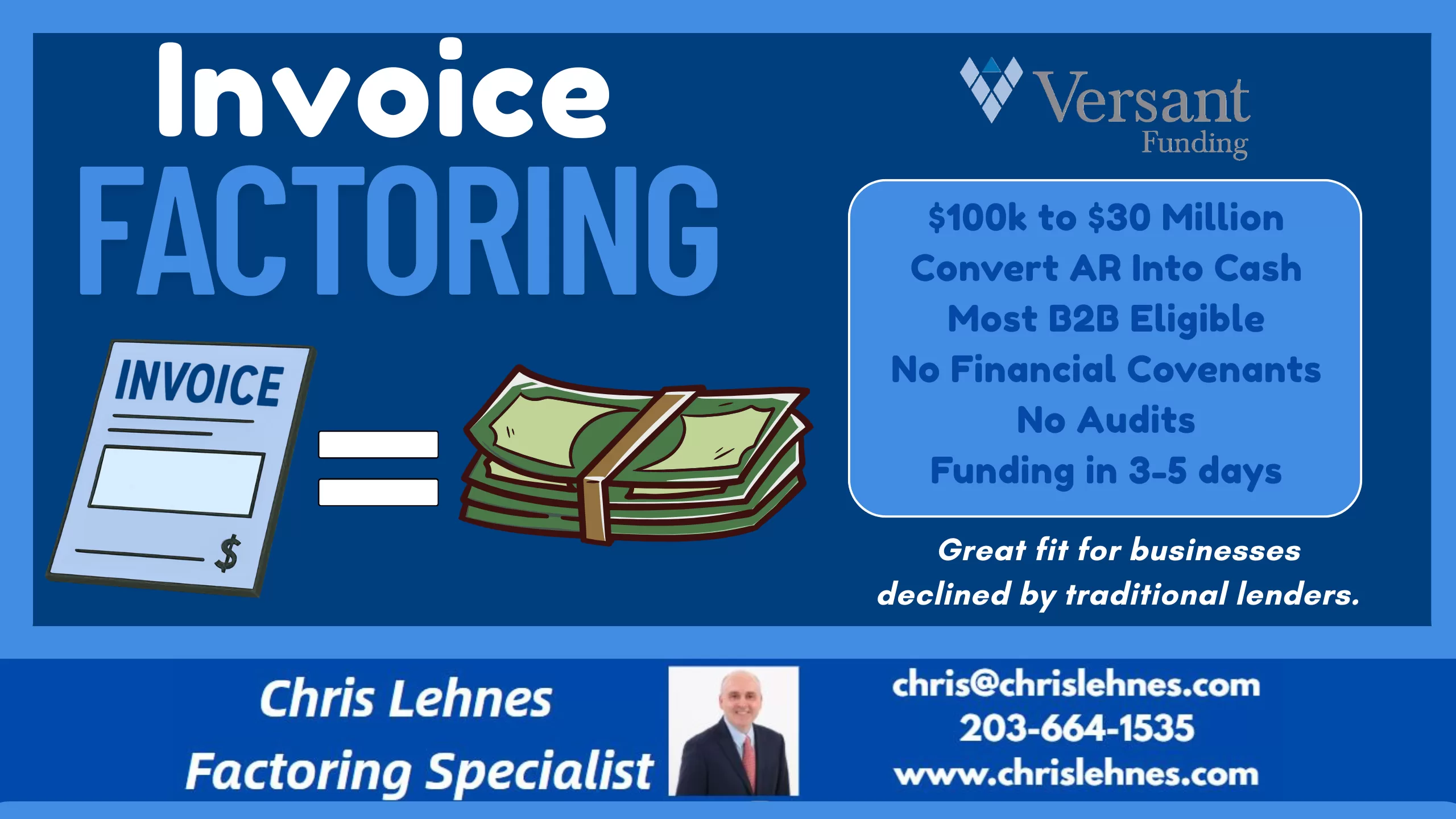
About Versant Funding: Versant Funding’s custom Non-Recourse Factoring Facilities have been designed to fill a void in the market by focusing exclusively on the credit quality of a company’s accounts receivable. Versant Funding offers non-recourse factoring solutions to companies with B2B or B2G sales from $100,000 to $30 Million per month. All we care about is the credit quality of the A/R. To learn more contact: Chris Lehnes|203-664-1535 | chris@chrislehnes.com

ABL Advisor: Versant Funds $1.4MM Non-Recourse Factoring Facility to Manufacturer

ABF Journal: Versant Funding Provides $1.4MM Factoring Facility to Manufacturer

LinkedIn Newsletter: Just Funded! $1.4 Million Non-Recourse Factoring to Manufacturer

Secured Finance Network: Versant Funds $1.4 Million Non-Recourse Factoring Facility to Manufacturer

IFA Commercial Factor: Versant Funds $1.4 Million Non-Recourse Factoring Facility to Manufacturer

CT Turnaround Management Association: Member News – Versant Funds $1.4 Million to Manufacturer

Factoring Myths vs. Reality: Clearing the Air

Factoring Myths vs. Reality: Clearing the Air

For many distributors, the word “factoring” carries some outdated baggage. If you’re hesitant to pull the trigger, it’s likely because of one of these common misconceptions. Let’s separate the noise from the facts:

The MythThe Reality
“Factoring is a sign of financial trouble.”Factoring is a sign of growth. Most companies use factoring because they are growing too fast for their cash flow to keep up. It’s a strategic choice to fuel expansion, not a last-ditch effort to stay afloat.
“My customers will think I’m going under.”It’s a standard B2B practice. Major retailers and manufacturers deal with factors every day. In many industries, like apparel or electronics distribution, it’s actually the “gold standard” for managing receivables.
“It’s way too expensive.”Look at the ROI. While the fee (1–3%) is higher than a bank loan, the “cost of waiting” 60 days for a check often means missing out on new inventory or early-pay discounts from your own suppliers that could actually save you more than the factoring fee.
“I’ll lose control of my customer relationships.”You stay in the driver’s seat. Modern factoring companies act as a professional extension of your back office. They want your customers to stay happy so they keep buying (and paying). You still manage the sales and service; they just handle the math.
“It’s just like a high-interest loan.”It’s not a loan at all. Because you are selling an asset (your invoice), you aren’t taking on debt. There are no monthly principal or interest payments to worry about—the “payment” comes from your customer, not your bank account.

The “Silent” Benefit: Professional Credit Checks

One “Reality” that distributors often overlook is that a factor acts as a free credit department. Before you ship $50,000 worth of goods to a new client, you can ask your factor to check their credit. If the factor won’t buy the invoice, that’s a massive red flag that you probably shouldn’t be selling to that customer on terms in the first place.

Contact Factoring Specialist, Chris Lehnes

Why Distributors are Embracing AR Factoring

What is Factoring: In the world of distribution, the “growth paradox” is a real headache. You land a massive new retail contract—which is great news—but suddenly you’re shelling out for inventory and shipping costs while your customer sits on a 60- or 90-day payment term.

For many distributors, waiting for those invoices to clear creates a suffocating bottleneck. This is where Accounts Receivable (AR) Factoring comes in. It’s not a loan; it’s a financial tool that turns your unpaid invoices into immediate working capital.


How It Works: The Quick Breakdown

Instead of waiting months for a customer to pay, you sell your outstanding invoices to a “factor” (a specialized financial company).

  1. The Advance: The factor typically advances you 80% to 90% of the invoice value within 24 hours.
  2. The Collection: The factor handles the collection from your customer.
  3. The Rebate: Once the customer pays, the factor sends you the remaining balance, minus a small fee (usually 1–3%).

4 Major Benefits for Distributors

1. Bridge the Inventory Gap

Distributors often have to pay suppliers long before they get paid by their own clients. Factoring provides the liquidity to pay your manufacturers upfront, often allowing you to take advantage of early-payment discounts that can actually offset the cost of the factoring fee itself.

2. Fuel Rapid Scalability

Traditional bank loans are limited by your credit history or collateral. Factoring, however, scales with your sales. The more you sell to reputable customers, the more funding becomes available. It allows you to say “yes” to large orders that you otherwise couldn’t afford to fulfill.

3. Professional Credit Management

Many factoring companies act as an extension of your back office. They perform credit checks on your potential customers, helping you avoid “bad seeds” before you ship a single pallet. This reduces your risk of bad debt and saves your team the awkwardness of making collection calls.

4. No New Debt

Since factoring is the purchase of an asset (your invoice) rather than a loan, it doesn’t show up as debt on your balance sheet. This keeps your debt-to-equity ratio clean, making your business look much healthier to future investors or traditional lenders.


Is It Right For You?

Factoring is particularly powerful if you are:

  • A startup with a thin credit history but blue-chip customers.
  • Experiencing seasonal spikes that drain your cash reserves.
  • Tired of the “waiting game” associated with 30, 60, or 90-day terms.

While there is a cost involved, the ability to reinvest that cash immediately into new inventory or operations often outweighs the fee. In the fast-moving world of distribution, speed is a competitive advantage.

Factoring vs. A Traditional Line of Credit: A Distributor’s Comparison

While both tools solve cash flow problems, they operate very differently. Here is how they stack up for a growing distributor:

FeatureAR FactoringTraditional Bank Line of Credit (LOC)
Funding Limit Based On…The creditworthiness of your customers and your accounts receivable balance.Your business’s credit history, profitability, and your collateral.
Speed of FundingExtremely fast. Setup takes a few days; once active, funding often occurs within 24–48 hours of invoice verification.Slow. The approval process can take weeks or even months.
Debt TypeNot Debt. It is the “asset purchase” of your invoices.Debt. This is a loan that appears as a liability on your balance sheet.
Impact on CreditBoosts Credit Score. It provides cash to pay your suppliers and operational debts on time.Lowers “Available” Credit. Utilizing the full LOC can temporarily lower your score until it’s paid down.
Administrative SupportThe factor often provides credit management and collection services, freeing up your back office.You retain full responsibility for all collections and monitoring customer credit.
ScalabilityUnlimited. As your credit-worthy sales grow, your available funding automatically increases.Capped. Your limit is fixed and requires a re-application process to increase.

Gemini said

Certainly. Here is a comparison table and a section you can drop directly into your blog post.


Factoring vs. A Traditional Line of Credit: A Distributor’s Comparison

While both tools solve cash flow problems, they operate very differently. Here is how they stack up for a growing distributor:

FeatureAR FactoringTraditional Bank Line of Credit (LOC)
Funding Limit Based On…The creditworthiness of your customers and your accounts receivable balance.Your business’s credit history, profitability, and your collateral.
Speed of FundingExtremely fast. Setup takes a few days; once active, funding often occurs within 24–48 hours of invoice verification.Slow. The approval process can take weeks or even months.
Debt TypeNot Debt. It is the “asset purchase” of your invoices.Debt. This is a loan that appears as a liability on your balance sheet.
Impact on CreditBoosts Credit Score. It provides cash to pay your suppliers and operational debts on time.Lowers “Available” Credit. Utilizing the full LOC can temporarily lower your score until it’s paid down.
Administrative SupportThe factor often provides credit management and collection services, freeing up your back office.You retain full responsibility for all collections and monitoring customer credit.
ScalabilityUnlimited. As your credit-worthy sales grow, your available funding automatically increases.Capped. Your limit is fixed and requires a re-application process to increase.

Which One Wins for Distributors?

A bank line of credit is almost always the cheapest form of capital if you can get approved for a large enough limit.

However, for distributors in a hyper-growth phase, or those whose balance sheets don’t match their ambition, AR factoring offers unmatched speed and scalability. It allows you to leverage your customers’ financial strength to fund your own growth.

The Final Verdict: When to Choose Factoring

For a distributor, the choice between factoring and other financing boils down to your growth trajectory and customer base.

A traditional bank line of credit is often the lowest-cost option, but it is also the most rigid. If you have years of steady profitability and a “boring” (predictable) growth curve, the bank is your best friend.

However, AR factoring is the superior choice if:

  • You are growing faster than your cash flow allows: If a sudden 50% increase in orders would actually break your business because you can’t afford the inventory, you need factoring.
  • You have “lumpy” revenue: If you deal with seasonal spikes where you need $500k in October but only $50k in January, the flexibility of factoring is unmatched.
  • Your customers are larger than you: If you are a small distributor selling to giants like Walmart or Amazon, a factor will look at their multi-billion-dollar credit rating to fund you, rather than your own limited history.

Ultimately, factoring isn’t just a way to get paid early—it’s a way to weaponize your accounts receivable to outmaneuver competitors who are still stuck waiting for a check in the mail.

Contact Factoring Specialist, Chris Lehnes

Announcement: Versant Funds $5 Million Factoring Facility to 90 Year Old Service Provider

(March 19, 2026) Versant Funding LLC is pleased to announce that it has funded a $5 Million non-recourse factoring facility to a 90+ year-old company that provides services to major consumer brands.

After acquisition by a Private Equity Group, our latest client’s new management team implemented a turnaround plan which required additional cash.  While the company was in the process of applying for an asset-based line of credit, time was of the essence and a funding date for the ABL facility was uncertain.

“Versant can fund faster than most traditional financing sources because we focus solely on the credit quality of our clients’ customers and do not perform a full underwriting or audit of the business” according to Chris Lehnes, Business Development Officer for Versant Funding, and originator of this financing opportunity. “Since this company’s customers include some of the world’s strongest consumer brands, we quickly approved the transaction and were ready to fund in about a week.”

Versant Funding’s custom Non-Recourse Factoring Facilities have been designed to fill a void in the market by focusing exclusively on the credit quality of a company’s accounts receivable. Versant Funding offers non-recourse factoring solutions to companies with B2B or B2G sales from $100,000 to $30 Million per month. All we care about is the credit quality of the A/R. To learn more contact: Chris Lehnes |203-664-1535 | chris@chrislehnes.com

Press Coverage

SFNET: Versant Funds $5 Million Non-Recourse Factoring Facility to Service Provider

abfjournal: Versant Funds $5MM Non-Recourse Factoring Facility to Service Provider

ABL Advisor: Versant Funds $5MM Non-Recourse Factoring Facility to Service Provider

LinkedIn Newsletter: Announcement: Versant Funds $5 Million Factoring Facility to 90 Year Old Service Company

IFA Commercial Factor: Versant Funds $5 Million Non-Recourse Factoring Facility to Service Provider

Cracking the Confounding Code on Credit Union Business Loans

Credit Union Business Loans

List of all credit unions in US

The first few warm days of spring mean flowers, baseball, and for many small business owners in March 2026, the annual financial checkup. If you’ve looked at your numbers and realized you need a cash injection for new equipment, that third location, or an aggressive inventory build, you know the drill: It’s time to find the capital. While large national banks are the obvious choice, they are often difficult, impersonal, and slow. By comparison, credit unions have become the unexpected superstars of commercial lending, especially for small and medium-sized enterprises (SMEs).

If you are hunting for a business loan this month, you need to understand why credit unions are dominating and how to find the one that will actually make that critical “yes” happen for your business.

The Not-So-Secret Advantage of the Member-Owner

To understand why credit unions often beat banks on business lending, you have to look at their structure.

Banks answer to shareholders who demand profits and high returns on equity. Every decision, including who gets a loan, is filtered through the lens of maximizing shareholder value.

Credit unions, however, are not-for-profit cooperatives. They do not have public stock. Their members (you, me, and other account holders) are the owners.

This single difference ripples through every interaction. For business lending in 2026, it means:

  • 1. Rates and Fees That Just Make More Sense: Instead of returning profit to Wall Street, credit unions reinvest earnings back into the institution and their members. This often manifests as lower interest rates on commercial loans and significantly lower loan-origination and maintenance fees. In 2026, when inflation has been a recent headache, a difference of 0.5% on a large loan term can mean thousands of dollars saved.
  • 2. Hyper-Local Expertise: When you sit down with a commercial lender at a bank, their rules, algorithms, and models might be set at headquarters 2,000 miles away. They may not understand the specific micro-market in Newtown, Connecticut, where you are operating. But your local credit union officer lives here. They understand why opening a second pizza parlor on the new development is a smart bet, not a risky venture. They lend based on local market knowledge.
  • 3. Relationships Over Risk-Scores: A bank will look at your credit score and financial statements, enter them into a model, and receive a automated “Approve” or “Deny.” Credit unions, especially smaller, focused ones, prioritize relationships. They are more likely to have a real human look at your complete business plan, understand your unique vision, and listen to the story behind your application, not just the numbers on the page.

The “New Reality” of SBA Lending

One of the most important developments in 2026 is that the Small Business Administration (SBA) has made it significantly easier and faster for credit unions to facilitate SBA 7(a) and 504 loans.

For many small businesses, these government-backed loans are the Holy Grail: long terms, lower interest rates, and lower down-payment requirements. Previously, massive banks dominated this space because the paperwork was crushing.

However, the “Streamline and Connect Act” of 2024 (as we projected) drastically simplified the SBA application process and created digital interfaces specifically designed for smaller community financial institutions.

This means that in March 2026, the local credit union you never expected to handle an SBA application is now a Preferred Lender, capable of getting your government-backed loan approved in weeks, not months.

How to Evaluate a Credit Union in March 2026

You can’t just walk into the nearest credit union and expect a perfect loan offer. To find the “best” one for your business right now, you must be strategic:

Step 1: Membership Criteria (The Gateway)

Credit unions can’t just lend to anyone. They operate under a specific “field of membership” (FOM). While some have broadened their charters, many are still strictly limited. To find the “best,” you must find the one you can actually join.

  • Geographic FOM: Are you eligible because your business is located in Newtown, CT, or the surrounding county? This is the most common path.
  • Associational or Professional FOM: Are you a veteran? An educator? A first responder? A member of a specific local church or union? There are niche credit unions specialized for these groups, and they often offer highly beneficial industry-specific lending programs.

Step 2: Technology and Speed

While personal relationships are the hallmark of credit unions, it’s 2026. You should not have to wait 30 days for a response to your application. A strong, business-friendly credit union will have a fast, streamlined digital application portal.

They should have digital tools that connect directly to your accounting software (like QuickBooks or Xero), allowing their lenders to instantly verify your cash flow without forcing you to hunt down piles of paper bank statements. If a credit union’s website looks like it hasn’t been updated since 2018, that is a massive red flag.

Step 3: Ask About Specific Business Expertise

The credit union that is excellent for a car loan or a personal mortgage is not necessarily the best choice for a $500,000 commercial line of credit to finance inventory for a manufacturing business.

When you interview a prospective credit union, ask about their experience in your industry. A credit union that specializes in healthcare practice lending will have different perspectives and better loan structures than one that primarily works with general contractors.

The March 2026 Takeaway: Don’t Lead with a Bank

Your default shouldn’t be the massive financial conglomerate that you can only reach via an 800-number. Your first stop in 2026 should be your local, community-focused credit union. They are built to serve owners like you, and they have the tools and local knowledge to help your business take flight this spring.

If traditional financing is unavailable to you, contact factoring specialist, Chris Lehnes to learn if your business is a factoring fit.

The Impact of Pump Shock on Small Business

While the macro economy is feeling the “pump shock,” the impact on small business lending and accounts receivable (AR) factoring is more nuanced. For many industries, rising oil prices act as a catalyst for alternative financing, as traditional bank credit tends to tighten just when operational costs spike.

1. Impact on Small Business Lending

Traditional bank lending to small businesses is becoming more restrictive as energy-driven inflation persists.

  • The “Double Squeeze”: Small businesses are facing higher input costs (fuel/transport) alongside high interest rates. Banks, wary of compressed profit margins, are increasing their underwriting scrutiny.
  • The Approval Gap: As of early 2026, large banks are approving only about 68% of small business loans, compared to 82% at smaller, community-focused institutions.
  • Pivot to High-Cost Credit: With traditional loans taking weeks to approve, many businesses are turning to credit cards (averaging 18%–36% interest) to cover immediate fuel and supply chain gaps, significantly increasing their long-term debt burden.

2. The Surge in AR Factoring Demand

In a high-oil-price environment, factoring often shifts from a “last resort” to a strategic cash-flow tool, particularly for energy-intensive sectors.

  • Fuel as a Fixed, Immediate Expense: In industries like trucking and oilfield services, fuel must be paid for daily or weekly, while customers (shippers or large operators) often demand 30- to 90-day payment terms. Factoring bridges this “cash gap” without adding traditional debt to the balance sheet.
  • Sector-Specific Trends:
    • Transportation/Trucking: Factoring companies are seeing record demand. These businesses often enjoy the highest advance rates (90%–97%+) because their invoices are backed by tangible freight delivery.
    • Oilfield Services: As drilling activity ramps up in response to higher prices (especially in the Permian Basin), service providers are using factoring to scale quickly—buying new equipment or meeting surge payroll without waiting for 60-day payouts from major oil producers.
    • Manufacturing: With raw material costs rising alongside energy, manufacturers are factoring invoices to maintain liquidity reserves to buy inventory before prices hike further.

Factoring vs. Traditional Lending in 2026

FeatureTraditional Bank LoanAR Factoring
Approval BasisBusiness credit & historyCustomer (Debtor) credit
Speed of Funding2 – 7 weeks24 – 48 hours
Debt LoadIncreases liability on balance sheetNo new debt (selling an asset)
ScalabilityFixed limitGrows with your sales volume
CostLower interest (6%–12%)Higher fees (1%–5% per 30 days)

Strategic Outlook

For the remainder of 2026, businesses that rely on “floating” cash flow are likely to prioritize speed over cost. While factoring fees are higher than bank interest, the ability to access cash within 24 hours to pay for $4.00/gallon diesel is often the difference between staying operational and grounding a fleet.

In a volatile economy where oil prices are surging and traditional banks are pulling back, choosing the right financing tool is a high-stakes decision. For B2B businesses—especially those in staffing, digital marketing, and manufacturing—the choice often comes down to the speed of Factoring versus the lower cost of a Bank Loan.

Below is a strategic comparison designed to help you evaluate which path aligns with your current cash flow needs.


Factoring vs. Bank Loans: 2026 Strategic Comparison

FeatureAccounts Receivable FactoringTraditional Bank Loan
Speed to CashUltra-Fast: Funds usually arrive within 24–48 hours after invoice setup.Slow: Approval typically takes 30–90 days of underwriting.
Credit FocusThe Debtor: Decisions are based on your customer’s credit and payment history.The Business: Based on your FICO score, tax returns, and years in business.
Balance SheetDebt-Free: It is the sale of an asset (invoices), not a liability.Debt-Heavy: Adds a liability that can impact your debt-to-income ratio.
ScalabilityUnlimited: As your sales grow, your available cash grows automatically.Fixed: You are capped at a set amount and must re-apply to increase it.
Total CostHigher Fees: Usually 1%–5% per 30 days (effective APR is higher).Lower Rates: Typically 6%–12% APR for qualified businesses.
RiskLow: No collateral like your house or equipment is typically required.High: Often requires a blanket lien on assets or personal guarantees.

Export to Sheets


The “Why Now?” Factor: Navigating 2026 Volatility

Pros of Factoring in This Market

  • Immediate Fuel/Supply Buffer: With diesel prices fluctuating, factoring gives you the cash today to buy inventory or fuel before the next price hike.
  • Protects Your Growth: In sectors like digital marketing or staffing, you can’t wait 60 days for a client to pay to meet your weekly payroll. Factoring ensures your team stays paid regardless of when the client cuts the check.
  • No “Covenant” Stress: Bank loans often come with strict “covenants” (rules about your profit margins). If high oil prices temporarily squeeze your margins, a bank might call your loan; a factor simply keeps funding your sales.

Cons to Consider

  • Margin Impact: If your profit margins are already thin (common in food production or distribution), the 1%–3% factoring fee could eat up a significant portion of your net income.
  • Customer Perception: While widely accepted today, some ultra-conservative clients might still prefer to pay you directly rather than a third-party factor.

The Bottom Line

If you have long-term stability and time to wait, a Bank Loan is cheaper. However, if you are growing rapidly or facing unpredictable costs, Factoring acts as a flexible insurance policy for your cash flow.


Contact Factoring Specialist, Chris Lehnes

Factoring Proposal – $3 Million – Apparel Distributor – Quick Cash to Recover

Factoring Proposal: After recently recovering from the devasting impacts of tariffs, this company requires PO financing to rebuild inventory. Their existing factor is uncooperative and must be replaced by Versant which has the ability to facilitate PO funding though a trusted partner.

Contact Factoring Specialist, Chris Lehnes

Factoring Proposal Issued: $600,000 Candy Importer | Non-Recourse

Factoring Proposal: With only a single major distributor as customer, this business was unable to find a lender willing to fund them. Our underwriting focuses solely on the quality of our client’s customer so time in business and customer concentration are irrelevant.

In the world of candy importing, timing is everything. You have to navigate seasonal peaks (think Halloween and Valentine’s Day), manage international shipping lead times, and juggle the demands of large retailers.

However, there is often a massive gap between the moment your colorful shipments clear customs and the moment your retail partners actually pay their invoices. If your capital is trapped in Accounts Receivable (AR), you might find yourself unable to jump on the next big inventory opportunity.

This is where Accounts Receivable Factoring—also known as invoice factoring—becomes a game-changer.


What Exactly is Factoring?

Factoring isn’t a loan; it’s the sale of your assets. You sell your outstanding invoices to a “factor” (a specialized financial company) at a slight discount. In return, you get immediate access to the cash that was previously tied up for 30, 60, or even 90 days.

1. Navigating the Seasonal Rush

Candy is a highly seasonal business. To prepare for the “Big Three”—Halloween, Christmas, and Easter—importers must place massive orders months in advance.

  • The Problem: Your cash is tied up in invoices from the previous season while you need to pay suppliers for the next one.
  • The Factoring Fix: By factoring current invoices, you get an immediate cash injection to cover manufacturing and shipping costs for upcoming peak periods, ensuring you never miss a shelf-stocking deadline.

2. Negotiating Supplier Discounts

When you have “cash in hand” thanks to factoring, you move to the front of the line with global suppliers. Many international manufacturers offer early payment discounts (e.g., a 2% discount if paid within 10 days).

  • The small fee you pay for factoring is often completely offset by the discounts you earn from your suppliers by paying them early.

3. Taking on Larger Retailers

Big-box retailers are great for volume, but they are notorious for long payment terms. If a major chain wants to place a massive order but won’t pay for 90 days, a small-to-medium importer might have to say “no” simply because they can’t afford to wait that long for the payout.

  • Factoring provides the “bridge” capital. You can fulfill the order, factor the invoice the day the candy ships, and have the funds to keep the rest of your business running smoothly.

4. Outsourcing the “Headache” of Collections

Many factoring companies handle the back-end credit checking and collections process. For a lean importing team, this is a massive relief.

  • The factor vets the creditworthiness of your customers before you even ship, reducing your risk of “bad debt” and allowing you to focus on sourcing the best sweets rather than chasing down checks.

Summary of Benefits

FeatureImpact on Your Candy Business
Immediate CashBuy inventory for the next holiday season without waiting.
No New DebtFactoring is an asset sale, not a bank loan with monthly interest.
Credit ProtectionMany factors provide credit snapshots of your retail partners.
ScalabilityThe more you sell, the more funding becomes available.

Is Factoring Right for You?

If your candy importing business is growing faster than your bank account can keep up with, factoring provides the liquidity to keep your momentum. It turns your “sold” inventory back into “buying” power instantly.

Contact Factoring Specialist, Chris Lehnes

Factoring: Funding the Energy Industry

Our Accounts Receivable Factoring program can quickly meet the working capital needs of businesses in the energy industry.

Versant’s underwriting focus is solely on the quality of a company’s accounts receivable, which enables us to rapidly fund businesses which do not qualify for traditional lending.

Factoring Program Overview

  • $100,000 to $30 Million
  • Non-recourse
  • Flexible Term
  • Ideal for B2B or B2G

We fund challenging deals:

  • Start-ups
  • Losses
  • Highly Leveraged
  • Customer Concentrations
  • Weak Personal Credit
  • Character Issues

In about a week, we can advance against accounts receivable to qualified manufacturers, distributors or service providers in the energy sector.

Contact me today to learn if your client could benefit.

Factoring Press Release: Versant Funds $5 Million Non-Recourse Factoring

Factoring Press Release : Versant Funds $5 Million Non-Recourse Factoring Facility to Manufacturer

(January 27, 2026) Versant Funding LLC is pleased to announce that it has funded a $5 Million non-recourse factoring facility to a company that manufactures products for a large customer base which includes one of America’s largest municipalities.

After a transition to Private Equity ownership and management restructuring, our newest client required an infusion of working capital to meet an urgent cash need. While the company has hundreds of customers with AR outstanding, the most efficient way to fund was to factor only the AR of their largest customer, but most factoring companies would not permit 100% customer concentration.

“Versant focuses solely on the credit quality of our clients’ customers,” according to Chris Lehnes, Business Development Officer for Versant Funding, and originator of this financing opportunity. “Since the company’s largest account is a large US city, we were willing to allow 100% customer concentration and meet the client’s short-term funding need.”

About Versant Funding

Versant Funding’s custom Non-Recourse Factoring Facilities have been designed to fill a void in the market by focusing exclusively on the credit quality of a company’s accounts receivable. Versant Funding offers non-recourse factoring solutions to companies with B2B or B2G sales from $100,000 to $30 Million per month. All we care about is the credit quality of the A/R. To learn more contact: Chris Lehnes | 203-664-1535 | chis@chrislehnes.com

Key Benefits of this Non-Recourse Factoring Deal:

  • Immediate Cash Flow: The manufacturer gains immediate access to working capital by selling its invoices to Versant Funding, significantly improving liquidity.
  • Mitigation of Customer Concentration Risk: By utilizing non-recourse factoring, Versant Funding assumes the credit risk associated with the manufacturer’s customer, protecting the manufacturer from potential bad debt.
  • Support for Growth: The increased cash flow will enable the manufacturer to invest in new equipment, expand production, take on larger orders, and capitalize on new market opportunities.
  • Operational Efficiency: The manufacturer can focus on its core business operations and production, knowing its cash flow is stable and predictable.
  • Flexible and Scalable: The factoring facility is designed to grow with the manufacturer’s sales, providing ongoing access to capital as their business expands.