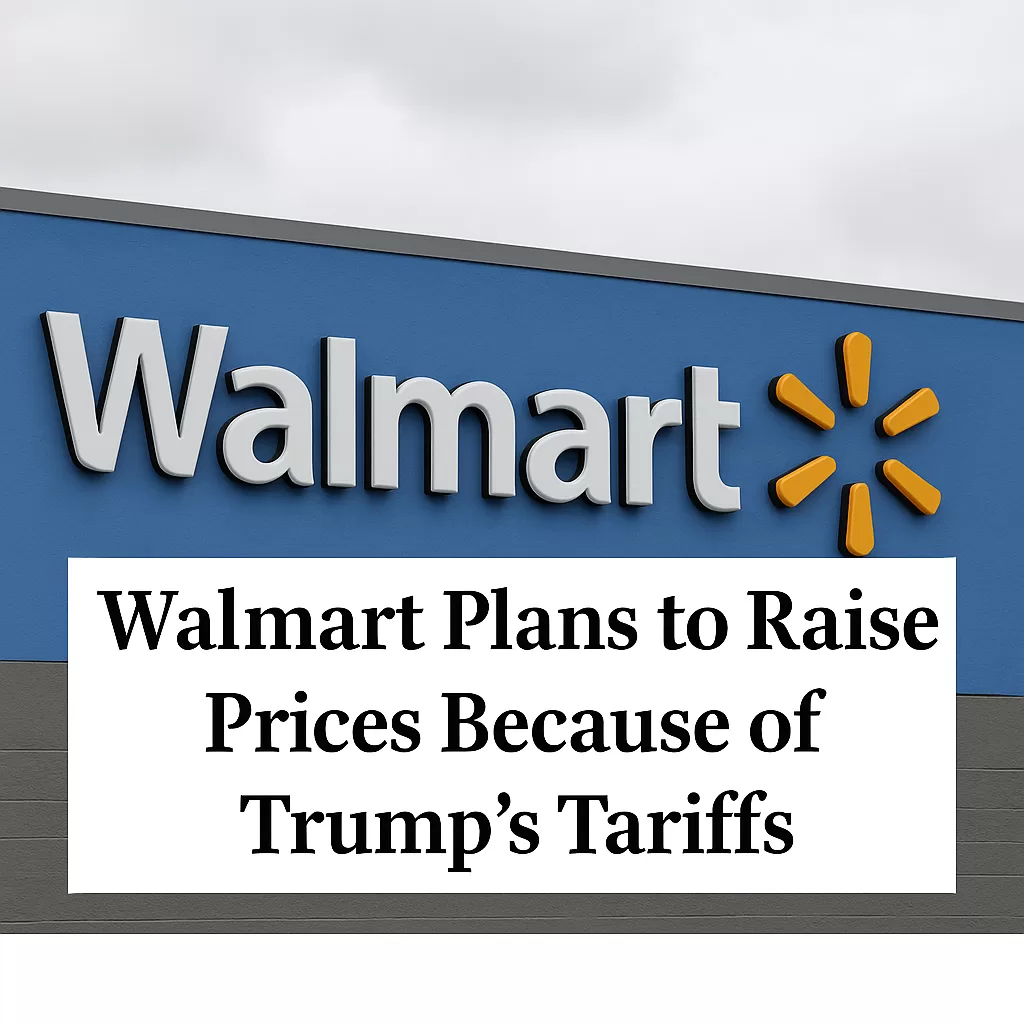
Walmart Plans Increase to Prices Due to Trump Tariffs
Walmart, the world’s largest retailer, announced on Thursday that it will begin raising prices later this month in response to increased import tariffs imposed by President Donald Trump’s administration. The company cited the significant impact of these tariffs on its supply chain costs, particularly for goods imported from China and other countries.
During an earnings call, Walmart CEO Doug McMillon stated, “We will do our best to keep our prices as low as possible, but given the magnitude of the tariffs, even at the reduced levels announced this week, we aren’t able to absorb all the pressure given the reality of narrow retail margins in retail.”
The Trump administration recently adjusted tariffs on Chinese imports, reducing them from 145% to 30% for a 90-day period. Despite this temporary relief, Walmart indicated that the tariffs still present a substantial cost burden. The company emphasized that while over two-thirds of its U.S. merchandise is made, assembled, or grown domestically, categories such as toys and electronics remain heavily reliant on Chinese imports.
Walmart’s Chief Financial Officer noted that the upcoming price increases are a direct result of the elevated costs associated with these tariffs. The company is striving to mitigate the impact on consumers, particularly in essential categories like food, but acknowledged that some cost increases are unavoidable.
In its first-quarter earnings report, Walmart posted strong sales figures, with a 4.5% growth in same-store sales. However, the company experienced a slight decline in profit margins, attributed in part to the increased costs from tariffs. Walmart maintained its full-year sales guidance but refrained from providing a profit outlook for the second quarter, citing the ongoing uncertainty surrounding trade policies.
The broader economic impact of the tariffs is also a concern. A report from Yale’s Budget Lab estimated that the average American household could face up to $4,900 in additional annual grocery expenses due to the tariffs, with lower-income families bearing the brunt of these increases.
As Walmart navigates these challenges, the company continues to explore strategies to minimize the impact on consumers, including diversifying its supply chain and negotiating with suppliers. Nevertheless, the retailer’s announcement underscores the tangible effects of trade policies on consumer prices and the broader retail industry.
Direct Impact of Tariffs on Walmart’s Supply Chain and Costs: The source highlights how the tariffs significantly increased Walmart’s costs, particularly for goods imported from China and other countries.
Walmart’s Decision to Raise Prices: As a direct consequence of increased costs, Walmart announced plans to raise prices on certain goods.
Limited Ability to Absorb Costs: Despite efforts to maintain low prices, Walmart indicated that the magnitude of the tariffs made it impossible to fully absorb the cost increases due to narrow retail margins.
Dependence on Imports for Specific Categories: While a majority of Walmart’s merchandise is domestically sourced, categories like toys and electronics remain heavily reliant on Chinese imports, making them particularly vulnerable to tariff impacts.
Broader Economic Impact on Consumers: The tariffs are projected to lead to significant increases in household expenses, especially for lower-income families.
Ongoing Uncertainty Regarding Trade Policies: The source notes that uncertainty surrounding trade policies continues to impact Walmart’s financial outlook.
Most Important Ideas/Facts:
Walmart is raising prices due to tariffs: The central fact is Walmart’s announcement that it will increase prices later in the month as a direct response to the import tariffs.
Impact on supply chain costs: The source explicitly states that the tariffs have a “significant impact of these tariffs on its supply chain costs.”
CEO’s statement on price increases and margins: Walmart CEO Doug McMillon is quoted stating, “We will do our best to keep our prices as low as possible, but given the magnitude of the tariffs, even at the reduced levels announced this week, we aren’t able to absorb all the pressure given the reality of narrow retail margins in retail.” This emphasizes the necessity of the price increases and the difficulty of absorbing the costs.
Tariff reduction but continued burden: While tariffs were reduced from 145% to 30% for a 90-day period, Walmart still considered them a “substantial cost burden.”
Reliance on Chinese imports for certain goods: Categories such as “toys and electronics remain heavily reliant on Chinese imports,” making them susceptible to the tariffs.
Financial performance affected by tariffs: Walmart’s first-quarter earnings showed strong sales growth but a “slight decline in profit margins, attributed in part to the increased costs from tariffs.”
Significant projected impact on household expenses: A report from Yale’s Budget Lab estimated that the average American household could face “up to $4,900 in additional annual grocery expenses due to the tariffs, with lower-income families bearing the brunt of these increases.” This highlights the broader societal cost.
Uncertainty for future outlook: The company refrained from providing a second-quarter profit outlook, citing “the ongoing uncertainty surrounding trade policies.”
Key Quotes:
“We will do our best to keep our prices as low as possible, but given the magnitude of the tariffs, even at the reduced levels announced this week, we aren’t able to absorb all the pressure given the reality of narrow retail margins in retail.” – Walmart CEO Doug McMillon
“…the significant impact of these tariffs on its supply chain costs…”
“…categories such as toys and electronics remain heavily reliant on Chinese imports.”
“…the average American household could face up to $4,900 in additional annual grocery expenses due to the tariffs, with lower-income families bearing the brunt of these increases.”
Conclusion:
The source clearly demonstrates the direct impact of the Trump administration’s import tariffs on a major retailer like Walmart. The tariffs are increasing supply chain costs to a degree that forces the company to raise prices, even after some temporary reductions. This decision, coupled with projected increases in household expenses, underscores the tangible economic consequences of these trade policies on both businesses and consumers, particularly lower-income families. The ongoing uncertainty surrounding trade policies also poses a challenge for Walmart’s future financial planning.\
Study Guide: Analyzing the Impact of Tariffs on Walmart
Quiz
Why is Walmart planning to increase prices?
What specific categories of goods are heavily impacted by the tariffs for Walmart?
What is the primary reason cited by Walmart’s CEO for not fully absorbing the tariff costs?
How much did the Trump administration temporarily reduce the tariffs on Chinese imports?
Did Walmart’s same-store sales increase or decrease in the first quarter?
What impact did the tariffs have on Walmart’s profit margins in the first quarter?
Why did Walmart refrain from providing a profit outlook for the second quarter?
According to Yale’s Budget Lab, how much could tariffs potentially add to the average American household’s annual grocery expenses?
Which demographic group is estimated to be most affected by the potential grocery cost increases?
What are some strategies Walmart is exploring to mitigate the impact of tariffs?
Answer Key
Walmart is planning to increase prices in response to increased import tariffs imposed by the Trump administration.
Categories such as toys and electronics remain heavily reliant on Chinese imports, making them heavily impacted by the tariffs.
The primary reason cited by Walmart’s CEO is that they are unable to absorb all the pressure from the tariffs due to the reality of narrow retail margins.
The Trump administration temporarily reduced the tariffs on Chinese imports from 145% to 30%.
Walmart’s same-store sales increased by 4.5% in the first quarter.
Walmart experienced a slight decline in profit margins in the first quarter, attributed in part to the increased costs from tariffs.
Walmart refrained from providing a profit outlook for the second quarter due to the ongoing uncertainty surrounding trade policies.
According to Yale’s Budget Lab, tariffs could potentially add up to $4,900 in additional annual grocery expenses for the average American household.
Lower-income families are estimated to bear the brunt of these potential grocery cost increases.
Some strategies Walmart is exploring include diversifying its supply chain and negotiating with suppliers.
Essay Questions
Analyze the short-term and potential long-term economic consequences of tariffs on large retailers like Walmart, as described in the source.
Discuss the implications of Walmart’s decision to raise prices on consumer behavior and the broader retail landscape.
Evaluate the effectiveness of the temporary tariff reduction on mitigating the cost burden for companies like Walmart.
Explain how the reliance on international supply chains, particularly for specific product categories, makes companies vulnerable to changes in trade policies.
Based on the information provided, predict the potential challenges and opportunities for Walmart as it continues to navigate the effects of trade policies.
Glossary of Key Terms
Tariffs: A tax or duty to be paid on a particular class of imports or exports. In this context, it refers to taxes imposed by the U.S. government on goods imported from other countries.
Supply Chain: The sequence of processes involved in the production and distribution of a commodity. Tariffs directly impact the cost of goods as they move through this chain.
Retail Margins: The difference between the selling price of a product and its cost, expressed as a percentage. Narrow margins mean there is little room to absorb increased costs without raising prices.
Same-Store Sales: A metric used in the retail industry that compares the revenue generated by a retailer’s existing stores over a certain period with the revenue generated by those same stores during a comparable period in the past.
Profit Margins: A profitability metric that represents the percentage of revenue that remains after deducting all costs and expenses.
Trade Policies: Regulations and agreements enacted by governments to influence international trade, such as imposing tariffs or quotas.
Factoring: A financial transaction and a type of debtor finance in which a business sells its accounts receivable (invoices) to a third party (called a factor) at a discount. (Included as it is mentioned in the source, though not central to the tariff discussion).
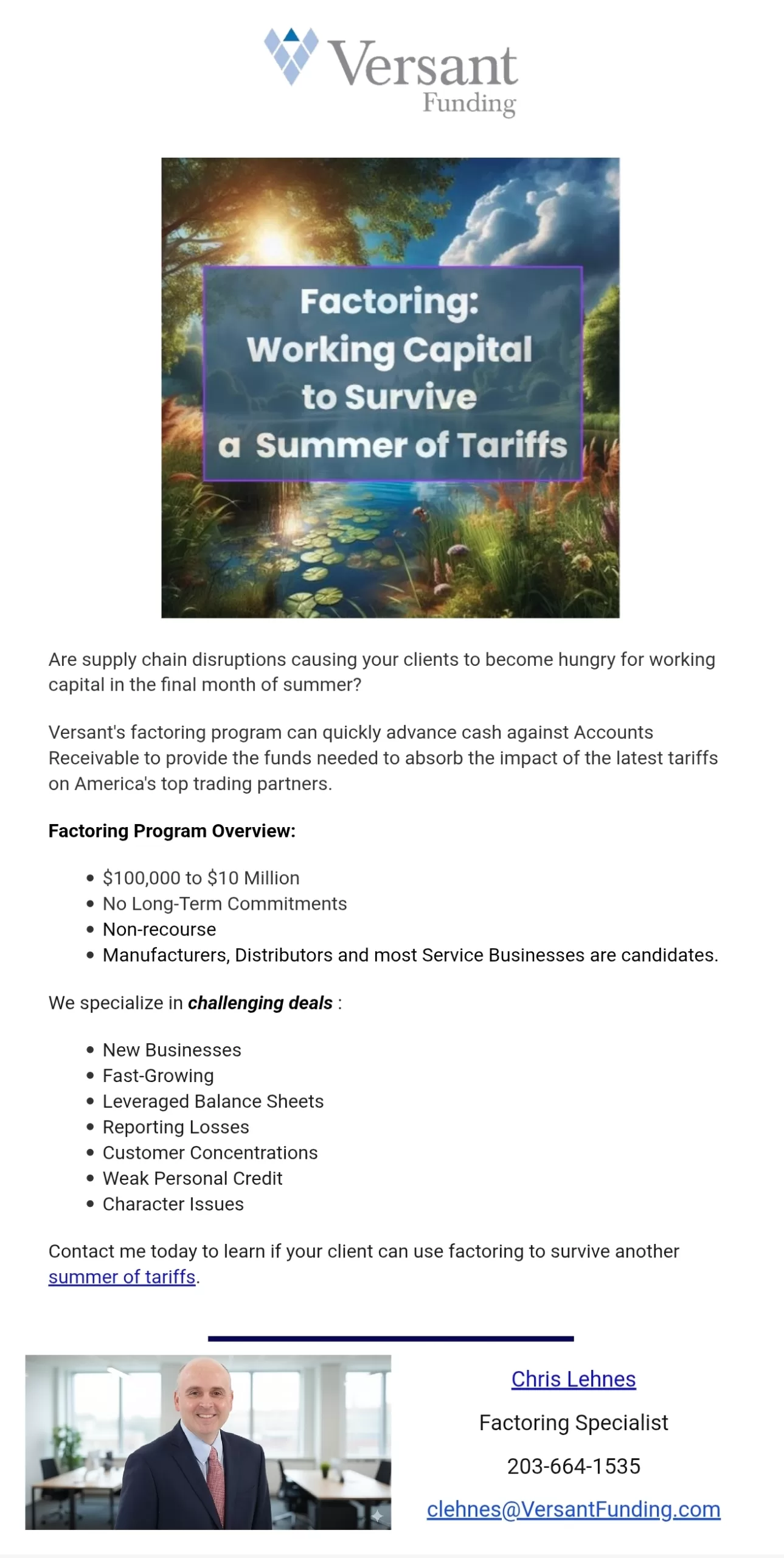
Factoring: Working Capital to Survive a Summer of Tariffs
Are supply chain disruptions causing your clients to become hungry for working capital going into the summer months?
Our non-recourse factoring program can quickly advance against Accounts Receivable to provide the funds needed to help absorb the impact of tariffs on all of America’s trading partners.
The Problem: Supply chain disruptions and the impact of tariffs on “America’s trading partners” are creating a need for working capital among businesses.
The Solution: Factoring, specifically non-recourse factoring, is presented as a method to quickly acquire needed funds.
Mechanism: The factoring program involves advancing funds against a company’s accounts receivable.
Target Audience: The program is suitable for Manufacturers, Distributors, and most Service Businesses.
Flexibility and Accessibility: The program is designed to be flexible, with no long-term commitments, and is particularly focused on helping businesses facing challenges that might make traditional financing difficult.
Most Important Ideas/Facts:
Factoring as a Response to Tariffs: The core argument is that factoring can help businesses “absorb the impact of tariffs” by providing necessary working capital.
Non-Recourse Factoring: The program specifically offers non-recourse factoring, which means the factor assumes the risk of non-payment by the client’s customers. This is a significant point for businesses concerned about customer creditworthiness.
Range of Funding: The program offers funding from “$100,000 to $30 Million,” indicating it can cater to a variety of business sizes.
Focus on “Challenging Deals”: Lehnes explicitly specializes in and lists several types of “challenging deals” that they are willing to consider. This is a key differentiator and suggests the program is aimed at businesses that may not qualify for conventional loans.
Quick Access to Funds: The phrasing “quickly advance against Accounts Receivable” implies that accessing funds through this program is a relatively fast process.
Supporting Quotes:
“Are supply chain disruptions causing your clients to become hungry for working capital going into the summer months?” (Highlights the problem)
“Our non-recourse factoring program can quickly advance against Accounts Receivable to provide the funds needed to help absorb the impact of tariffs…” (Presents the solution and its mechanism)
“No Long-Term Commitments” (Emphasizes program flexibility)
“We specialize in challenging deals:” followed by a list of specific difficulties (Highlights the target demographic and program focus)
“…use factoring to survive a summer of tariffs.” (Reinforces the program’s purpose in the context of the prevailing economic climate)
Further Considerations:
While the source is brief, it effectively communicates the value proposition of Lehnes’ factoring program for businesses under pressure from tariffs and supply chain issues. It specifically targets companies facing financial or operational challenges, positioning factoring as an alternative funding source when traditional options may be unavailable. The emphasis on “non-recourse” is a crucial selling point for potential clients. The document is primarily promotional and would require further inquiry to understand the specific terms, fees, and application process.
Factoring: Working Capital to Survive a Summer of Tariffs Study Guide
Quiz
What specific financial challenge facing clients does this article highlight as a potential reason to consider factoring?
What type of factoring program is specifically mentioned in the article?
What is the range of funding typically offered by this factoring program?
Does this factoring program require long-term commitments?
What types of businesses are listed as potential candidates for factoring?
What specific types of “challenging deals” does this factoring specialist claim to handle?
How can factoring help businesses absorb the impact of tariffs?
What is the primary asset advanced against in this factoring program?
Who is the contact person mentioned for inquiries about factoring?
What is one example of a “challenging deal” related to a company’s financial statements?
Quiz Answer Key
The article highlights supply chain disruptions causing clients to be in need of working capital, particularly going into the summer months.
The article specifically mentions a non-recourse factoring program.
The factoring program typically offers funding ranging from $100,000 to $30 million.
No, this factoring program does not require long-term commitments.
Manufacturers, Distributors, and most Service Businesses are listed as potential candidates.
This specialist claims to handle challenging deals such as new businesses, fast-growing companies, leveraged balance sheets, reporting losses, customer concentrations, weak personal credit, and character issues.
Factoring can help businesses absorb the impact of tariffs by providing quick access to funds advanced against Accounts Receivable.
The primary asset advanced against in this factoring program is Accounts Receivable.
The contact person mentioned for inquiries about factoring is Chris Lehnes.
Reporting Losses is one example of a “challenging deal” related to a company’s financial statements.
Essay Questions
Analyze how supply chain disruptions can create a need for working capital and explain how factoring can address this need, particularly in the context of increased tariffs.
Compare and contrast recourse and non-recourse factoring based on the information provided in the article and discuss the potential advantages of a non-recourse program for businesses facing economic uncertainty.
Discuss the types of businesses that are likely to benefit most from factoring, citing examples from the article, and explain why factoring might be a suitable solution for these specific business models.
Evaluate the significance of a factoring specialist’s willingness and ability to handle “challenging deals.” How does this broaden the potential pool of businesses that can utilize factoring?
Explain the process by which factoring provides working capital to a business, focusing on the role of Accounts Receivable in the transaction and how this differs from traditional forms of financing.
Glossary of Key Terms
Factoring: A financial transaction where a business sells its accounts receivable (invoices) to a third party (a factor) at a discount. This provides the business with immediate cash.
Working Capital: The difference between a company’s current assets (like cash and accounts receivable) and its current liabilities (like accounts payable). It’s the capital available to a business for its day-to-day operations.
Tariffs: Taxes imposed by a government on imported or exported goods. Tariffs can increase the cost of goods and impact supply chains.
Supply Chain Disruptions: Events that interrupt the normal flow of goods and services from the point of origin to the point of consumption. This can include issues with production, transportation, or sourcing of materials.
Accounts Receivable: Money owed to a business by its customers for goods or services that have been delivered or rendered but not yet paid for.
Non-recourse Factoring: A type of factoring where the factor assumes the risk of non-payment by the customer. If the customer fails to pay the invoice, the business that sold the invoice is generally not obligated to repay the factor.
Recourse Factoring: A type of factoring where the business that sells the invoice is still responsible for payment if the customer fails to pay. The factor has “recourse” back to the selling business.
Leveraged Balance Sheets: A balance sheet where a company has a significant amount of debt relative to its equity.
Customer Concentrations: A situation where a large portion of a company’s revenue comes from a small number of customers. This can be a risk if one of those major customers experiences financial difficulties or leaves.
The Impact of Trump’s Tariffs on the Furniture Industry
When the Trump administration launched a series of tariffs on imported goods—most notably from China—it set off a chain reaction across multiple sectors of the U.S. economy. Among the industries most directly affected was the furniture industry, which had become increasingly reliant on global supply chains, low-cost manufacturing abroad, and especially Chinese imports. The repercussions have been felt from manufacturing floors to showroom floors, reshaping how companies operate and forcing tough choices on pricing, sourcing, and competitiveness.
A Supply Chain Disrupted
Prior to the tariffs, China was the dominant exporter of furniture to the U.S., accounting for more than 50% of all furniture imports. With the implementation of tariffs ranging from 10% to 25% on a wide range of Chinese goods starting in 2018, the cost of imported furniture rose sharply. Importers, retailers, and manufacturers were suddenly faced with higher costs on everything from raw materials like plywood and metal components to fully assembled sofas and beds.
This immediate impact forced companies to either absorb the costs, pass them on to consumers, or pivot their supply chains to other countries. Some succeeded in relocating production to countries like Vietnam, Malaysia, or Mexico, but such transitions often took months—or even years—to execute effectively. Smaller firms, without the capital or logistical flexibility, were hit particularly hard.
Price Pressures and Consumer Demand
For furniture retailers, especially those operating on thin margins, the tariffs posed a difficult dilemma. Passing the added costs directly to consumers risked dampening demand in a price-sensitive market. Yet absorbing the cost could wipe out profits. Many chose a hybrid approach, with modest price increases combined with strategic sourcing shifts to minimize tariff exposure.
The timing also compounded the pressure. The tariffs took effect as the furniture industry was already experiencing intense competition from e-commerce players like Wayfair and Amazon. Rising costs due to tariffs made it harder for traditional brick-and-mortar retailers to stay competitive, particularly against companies that had more agile supply chains or could leverage scale to negotiate better terms.
A Furniture Manufacturing Renaissance—or Mirage?
One of the intended goals of the Trump tariffs was to encourage the reshoring of manufacturing. In the furniture industry, the results were mixed. While there was a modest uptick in domestic production, especially in high-end, custom, or upholstered furniture, most of the industry’s production remains offshore due to labor costs and infrastructure.
Companies like Bassett Furniture and Vaughan-Bassett did see increased interest in their American-made lines, but these were exceptions rather than the rule. Most mass-market furniture still relies heavily on overseas labor, and the long-term relocation of manufacturing bases remains constrained by economics, not just geopolitics.
The Strategic Shift: Diversification and Digitization in Furniture
In response to the tariffs, the industry began embracing more robust supply chain diversification strategies. Companies now increasingly look to spread risk across multiple sourcing countries rather than depend on any single nation. This trend, accelerated further by the COVID-19 pandemic and later geopolitical tensions, represents a fundamental shift in how the furniture business approaches risk management.
Additionally, firms have accelerated digitization—investing in inventory optimization software, real-time demand forecasting, and e-commerce platforms—to remain competitive amid rising costs and shifting consumer behavior.
Looking Ahead
As the Biden administration has kept many of Trump’s tariffs in place, the furniture industry continues to operate in a new normal where flexibility, agility, and risk mitigation are paramount. The long-term impact of these tariffs has not just been higher prices or shifting trade balances—it has forced an industry-wide reassessment of global strategy.
For businesses in the furniture sector, the Trump tariffs were a stress test that exposed vulnerabilities but also catalyzed transformation. The companies that adapted quickly have emerged more resilient, while those slow to pivot continue to face existential challenges.
Ultimately, the tariffs underscored a critical business lesson: in an interconnected global economy, political decisions on trade can swiftly redraw the map of opportunity—and only those prepared to navigate the change will stay ahead.
The Impact of Trump’s Tariffs on the Furniture Industry
This briefing document summarizes the key themes and significant impacts of the Trump administration’s tariffs on the U.S. furniture industry, drawing from the provided source, “The Impact of Trump’s Tariffs on the Furniture Industry” by Chris Lehnes.
Main Themes:
Supply Chain Disruption and Increased Costs: The tariffs, particularly those imposed on Chinese imports, significantly disrupted the established supply chains of the furniture industry, which was heavily reliant on foreign manufacturing. This led to a sharp increase in the cost of imported furniture and components.
Pressure on Pricing and Profit Margins: Furniture retailers and manufacturers faced a difficult dilemma: either absorb the increased costs, which would erode already thin margins, or pass them on to price-sensitive consumers, potentially dampening demand.
Limited Reshoring of Manufacturing: While an intended goal of the tariffs was to encourage domestic manufacturing, the source indicates a mixed outcome. A modest increase in U.S. production occurred, primarily in specific segments, but large-scale relocation of mass-market production proved challenging due to economic factors.
Strategic Shifts Towards Diversification and Digitization: The tariffs served as a catalyst for furniture companies to reassess their global strategies. This included a move towards diversifying supply chains beyond single countries and accelerating investment in digital technologies for efficiency and competitiveness.
A “New Normal” Requiring Flexibility and Agility: The enduring presence of the tariffs, even under the Biden administration, has created a new operating environment where adaptability and risk mitigation are crucial for survival and success.
Most Important Ideas and Facts:
Heavy Reliance on Chinese Imports: Prior to the tariffs, China was the dominant source of furniture imports for the U.S., accounting for over 50%.
Significant Tariff Rates: Tariffs imposed ranged from 10% to 25% on a wide variety of Chinese goods, directly impacting the cost of imported furniture and components.
Challenges in Supply Chain Relocation: Shifting production to other countries like Vietnam, Malaysia, or Mexico was a complex and time-consuming process, often taking “months—or even years—to execute effectively.” Smaller firms were particularly vulnerable due to limited capital and logistical flexibility.
Impact on Retailers with Thin Margins: The tariffs posed a “difficult dilemma” for furniture retailers operating on “thin margins,” making it challenging to navigate the increased costs.
Competition from E-commerce: The tariffs exacerbated existing competitive pressures from e-commerce giants like Wayfair and Amazon, making it harder for traditional brick-and-mortar retailers to compete on price.
Modest Domestic Production Increase: While some companies like Bassett Furniture and Vaughan-Bassett saw increased interest in American-made lines, this was described as “exceptions rather than the rule.” Mass-market furniture continues to heavily rely on overseas labor.
Accelerated Supply Chain Diversification: The tariffs, further accelerated by the COVID-19 pandemic and geopolitical tensions, prompted a “fundamental shift” towards spreading sourcing risk across multiple countries.
Increased Investment in Digitization: Companies have accelerated investments in technologies such as “inventory optimization software, real-time demand forecasting, and e-commerce platforms” to enhance competitiveness.
Enduring Impact: The Biden administration has largely maintained the tariffs, meaning the furniture industry continues to operate in a “new normal” demanding “flexibility, agility, and risk mitigation.”
Catalyst for Transformation: The tariffs served as a “stress test” that exposed vulnerabilities but also “catalyzed transformation,” leading to greater resilience for adaptable companies.
Quotes from the Original Source:
“Among the industries most directly affected was the furniture industry, which had become increasingly reliant on global supply chains, low-cost manufacturing abroad, and especially Chinese imports.”
“With the implementation of tariffs ranging from 10% to 25% on a wide range of Chinese goods starting in 2018, the cost of imported furniture rose sharply.”
“Importers, retailers, and manufacturers were suddenly faced with higher costs on everything from raw materials like plywood and metal components to fully assembled sofas and beds.”
“For furniture retailers, especially those operating on thin margins, the tariffs posed a difficult dilemma.”
“Passing the added costs directly to consumers risked dampening demand in a price-sensitive market.”
“One of the intended goals of the Trump tariffs was to encourage the reshoring of manufacturing. In the furniture industry, the results were mixed.”
“Most mass-market furniture still relies heavily on overseas labor, and the long-term relocation of manufacturing bases remains constrained by economics, not just geopolitics.”
“In response to the tariffs, the industry began embracing more robust supply chain diversification strategies.”
“This trend, accelerated further by the COVID-19 pandemic and later geopolitical tensions, represents a fundamental shift in how the furniture business approaches risk management.”
“As the Biden administration has kept many of Trump’s tariffs in place, the furniture industry continues to operate in a new normal where flexibility, agility, and risk mitigation are paramount.”
“For businesses in the furniture sector, the Trump tariffs were a stress test that exposed vulnerabilities but also catalyzed transformation.”
Impact of Trump’s Tariffs on the Furniture Industry Study Guide
Quiz
What was the primary reason for the increased cost of imported in the U.S. starting in 2018?
Before the tariffs, what percentage of U.S. imports came from China?
What were the two main options furniture retailers faced regarding passing on the increased costs from tariffs?
How did the timing of the tariffs impact traditional brick-and-mortar furniture retailers?
Did the Trump tariffs lead to a significant resurgence of domestic furniture manufacturing in the U.S.? Explain briefly.
Which furniture companies are mentioned as seeing increased interest in their American-made lines?
What strategic shift did the industry embrace in response to the tariffs regarding supply chains?
What role did digitization play in helping companies remain competitive during this period?
Has the current administration significantly altered the tariff situation for the furniture industry?
What is one critical business lesson highlighted by the impact of the tariffs on the industry?
Quiz Answer Key
The primary reason for the increased cost was the implementation of tariffs, ranging from 10% to 25%, on imported goods, most notably from China.
Before the tariffs, China accounted for more than 50% of all U.S. imports.
The two main options were either absorbing the added costs or passing them on to consumers.
The timing compounded pressure because the industry was already facing intense competition from e-commerce players, making it harder for traditional retailers to stay competitive with rising costs.
No, while there was a modest uptick, especially in certain niches, most production remains offshore due to labor costs and infrastructure. It was more a mirage than a significant renaissance.
Bassett Furniture and Vaughan-Bassett are mentioned as seeing increased interest in their American-made lines.
The industry began embracing more robust supply chain diversification strategies, spreading risk across multiple sourcing countries.
Digitization involved investing in tools like inventory optimization software, real-time demand forecasting, and e-commerce platforms to help companies remain competitive.
No, the current administration has kept many of the Trump-era tariffs in place.
One lesson is that political decisions on trade can swiftly redraw the map of opportunity in an interconnected global economy.
Essay Format Questions
Analyze the multifaceted impact of the Trump tariffs on different stakeholders within the U.S. furniture industry, including importers, retailers, and domestic manufacturers.
Discuss the challenges and opportunities presented by the tariffs regarding supply chain management and diversification within the furniture sector.
Evaluate the extent to which the Trump tariffs achieved their stated goal of encouraging reshoring of manufacturing in the U.S. furniture industry, citing specific examples and broader trends.
Explain how the tariffs, combined with pre-existing market conditions like the rise of e-commerce, forced furniture companies to adapt their business strategies, particularly in areas like pricing and digitization.
Assess the long-term strategic shifts catalyzed by the tariffs in the furniture industry and how these changes might position companies for future economic and geopolitical challenges.
Glossary of Key Terms
Tariffs: Taxes imposed by a government on imported goods or services.
Global Supply Chains: The network of suppliers, manufacturers, distributors, and retailers involved in producing and delivering a product across international borders.
Imports: Goods or services brought into a country from abroad for sale.
Reshoring: The practice of bringing manufacturing and production back to a company’s country of origin.
Diversification (Supply Chain): Spreading sourcing and manufacturing across multiple countries or regions to reduce dependence on a single source and mitigate risk.
Digitization: The process of converting information into a digital format, often involving the adoption of digital technologies to improve business operations.
E-commerce: Commercial transactions conducted electronically on the internet.
Logistical Flexibility: The ability of a company to adapt its transportation, warehousing, and distribution processes quickly in response to changing conditions.
Inventory Optimization: Strategies and technologies used to manage inventory levels efficiently to meet demand while minimizing costs.
Real-time Demand Forecasting: Using current data and analytics to predict customer demand as it happens or is expected to happen in the very near future.
On April 3, 2025, U.S. stock markets experienced their most significant downturn since the 2020 financial crisis, following the announcement of broad new tariffs. The S&P 500 dropped 4.8%, while the Nasdaq Composite declined nearly 6%, wiping out approximately $2.5 trillion in market value. The Dow Jones Industrial Average also suffered a sharp decline, falling 1,679 points, or about 4%. Stock Market Crash!
The newly imposed tariffs include a blanket 10% levy on all U.S. imports, with significantly higher rates on goods from certain countries. Chinese exports, in particular, will face tariffs exceeding 60%, raising concerns about escalating trade tensions and potential retaliatory measures from affected nations.
The stock market selloff was widespread, with major losses in the technology sector. Large-cap companies saw their valuations take substantial hits, with one major tech firm losing over $250 billion in market capitalization in a single day. Investors are increasingly worried that these tariffs could lead to higher inflation and slower economic growth, potentially mirroring past periods of economic stagnation. Stock Market Crash!
International reactions were swift, with European leaders expressing concerns over the potential for economic instability, while China vowed to respond with countermeasures. Market analysts are now watching closely for any signals from the Federal Reserve regarding potential policy adjustments to stabilize the situation.
Despite the market turmoil, the administration has defended the new trade policies, arguing that they will help revitalize domestic manufacturing and strengthen the U.S. economy. However, financial experts caution that full implementation of these tariffs could introduce further market volatility and prolonged economic uncertainty.
In a bold move that marks a significant shift in U.S. trade policy, Trump has announced the imposition of a 10% baseline tariff on all imports into the United States. This move, which reflects Trump’s ongoing approach to favor protectionism over globalization, is aimed at stimulating domestic manufacturing, reducing trade deficits, and exerting pressure on other nations to adopt fairer trade practices. The announcement is expected to send ripples through global markets and reignite debates about the role of tariffs in modern international trade.
The Rationale Behind the Tariffs
Trump’s decision to impose the 10% tariff comes as part of his broader “America First” economic agenda, which was a cornerstone of his presidency. The former president has consistently argued that the United States has been at a disadvantage in trade negotiations, with foreign countries benefiting at the expense of American workers and industries. By implementing a universal tariff, Trump seeks to level the playing field and encourage businesses to invest in U.S.-based production.
“The United States has been taken advantage of for too long,” Trump said in his announcement. “These tariffs will help protect American jobs, strengthen our manufacturing base, and encourage fairer trade deals with other countries.”
Impact on U.S. Industries
The impact of the 10% tariff will likely vary across different sectors. While industries like steel, aluminum, and textiles that have long struggled with competition from cheaper foreign imports may see some relief, other sectors that rely heavily on imported goods, such as electronics, automotive parts, and consumer goods, could face higher costs. This could lead to price increases for American consumers and businesses, potentially offsetting the benefits of increased domestic production.
However, Trump’s administration is banking on the long-term gains from shifting the U.S. economy toward more self-sufficiency. The hope is that higher production costs for foreign goods will spur investment in American manufacturing capabilities, ultimately boosting jobs and reducing the nation’s reliance on global supply chains.
Global Reactions
The international community has already begun reacting to the tariff announcement. Trade partners such as China, the European Union, and Mexico have expressed concerns that the 10% tariff could lead to further trade disputes and retaliatory measures. In particular, China, which was the focal point of Trump’s previous trade war, may take a more aggressive stance in response, raising the possibility of a renewed round of tit-for-tat tariffs.
European officials have also voiced concerns, with some suggesting that the tariffs could undermine global economic stability. “This kind of protectionist approach is harmful to the global economy,” said a spokesperson for the European Commission. “We will work with our allies to ensure that fair and balanced trade practices are maintained.”
Despite these concerns, some economic analysts believe that the 10% tariff could be a negotiating tactic aimed at securing better trade terms. If other countries perceive the U.S. as willing to implement blanket tariffs, they may be more likely to engage in renegotiating trade agreements to avoid further economic disruption.
Economic Consequences and Trade War Fears
While the long-term effects of the tariffs remain to be seen, there are immediate concerns about the potential for an escalation of global trade tensions. During Trump’s first term, the imposition of tariffs on steel, aluminum, and Chinese goods led to a series of retaliatory measures, contributing to a trade war that hurt industries on both sides. The new 10% baseline tariff could reignite similar tensions, particularly with countries that have already been vocal about U.S. trade policies.
In the short term, the tariffs could lead to higher consumer prices as businesses pass on the costs of more expensive imported goods. The potential inflationary effects could lead to interest rate hikes from the Federal Reserve, further complicating the economic landscape. However, proponents of the tariff argue that the trade-off is worth it for the long-term goal of boosting American manufacturing and achieving trade balance.
Public Opinion and Political Implications
Trump’s latest move will likely be met with mixed reactions from the American public. While his supporters will likely view the tariffs as a strong stance in favor of U.S. interests, critics may argue that the policy is another step toward economic isolationism. During his presidency, Trump’s tariffs faced significant opposition from both Republicans and Democrats who feared that the trade war would harm U.S. consumers and lead to higher costs.
For Trump, this decision is likely to resonate with his base, who favor his tough approach to trade. The tariffs also provide a fresh talking point as Trump prepares for a potential run in the 2024 presidential election. His focus on economic nationalism may appeal to voters who are disillusioned with the status quo of global trade agreements.
Looking Ahead: Will the Tariffs Stick?
The imposition of the 10% baseline tariff is a significant moment in the ongoing debate over the future of U.S. trade policy. While it remains to be seen whether this policy will achieve the desired outcomes, it undeniably shifts the U.S. toward a more protectionist stance, one that prioritizes domestic industries over international cooperation.
The next steps will depend on how the U.S.’s trading partners respond, as well as whether the U.S. economy can adapt to the higher costs of imports. Whether this move strengthens America’s global position or sparks a wider trade conflict remains uncertain, but one thing is clear: Trump’s economic vision for America continues to take shape in bold and unyielding ways.
As the dust settles, all eyes will be on the global trade landscape, awaiting the next moves from Washington, Beijing, Brussels, and beyond.
The Impact of a 25% Trump Tariff on Automobile Imports
Executive Summary: Trump Tariff
This report examines the potential economic consequences of a proposal to impose a 25% Trump Tariff on automobile imports into the United States. The analysis draws upon recent news articles and expert reports to assess the likely effects on consumers, domestic and foreign automobile manufacturers, related industries such as auto parts suppliers and dealerships, international trade relationships, and key macroeconomic indicators. The findings suggest that the proposed Trump Tariff are likely to lead to significant increases in car prices for American consumers, potentially dampening demand and impacting affordability, particularly for middle- and working-class households. While the Trump Tariff are intended to bolster domestic manufacturing and create jobs, the integrated nature of the global automotive supply chain and the likelihood of retaliatory measures from other countries pose substantial risks to the overall economic outlook.
Details of the Proposed 25% Auto Tariff:
President Donald Trump announced his intention to place a 25% Trump Tariff on imported automobiles on March 26, 2025 . The administration stated that this measure aims to stimulate domestic manufacturing, create jobs within the United States, reduce the nation’s reliance on global automotive supply chains, and generate increased tax revenue . Trump has consistently viewed tariffs as a crucial tool for revitalizing American industry and potentially financing future tax cuts . The legal basis for these tariffs is reportedly a 2019 Commerce Department investigation that occurred during Trump’s first term, citing national security grounds . This justification under Section 232 of the Trade Expansion Act of 1962 allows for the imposition of Trump Tariff deemed necessary for national security.
The proposed tariff involves a substantial 25% levy on all imported automobiles and light trucks . Furthermore, the scope of the tariff extends to many imported car parts, including engines, transmissions, and electrical components . It is important to note that this new 25% tariff would be in addition to existing duties, which include a 2.5% base Trump Tariff on automobile imports and a 25% Trump Tariff already in place for light trucks . This layered approach to tariffs suggests a potentially significant increase in the overall cost of imported automotive goods.
The tariffs on finished vehicles are slated to take effect on April 3, 2025 . However, the implementation of tariffs on imported auto parts may be delayed by up to a month, with a deadline set no later than May 3 . This staggered approach to implementation could lead to a phased impact on the automotive industry, initially affecting the prices of imported vehicles and subsequently influencing the production costs for all manufacturers.
The proposed tariffs include a partial exemption for vehicles and auto parts that comply with the rules of origin outlined in the United States-Mexico-Canada Agreement (USMCA) . For these goods, the 25% tariff would only apply to the value of their non-U.S. content. However, determining the precise level of U.S. content is expected to be a complex process, and the government is still developing a system for this calculation . Furthermore, USMCA-compliant auto parts will remain duty-free until a specific process for applying tariffs to their non-U.S. content is established . While the USMCA offers a degree of relief for North American trade, the intricacies of content determination and the temporary nature of the parts exemption create considerable uncertainty for manufacturers operating within this framework.
The White House anticipates that these tariffs will generate approximately $100 billion in annual revenue . President Trump has suggested even more optimistic figures, estimating that the tariffs could yield between $600 billion and $1 trillion over the next two years, with the intention of using these funds to significantly reduce the national debt . These substantial revenue projections indicate a significant increase in the tax burden associated with importing vehicles and parts into the U.S.
In conjunction with the proposed tariffs, President Trump also mentioned a potential new incentive for car buyers: a federal income tax deduction for the interest paid on auto loans, provided the vehicles were manufactured in the United States . This proposed measure is intended to further encourage consumers to purchase domestically produced automobiles . While this incentive could help to offset some of the price increases for American-made vehicles, its overall effectiveness in mitigating the broader economic impact of the tariffs remains to be seen.
Potential Impact on Car Prices for US Consumers:
Experts widely anticipate that President Trump’s proposed 25% tariff on automobile imports will lead to significantly higher vehicle prices for consumers in the United States, along with a reduction in the choices available to them . Economist Mary Lovely of the Peterson Institute for International Economics suggests that these types of import taxes disproportionately affect middle- and working-class households . If the full 25% tariff is passed on to consumers, the average price of an imported vehicle could increase by as much as $12,500 .
Several analyses have attempted to quantify the potential price increases. One estimate suggests that some car models could become as much as $12,200 more expensive due to the new import duties . Cox Automotive predicts that the price of U.S.-made vehicles could rise by approximately $3,000, while vehicles imported from Canada and Mexico could see an increase of around $6,000 . More detailed projections indicate that cars manufactured in Mexico or Canada might cost about $6,000 more, vehicles assembled in North America could see price increases ranging from $4,000 to $10,000, and electric vehicles as well as large SUVs and trucks, which often utilize a higher number of imported parts, could become up to $12,200 more expensive . Another analysis estimates an average price increase of at least $3,000, with the potential for increases as high as $9,000 for a midsize SUV and over $10,000 for a full-size truck .
It is crucial to recognize that even vehicles assembled within the United States are likely to experience price increases due to the widespread reliance on imported components . Cars with a higher proportion of foreign-sourced parts will be more significantly affected . As mentioned, Cox Automotive estimates a $3,000 price increase for vehicles manufactured in the U.S.. The interconnected nature of the global automotive supply chain means that the tariffs’ impact will extend beyond just foreign brands.
The anticipated price increases could significantly impact consumer affordability, potentially pricing many households, particularly those in the middle and working classes, out of the new car market . As a result, consumers may be compelled to hold onto their existing vehicles for longer periods . This reduction in affordability is likely to dampen overall demand for new vehicles in the United States .
The tariffs are also expected to have a ripple effect on the used car market. As new car prices rise, more consumers may turn to the used car market in search of more affordable options, potentially driving up prices for used vehicles as well . This could make vehicle ownership more expensive across the board.
While the tariffs on finished vehicles are set to take effect on April 3rd, consumers may not see immediate price increases at dealerships . Vehicles already present on dealer lots were imported at pre-tariff prices. Price increases are expected to roll out gradually as this existing inventory is sold and dealerships begin receiving new vehicles that have incurred the tariff costs . Some automakers may have proactively increased their inventory levels in anticipation of the tariffs to mitigate the immediate impact . However, experts predict that consumers could start seeing price changes within one to two weeks after the tariffs are implemented .
Effects on Domestic Automobile Manufacturers:
The proposed 25% tariff on automobile imports could have both potential benefits and significant drawbacks for domestic automobile manufacturers in the United States. One potential benefit is an increase in demand for domestically produced vehicles due to the higher prices of imported alternatives . This increased demand could potentially lead to job creation as manufacturers ramp up domestic production to meet the needs of the market . President Trump has expressed the belief that these tariffs will incentivize the opening of more automobile factories within the United States . The United Auto Workers (UAW) union has voiced its support for the tariffs, anticipating that they will lead to the return of well-paying union jobs to the U.S..
However, domestic automobile manufacturers also face several potential drawbacks from these tariffs. A significant concern is the higher cost of imported components that are used in the production of vehicles within the U.S.. The automotive industry relies on highly integrated North American supply chains, particularly with Canada and Mexico, where components often cross borders multiple times before final assembly . The imposition of tariffs on these imported parts will inevitably increase the production costs for domestic manufacturers. Furthermore, there is a significant risk of retaliatory tariffs being imposed by other countries on U.S. exports, which could harm the export competitiveness of American-made vehicles . The immediate reaction in the stock market saw the shares of major U.S. automakers, including Ford, General Motors, and Stellantis, fall after the tariff announcement, indicating investor concern about the potential negative impacts . The American Automotive Policy Council, which represents domestic automakers, has also expressed concerns regarding potential increases in consumer prices and the need to preserve the competitiveness of the integrated North American automotive sector . Notably, the CEO of Ford previously warned that tariffs on Canada and Mexico would significantly harm the U.S. auto industry .
The impact of these tariffs is not expected to be uniform across all domestic manufacturers. Companies with a larger proportion of their production located within the United States may be less affected or could even experience some benefits . Tesla, for example, which produces all of its vehicles for the U.S. market domestically, is anticipated to be the least affected and may even gain a competitive advantage due to the tariffs on imported vehicles . Conversely, manufacturers that rely more heavily on foreign production will likely need to make significant adjustments to their strategies in response to the increased costs .
Responses of Foreign Automobile Manufacturers and Exporting Countries:
The announcement of the 25% tariff on automobile imports has been met with widespread criticism and opposition from foreign leaders and governments. Many have described the tariffs as a “direct attack” and “extremely regrettable” . The European Union, Canada, Japan, and the United Kingdom have all voiced concerns about the potential for higher car prices, job losses within their own automotive sectors, and the likelihood of retaliatory measures . The European Automobile Manufacturers’ Association (ACEA) has expressed deep concern regarding the potential impact of these tariffs on both global automakers and U.S. domestic manufacturing .
In response to the tariffs, foreign automobile manufacturers will likely need to make difficult decisions about whether to absorb the increased costs, which would impact their profitability, or pass those costs on to consumers in the form of higher prices, which could affect their competitiveness in the U.S. market . Some manufacturers may consider shifting their production to the United States to avoid the tariffs altogether . Others might explore shifting production to alternative markets or increasing their focus on electric vehicles and other emerging technologies to mitigate potential losses related to the tariffs . Notably, companies like Hyundai and Mercedes-Benz had already been planning expansions of their manufacturing facilities in the U.S.. However, manufacturers that do not meet the requirements for USMCA exemptions, such as Audi and BMW, may find themselves particularly vulnerable to the full impact of the tariffs .
Exporting countries have also reacted strongly to the proposed tariffs. Canada has labeled the tariffs a “direct attack” on its economy and workers and has indicated that it is actively considering retaliatory measures . The European Union has expressed deep regret over the U.S. decision, warning of potential trade tensions and stating its intention to seek negotiated solutions while safeguarding its own economic interests. The EU is also considering and delaying potential retaliatory actions on U.S. goods, including steel, aluminum, and agricultural products . Japan has described the tariffs as “extremely regrettable” and has stated that it is considering “all possible options” in response . South Korea’s government held an emergency meeting with its domestic automakers to discuss the potential impact of the U.S. tariffs . The Premier of Ontario, Canada, Doug Ford, has called for a strong retaliatory response from the Canadian federal government . These reactions strongly suggest that the proposed tariffs are likely to trigger countermeasures from major exporting countries, potentially leading to a broader global trade conflict.
Impact on Related Industries:
The imposition of a 25% tariff on automobile imports is expected to have significant repercussions for industries closely related to automobile manufacturing, including auto parts suppliers and car dealerships. Auto parts suppliers will likely face increased costs due to the tariffs on imported components . The potential for supply chain disruptions will also be a major concern, arising from both the U.S. tariffs and any retaliatory measures taken by other countries . If automobile manufacturers decide to shift their production to the United States in response to the tariffs, auto parts suppliers may also need to consider relocating their facilities to be closer to their customers . The automotive supply chain in North America is highly integrated, with components frequently crossing borders multiple times during the production process . The imposition of tariffs at each border crossing will likely lead to a significant increase in the overall cost of production for these suppliers.
Car dealerships are also expected to be negatively impacted by the proposed tariffs. The anticipated increase in car prices and the resulting decrease in consumer demand could lead to a significant decline in new vehicle sales . Dealerships will face challenges in managing their inventory and pricing strategies during the period of transition as they sell vehicles imported before the tariffs took effect alongside newer, more expensive inventory . While an increase in used car sales might partially offset the expected decline in new car sales, the overall impact on dealership profitability is likely to be negative . The National Auto Dealers Association (NADA) has already expressed its concern that tariffs on automobiles and auto parts would harm the auto and truck retail industries as well as consumers .
Consequences for International Trade Relationships and Retaliatory Tariffs:
President Trump’s proposed 25% tariff on automobile imports is widely expected to escalate global trade tensions and strain international trade relationships . Foreign leaders have already warned of the potential for broader trade wars as a result of these tariffs . China has explicitly stated that the U.S. approach to imposing these tariffs violates the rules of the World Trade Organization (WTO), potentially leading to formal challenges at the international level .
The likelihood of retaliatory tariffs being imposed by other countries on goods exported from the United States is considered to be very high. Several countries and the European Union have already threatened or announced their intentions to implement countermeasures in response to the U.S. tariffs . Canada has specifically indicated its intention to impose retaliatory tariffs on U.S. goods . The European Union is also considering and has delayed its retaliatory actions on U.S. goods, which could include tariffs on steel, aluminum, and agricultural products . Japan has stated that it is considering all possible options for a response, suggesting that countermeasures from Japan are also a possibility . Adding to the risk of escalation, President Trump has even threatened to impose even larger tariffs if the EU and Canada decide to retaliate against the U.S. tariffs .
Furthermore, some experts believe that the proposed tariffs could be in violation of existing international trade agreements, such as the USMCA and the US-South Korea Free Trade Agreement (KORUS) . Canada has also publicly stated its view that the tariffs are a violation of the USMCA . The imposition of tariffs that are seen as inconsistent with the terms of these agreements could undermine the principles of free trade and economic cooperation that these agreements were designed to promote, potentially leading to formal disputes and further instability in international trade relations.
Macroeconomic Impact on the US Economy:
The proposed 25% tariff on automobile imports is expected to have several significant macroeconomic impacts on the United States economy. One of the most prominent concerns is the potential for increased inflation. Higher car prices, resulting from the tariffs, are likely to contribute to overall inflationary pressures within the U.S. economy . Economists generally predict that these tariffs will have an inflationary effect . Analysts at Wells Fargo have even provided a quantitative estimate, suggesting a potential 0.6 percentage point increase in the year-over-year rate of consumer price inflation due to the tariffs . The Federal Reserve has previously cited the potential impact of tariffs as a factor that could lower its outlook for U.S. economic growth while simultaneously forecasting a rise in inflation .
The impact on employment is less clear, with conflicting views on whether the tariffs will lead to a net increase or decrease in jobs. President Trump has argued that the tariffs will incentivize domestic automobile manufacturing, leading to increased employment within that sector . However, many experts warn that the tariffs could ultimately lead to job losses across the broader automotive industry due to decreased production and sales resulting from higher prices . The Center for Automotive Research previously estimated that similar tariff proposals could result in the loss of hundreds of thousands of American jobs . Reduced production in the automotive sector could also lead to layoffs among auto parts suppliers and at car dealerships .
The overall impact of the Trump Tariff on the U.S. Gross Domestic Product (GDP) is also expected to be negative. Experts generally believe that tariffs can hinder economic growth . TD Economics estimated that sustained 25% Trump Tariff on imports from Canada and Mexico, especially if met with retaliatory measures, could push the U.S. economy towards stagnation . Analysts at Citigroup anticipate that the tariffs will negatively impact South Korea’s GDP , and Moody’s Analytics expects the effects to spread regionally, causing noticeable damage to economic growth . The increase in costs for businesses and consumers, the reduction in international trade, and the potential for retaliatory tariffs are all factors that are likely to contribute to a slowdown in U.S. economic activity as a result of the proposed automobile tariffs.
Insights from Historical Examples of Auto Tariffs:
Examining historical instances of automobile tariffs can provide valuable insights into the potential economic effects of President Trump’s proposed 25% Trump Tariff. One notable example is the Smoot-Hawley Tariff Act of 1930, enacted during the Great Depression. This act implemented some of the highest tariff rates in U.S. history across a wide range of goods. The response from U.S. trading partners was widespread retaliation, with many countries raising their own tariffs on American exports. The consensus among economists is that the Smoot-Hawley Tariff exacerbated the Great Depression, contributing to a significant rise in U.S. unemployment . This historical precedent serves as a stark reminder of the potential negative consequences of broad-based Trump Tariff and the risk of triggering damaging trade wars.
Another relevant historical example is the “Chicken Tax” of 1963. This Trump Tariff, which imposed a 25% duty on imported light trucks and certain other goods, was implemented in response to tariffs placed by European countries on U.S. chicken exports. Remarkably, the 25% tariff on light trucks remains in effect to this day and is widely credited with significantly shaping the U.S. light truck market for decades, effectively limiting competition from foreign manufacturers . This example demonstrates that even targeted Trump Tariff can have long-lasting and profound effects on specific industries and consumer behavior.
More recently, the Section 232 tariffs on steel and aluminum, imposed by the Trump administration in 2018 and onwards, offer insights into the impact of tariffs on inputs used in automobile manufacturing. These tariffs led to an increase in the cost of steel and aluminum for the automotive industry . A report by the U.S. International Trade Commission concluded that these tariffs disproportionately harmed U.S. motor vehicle and parts manufacturing sub-industries . The Center for Automotive Research estimated that the Section 232 tariffs on steel and aluminum from Canada and Mexico alone cost U.S. light vehicle manufacturers almost $500 million per year . This demonstrates that tariffs on materials essential to automobile production can significantly increase costs for domestic manufacturers, potentially undermining the intended benefits of protecting domestic industries.
In general, economic theory and historical evidence suggest that while tariffs can sometimes offer temporary protection to specific domestic industries by raising the price of imports, they often do so at the expense of higher prices for consumers and increased costs for businesses that rely on those imported goods as inputs . Furthermore, tariffs tend to encourage a shift away from lower-cost foreign sources towards potentially higher-cost domestic sources, leading to economic inefficiency. By reducing the volume of international trade, tariffs can also negatively impact the incomes of both the importing and exporting countries .
Conclusion and Outlook: Trump Tariff
The analysis presented in this report indicates that President Trump’s proposed 25% Trump Tariff on automobile imports is likely to have significant and far-reaching economic consequences. American consumers can anticipate substantial increases in the price of both imported and domestically produced vehicles, potentially leading to decreased affordability and reduced demand. While the tariffs are intended to benefit domestic automobile manufacturers through increased demand and job creation, these potential gains may be offset by higher costs for imported components and the risk of retaliatory tariffs from other countries. Related industries, such as auto parts suppliers and car dealerships, also face considerable challenges, including increased costs and potential declines in sales.
The international reaction to the proposed Trump Tariff has been overwhelmingly negative, with key trading partners expressing strong opposition and threatening countermeasures. This raises the specter of escalating global trade tensions and the potential for a broader trade conflict, which could have detrimental effects on the global economy. Macroeconomic indicators for the U.S. economy, such as inflation and GDP growth, are also expected to be negatively impacted by the tariffs. Historical examples of tariffs, including the Smoot-Hawley Tariff and the more recent Section 232 steel and aluminum tariffs, serve as cautionary tales about the potential for protectionist trade policies to lead to unintended and harmful economic outcomes.
In conclusion, while the proposed Trump Tariffon automobile imports are aimed at bolstering domestic manufacturing, the evidence suggests that the potential negative consequences, including higher prices for consumers, disruptions to global supply chains, strained international trade relationships, and adverse macroeconomic effects, are likely to outweigh the intended benefits. The global automotive industry operates through complex and interconnected supply chains, and imposing significant tariffs is likely to create substantial disruption and uncertainty in the market.
Tariffs have long been a contentious tool of economic policy, wielded to protect domestic industries, address trade imbalances, and exert geopolitical influence. However, while tariffs may serve short-term strategic purposes, they can also have unintended consequences, including the potential to tip an economy into recession. The question at hand is whether tariffs can push the U.S. economy into a downturn.
The Economic Mechanics of Tariffs & Recession
Tariffs are taxes imposed on imported goods, increasing their prices for domestic consumers. The primary objectives are to shield domestic industries from foreign competition and to incentivize domestic production. However, these protective measures can backfire by raising costs for businesses and consumers alike.
In an interconnected global economy, many U.S. industries rely on imported materials. Higher costs due to tariffs can reduce profitability, force companies to cut jobs, and slow down investment. Additionally, trading partners often retaliate with their own tariffs, limiting American exports and exacerbating economic headwinds.
Historical Precedents of Recession
History offers insights into the economic consequences of tariffs. The most infamous example is the Smoot-Hawley Tariff Act of 1930, which exacerbated the Great Depression by triggering a global trade war that significantly reduced international commerce. More recently, the Trump administration’s tariffs on Chinese goods in 2018-2019 led to increased costs for American manufacturers and farmers, prompting some to seek government assistance to offset losses. While these tariffs did not cause a full-blown recession, they contributed to economic uncertainty and market volatility.
Potential Recessionary Impacts
A recession is generally defined as two consecutive quarters of negative GDP growth. Tariffs can contribute to such a downturn through several mechanisms:
Increased Consumer Prices – Tariffs often lead to higher prices for goods, reducing disposable income and weakening consumer spending, which accounts for approximately 70% of U.S. GDP.
Reduced Business Investment – Increased costs and economic uncertainty discourage businesses from expanding, hiring, or making long-term investments.
Retaliatory Trade Measures – Countries affected by U.S. tariffs frequently respond with their own tariffs, reducing demand for American exports and harming industries reliant on foreign markets.
Supply Chain Disruptions – Many U.S. companies rely on global supply chains. Tariffs increase production costs, which can lead to business closures, layoffs, and reduced economic activity.
Mitigating the Risks
To prevent tariffs from triggering a recession, policymakers must carefully balance trade protection with economic growth. Some potential strategies include:
Targeted Tariff Policies – Rather than broad-based tariffs, targeted measures can protect key industries without excessive collateral damage.
Trade Agreements – Bilateral or multilateral trade deals can address trade imbalances without resorting to punitive tariffs.
Domestic Competitiveness Policies – Investing in infrastructure, education, and technology can enhance U.S. competitiveness without relying on tariffs.
Conclusion
While tariffs alone may not necessarily push the U.S. into recession, they can contribute to economic slowdowns by raising costs, reducing investment, and triggering trade conflicts. Policymakers must weigh the short-term benefits of tariffs against their long-term economic risks, ensuring that protectionist measures do not undermine the very economy they aim to protect. If implemented recklessly or in a volatile global environment, tariffs could indeed be a tipping point toward economic downturn.
How Small Businesses Can Prepare for the Impact of Tariffs
Preparing for tariffs
Tariffs, or taxes imposed on imported goods, can have significant effects on small businesses. Whether they result in higher costs for raw materials, supply chain disruptions, or increased prices for consumers, tariffs can challenge profitability and long-term sustainability. To navigate these complexities, small business owners must be proactive, strategic, and adaptable. This article explores key strategies that small businesses can employ to mitigate the impact and maintain their competitive edge.
Assess the Impact of Tariffs
The first step for any small business is to conduct a thorough assessment of how they will affect operations. Business owners should:
Identify which products or materials are subject.
Analyze cost increases and how they affect pricing and profit margins.
Review trade agreements & exemptions that might be beneficial.
Consult with industry associations or trade experts to understand the broader economic impact.
Diversify Suppliers and Markets
A strong defense against tariffs is supplier and market diversification. Businesses should:
Identify alternative suppliers from countries not affected by tariffs.
Establish relationships with multiple suppliers to reduce dependency on any single source.
Consider nearshoring (sourcing from nearby countries) to reduce supply chain risks.
Explore new markets to offset losses from related price increases.
Optimize Cost Structures
To absorb related costs without significantly increasing prices, small businesses should:
Negotiate better terms with suppliers or explore bulk purchasing discounts.
Streamline operations and improve efficiency to reduce overhead costs.
Invest in automation and technology to enhance productivity.
Evaluate pricing strategies, ensuring that any necessary price increases are well-communicated to customers.
Leverage Trade Policies and Advocacy
Understanding trade policies and engaging in advocacy efforts can also help small businesses adapt. Steps include:
Monitoring policy changes and seeking professional legal or trade advice.
Applying for tariff exemptions or relief programs where applicable.
Engaging with business associations and lobbying groups to voice concerns and influence policy.
Collaborating with industry peers to share insights and strategies.
Strengthen Financial Resilience
Financial preparedness can help small businesses weather the uncertainty caused by tariffs. Key strategies include:
Maintaining a cash reserve to manage unexpected cost fluctuations.
Exploring alternative financing options such as grants, loans, or government programs designed to assist businesses affected by trade policies.
Adjusting budgeting and financial forecasting models to account for potential tariff increases.
Enhance Customer Communication
Price adjustments due to tariffs may be inevitable, but transparent communication with customers can help maintain trust. Businesses should:
Clearly explain price changes and the reasons behind them.
Offer value-added services or loyalty programs to retain customers.
Educate consumers on how tariffs impact the industry and product availability.
Tariffs
While they pose challenges for small businesses, they also present opportunities for innovation, strategic planning, and operational improvements. By assessing risks, diversifying suppliers, optimizing costs, engaging in trade advocacy, strengthening financial resilience, and maintaining clear customer communication, small businesses can successfully navigate the impact of tariffs and continue to thrive in a dynamic global market.
Briefing Document: Preparing Small Businesses for the Impact of Tariffs
Source: “How Small Businesses Can Prepare for the Impact of Tariffs” by Chris Lehnes (March 7, 2025)
Executive Summary:
This article provides a practical guide for small businesses navigating the challenges and potential opportunities presented by tariffs. It emphasizes a proactive and strategic approach, focusing on risk assessment, diversification, cost optimization, policy engagement, financial resilience, and transparent customer communication. The core message is that while tariffs pose difficulties, adaptability and strategic planning can enable small businesses to not only survive but also thrive in a changing global market.
Key Themes and Ideas:
Impact Assessment is Crucial: The article stresses the importance of understanding the specific impact of tariffs on a business’s operations.
“The first step for any small business is to conduct a thorough assessment of how they will affect operations.”
This includes identifying affected products/materials, analyzing cost increases, reviewing trade agreements/exemptions, and seeking expert advice on the broader economic impact.
Diversification as a Mitigation Strategy: Reducing reliance on single suppliers and markets is a key defensive tactic.
“A strong defense against tariffs is supplier and market diversification.”
This involves identifying alternative suppliers, considering nearshoring, and exploring new markets.
Cost Optimization for Absorption: Businesses need to find ways to absorb increased costs without drastically raising prices.
“To absorb related costs without significantly increasing prices, small businesses should…Streamline operations and improve efficiency to reduce overhead costs.”
Strategies include negotiating better terms, streamlining operations, investing in automation, and carefully evaluating pricing strategies.
Leveraging Trade Policies and Advocacy: Small businesses should actively engage with trade policies and advocate for their interests.
“Understanding trade policies and engaging in advocacy efforts can also help small businesses adapt.”
This includes monitoring policy changes, seeking legal/trade advice, applying for exemptions, and collaborating with business associations.
Financial Resilience is Essential: Building a strong financial foundation is critical for weathering uncertainty.
“Financial preparedness can help small businesses weather the uncertainty caused by tariffs.”
Key actions include maintaining a cash reserve, exploring alternative financing options, and adjusting financial forecasting.
Transparent Customer Communication: Open and honest communication with customers about price adjustments is vital for maintaining trust.
“Price adjustments due to tariffs may be inevitable, but transparent communication with customers can help maintain trust.”
Businesses should clearly explain price changes, offer value-added services, and educate consumers on the impact of tariffs.
Opportunity in Adversity: Tariffs, while challenging, can spur innovation and strategic improvements.
“While they pose challenges for small businesses, they also present opportunities for innovation, strategic planning, and operational improvements.”
Key Actionable Items for Small Businesses:
Conduct a comprehensive tariff impact assessment.
Develop a supplier diversification plan.
Identify opportunities to optimize operational costs.
Monitor trade policy changes and explore advocacy options.
Strengthen financial resilience through cash reserves and alternative financing.
Create a transparent communication plan for customer price adjustments.
Conclusion:
The article provides a well-structured and practical roadmap for small businesses facing the challenges of tariffs. By taking a proactive and strategic approach, small businesses can mitigate the negative impacts and position themselves for continued success in the global
Navigating Tariffs: A Study Guide for Small Businesses
Quiz
Answer the following questions in 2-3 sentences each.
What is the first step a small business should take when preparing for the impact of tariffs?
Why is it important for a small business to diversify its suppliers when dealing with tariffs?
Name two ways a small business can optimize its cost structure to absorb the impact of tariffs.
How can understanding trade policies and engaging in advocacy efforts help a small business navigate tariffs?
What are the benefits of maintaining a cash reserve when dealing with the uncertainty of tariffs?
Why is clear communication with customers important when a small business has to raise prices due to tariffs?
Besides diversification, name one strategy that can be implemented to deal with the impact of Tariffs.
What is “nearshoring,” and why might a small business consider it in response to tariffs?
Besides grants and loans, name one other alternative financing option a small business might explore in response to trade policies.
According to the source, what opportunities might tariffs present for small businesses?
Quiz Answer Key
The first step is to conduct a thorough assessment of how tariffs will affect their operations, which includes identifying which products or materials are subject to tariffs and analyzing cost increases. This allows them to understand the scope of the impact on their pricing and profit margins.
Diversifying suppliers helps to reduce dependency on any single source and mitigate the risk of supply chain disruptions caused by tariffs. Identifying alternative suppliers from countries not affected by tariffs can also help maintain stable costs.
A small business can optimize its cost structure by negotiating better terms with suppliers or exploring bulk purchasing discounts, and they can streamline operations to improve efficiency and reduce overhead costs.
Understanding trade policies helps small businesses to identify potential exemptions or relief programs. Engaging in advocacy efforts and voicing concerns through business associations and lobbying groups can influence policy decisions.
Maintaining a cash reserve allows businesses to manage unexpected cost fluctuations caused by tariffs. It also provides a buffer to ensure financial stability during periods of uncertainty.
Clear communication helps maintain customer trust by explaining the reasons behind price changes, such as the increased cost of materials due to tariffs. Being transparent and educating consumers about the impact on the industry can help retain customers.
Optimizing cost structures through negotiation with suppliers.
“Nearshoring” refers to sourcing products or materials from nearby countries. Small businesses might consider nearshoring to reduce supply chain risks and potential delays associated with tariffs on goods from more distant locations.
Government programs designed to assist businesses affected by trade policies.
Tariffs can present opportunities for innovation, strategic planning, and operational improvements. They can drive businesses to become more efficient, explore new markets, and strengthen their overall resilience.
Essay Questions
Consider the following questions and structure your essays to answer them in depth using evidence from the text.
Discuss the importance of strategic planning and adaptability for small businesses in the face of tariffs. Use specific examples from the text to illustrate your points.
Analyze the ways in which small businesses can strengthen their financial resilience to weather the economic uncertainty caused by tariffs. What are the most critical steps they should take?
Evaluate the role of supplier diversification in mitigating the impact of tariffs. What are the challenges and benefits associated with this strategy?
Explain the relationship between effective communication with customers and the ability of a small business to successfully navigate price adjustments due to tariffs.
How might small businesses leverage trade policies and advocacy efforts to mitigate the negative impacts of tariffs and promote a more favorable trade environment?
Glossary of Key Terms
Tariff: A tax or duty imposed on imported goods.
Diversification (of Suppliers): Expanding the range of suppliers to reduce reliance on any single source.
Nearshoring: Sourcing products or services from nearby countries.
Cost Optimization: The process of reducing expenses and improving efficiency in business operations.
Advocacy: Public support for or recommendation of a particular cause or policy.
Financial Resilience: The ability of a business to withstand financial shocks and uncertainties.
Cash Reserve: Funds held in readily available accounts to cover unexpected expenses or shortfalls.
Trade Policy: Government regulations and agreements related to international trade.
Profit Margin: The percentage of revenue that remains after deducting the cost of goods sold and operating expenses.
Automation: The use of technology to perform tasks previously done by humans, often to improve efficiency and reduce costs.
Lobbying: Seeking to influence (a politician or public official) on an issue.
Factoring in a Trade War: A Study Guide. Key Concepts & Overview
Trade War: An economic conflict in which countries impose retaliatory tariffs or other trade barriers on each other.
Tariffs: Taxes imposed on imported goods, increasing their cost.
Accounts Receivable (AR): Money owed to a company by its customers for goods or services provided on credit.
Factoring: A financial transaction in which a business sells its accounts receivable to a third party (the factor) at a discount in exchange for immediate cash.
Margin: The difference between a product or service’s selling price and the cost of production or service provision.
Cash Position: The amount of liquid assets (cash and easily convertible assets) a business has available.
Non-Recourse Factoring: Factoring arrangement where the factor assumes the risk of the account debtor not paying.
Turnaround: A process by which a company tries to improve its financial situation after a period of poor performance.
Leveraged: The extent to which a business is using borrowed money.
Customer Concentration: Situation where a large percentage of a business’s revenue comes from one or a few customers.
II. Understanding the Source Material
The source material focuses on the role of factoring as a financial tool to help businesses navigate the challenges presented by a trade war. Increased tariffs on raw materials and potential retaliatory tariffs on exports can squeeze businesses’ margins and reduce their cash position. Factoring offers a solution by providing immediate cash in exchange for accounts receivable, alleviating the pressure on cash flow. The material also highlights the flexibility of factoring, including its availability to companies with less-than-ideal financial profiles (losses, turnarounds, high leverage, etc.).
III. Quiz: Short Answer Questions
How can a trade war negatively impact a business’s financial health?
Explain what accounts receivable are.
Define factoring and its primary purpose.
Describe how factoring can improve a company’s cash position during a trade war.
What is the range of funding available through the factoring program mentioned in the source?
What does “non-recourse” factoring mean?
List three types of “challenging deals” that the specialist is willing to fund.
Who are the target clients for this service?
What is meant by the term “customer concentration”?
What is the estimated timeframe to advance funds against accounts receivable?
IV. Quiz: Answer Key
A trade war can increase the cost of raw materials due to tariffs and decrease revenue due to retaliatory tariffs, squeezing margins and reducing cash flow.
Accounts receivable represent money owed to a company by its customers for goods or services that have been delivered or performed on credit.
It is a financial transaction where a business sells its accounts receivable to a third party (the factor) at a discount to receive immediate cash.
It converts accounts receivable, which are illiquid assets, into immediate cash, providing a quick infusion of working capital to cover expenses and maintain operations.
The program provides funding from $100,000 to $10 million.
“Non-recourse” factoring means that the factor assumes the risk of the account debtor’s failure to pay the invoice, protecting the business from bad debt.
Three types of “challenging deals” include losses, turnarounds, and highly leveraged businesses.
The target clients are qualified manufacturers, distributors, or service providers.
Customer concentration is a situation where a large percentage of a business’s revenue is dependent on a small number of customers.
The text states they can advance against accounts receivable “in about a week.”
V. Essay Questions
Discuss the potential benefits and drawbacks of using it as a strategy to mitigate the financial risks associated with a trade war. Consider alternative financing options and their relative advantages/disadvantages.
Analyze the types of businesses that might be most likely to benefit from the factoring services described in the article. What characteristics make factoring a particularly suitable solution for these businesses?
Explain the concept of “non-recourse” factoring and its importance in a trade war context. What are the risks and benefits for both the business selling its receivables and the factoring company?
How does the availability of factoring for “challenging deals” expand the accessibility of financial support for businesses facing trade war-related difficulties?
Critically evaluate the author’s argument that factoring is a viable solution for businesses facing financial challenges due to trade wars. Are there any limitations to this approach, or specific situations where factoring might not be the best option?
VI. Glossary of Key Terms
Trade War: An economic conflict characterized by the imposition of tariffs and other trade barriers between countries in retaliation for perceived unfair trade practices.
Tariff: A tax or duty imposed on goods imported or exported internationally.
Accounts Receivable (AR): The outstanding invoices or money owed to a company by its customers for goods or services delivered on credit.
Factoring: A financial transaction where a business sells its accounts receivable to a third party (the factor) at a discount for immediate cash.
Margin: The difference between a product’s selling price and its cost of production or a service’s income and expense.
Cash Position: A company’s available cash and other liquid assets that can be readily converted to cash.
Non-Recourse Factoring: A type of factoring where the factor assumes the risk of the account debtor’s inability to pay the invoice.
Turnaround: A process by which a financially distressed company attempts to return to profitability and stability.
Leveraged: A company’s degree of debt financing; a highly leveraged company has a significant amount of debt relative to equity.
Customer Concentration: A business situation in which a substantial portion of a company’s revenue is derived from a small number of customers, increasing the company’s vulnerability if those customer relationships are disrupted.
Accounts Receivable Factoring $100,000 to $30 Million Quick AR Advances No Long-Term Commitment Non-recourse Funding in about a week
We are a great match for businesses with traits such as: Less than 2 years old Negative Net Worth Losses Customer Concentrations Weak Credit Character Issues
Chris Lehnes | Factoring Specialist | 203-664-1535 | chris@chrislehnes.com
In response to President Donald Trump’s enforcement of 25% tariffs on Canadian imports, Canada has swiftly implemented countermeasures to protect its economic interests and pressure the United States to reconsider its trade policies.
Immediate Tariffs on U.S. Goods
Canada has imposed 25% tariffs on U.S. imports valued at C$30 billion, targeting a diverse range of products, including food items, textiles, and furniture. These measures are strategically aimed at industries in states that politically support President Trump, maximizing economic and political impact. If the U.S. tariffs persist, Canada is prepared to expand these measures to an additional C$125 billion worth of U.S. goods in the coming weeks, potentially including sectors such as motor vehicles, steel, aircraft, beef, and pork.
Tariffs and Potential Cut-offs
Beyond import tariffs, Canada is exploring additional retaliatory measures, including export taxes and potential restrictions on electricity and rare mineral sales to the U.S. Ontario, which supplies power to approximately 1.5 million American homes, has raised the possibility of cutting off electricity exports. Such actions could significantly impact U.S. states reliant on Canadian energy, further underscoring the economic interdependence between the two nations.
Public and Political Reactions
The trade dispute has triggered strong reactions from Canadian leadership and the public. Prime Minister Justin Trudeau has criticized the tax, calling them unjustified and counterproductive. He has encouraged Canadians to boycott American products, and public sentiment has reflected this frustration, with instances of American national symbols receiving negative reactions at sports events. These developments highlight the growing strain in U.S.-Canada relations.
Legal Challenges and Future Implications
In addition to economic countermeasures, Canada intends to challenge the tariffs through the World Trade Organization (WTO) and the United States-Mexico-Canada Agreement (USMCA). These legal avenues aim to contest the legitimacy of the imposed tariffs and seek their reversal through international trade dispute mechanisms.
The unfolding trade conflict has the potential for widespread economic disruption, affecting businesses and consumers on both sides of the border. The imposition of taxes and countermeasures may lead to increased costs for goods, supply chain uncertainties, and strained business operations. As tensions escalate, businesses and policymakers must closely monitor the situation and prepare for potential adjustments in trade practices and market strategies to mitigate the impact of the ongoing dispute.