Why Importers Are Aggressively Selling IEEPA Tariff Refund Claims

Why Importers Are Aggressively Selling IEEPA Tariff Refund Claims
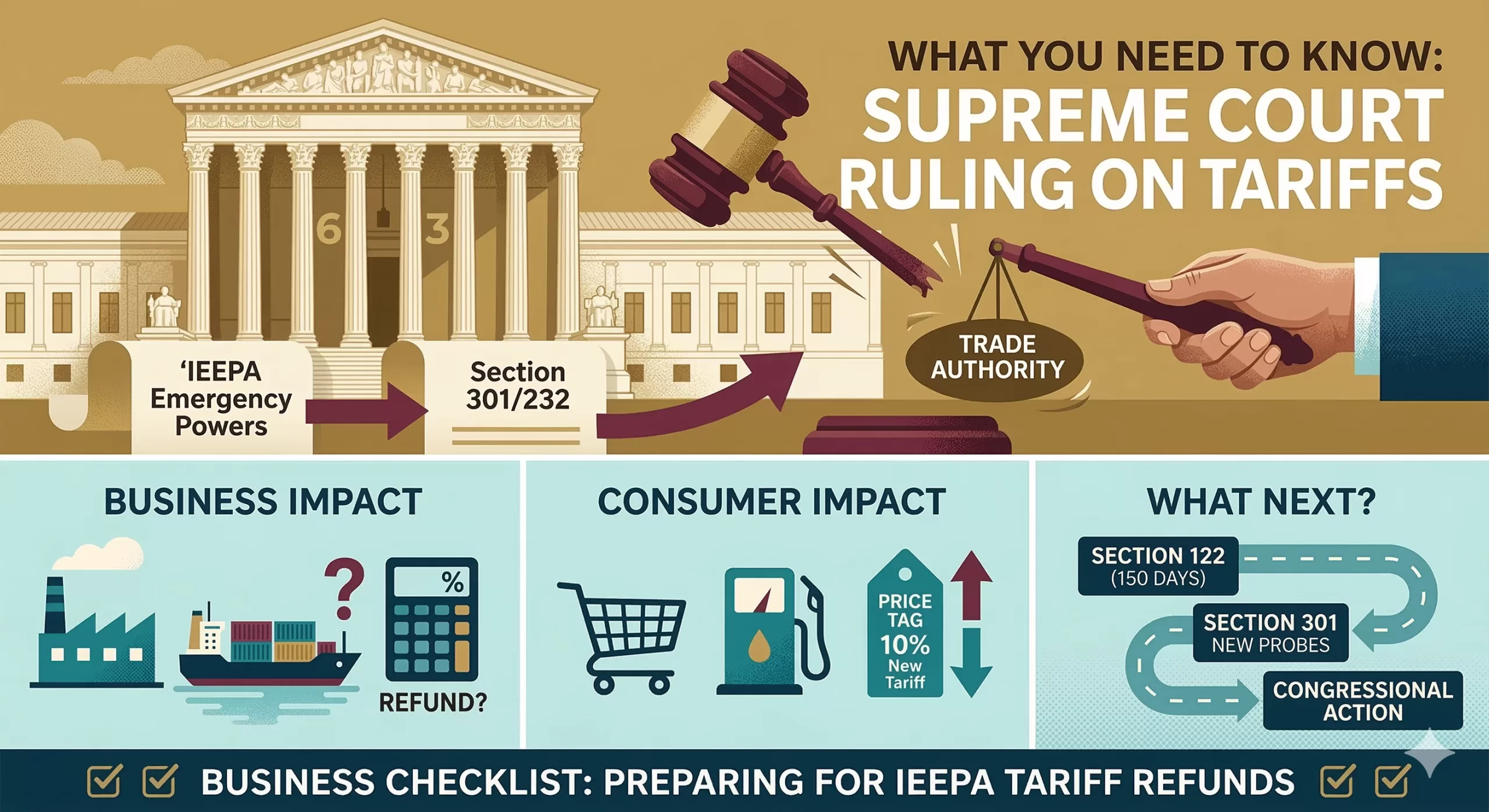
We continue to assist companies nationwide in converting IEEPA tariff refund claims into immediate cash, even after the launch of U.S. Customs and Border Protection’s(“CBP”) CAPE refund portal and the latest April 28th update from the U.S. Court of International Trade (“CIT”).  

CIT’s April 28th status review confirmed that the lead IEEPA refund litigation has largely moved from the legal entitlement phase into the implementation and payment phase. In simple terms, the question is no longer primarily whether many importers are entitled to refunds, the issue is when those refunds will actually be paid.  

While CBP officially launched CAPE on April 20th to process refunds, there was no new court order requiring immediate payment of all claims. Instead, the CIT is supervising execution, while Customs works through claim submissions, liquidation status, eligibility reviews, and administrative processing.   This distinction matters. CBP has indicated that certain accepted claims may be paid within approximately 45–60 days plus statutory interest.

However, “acceptance” is not the same as submission. Importers must first complete filing requirements, resolve broker authority issues, verify liquidation status, satisfy procedural review, and clear compliance review before the payment clock truly begins.   For many importers, especially those with older entries, previously liquidated claims, multiple brokers, documentation issues, or claims that may fall outside CAPE Phase 1, the actual recovery timeline could extend for many months or significantly longer. As a result, our buyers remain highly active in purchasing IEEPA tariff refund claims, with transactions from $250,000 to $7 million purchased at a Buy Rate of 85%, while claims exceeding $7 million have a Buy Rate of 90%.    

Why Importers are still Selling Tariff Refund Claims after CAPE Opened

Judge Eaton of CIT did not order immediate universal payment of all claims. CBP’s estimated payment window begins only after formal claim acceptance, not submission.

Many claims do not clearly qualify for CAPE Phase 1 and may require later phases. Finally liquidated entries remain one of the largest unresolved issues. Previously liquidated entries may still require protests, reliquidation, or additional litigation. The right to a refund is clearer—but the timing of payment remains uncertain.

CSV upload issues, ACE access problems, and broker mismatches can delay acceptance. Documentation gaps and reconciliation issues remain common. Customs audit and compliance review may delay payment even after filing.

Trump Administration appeal deadlines and future legal developments could delay the timing of refund payments. Processing millions of entries may create substantial administrative backlogs. Port-by-port inconsistencies may slow recovery for certain importers. Working capital needs often cannot wait for government processing timelines/.


Importers Are Choosing To Monetize Now

Immediate working capital for inventory, payroll, and vendor obligations. Reduced lender pressure and improved borrowing base flexibility. Elimination of refund timing risk and litigation uncertainty. Improved balance sheet certainty. Faster access to liquidity without waiting for government disbursement. Stronger buyer pricing now that CAPE implementation is underway as Buy Rates increased from 45% in February to 85% today  

For many businesses, immediate liquidity today is worth more than waiting for a larger payment later. Many importers are no longer asking. “Will I get paid?”, They are asking, “Is waiting worth the delay, uncertainty, and operational risk?”. For many companies, the answer is no.   We work with importers with claims starting at $250,000, with no maximum limit across industries including food, seasonal goods, apparel, and home products.  

Most transactions can be completed in approximately 10 business days, assuming proper documentation and credit quality.  

To learn more about IEEPA Tariff Claim Refunds, Contact Factoring Specialist Chris Lehnes

https://www.cbsnews.com/news/tariff-refund-portal-trump-cbp

Destroy Cash Flow Gaps with Factoring

Our accounts receivable factoring program can help businesses meet payroll or other essential obligations in as quick as a week.

Versant's accounts receivable factoring program can help businesses meet payroll or other essential obligations in as quick as a week.

Factoring Program Overview

  • $100,000 to $30 Million
  • Competitive Advance Rates
  • Non-Recourse
  • No Audits or Financial Covenants
  • Most businesses with strong customers are eligible

We specialize in difficult deals:

  • Start-ups
  • Weak Balance Sheets
  • Historic Losses
  • Customer Concentrations
  • Poor Personal Credit
  • Character Issues

We focus on the quality of your client’s accounts receivable, ignoring their financial condition.

This enables us to move quickly and fund qualified businesses including Manufacturers, Distributors and a wide variety of Service Businesses in as few as 3-5 days.

Contact me today to learn if your client is a fit.

Chris Lehnes 203-664-1535 Chris@chrislehnes.com

The Purchase Price of IEEPA Tariff Refund Claims has Increased to up to 85% of the Claim Amount

Convert IEEPA Tariff Claims to Cash on an Expedited Basis  

I have been actively assisting companies nationwide in converting their IEEPA tariff refund claims into immediate cash.  

U.S. Customs and Border Protection is rolling out a centralized system (CAPE) to process refunds, and some trade experts believe that certain importers could begin receiving refunds within the next six months. However, there remains significant uncertainty around timing, and many industry participants believe that a large portion of claims could still take years to fully resolve.

   Convert IEEPA Tariff Claims to Cash on an Expedited Basis  
  Convert IEEPA Tariff Claims to Cash on an Expedited Basis  

This divergence is driven by several factors, including:
The complexity and scale of processing millions of entries
The possibility that certain categories of claims may be prioritized over others, delaying recovery for more complex or lower-volume importers
The need for new administrative procedures, as IEEPA does not clearly define a refund mechanism
The potential for case-by-case eligibility determinations

Ongoing legal and procedural developments, including possible appeals by the Trump Administration and implementation challenges

Liquidation Status – Whether entries have already been liquidated, which in many cases may require formal protests or litigation to reopen and recover duties
The likelihood of inconsistent treatment across ports (port-by-port) or entry types as CBP implements new processes in phases
Documentation gaps and data reconciliation issues, particularly for older entries or those filed across multiple brokers
The absence of clear guidance on how interest on refunds will be calculated and paid, which could lead to further disputes


Capacity constraints within CBP and the potential for processing backlogs as refund volumes scale

Continued legal challenges around the scope of eligibility, including disputes over classifications, valuation, or origin that could delay specific claims


As a result, while some importers may receive refunds within six months, others, particularly those with more complex or previously liquidated entries, could face a multi-year recovery timeline. To address this uncertainty, financial institutions and hedge funds are actively purchasing IEEPA tariff refund claims at a discount.

Current buy rates are as high as 85% of the expected refund value, depending on claim size, credit quality of the importer and documentation quality as these claims are not directly assignable. AES works with importers with claims starting at $250,000, with no maximum limit. Since entering this market five months ago, AES has facilitated the monetization of approximately $20 million in claims across industries including food, seasonal goods, apparel, and home products.  

Market pricing has evolved significantly: Prior to the February 20, 2026, Supreme Court ruling, claims traded at approximately 20–25%
Following the ruling, pricing increased to 40–50%
More recently, improving legal clarity and market participation have driven pricing to current levels of up to 85% of the IEEPA tariff refund amount


While some importers initially adopted a “wait and see” approach in anticipation of near-term refunds, the combination of timing uncertainty and significantly improved pricing has led many to explore monetization as a way to eliminate risk and accelerate liquidity. The Funds AES works with are able to complete transactions in approximately 2–3 weeks, depending on the completeness and quality of documentation.  

For more information on this process, contact Factoring Specialist, Chris Lehnes

PRESS RELEASE: Versant Funds $1.4 Million Factoring Facility to Manufacturer

Press Release: (March 26, 2026) Versant Funding LLC is pleased to announce that it has funded a $1.4 Million non-recourse factoring facility to a manufacturer of equipment used by global auto companies.

PRESS RELEASE: Versant Funds $1.4 Million Factoring Facility to Manufacturer

While our newest client has successfully secured contracts with some of the world’s largest manufacturers, slow-paying accounts receivable are putting pressure on the company’s cash flow and preventing them from taking on new business.

“In evaluating a funding opportunity, Versant focuses exclusively on the quality of our client’s accounts receivable” according to Chris Lehnes, Business Development Officer for Versant Funding, and originator of this transaction. “Since this company’s customers are among the strongest on the planet, our facility will essentially have no cap and will grow automatically as the company’s AR balances increase, providing our client the cash needed to expand.”

About Versant Funding: Versant Funding’s custom Non-Recourse Factoring Facilities have been designed to fill a void in the market by focusing exclusively on the credit quality of a company’s accounts receivable. Versant Funding offers non-recourse factoring solutions to companies with B2B or B2G sales from $100,000 to $30 Million per month. All we care about is the credit quality of the A/R. To learn more contact: Chris Lehnes|203-664-1535 | chris@chrislehnes.com

ABL Advisor: Versant Funds $1.4MM Non-Recourse Factoring Facility to Manufacturer

ABF Journal: Versant Funding Provides $1.4MM Factoring Facility to Manufacturer

LinkedIn Newsletter: Just Funded! $1.4 Million Non-Recourse Factoring to Manufacturer

Secured Finance Network: Versant Funds $1.4 Million Non-Recourse Factoring Facility to Manufacturer

IFA Commercial Factor: Versant Funds $1.4 Million Non-Recourse Factoring Facility to Manufacturer

CT Turnaround Management Association: Member News – Versant Funds $1.4 Million to Manufacturer

Factoring Myths vs. Reality: Clearing the Air

Factoring Myths vs. Reality: Clearing the Air

Factoring Myths vs. Reality: Clearing the Air

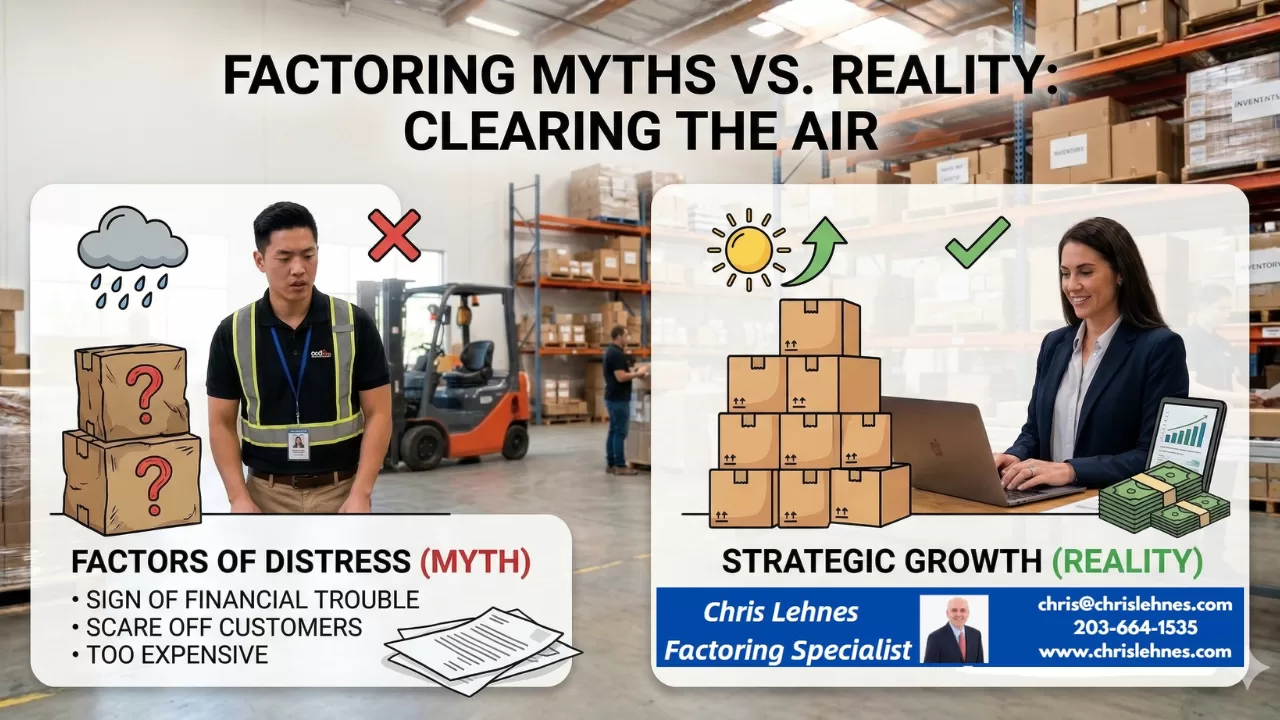
For many distributors, the word “factoring” carries some outdated baggage. If you’re hesitant to pull the trigger, it’s likely because of one of these common misconceptions. Let’s separate the noise from the facts:

The MythThe Reality
“Factoring is a sign of financial trouble.”Factoring is a sign of growth. Most companies use factoring because they are growing too fast for their cash flow to keep up. It’s a strategic choice to fuel expansion, not a last-ditch effort to stay afloat.
“My customers will think I’m going under.”It’s a standard B2B practice. Major retailers and manufacturers deal with factors every day. In many industries, like apparel or electronics distribution, it’s actually the “gold standard” for managing receivables.
“It’s way too expensive.”Look at the ROI. While the fee (1–3%) is higher than a bank loan, the “cost of waiting” 60 days for a check often means missing out on new inventory or early-pay discounts from your own suppliers that could actually save you more than the factoring fee.
“I’ll lose control of my customer relationships.”You stay in the driver’s seat. Modern factoring companies act as a professional extension of your back office. They want your customers to stay happy so they keep buying (and paying). You still manage the sales and service; they just handle the math.
“It’s just like a high-interest loan.”It’s not a loan at all. Because you are selling an asset (your invoice), you aren’t taking on debt. There are no monthly principal or interest payments to worry about—the “payment” comes from your customer, not your bank account.

The “Silent” Benefit: Professional Credit Checks

One “Reality” that distributors often overlook is that a factor acts as a free credit department. Before you ship $50,000 worth of goods to a new client, you can ask your factor to check their credit. If the factor won’t buy the invoice, that’s a massive red flag that you probably shouldn’t be selling to that customer on terms in the first place.

Contact Factoring Specialist, Chris Lehnes

Selecting a Factoring Partner: An Helpful Distributor’s Checklist

What you should know in selecting a factoring Partner

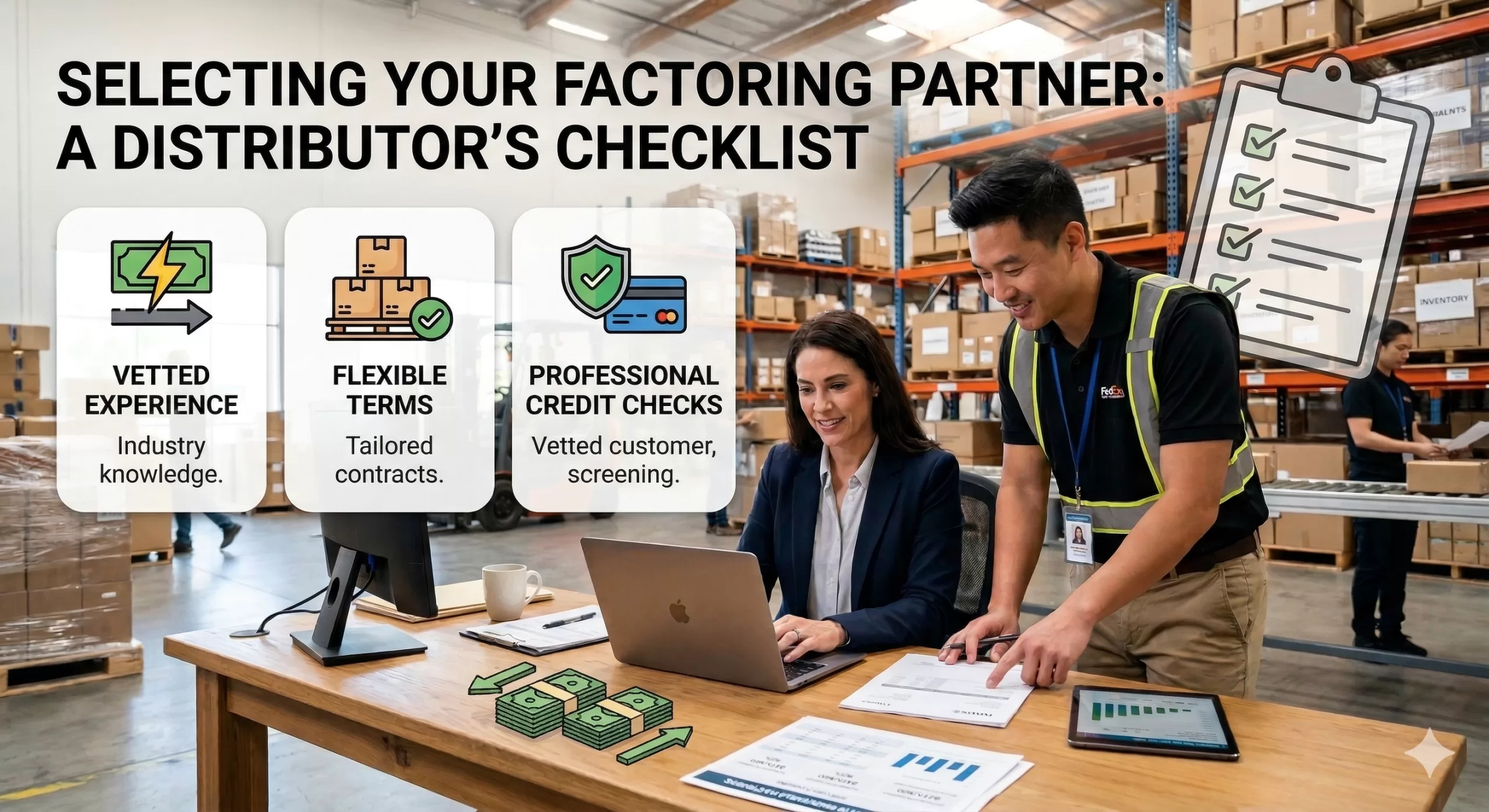
Choosing a factoring company is like choosing a long-term business partner. The right one will act as your back-office credit department; the wrong one can be an expensive administrative nightmare. Use this checklist to vet potential partners:

Selecting a Factoring Partner: An Insightful Distributor’s Checklist

1. The Core Logistics

  • [ ] Industry Expertise: Do they have experience with the specific nuances of distribution (e.g., handling chargebacks, bill-backs, or progressive shipping)?
  • [ ] Advance Rate: Will they advance at least 80–90% of the invoice value?
  • [ ] Funding Speed: Can they provide “Same Day” or “Next Day” funding once an invoice is verified?
  • [ ] Funding Source: Are they a Direct Lender (bank-backed) or an independent factor? (Direct lenders often have lower rates and more stability).

2. Transparency & Fees

  • [ ] The “All-In” Rate: Ask for a breakdown of all fees. Look out for hidden “junk fees” like application fees, wire fees, or credit check fees.
  • [ ] Recourse vs. Non-Recourse: * Recourse: You must buy back the invoice if your customer doesn’t pay. (Lower fees).
    • Non-Recourse: The factor takes the credit risk if the customer goes bankrupt. (Higher fees).
  • [ ] Volume Requirements: Are there “Monthly Minimums”? If you don’t hit a certain volume, will you be penalized?

3. The “Relationship” Factor

  • [ ] Dedicated Account Manager: Will you have a single point of contact who knows your business, or a generic 1-800 help desk?
  • [ ] Customer Interaction Style: How do they contact your customers for verification? You want a partner who is professional and polite, as they represent your brand.
  • [ ] Technology Integration: Do they sync with your accounting software (QuickBooks, NetSuite, etc.) for easy invoice uploading?

4. Contract Flexibility

  • [ ] Contract Length: Avoid multi-year lock-ins. Look for month-to-month or one-year terms with clear exit clauses.
  • [ ] Termination Notice: How much notice is required to leave? (Usually 30–90 days).
  • [ ] Personal Guarantee: Is a personal guarantee required? (Standard for many small business factors, but worth clarifying).

Contact Factoring Specialist, Chris Lehnes

Announcement: Versant Funds $5 Million Factoring Facility to 90 Year Old Service Provider

Announcement: Versant Funds $5 Million Factoring Facility to Service Provider

(March 19, 2026) Versant Funding LLC is pleased to announce that it has funded a $5 Million non-recourse factoring facility to a 90+ year-old company that provides services to major consumer brands.

After acquisition by a Private Equity Group, our latest client’s new management team implemented a turnaround plan which required additional cash.  While the company was in the process of applying for an asset-based line of credit, time was of the essence and a funding date for the ABL facility was uncertain.

“Versant can fund faster than most traditional financing sources because we focus solely on the credit quality of our clients’ customers and do not perform a full underwriting or audit of the business” according to Chris Lehnes, Business Development Officer for Versant Funding, and originator of this financing opportunity. “Since this company’s customers include some of the world’s strongest consumer brands, we quickly approved the transaction and were ready to fund in about a week.”

Versant Funding’s custom Non-Recourse Factoring Facilities have been designed to fill a void in the market by focusing exclusively on the credit quality of a company’s accounts receivable. Versant Funding offers non-recourse factoring solutions to companies with B2B or B2G sales from $100,000 to $30 Million per month. All we care about is the credit quality of the A/R. To learn more contact: Chris Lehnes |203-664-1535 | chris@chrislehnes.com

Announcement: Versant Funds $5 Million Factoring Facility to 90 Year Old Service Company

Press Coverage

SFNET: Versant Funds $5 Million Non-Recourse Factoring Facility to Service Provider

abfjournal: Versant Funds $5MM Non-Recourse Factoring Facility to Service Provider

ABL Advisor: Versant Funds $5MM Non-Recourse Factoring Facility to Service Provider

LinkedIn Newsletter: Announcement: Versant Funds $5 Million Factoring Facility to 90 Year Old Service Company

IFA Commercial Factor: Versant Funds $5 Million Non-Recourse Factoring Facility to Service Provider

Cracking the Confounding Code on Credit Union Business Loans

Credit Union Business Loans

List of all credit unions in US

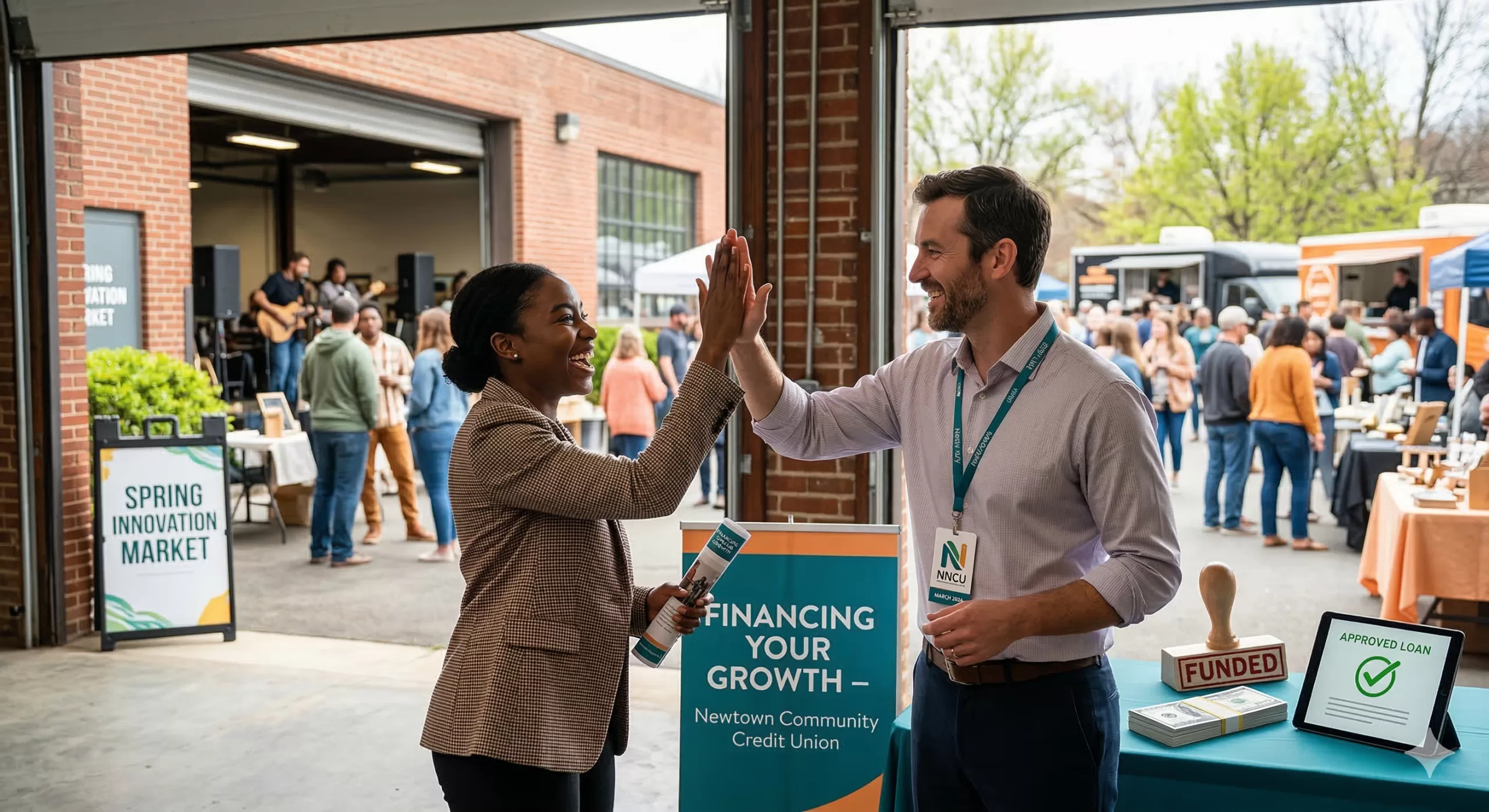
The first few warm days of spring mean flowers, baseball, and for many small business owners in March 2026, the annual financial checkup. If you’ve looked at your numbers and realized you need a cash injection for new equipment, that third location, or an aggressive inventory build, you know the drill: It’s time to find the capital. While large national banks are the obvious choice, they are often difficult, impersonal, and slow. By comparison, credit unions have become the unexpected superstars of commercial lending, especially for small and medium-sized enterprises (SMEs).

Cracking the Confounding Code on Credit Union Business Loans

If you are hunting for a business loan this month, you need to understand why credit unions are dominating and how to find the one that will actually make that critical “yes” happen for your business.

The Not-So-Secret Advantage of the Member-Owner

To understand why credit unions often beat banks on business lending, you have to look at their structure.

Banks answer to shareholders who demand profits and high returns on equity. Every decision, including who gets a loan, is filtered through the lens of maximizing shareholder value.

Credit unions, however, are not-for-profit cooperatives. They do not have public stock. Their members (you, me, and other account holders) are the owners.

This single difference ripples through every interaction. For business lending in 2026, it means:

  • 1. Rates and Fees That Just Make More Sense: Instead of returning profit to Wall Street, credit unions reinvest earnings back into the institution and their members. This often manifests as lower interest rates on commercial loans and significantly lower loan-origination and maintenance fees. In 2026, when inflation has been a recent headache, a difference of 0.5% on a large loan term can mean thousands of dollars saved.
  • 2. Hyper-Local Expertise: When you sit down with a commercial lender at a bank, their rules, algorithms, and models might be set at headquarters 2,000 miles away. They may not understand the specific micro-market in Newtown, Connecticut, where you are operating. But your local credit union officer lives here. They understand why opening a second pizza parlor on the new development is a smart bet, not a risky venture. They lend based on local market knowledge.
  • 3. Relationships Over Risk-Scores: A bank will look at your credit score and financial statements, enter them into a model, and receive a automated “Approve” or “Deny.” Credit unions, especially smaller, focused ones, prioritize relationships. They are more likely to have a real human look at your complete business plan, understand your unique vision, and listen to the story behind your application, not just the numbers on the page.

The “New Reality” of SBA Lending

One of the most important developments in 2026 is that the Small Business Administration (SBA) has made it significantly easier and faster for credit unions to facilitate SBA 7(a) and 504 loans.

For many small businesses, these government-backed loans are the Holy Grail: long terms, lower interest rates, and lower down-payment requirements. Previously, massive banks dominated this space because the paperwork was crushing.

However, the “Streamline and Connect Act” of 2024 (as we projected) drastically simplified the SBA application process and created digital interfaces specifically designed for smaller community financial institutions.

This means that in March 2026, the local credit union you never expected to handle an SBA application is now a Preferred Lender, capable of getting your government-backed loan approved in weeks, not months.

How to Evaluate a Credit Union in March 2026

You can’t just walk into the nearest credit union and expect a perfect loan offer. To find the “best” one for your business right now, you must be strategic:

Step 1: Membership Criteria (The Gateway)

Credit unions can’t just lend to anyone. They operate under a specific “field of membership” (FOM). While some have broadened their charters, many are still strictly limited. To find the “best,” you must find the one you can actually join.

  • Geographic FOM: Are you eligible because your business is located in Newtown, CT, or the surrounding county? This is the most common path.
  • Associational or Professional FOM: Are you a veteran? An educator? A first responder? A member of a specific local church or union? There are niche credit unions specialized for these groups, and they often offer highly beneficial industry-specific lending programs.

Step 2: Technology and Speed

While personal relationships are the hallmark of credit unions, it’s 2026. You should not have to wait 30 days for a response to your application. A strong, business-friendly credit union will have a fast, streamlined digital application portal.

They should have digital tools that connect directly to your accounting software (like QuickBooks or Xero), allowing their lenders to instantly verify your cash flow without forcing you to hunt down piles of paper bank statements. If a credit union’s website looks like it hasn’t been updated since 2018, that is a massive red flag.

Step 3: Ask About Specific Business Expertise

The credit union that is excellent for a car loan or a personal mortgage is not necessarily the best choice for a $500,000 commercial line of credit to finance inventory for a manufacturing business.

When you interview a prospective credit union, ask about their experience in your industry. A credit union that specializes in healthcare practice lending will have different perspectives and better loan structures than one that primarily works with general contractors.

The March 2026 Takeaway: Don’t Lead with a Bank

Your default shouldn’t be the massive financial conglomerate that you can only reach via an 800-number. Your first stop in 2026 should be your local, community-focused credit union. They are built to serve owners like you, and they have the tools and local knowledge to help your business take flight this spring.

If traditional financing is unavailable to you, contact factoring specialist, Chris Lehnes to learn if your business is a factoring fit.

Factoring: Cash for Suppliers to the Healthcare Industry

Factoring: Cash for Suppliers to the Healthcare Industry – Accounts Receivable Factoring can quickly meet the working capital needs of manufacturers and distributors which serve the healthcare industry.

Accounts Receivable Factoring can quickly meet the working capital needs of manufacturers and distributors which serve the healthcare industry.

Program Overview:

  • $100,000 to $30 Million
  • Quick AR Advances
  • No Audits
  • No Financial Covenants
  • Most Suppliers are Eligible

We specialize in challenging deals :

  • Start-ups
  • Turnarounds
  • Historic Losses
  • Customer Concentrations
  • Poor Personal Credit
  • Character Issues

Versant focuses on the quality of your client’s accounts receivable, ignoring their financial condition.

This enables us to move quickly and fund in as few as 3-5 days. Contact me today to learn if your client is a factoring fit.

Chris Lehnes
203-664-1535
chris@chrislehnes.com
Schedule a Call
Accounts Receivable Factoring can quickly meet the working capital needs of manufacturers and distributors which serve the healthcare industry.

The Impact of Pump Shock on Small Business

While the macro economy is feeling the “pump shock,” the impact on small business lending and accounts receivable (AR) factoring is more nuanced. For many industries, rising oil prices act as a catalyst for alternative financing, as traditional bank credit tends to tighten just when operational costs spike.

The Impact of Pump Shock on Small Business

1. Impact on Small Business Lending

Traditional bank lending to small businesses is becoming more restrictive as energy-driven inflation persists.

  • The “Double Squeeze”: Small businesses are facing higher input costs (fuel/transport) alongside high interest rates. Banks, wary of compressed profit margins, are increasing their underwriting scrutiny.
  • The Approval Gap: As of early 2026, large banks are approving only about 68% of small business loans, compared to 82% at smaller, community-focused institutions.
  • Pivot to High-Cost Credit: With traditional loans taking weeks to approve, many businesses are turning to credit cards (averaging 18%–36% interest) to cover immediate fuel and supply chain gaps, significantly increasing their long-term debt burden.

2. The Surge in AR Factoring Demand

In a high-oil-price environment, factoring often shifts from a “last resort” to a strategic cash-flow tool, particularly for energy-intensive sectors.

  • Fuel as a Fixed, Immediate Expense: In industries like trucking and oilfield services, fuel must be paid for daily or weekly, while customers (shippers or large operators) often demand 30- to 90-day payment terms. Factoring bridges this “cash gap” without adding traditional debt to the balance sheet.
  • Sector-Specific Trends:
    • Transportation/Trucking: Factoring companies are seeing record demand. These businesses often enjoy the highest advance rates (90%–97%+) because their invoices are backed by tangible freight delivery.
    • Oilfield Services: As drilling activity ramps up in response to higher prices (especially in the Permian Basin), service providers are using factoring to scale quickly—buying new equipment or meeting surge payroll without waiting for 60-day payouts from major oil producers.
    • Manufacturing: With raw material costs rising alongside energy, manufacturers are factoring invoices to maintain liquidity reserves to buy inventory before prices hike further.

Factoring vs. Traditional Lending in 2026

FeatureTraditional Bank LoanAR Factoring
Approval BasisBusiness credit & historyCustomer (Debtor) credit
Speed of Funding2 – 7 weeks24 – 48 hours
Debt LoadIncreases liability on balance sheetNo new debt (selling an asset)
ScalabilityFixed limitGrows with your sales volume
CostLower interest (6%–12%)Higher fees (1%–5% per 30 days)

Strategic Outlook

For the remainder of 2026, businesses that rely on “floating” cash flow are likely to prioritize speed over cost. While factoring fees are higher than bank interest, the ability to access cash within 24 hours to pay for $4.00/gallon diesel is often the difference between staying operational and grounding a fleet.

In a volatile economy where oil prices are surging and traditional banks are pulling back, choosing the right financing tool is a high-stakes decision. For B2B businesses—especially those in staffing, digital marketing, and manufacturing—the choice often comes down to the speed of Factoring versus the lower cost of a Bank Loan.

Below is a strategic comparison designed to help you evaluate which path aligns with your current cash flow needs.


Factoring vs. Bank Loans: 2026 Strategic Comparison

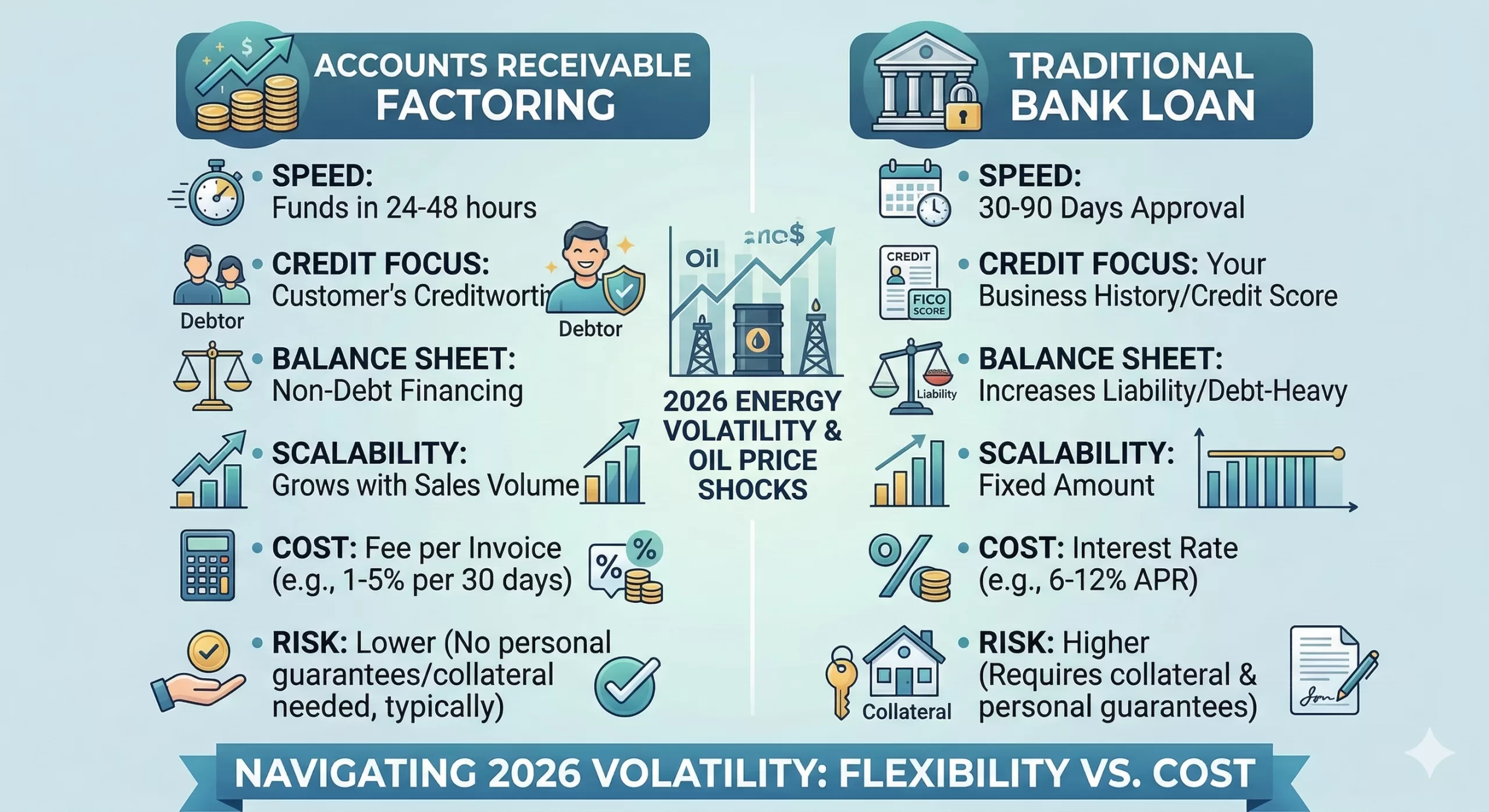
FeatureAccounts Receivable FactoringTraditional Bank Loan
Speed to CashUltra-Fast: Funds usually arrive within 24–48 hours after invoice setup.Slow: Approval typically takes 30–90 days of underwriting.
Credit FocusThe Debtor: Decisions are based on your customer’s credit and payment history.The Business: Based on your FICO score, tax returns, and years in business.
Balance SheetDebt-Free: It is the sale of an asset (invoices), not a liability.Debt-Heavy: Adds a liability that can impact your debt-to-income ratio.
ScalabilityUnlimited: As your sales grow, your available cash grows automatically.Fixed: You are capped at a set amount and must re-apply to increase it.
Total CostHigher Fees: Usually 1%–5% per 30 days (effective APR is higher).Lower Rates: Typically 6%–12% APR for qualified businesses.
RiskLow: No collateral like your house or equipment is typically required.High: Often requires a blanket lien on assets or personal guarantees.

Export to Sheets


The “Why Now?” Factor: Navigating 2026 Volatility

Pros of Factoring in This Market

  • Immediate Fuel/Supply Buffer: With diesel prices fluctuating, factoring gives you the cash today to buy inventory or fuel before the next price hike.
  • Protects Your Growth: In sectors like digital marketing or staffing, you can’t wait 60 days for a client to pay to meet your weekly payroll. Factoring ensures your team stays paid regardless of when the client cuts the check.
  • No “Covenant” Stress: Bank loans often come with strict “covenants” (rules about your profit margins). If high oil prices temporarily squeeze your margins, a bank might call your loan; a factor simply keeps funding your sales.

Cons to Consider

  • Margin Impact: If your profit margins are already thin (common in food production or distribution), the 1%–3% factoring fee could eat up a significant portion of your net income.
  • Customer Perception: While widely accepted today, some ultra-conservative clients might still prefer to pay you directly rather than a third-party factor.

The Bottom Line

If you have long-term stability and time to wait, a Bank Loan is cheaper. However, if you are growing rapidly or facing unpredictable costs, Factoring acts as a flexible insurance policy for your cash flow.


Contact Factoring Specialist, Chris Lehnes