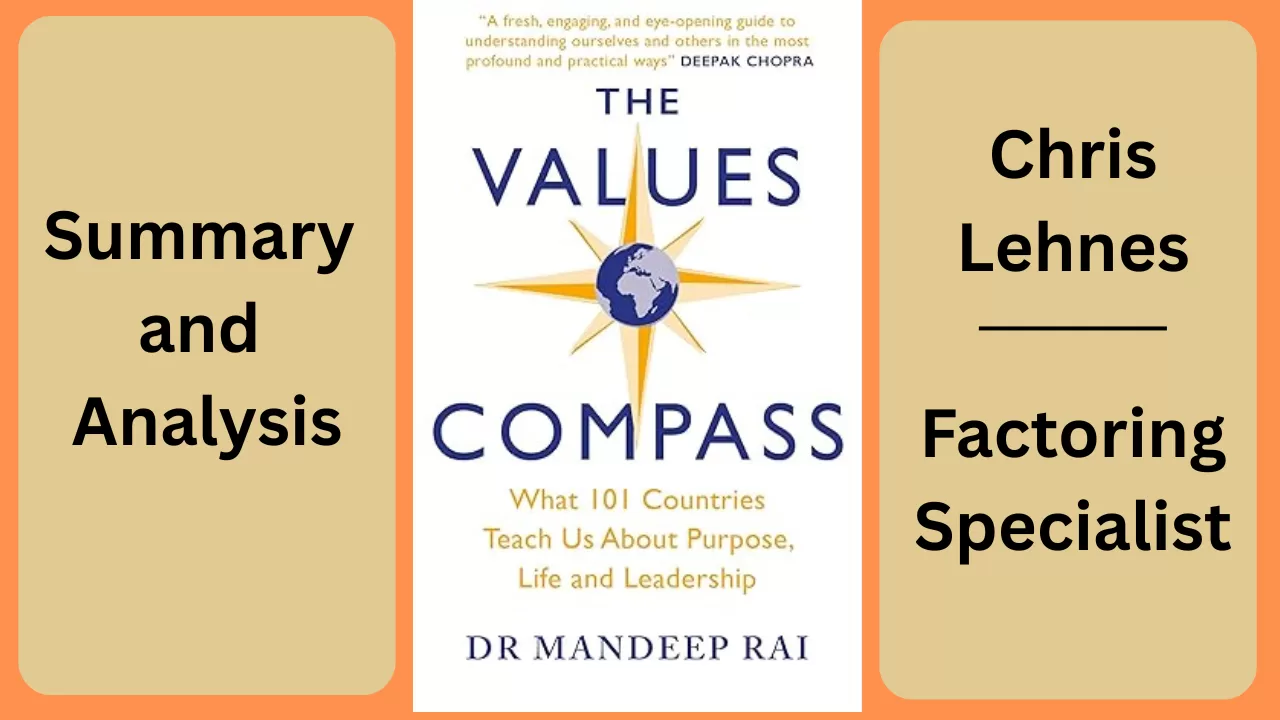
Dr. Mandeep Rai’s “The Values Compass” offers country-specific examples to illustrate how values shape societies, cultures, and individual lives around the world. The document aims to highlight the significance of values in decision-making, cultural understanding, and achieving success and fulfillment.
Key Themes and Ideas:
- The Centrality of Values: The core premise is that values are fundamental to shaping not only individual destinies but also the character and behavior of nations, communities, and cultures. The author posits that understanding values provides a “cultural language” that dictates many aspects of everyday life globally.
- Quote: “Wherever you go, there is something apparent yet unspoken, a sort of cultural language that dictates so many aspects of everyday life.”
- Quote: “Your beliefs become your thoughts, Your thoughts become your words, Your words become your actions, Your actions become your habits, Your habits become your values, Your values become your destiny.” – Mahatma Gandhi (quoted in the introduction)
- Values as a Guide and Tiebreaker: Values serve as a mechanism for navigating personal dilemmas and making challenging life decisions by aligning choices with what is most important to us. They contribute to a “successful, ful�lling, and happy life.”
- Quote: “They provide a tiebreaker, o�ering a mechanism to settle personal dilemmas and challenging life decisions—to see which option is most aligned with our values and will contribute to a more successful, ful�lling, and happy life.”
- Categorization of Values: The author groups values into five sections to reflect different areas of life they influence:
- Change Values: How nations and people respond to change.
- Continuity Values: How tradition and memory are preserved.
- Connection Values: Shaping personal relationships.
- Communal Values: Universally recognized norms in communities, companies, and countries.
- (Note: The fifth category, while mentioned in the introduction, is not explicitly named in the provided excerpts, though country examples illustrate various values beyond the first four categories).
- Values as a Lens for Understanding Nations: The excerpts demonstrate how specific values are deeply embedded in the cultural fabric and history of different countries, influencing their actions, resilience, and achievements. Examples include:
- Cuba (Resolver): The ability to “make the best of often trying circumstances,” adapting and surviving against economic hardship. Illustrated by makeshift repairs and doctors improvising medical supplies.
- Quote: “It was resolver that allowed Cubans to survive the desperately di�cult decade after the fall of the Soviet Union, with the nation’s global trade plummeting by over 80 percent and triggering a brutal recession…”
- Denmark (Equality/Janteloven): A principle prioritizing the collective over the individual, discouraging boasting, and leading to a highly equal society with low income inequality and strong social support systems.
- Quote: “Although the initial creation of Janteloven was as a joke, over time it has taken on a more serious guise and become shorthand for the Danish obsession with equality: the principle that the collective trumps the individual, and the greatest faux pas is to boast about your abilities or achievements.”
- Luxembourg (Adaptability): The capacity to adapt to changing external influences and economic landscapes, particularly in maintaining a competitive financial sector through regulatory upgrades.
- Nigeria (Drive): An inherent desire to “keep earning, achieving, and climbing,” reflecting a strong optimistic outlook and lack of complacency.
- Quote: “This is not a place where you encounter laziness or complacency. Nigerians are driven to keep earning, achieving, and climbing.”
- Norway (Influence/Engagement): Achieving diplomatic ends through being independent, humble, and willing to engage in complex situations where others are not.
- Portugal (Exploration/Innovation): Driven by geography and visionary leadership (Henry the Navigator), leading to significant maritime exploration and technological innovation (the caravel).
- Scotland (Influence): Historically a source of significant ideas and inventions across philosophy, innovation, and economics, maintaining influence globally despite its size.
- Quote: “‘We look to Scotland for all our ideas of civilization,’ the French philosopher Voltaire once argued. Since he said that in the eighteenth century, the world has indeed been in�uenced by numerous Scottish ideas and inventions.”
- Singapore (Order/Precision): Governed by a strong sense of rules and regulations, leading to a meticulously planned and economically prosperous nation.
- Quote: “In every sense, Singapore is a nation governed by an overwhelming sense of order. It is often described as a �ne country, because you can be �ned for almost anything…”
- Slovakia (Impact): A desire to “punch above its weight” and make an “outsize impact” through innovation and self-sufficiency. Illustrated by pioneering flying car and energy-efficient dwelling concepts.
- Quote: “Slovakia, and Slovakians, are obsessed with the question of how they can make an impact and be a force for positive change.”
- South Africa (Ubuntu): “Humanity toward others,” emphasizing community support and affirmation over shame and punishment in addressing mistakes.
- South Korea (Dynamism): A forward-looking and determined spirit that rejects the status quo and drives continuous improvement, leading to rapid economic development.
- Quote: “Being dynamic means never accepting the status quo, never settling for what you have, and always trying to �nd ways to improve yourself.”
- UAE (Vision): Built on ambitious plans for growth, technological advancement, and improving the lives of its people. Characterized by ambitious architectural projects and dedicated government ministries focused on concepts like happiness and AI.
- Quote: “Above all, the mind-set that nothing is impossible predominates. This is a country with the wealth, the focus, and the committed citizenry to make things happen, and fast.”
- Bolivia (Rootedness): Deep connection to history, indigenous culture, and the land, influencing national identity and priorities (e.g., indigenous groups protecting land from exploration).
- Quote: “Bolivia is a country where history is everywhere and roots matter. The present, and hopes for the future, are informed in so many ways by the past…”
- Georgia (Recognition/Community): Emphasized through the tradition of the supra (feast) and the tamada (toastmaster), focusing on recognizing and celebrating individuals and shared heritage through toasts and folklore singing.
- Republic of Ireland (Storytelling): A national culture of eloquence, embellishment, and mythmaking, symbolized by the Blarney Stone and evident in its literary tradition.
- Italy (Care/Attention to Detail): Reflected in meticulous attention to appearance (“how you look and are seen”), adherence to social conventions, and care in presentation, extending to seemingly minor daily activities.
- Quote: “Care is an Italian value that has taken over almost every aspect of life: from how you dress, to what and when you eat, to the car you drive.”
- Poland (Irrepressibility): The ability to maintain national identity, culture, and language despite prolonged periods of foreign occupation and official non-existence.
- Quote: “The irrepressible spirit that de�nes Poland is not just an intrinsic national characteristic, but also one that was fundamental to the preservation of the nation.”
- Switzerland (Precision/Order): A culture prioritizing punctuality and meticulous detail, leading to a well-maintained country, efficient systems, and economic prosperity despite limited resources. Evident in everything from train schedules to hosting international events like Davos.
- Quote: “Swiss culture demands that it happens on time, all the time.”
- Uzbekistan (Etiquette): A deeply ingrained system of behavior and tradition, particularly evident in hospitality and customs surrounding everyday items like bread (non).
- Vietnam (Resilience/Adaptability): The capacity to overcome adversity and “make the best of di�cult circumstances,” historically facing challenging climate, military threats, and economic hardship with resourcefulness.
- Albania (Besa): A concept representing “one’s word, promise, honor and all the responsibilities it entails,” considered the “highest authority” and driving individuals to protect even strangers, as demonstrated during the Holocaust.
- Quote: “Besa, a word that �rst gained prominence in the Kanun of Lekë Dukagjini—an assembly of customary codes and traditions documented by the �fteenth century… the besa is described as the highest authority.”
- Australia (Mateship): A cultural touchstone emphasizing trust, loyalty, commitment, and self-sacrifice, viewed as a fundamental part of the national psyche and an “essential value” holding together an egalitarian society.
- Quote: “For better or worse, mateship is part of our cultural DNA… mateship has acted the part of a de facto religion.”
- Croatia (Friendship/Mutual Support): A deep commitment to supporting friends, even those not closely known, with financial or moral assistance, particularly stemming from a history of reliance on personal networks due to turbulent political periods.
- Cyprus (Appreciation): Valuing not just individuals but also heritage, identity, and roots, evident in how people introduce themselves and the meticulous care taken of historical sites.
- Jordan (Helpfulness/Unquestioning Aid): An instinctive and immediate response to requests for help, rooted in cultural norms and, in some cases, religious teachings.
- Quote: “In Jordan, if someone asks you for help, you don’t pause to ask why, who, or when. There is no weighing up of who this person is or what their ulterior motive might be. Helpfulness is instinctive, immediate, and unquestioning.”
- Qatar (Trust): A strong culture of trust among the small ethnic Qatari population, stemming from historical scarcity of resources and reinforced by external pressures.
- Quote: “This culture of trust is rooted in the small, tightly knit population of ethnic Qataris, who today comprise only 12 percent of the national population.”
- Sweden (Cooperation/Innovation): Despite its small size, a highly innovative country, partly attributed to a culture of cooperation and perhaps influenced by introspection (though the connection is not fully elaborated in the excerpt).
- Thailand (Kreng Jai): A unique form of empathy and consideration (“awe of heart”) that involves constantly assessing how one’s actions will affect others, leading to thoughtful behavior and avoiding causing discomfort.
- Quote: “Practically this means to walk in the other’s shoes and to assess constantly how your actions will a�ect them.”
- Turkey (Hospitality): A deeply ingrained value, extending to home design (guest rooms), preparation of special food and drink for visitors, and a commitment to presenting the “best possible self” to guests.
- Hungary (Competitiveness/Drive): A historical drive to make a mark on the world, particularly in science, technology, and medicine, leading to significant contributions from Hungarians who emigrated.
- Indonesia (Gotong Royong/Mutual Cooperation): A uniquely mutual and supportive culture where “your problem is my problem,” rooted in a form of Islam that emphasizes benefiting others.
- Quote: “The state of Indonesia, which we are to establish, should be a state of mutual cooperation… How �ne that is! A gotong royong state!”
- Jamaica (Discipline): A core value that underpins creativity and is enforced widely within the community, with individuals feeling responsible for guiding and correcting younger generations.
- Kenya (Harambee/Self-Help): A principle of national unity and self-sufficiency, where communities unite around common causes through collective investment and labor to solve problems locally.
- Quote: “The idea of harambee may have had political origins, but it has been taken to heart by Kenyans who want to solve their problems locally rather than relying on government intervention.”
- Latvia (Self-Expression/Song): Singing and folk culture are central to Latvian identity and have served as a primary vehicle for maintaining nationhood and resisting occupation throughout history.
- Quote: “To say that singing has been central to the culture and spirit of Lativa would be an understatement. In fact it is probably no exaggeration to say that the power of song helped create modern Latvia as an independent nation.”
- Malta (Community): A tightly knit society, reflecting a village mentality, where everyone knows each other and community support (both personal and through charitable foundations) is strong.
- Mexico (Celebration): Celebrations (fiestas, national holidays, religious events, sporting events) play a central role in Mexican life, fostering social connection and identity.
- Philippines (Family/Kinship): A strong emphasis on sticking together as an entire extended family unit, creating happy and supportive environments despite limited personal space.
- Belgium (Modesty): A defining characteristic that avoids ostentation, even when individuals possess significant wealth or status.
- Bulgaria (Hospitality): While not explicitly named as the value, the excerpt describes aspects of Bulgarian life, including the diet and social customs, hinting at underlying cultural norms.
- Chile (Perspective): Shaped by dramatic geography and natural disasters, leading to a philosophical outlook on life and what truly matters.
- Quote: “With natural disasters accepted as a normal part of life, Chileans have more perspective than most on what does and doesn’t matter.”
- Dominican Republic (Enlivenment): Characterized by expressive communication (“talking with their whole body”), a vibrant culture of music, dance, and fashion, and a focus on lively experiences.
- England (Steadfast Resolve/Duty): Historically defined by its response to external threats and a commitment to duty, reflected in famous national speeches and leaders.
- Quote: “England expects that every man will do his duty.” – Admiral Nelson
- Quote: “We shall �ght on the beaches… we shall never surrender.” – Winston Churchill
- Finland (Patience/Introspection): A culture that values silence in communication and takes words seriously, leading to a deliberate and unhurried pace. This introspection may contribute to innovation.
- Quote: “Take a man by his words and a bull by his horns,” says a Finnish proverb.”
- Greece (Philotimo/Goodness): A multifaceted concept with deep roots, essentially meaning “friend of honor” and encompassing seeing the good in people, doing good for its own sake, and striving to be a good person contributing positively to others and the long term. It includes values like respect, selflessness, humility, empathy, generosity, and gratitude.
- Quote: “This is philotimo, an idea with deep roots in one of the world’s oldest civilizations, which everyone knows but no one can entirely agree on an apt translation for.”
- Quote: “Because philotimo is about seeing the good in people, it is about doing good and helpful things for their own sake, and trying to be a good person who contributes positively to the lives of your friends, family, and community.”
- India (Faith): Illustrated through the personal experience of wearing a Sikh turban (dastaar) and kara, highlighting the transformative power of faith in providing strength, identity, and becoming a symbol of trust for others.
- Israel (Chutzpah): A value encompassing both determination to overcome obstacles and aspects of stubbornness or rudeness. It is seen as intrinsic to Israel’s creation, survival, and entrepreneurial spirit.
- Quote: “Chutzpah is a value that captures both admirable and less attractive characteristics. It is about the determination and inner strength to do things even when people tell you it can’t be done. And it’s just as much about stubbornness, bloody-mindedness, and even rudeness.”
- Lithuania (Work/Commitment): A strong work ethic, valuing commitment and seeing multiple jobs as a sign of respectability, with no strict hierarchy among professions.
- Mongolia (Autonomy/Self-Reliance): Fueled by the vast, open environment, inspiring a spirit of independence and a determination to build the nation and economy on its own terms (“Wolf Economy”).
- Russia (Fortitude): A necessary quality for survival in a historically harsh and unforgiving environment, viewed as a badge of honor and reflected in cultural displays of strength.
- Quote: “…it is a harsh, unforgiving place, and the only way to survive is with fortitude.”
- Sri Lanka (Joy/Elation): More than just cheerfulness, a pervasive joy and elation that informs many aspects of life and interactions, evident in smiling people and uplifting energy.
- Quote: “What I witnessed, however, was more than just cheerfulness. There was something more pervasive and profound: a joy and an elation that informs how Sri Lankans approach so many aspects of their life…”
- Uruguay (Humility): Rooted in the country’s small size and a history of immigration by people who arrived with little, fostering a sense of humility and closeness.
- Bhutan (Gross National Happiness/Contentment): A unique national philosophy prioritizing the well-being and happiness of its people over purely economic indicators. It emphasizes internal sources of contentment, sustainable practices, and good governance.
- Quote: “We believe that the source of happiness lies within the self, and that there is no external source for contentment,” the King told me.”
- Values for Individual Growth and Fulfillment: Beyond national examples, the author emphasizes the importance of individuals identifying and embracing their own values for self-knowledge, success, and fulfillment.
- Quote: “Values are how we obtain the level of self-knowledge that is a platform to achieving success and ful�llment. They provide the foundation for so many happy, successful, and ful�lled lives.”
- Quote: “…unless you are honest to yourself—and live by your values—you can never give of yourself in the way that philotimo demands.” (referencing Greek philotimo and the Delphic inscription “Know thyself”)
Most Important Ideas/Facts:
- Values are not abstract concepts but tangible forces that shape behavior, relationships, and entire cultures, both nationally and individually.
- Identifying and living by one’s values is crucial for personal decision-making, finding direction, and achieving a successful and fulfilling life.
- Different countries exemplify distinct core values that have influenced their history, resilience, innovation, and social structures (e.g., Cuba’s resolver, Denmark’s equality/Janteloven, Albania’s besa, Qatar’s trust, Bhutan’s GNH).
- Understanding the values of different cultures provides a framework for interpreting their “cultural language” and interactions.
- Cultivating specific values, such as Russian fortitude, South Korean dynamism, or Greek philotimo, can provide inspiration and tools for individuals to navigate challenges and contribute positively to the world.
- Self-knowledge gained through exploring values is presented as a platform for personal and societal betterment.
Conclusion:
The excerpts from “The Values Compass” introduce the compelling idea that values are the unseen architecture of societies and individual lives. By examining diverse countries through the lens of their defining values, the author demonstrates how these principles influence everything from economic resilience and social norms to personal interactions and national identity. The document strongly advocates for the conscious recognition and embrace of values as a vital tool for understanding the world, navigating life’s challenges, and pursuing a path of meaning and fulfillment.
Values and Culture Study Guide
Quiz
Answer each question in 2-3 sentences.
- What does the Cuban concept of resolver represent?
- How has Denmark’s Janteloven influenced its society?
- What enabled Luxembourg to become a major financial center despite lacking natural resources?
- What is the significance of the Portuguese development of the caravel?
- How has Scotland influenced the modern world beyond inventions?
- What is the significance of the traditions surrounding non, Uzbekistan’s national bread?
- What does the Albanian concept of besa represent, and how was it demonstrated during the Holocaust?
- What does the Australian concept of mateship encompass beyond just friendship?
- How has Croatia’s recent history influenced the importance of friendship in its culture?
- What does the Greek concept of philotimo fundamentally mean, according to the text?
Essay Questions
Please prepare an essay response for five of the following prompts.
- Analyze how values function as tiebreakers in personal dilemmas and challenging life decisions, drawing on examples from the text.
- Discuss the interplay between geography and national values, using specific examples from the provided text.
- Compare and contrast the values of cooperation in Sweden and mutual cooperation (gotong royong) in Indonesia, considering their origins and societal impact.
- Explore the various ways in which different cultures, as described in the text, emphasize community and support networks.
- Examine how historical experiences, such as occupation or economic hardship, have shaped the prominent values of different nations in the source material.
- Analyze the role of tradition and heritage in maintaining national identity, using examples like Uzbekistan’s non or Latvia’s Song and Dance Festival.
- Discuss the concept of “impact” as a national value, drawing on the examples of Slovakia and Georgia.
- Evaluate the positive and negative aspects of the Israeli value of chutzpah as described in the text.
- Analyze how cultural artifacts and practices, like Georgia’s supra or the Irish Blarney Stone, serve as expressions and embodiments of national values.
- Discuss the Bhutanese concept of Gross National Happiness as an alternative to purely economic indicators of national well-being.
Glossary of Key Terms
- Resolver: A Cuban concept representing resourcefulness, adaptability, and making the best of difficult circumstances, often through creative problem-solving and patch-working.
- Janteloven (The Law of Jante): A Danish concept, originating from Aksel Sandemose’s satire, that emphasizes equality and discourages boasting or thinking oneself better than others, serving as shorthand for the Danish obsession with equality.
- Caravel: A new, lighter design of ship with triangular sails, developed by the Portuguese at Sagres, designed to be more compact and better able to take advantage of the wind, considered a pioneering innovation in maritime exploration.
- Non: Uzbekistan’s national bread, a golden, tandoor-baked flatbread, around which numerous cherished traditions and etiquette are centered.
- Besa: An Albanian concept, described as the highest authority in the Kanun of Lekë Dukagjini, representing one’s word, promise, honor, and all the responsibilities it entails; often referred to as “Albanianism.”
- Mateship: A significant cultural touchstone in Australian culture, representing more than just friendship, encompassing essential values like trust, loyalty, commitment, and self-sacrifice within an egalitarian society.
- Philotimo: A Greek idea with deep roots, meaning “friend of honor,” but more profoundly representing goodness, seeing the good in people, doing good for its own sake, and aspiring to be a good person who contributes positively to the lives of others and the community.
- Dastaar: A traditional Sikh cloth turban worn around the head, symbolizing service, discipline, and commitment, and representing faith and inner strength.
- Kara: An iron bangle worn around the wrist by Sikhs, adding to feelings of strength, defiance, and resilience.
- Chutzpah: An Israeli value capturing both admirable and less attractive characteristics, representing the determination and inner strength to do things against the odds, as well as stubbornness, bloody-mindedness, and sometimes rudeness.
- Honeybee: An important Lithuanian symbol, representing the national value of work ethic and commitment.
- Wolf Economy: A term used by Mongolia to describe its rapidly growing economy, aiming to be strong, clever, and able to survive harsh conditions, in contrast to the “Tiger” economies of Asia.
- Fortitude: A Russian value representing steadfast resolve, inner core strength, confidence, and determination to keep going and achieve goals in the face of hardship and setbacks.
- Joy: A pervasive and profound quality in Sri Lanka, influencing how people approach many aspects of life, characterized by cheerfulness, elation, and mutual upliftment.
- Paisito: A nickname for Uruguay, meaning “little country,” reflecting its small size compared to its neighbors.
- Gross National Happiness (GNH): Bhutan’s national indicator, considered a more comprehensive measure of human well-being than Gross Domestic Product (GDP), emphasizing good governance, environmental preservation, cultural promotion, and economic development.
- Nishkam: A Sikh concept representing selfless service and support, exemplified by the author’s parents and siblings.
- Supra: A Georgian feast with family and friends, centered around a tradition of toasting (tamada) that involves recognizing and celebrating each individual present.
- Tamada: The toastmaster at a Georgian supra, responsible for introducing guests and leading a series of elaborate toasts.
- Kanun of Lekë Dukagjini: An assembly of customary codes and traditions documented by the fifteenth century in Albania, in which besa is described as the highest authority.
- Gotong royong: An Indonesian term and idea popularized by President Sukarno, representing mutual cooperation, where community members come together to support each other and address collective needs.
- Harambee: A ubiquitous symbol in Kenyan society, originally a socialist platform, that represents coming together for a common cause, often for local problem-solving and community development.
- Chama: Local cooperatives in Kenya into which people pay a monthly amount to pool resources and help members in times of need, underpinned by the principle of harambee.
- Jaunlatvieši (Young Latvians): A movement in mid-nineteenth-century Latvia focused on recapturing national identity, culture, and heritage during Russian Empire rule.
- Singing Revolution: A series of events spanning Estonia, Lithuania, and Latvia where festivals of song became a central part of protests leading to independence from the Soviet Union in 1991.
- Fiestas patronales: Local festivals in Mexico commemorating the patron saint of a village, town, or city district, playing a central role in Mexican life and celebrations.
Quiz Answer Key
- Resolver represents the resourcefulness and adaptability of Cubans, allowing them to survive difficult circumstances by creatively finding solutions and making the best of limited resources.
- Janteloven has contributed to Denmark being a remarkably equal society, with low income inequality and high gender equality, although some criticize it for potentially encouraging mediocrity.
- Luxembourg became a major financial center by adapting its legal, tax, and regulatory framework to attract significant foreign investment, overcoming its lack of natural resources or homegrown industry.
- The caravel, developed by the Portuguese, was a lighter, more maneuverable ship design that significantly advanced maritime exploration by allowing sailors to take better advantage of wind conditions.
- Beyond inventions like the telephone or steam engine, Scotland has influenced modern economics through figures like Adam Smith and shaped institutions and even nations through the large populations who can trace Scottish ancestry.
- The traditions surrounding non highlight the deep cultural significance of this national bread in Uzbekistan, serving as a symbol of heritage, family bonds, and a connection to home and tradition.
- Besa represents honor and trustworthiness in Albania, demonstrated during the Holocaust when Albanians protected Jews, with no known cases of Jews being turned over to Nazi authorities, earning Albania recognition as “Righteous Among the Nations.”
- Beyond friendship, mateship in Australia signifies core values like trust, loyalty, commitment, and self-sacrifice, forming a fundamental part of the Australian egalitarian psyche.
- Croatia’s turbulent recent history, including various dictatorships and wars, has reinforced the importance of friendship as a vital support network when the state cannot be relied upon.
- According to the text, philotimo fundamentally means goodness, encompassing seeing the good in others, doing good deeds for their own sake, and aspiring to be a good person who contributes positively to their community and the world.