Accounts Receivable Factoring can quickly meet the working capital needs of Distributors impacted by rising tariffs.
Our underwriting focus is solely on the quality of a company’s accounts receivable, which enables us to rapidly fund businesses which do not qualify for traditional lending such as those experiencing losses or where the owners have weak personal credit or even “character issues.”
The Psychology of Money synthesizes the core themes from an analysis of personal finance, arguing that financial success is less about what you know and more about how you behave. It is a soft skill, rooted in psychology, rather than a hard science like physics. The central premise is that an individual’s relationship with money is complex, often counterintuitive, and heavily influenced by unique personal experiences, emotions, and the stories they believe.
Key Takeaways:
Behavior Over Intelligence: Financial outcomes are more dependent on behavioral skills than on traditional measures of intelligence or education. A person with average financial knowledge but strong behavioral discipline can outperform a financial genius who lacks emotional control.
The Power of Personal Experience: Individual financial perspectives are shaped by personal history—generation, upbringing, and economic experiences. What seems rational to one person can appear “crazy” to another, but every decision makes sense to the individual at the time, based on their unique mental model of the world.
Luck and Risk are Siblings: Every outcome in life is guided by forces other than individual effort. Luck and risk are pervasive and powerful, yet often overlooked. Success is never as good as it seems, and failure is never as bad, making it crucial to focus on broad patterns rather than extreme individual case studies.
The Goal is “Enough”: The hardest financial skill is getting the goalpost to stop moving. An insatiable appetite for “more”—more wealth, power, and prestige—is a path to ruin, as it pushes individuals to take risks with things they have and need for things they don’t. True success lies in defining and achieving “enough.”
Survival and Compounding: Getting wealthy and staying wealthy are two different skills. Staying wealthy requires survival—avoiding ruin at all costs. The power of compounding is only unleashed through time and endurance. Therefore, a survival mindset that prioritizes being financially unbreakable over chasing the highest possible returns is paramount.
Tails Drive Everything: Most outcomes in finance are driven by a small number of extreme events, or “tails.” An investor can be wrong most of the time and still succeed if their few correct decisions generate massive returns. This means it is normal for most ventures to fail or produce mediocre results.
Wealth’s True Value is Freedom: The highest dividend money pays is control over one’s time. The ability to do what you want, when you want, with whom you want, for as long as you want, is the ultimate form of wealth.
The Importance of a Margin of Safety: The future is unpredictable, and “things that have never happened before happen all the time.” The most effective way to navigate this uncertainty is with a “room for error” or “margin of safety,” which renders precise forecasts unnecessary by allowing for a range of outcomes.
Core Themes and Analysis
I. The Behavioral Nature of Money
The foundational argument is that finance is better understood through the lens of psychology and history than through traditional financial models. While finance is taught like a math-based field with formulas and rules, real-world financial decisions are made at the dinner table, not on a spreadsheet. They are governed by emotions, ego, personal history, and the unique narratives people tell themselves.
No One’s Crazy: The Primacy of Personal Experience
People’s financial behaviors are anchored to their unique life experiences. An individual’s worldview is dominated by what they’ve personally lived through, which represents a minuscule fraction of what has happened in the world but constitutes the majority of how they think the world works.
Contrasting Case Studies:
Ronald Read: A janitor and gas station attendant who amassed an $8 million fortune through patient saving and investing in blue-chip stocks over decades. His success was entirely behavioral.
Richard Fuscone: A Harvard-educated Merrill Lynch executive who went bankrupt after taking on excessive debt, driven by greed. His failure was entirely behavioral.
The Tech Executive: A genius inventor who went broke due to childish and insecure behavior, such as throwing gold coins into the ocean for fun.
Generational and Economic Divides: Different generations experience profoundly different economic realities that shape their risk tolerance and financial outlook.
Inflation: Someone who grew up during the high inflation of the 1960s will have a fundamentally different view on bonds and cash than someone born in the low-inflation 1990s.
Stock Market: An individual born in 1970 saw the S&P 500 increase 10-fold in their teens and 20s, while someone born in 1950 saw it go nowhere during the same life stage.
Subjective Rationality: Every financial decision a person makes seems rational to them in the moment. The decision to buy lottery tickets, for instance, seems irrational to a high-income individual but can be seen by a low-income person as “paying for a dream,” the only tangible hope of attaining the lifestyle others take for granted.
Modern Finance is New: Concepts like widespread retirement savings (the 401(k) was created in 1978), index funds, and consumer credit are relatively new. Humans have had little time to adapt to the modern financial system, which helps explain why many people are “bad” at it. We are not crazy; we are all newbies.
II. The Duality of Unseen Forces: Luck and Risk
Luck and risk are two sides of the same coin: the reality that outcomes are not 100% determined by individual effort. The world is too complex for one’s actions to fully dictate results.
The Case of Bill Gates and Kent Evans:
Luck: Bill Gates had a one-in-a-million head start by attending Lakeside School, one of the only high schools in the world with a computer in 1968. He himself stated, “If there had been no Lakeside, there would have been no Microsoft.”
Risk: Gates’s classmate, Kent Evans, was equally skilled and ambitious and would have been a founding partner of Microsoft. He died in a one-in-a-million mountaineering accident before graduating high school.
The Danger of Studying Extreme Examples: When we study extreme successes (billionaires) or failures, we risk emulating traits that were heavily influenced by luck or risk, which are not repeatable. It is more effective to study broad patterns of success and failure.
Attribution Bias: We tend to attribute others’ failures to bad decisions, while attributing our own failures to bad luck (the dark side of risk).
The Thin Line: The line between “inspiringly bold” and “foolishly reckless” is often a millimeter thick and only visible in hindsight. Cornelius Vanderbilt’s success involved flagrantly breaking laws, which is praised as visionary; a different outcome could have branded him a failed criminal.
III. The Pursuit of Wealth: Strategy and Mindset
A critical distinction is made between the act of getting wealthy and the separate, more challenging skill of staying wealthy. This requires understanding the mechanics of compounding and the psychological discipline to define “enough.”
The Danger of “Never Enough”
An insatiable appetite for more will eventually lead to regret. This is driven by social comparison, which is a battle that can never be won as the ceiling is always higher.
Cautionary Tales:
Rajat Gupta: A former McKinsey CEO worth $100 million, he threw it all away chasing billionaire status through insider trading.
Bernie Madoff: He ran a wildly successful and legitimate market-making firm that made him wealthy, yet he risked it all to become even wealthier through his infamous Ponzi scheme.
The Hardest Skill: The most difficult financial skill is getting the goalpost to stop moving. If expectations rise with results, there is no end to the cycle, forcing one to take ever-greater risks. As Warren Buffett said of the traders at Long-Term Capital Management, “To make money they didn’t have and didn’t need, they risked what they did have and did need. And that’s foolish.”
Compounding and the Power of Time
Extraordinary results do not require extraordinary force; they require average force sustained over an extraordinarily long time.
Buffett’s Secret: Warren Buffett’s $84.5 billion fortune is not just due to his skill as an investor, but to the fact that he has been investing since he was a child. His secret is time. If he had started in his 30s and retired in his 60s, his net worth would be an estimated $11.9 million—99.9% less than his actual wealth.
Skill vs. Time: Hedge fund manager Jim Simons has compounded money at 66% annually, far outperforming Buffett’s 22%. Yet Simons is 75% less wealthy because he only started in his 50s and has had less time for his money to compound.
The Intuition Gap: Linear thinking is more intuitive than exponential thinking. We underestimate how quickly small changes can lead to extraordinary results, causing us to overlook the power of compounding.
Getting Wealthy vs. Staying Wealthy
These are two distinct skills. Getting money often requires optimism and risk-taking. Keeping it requires humility, fear, and a recognition that past success may have been aided by luck and is not guaranteed to repeat.
The Core Skill is Survival: The ability to stick around for a long time, without wiping out or being forced to give up, is what makes the biggest difference. Compounding only works if you can give an asset years to grow.
Key Survival Tactics:
Aim to be Financially Unbreakable: More than big returns, the goal should be to survive market downturns. Holding cash prevents being a forced seller of stocks at the worst possible time.
Plan for the Plan to Fail: A good plan embraces uncertainty and incorporates a margin of safety. Room for error is more important than any specific element of the plan.
Adopt a “Barbelled” Personality: Be optimistic about the long-term future but paranoid about the short-term threats that will prevent you from reaching it. The U.S. economy has grown 20-fold over 170 years despite constant setbacks, including wars, recessions, and pandemics.
IV. Dynamics of Markets and Investor Psychology
Understanding how markets truly work—driven by tails, played by participants with different goals, and subject to powerful narratives—is crucial for navigating them successfully.
Tails Drive Everything
A small number of events account for the majority of outcomes. This is true for venture capital, public stock markets, and individual investment careers.
Venture Capital: The majority of returns come from a tiny fraction of investments (0.5% of companies earn 50x or more), while 65% lose money.
Public Markets: Effectively all of the Russell 3000 Index’s returns since 1980 came from just 7% of its component companies. Forty percent of the companies lost most of their value and never recovered.
Investor Behavior: An investor’s lifetime returns will be determined not by their day-to-day decisions, but by how they behave during a few key moments of terror when everyone else is panicking.
The Appeal of Stories and Pessimism
Humans are story-driven creatures who use narratives to fill in the gaps of an incomplete worldview. This makes them susceptible to both appealing fictions and the seductive nature of pessimism.
Appealing Fictions: The more you want something to be true, the more likely you are to believe a story that overestimates its odds. The high stakes of investing make people particularly vulnerable to believing in forecasts and strategies with a low probability of success.
The Seduction of Pessimism: Pessimism sounds smarter, more plausible, and receives more attention than optimism. This is because:
Losses loom larger than gains (evolutionary).
Financial problems are systemic and capture everyone’s attention.
Pessimists often extrapolate current trends without accounting for how markets adapt.
Progress happens slowly, while setbacks happen quickly.
You & Me: Playing Different Games
Bubbles form when long-term investors begin taking cues from short-term traders playing a different game. Prices that are rational for a day trader (who only cares about momentum) are irrational for a long-term investor (who cares about discounted cash flows). The collision of these different time horizons and goals causes havoc.
V. A Framework for Personal Financial Strategy
Based on these psychological realities, a practical framework for managing money emerges, emphasizing reasonableness, flexibility, and a deep respect for uncertainty.
True Wealth: Control Over Time
Freedom is the Goal: Money’s greatest value is its ability to grant control over one’s time—the ability to say “I can do whatever I want today.” This is a more dependable predictor of happiness than salary, house size, or job prestige.
Wealth is What You Don’t See: Richness is current income, often displayed through lavish spending. Wealth, however, is hidden; it is income that has been saved, not spent. It represents financial assets that have not yet been converted into visible things, providing options and flexibility.
A high savings rate is the most reliable and controllable way to build wealth, more so than high income or high returns. Savings should not be for a specific goal but for the inevitable surprises life throws at you.
Reasonable > Rational
Aim to be “pretty reasonable” rather than “coldly rational.” The mathematically optimal strategy is often psychologically unbearable. The best strategy is the one you can stick with.
Embrace Room for Error
The future is a domain of odds, not certainties. A margin of safety renders precise forecasts unnecessary by creating a buffer between what you think will happen and what could happen.
Avoid Ruinous Risk
You must take risks to get ahead, but no risk that can wipe you out is ever worth taking. Leverage is the primary driver of routine risks becoming ruinous ones.
Accept That You’ll Change
The “End of History Illusion” shows we consistently underestimate how much our goals and desires will change. This makes extreme financial plans dangerous and highlights the need for balance and the courage to abandon sunk costs.
Recognize the Price
The price of investing success is not paid in dollars but in volatility, fear, uncertainty, and regret. This price must be viewed as a “fee” for admission to higher returns, not a “fine” for doing something wrong.
The Shutdown Effect: How a Government Shutdown Impacts Small Businesses
The Shutdown Effect
How a Federal Government Shutdown Stalls Main Street’s Engine
The Staggering Daily Cost
A federal government shutdown isn’t just a political headline; it’s a direct economic blow. The ripple effects extend far beyond Washington D.C., impacting businesses and communities nationwide. Past shutdowns have shown that the economic damage can be significant and long-lasting.
$250 Million+
Estimated daily economic loss during a full shutdown.
Frozen Payments: The Contractor Crisis
A significant portion of small businesses rely on federal contracts. When the government shuts down, payments are halted, creating a severe cash flow crisis for these companies, threatening payroll and operations.
SBA Loan Deadlock
The Small Business Administration (SBA) is a lifeline for many entrepreneurs, guaranteeing crucial loans for starting, expanding, and operating. During a shutdown, the SBA stops processing new loan applications, effectively freezing a vital source of capital for the small business ecosystem.
The Consumer Spending Squeeze
Hundreds of thousands of federal employees are furloughed or work without pay. This massive loss of income directly translates to reduced consumer spending, hitting local businesses that rely on their patronage, from coffee shops to car mechanics.
Regulatory Red Tape
Need a federal permit, license, or certification? During a shutdown, the agencies that issue them are closed. This can halt business expansions, product launches, and other critical operations indefinitely.
📄
⏸️
📑
Approvals on Standby
Sector Spotlight: Uneven Impacts
While all small businesses feel the squeeze, some sectors are disproportionately affected. Government contractors face immediate revenue loss, while tourism-dependent businesses near national parks and monuments suffer from closures and a lack of visitors.
The Domino Effect: A Chain Reaction
A shutdown triggers a cascade of negative economic events. What starts with a furloughed worker quickly spreads through the local economy, demonstrating how interconnected federal operations are with the health of small businesses.
👨💼
Federal Worker Furloughed
No paycheck means immediate spending cuts on non-essentials.
☕️
Local Cafe Revenue Drops
Daily coffee and lunch sales plummet as federal workers stay home.
📦
Supplier Orders Reduced
The cafe orders less coffee, milk, and pastries from its small business suppliers.
📉
Wider Economic Slowdown
This pattern repeats across sectors, leading to a broader slowdown and potential job losses.
Historical Precedent: The Cost Grows Over Time
We can project the escalating economic damage by looking at past shutdowns. The financial impact is not linear; it accelerates as the shutdown continues, confidence erodes, and more parts of the economy are affected.
I. Executive Summary: The Anatomy of a Shutdown Shock
A federal government shutdown, triggered by Congress’s failure to pass full-year spending legislation or a continuing resolution, represents an acute, non-cyclical shock to the American economic system.1 While politicians often view these events as temporary funding disputes, the resultant operational paralysis across federal agencies creates friction that severely damages the highly leveraged and often under-reserved small business sector. The impact is not merely a temporary inconvenience; it is a profound and measurable liquidity and regulatory crisis.
A. Overview of Historical Precedents and the Escalating Cost Curve
The phenomenon of the government shutdown is a recurring element of the U.S. fiscal landscape, with the nation having experienced 14 such lapses since 1980.1 These events typically stem from deep disagreements between lawmakers and the White House regarding spending priorities, taxes, or other fiscal matters.2 The immediate mechanism of economic harm involves the furloughing of non-essential government workers, halting their pay until funding is restored. For example, contingency plans often call for the Small Business Administration (SBA) to furlough approximately 23% of its staff.3
B. Duration-Dependency: From Furlough to Recessionary Drag
Expert analysis consistently establishes that the financial impact of a shutdown is inextricably linked to its duration.1 Short, localized shutdowns historically have had limited aggregate economic effect because delayed federal salaries are often reimbursed upon resolution.4 However, the general rule holds that the longer the disruption persists, the greater the aggregate disruption becomes.1
Economic models, such as those conducted by EY-Parthenon, quantify this friction precisely, estimating that each week of a shutdown would reduce U.S. Gross Domestic Product (GDP) growth by 0.1 percentage points (in annualized terms). This translates into a substantial direct economic hit of approximately $7 billion per week.1 This calculation highlights the magnitude of economic activity that is instantly extinguished or severely delayed across the private sector.
C. Quantifiable Macro Costs: GDP Loss, Confidence Erosion, and Data Gaps
Analysis of past shutdowns provides concrete evidence that these events lead to permanent economic damage. Following the five-week partial government shutdown that spanned late 2018 into early 2019, the Congressional Budget Office (CBO) estimated that the disruption reduced overall economic output by $11 billion over the subsequent two quarters.6 Crucially, the CBO determined that $3 billion of that economic output was never regained.6
The significance of this unrecovered output is paramount. While federal workers typically receive back pay, offsetting some of the initial demand shock, the fact that billions of dollars in economic activity vanish permanently demonstrates that the primary damage mechanism is not lost federal wages, but rather the destruction of opportunity costs and the permanent loss of small business capacity. For instance, small businesses relying on time-sensitive federal loans or contracts may fail due to a lack of liquidity, representing a systemic loss of productive output that cannot be offset by later government reimbursement of salaries.
Beyond direct output losses, shutdowns severely erode market stability and private sector confidence. The 2019 shutdown caused a spike in policy uncertainty, resulting in the sharpest monthly drop in the University of Michigan Consumer Sentiment Index since 2012.5 This generalized uncertainty can heighten risk premiums, making private capital more difficult and expensive to obtain for small businesses, further exacerbating the financial shocks caused by federal agency freezes.
Compounding this instability is the suspension of critical government data publication.4 At a time when the Federal Reserve and private financial institutions rely on current economic indicators (such as inflation readings and private-sector job data) to make policy and investment decisions, the lack of timely information creates a “Fog of Policy War.” This analytical blind spot necessitates greater caution among financial institutions, leading to higher borrowing costs or restricted credit availability for small businesses, thus amplifying the effects of the shutdown on the small business community.7
II. Immediate Financial Liquidity Crisis: The SBA Mechanism Failure
The most acute and immediate threat posed by a federal shutdown to the broader small business sector is the instantaneous paralysis of the federal loan guarantee system, administered by the Small Business Administration (SBA). This cessation of lending acts as a sudden constriction of the primary artery for small business growth capital.
A. Complete Paralysis of New Federal Loan Guarantees
During a funding lapse, the SBA, operating without appropriations, immediately halts its core lending operations. This means that processing and approval for new SBA 7(a) and CDC/504 loans stops entirely.8
The paralysis extends even to the most streamlined lending mechanisms. SBA lenders that possess special permission to approve loans on their own—such as those in the Preferred Lenders Program (PLP) or Express lenders, known for their speed—are prohibited from issuing new loans.8 These lenders must wait until the government reopens to move forward with approvals. The only exception applies to loans that had already been assigned an SBA loan number prior to the shutdown, allowing the lender to proceed with disbursing those specific, pre-approved funds.8
This immediate freeze on delegated authority transforms a public policy dispute into an instant private sector credit crisis. Small businesses, particularly those engaged in high-growth activities, rely on these mechanisms for quick access to capital to fund crucial hiring, equipment purchases (CapEx), or expansion projects. The halt effectively imposes a government-mandated moratorium on non-emergency economic expansion, disrupting cash flow, hiring, and growth plans indefinitely.8
B. Servicing Delays and Contingency Planning for Existing Loans
Even for businesses with existing loans, a shutdown poses significant operational risks. While the SBA is obligated to continue certain essential activities, such as limited loan servicing and liquidation, the overall operational capacity is severely constrained.9
With roughly 23% of SBA staff furloughed 3, routine servicing actions—such as processing modifications, collateral releases, or necessary changes to loan covenants—are heavily delayed.8 This reduction in capacity creates a “compliance limbo” for both lenders and borrowers. A small business needing a minor, unforeseen adjustment to its existing SBA loan terms could face technical default or breach covenants simply because the federal agency responsible for processing the change is offline. This uncertainty forces lending institutions to adopt a highly cautious approach, slowing down operations even for pre-approved credit lines due to risk management concerns.
C. The Critical Role of Disaster Loans: Availability versus Slowdown
One mandated exception to the lending freeze involves disaster loans. Recognizing the criticality of protecting life and property, the SBA generally continues to issue and service disaster loans should the need arise.8
However, even this essential service is compromised by the operational constraints of a shutdown. Operating with limited staff, the agency must prioritize core functions, meaning that even borrowers pursuing disaster relief should anticipate longer processing times and assistance that is demonstrably “slower than normal”.8 This delay can profoundly impact the recovery timelines for small businesses affected by natural disasters.
D. Indirect Effects on Private Capital Access and Lender Risk Perception
The functional paralysis of the SBA has reverberating effects on the broader private lending market. The absence of the federal guarantee for thousands of potential small business loans instantly increases the overall perceived risk profile of small business financing.
This systemic risk perception leads to an amplification of credit crunch conditions. Private lenders, wary of the economic instability and uncertainty signaled by the shutdown 7, often tighten their underwriting standards across the board. The expected result is a reduction in the available pool of private capital, higher interest rates, and more stringent terms for small businesses seeking financing—precisely when they may need bridge funding to survive the government payment delay shock.
III. The Federal Contracting Ecosystem: Managing Mandatory Stoppage
The federal contracting community, heavily populated by small businesses that serve as specialized vendors, consultants, and service providers, faces the most direct financial shock from a funding lapse. These businesses operate under complex legal obligations governed primarily by the Antideficiency Act.
A. Legal Mandates and the Antideficiency Act in Contract Management
The Antideficiency Act prohibits federal agencies from obligating funding without prior Congressional appropriations.10 When funding lapses, agencies must immediately suspend all non-essential activities, leading to the rapid issuance of stop-work orders for contractors engaged in functions deemed non-essential.
Small business federal contractors must immediately determine their operational status based on highly nuanced contract language.11 The resulting legal and financial strain can be immediate and catastrophic for firms without deep cash reserves.
B. Differential Impact Based on Contract Type and Funding Source
The financial obligation imposed on a small contractor varies greatly depending on the type of contract they hold:
Fixed-Price (FP) Contracts: Under these arrangements, small businesses may be required to continue work despite payment delays, based on the legal presumption that the ultimate funding exists, but the administrative process is stalled.11 This mandate forces the small business to use its internal working capital to cover operational costs, effectively turning the firm into an involuntary, short-term, zero-interest lender to the federal government.
Cost-Reimbursement (CR) Contracts: For CR contracts, the risk is different. The government will often issue a formal stop-work order. If a formal order is not received, the contractor must calculate the risk of continuing, as any costs incurred during the lapse may be deemed “unallowable” and thus non-reimbursable later.11 Prudence often dictates halting work to avoid non-reimbursable expenditures.
Essential Services & Multi-Year Funding: Contracts designated for “essential services,” such as national security or public safety, or those funded by multi-year appropriations, are less likely to be stopped.11 However, even firms deemed essential are vulnerable to payment delays, as the non-essential administrative personnel responsible for processing and releasing invoices may be furloughed.11
C. Cash Flow Catastrophe: The Inevitability of Payment Delays
For all contractors, the immediate reality is a profound liquidity shock. The consensus expectation is that payment processing will be severely delayed, likely lasting for at least 30 days after the shutdown ends.12 This delay is due to the massive backlog of invoices and administrative work accumulated during the lapse.
For small contractors operating on narrow margins and relying on 30-day payment cycles, a protracted shutdown creates an unsustainable cash gap. If the shutdown lasts three weeks and the backlog takes four weeks to clear, the firm faces a seven-week period without expected revenue. This intense cash flow stress tests their internal reserves and existing lines of credit, which can lead to immediate operational failure for firms with limited financial resilience.13 Careful cash flow planning, clear communication with Contracting Officers (COs), and meticulous documentation are therefore mandatory steps for survival.12
D. Operational and Labor Implications for Contractors
The workforce consequences of a shutdown are equally complex. Many federal contractors mirror the government and implement their own furlough programs for employees whose work is tied to non-funded projects.14 This process triggers complex employment law issues, requiring strict adherence to federal statutes, including the Worker Adjustment and Retraining Notification (WARN) Act requirements regarding mass layoffs or plant closings.14
Furthermore, contractors must dedicate significant resources to administrative compliance during the shutdown. Firms are advised to create separate accounting codes immediately to track all shutdown-related expenses meticulously.11 This tracking must include idle employee time, shutdown and start-up expenses, and any other costs directly attributable to the funding lapse. This documentation is essential because it forms the basis for potential Requests for Equitable Adjustments (REAs) or claims submitted to the government to recover these necessary expenses once the agencies reopen.11
The operational necessity of pursuing recovery via REAs introduces a legal dependency and administrative complexity that disproportionately harms micro-businesses. Large firms have legal departments dedicated to preparing such claims, but small firms must divert management time and critical financial resources away from core operations to prepare detailed claim packets that document work stoppage circumstances, safeguard government property, and log every cost.11 This administrative burden can be insurmountable, often leading to under-recovery or abandonment of legitimate claims.
Table 1: Risk Matrix for Small Business Federal Contractors During Shutdown
Contract Type
Likely Shutdown Directive
Immediate Cash Flow Risk
Operational/Legal Risk
Post-Shutdown Recovery Mechanism
Cost-Reimbursement (CR)
Stop-Work Order (Likely)
Low (work halted)
Risk of incurring unallowable costs without formal order 11
Claim for reasonable stop-work costs/demobilization
Fixed-Price (FP)
Continuation Expected (Possible delay in payment)
High (must fund operations internally) 11
Involuntary self-financing; risk of technical default on private loans
Request for Equitable Adjustment (REA) for idle time/costs 11
Essential Services/Multi-Year Funding
Continuation (Likely, but payment delay possible)
Medium (must manage delayed invoicing)
Risk of payment backlog due to furloughed processing staff 11
Invoicing backlog prioritized upon reopening
IV. Regulatory Gridlock and Operational Stagnation
Beyond direct financial and contractual impacts, a government shutdown inflicts severe, long-term harm by causing widespread regulatory and administrative paralysis. This gridlock creates bureaucratic backlogs that impede growth, delay critical expansion projects, and increase compliance risks long after the government reopens.
A. Regulatory Backlogs and the Pause on Critical Permit Issuance
Many agencies that provide essential services to businesses—particularly those involving licenses, inspections, and permits—rely entirely on annual appropriations and are immediately curtailed. The resulting regulatory friction stifles innovation and slows economic development.
A prime example is the Environmental Protection Agency (EPA). Under contingency plans, nearly 90 percent of EPA workers are furloughed, halting essential functions.15 Operations that cease include the issuance of new permits, the majority of enforcement inspections, and the approval of state air and water cleanup plans.15
This paralysis affects businesses across various sectors. Small firms in regulated industries, such as cleantech, biotech, or manufacturing, require these permits and approvals to begin new construction, launch new products, or expand operations. The delay of critical processes required for market entry, licensing, or delivery—processes overseen by agencies like the Food and Drug Administration (FDA) or the Bureau of Alcohol, Tobacco, Firearms and Explosives (ATF)—can stall crucial investment timelines by months or even a year.10 The halt of scientific publications and state plan approvals creates a long-term innovation and infrastructure drag, causing capital flight and delaying revenue generation.
B. The Status of Federal Research and Grant Administration
For small businesses dependent on federal research funding, the shutdown presents a mixed but generally negative picture. The Small Business Innovation Research (SBIR) Program and the Small Business Technology Transfer (STTR) programs may continue to issue grant awards, as their funding sources are sometimes structured differently.8
However, the administration of other critical SBA contracting programs, including the processing of new applications and ongoing program support, largely pauses.8 Moreover, the overall atmosphere of uncertainty and the halt of funding for new research efforts across various agencies constrain the ecosystem that high-tech small businesses rely upon.
C. Paralysis of Labor and Compliance Agencies
Agencies responsible for ensuring a stable and fair labor environment are severely impacted, creating administrative backlogs that translate directly into higher legal risk and operational overhead for small businesses.
The Equal Employment Opportunity Commission (EEOC) and the National Labor Relations Board (NLRB), key enforcement and mediation agencies, often face dramatic functional curtailment during a shutdown.7 During past shutdowns, the EEOC received thousands of charges of discrimination, yet no investigations could commence, and mediations and hearings were canceled.7
This paralysis generates legal complications. Individuals are usually advised to file charges to avoid exceeding statutory limitations, but the resulting backlogs can take months to resolve.7 When a charge finally moves forward after a months-long delay, the evidence may be stale, memories faded, and the litigation process inherently more expensive and drawn-out. Small employers with pending labor disputes cannot receive guidance during the blackout period, delaying critical internal resolutions and increasing the administrative and litigation costs necessary to maintain compliance.
V. Sector-Specific Vulnerabilities and Downstream Demand Shock
The economic friction generated by a federal shutdown is not uniformly distributed across the small business landscape. Its effects are surgically focused on firms dependent on federal cash flow or geography, and broadly applied to firms sensitive to consumer confidence.
A. Structural Vulnerability: Micro-Businesses and High-Risk Sectors
Financial resilience is the primary determinant of survival during an unexpected shock like a shutdown. Research indicates that prior to crises, only 35 percent of small businesses were deemed financially healthy.13 Critically, less healthy firms were three times more likely than their healthier counterparts to close or sell in response to an immediate revenue shock.13 A shutdown functions as an acute, politically induced revenue shock.
The sectors most vulnerable to this disruption are those already sensitive to changes in customer behavior or mandated operational restrictions, such as accommodations, food service, and educational services.13
B. The Critical Impact on Tourism and Gateway Economies
Small businesses situated in communities bordering federal lands, particularly National Parks and forests, face devastating, immediate losses. These “gateway towns” rely heavily on the approximately $29 billion tourists spend annually around federal parks.16
When a shutdown leads to the closure or severe under-staffing of these assets, the local economic impact is swift. For instance, in a typical year, Yellowstone National Park alone generates $169 million in lodging revenue and $55.6 million in recreation business for surrounding communities.16 Tour operators risk losing client trips booked during the shoulder season, creating immediate cash flow crises.16 Past shutdowns have resulted in tourists being “locked out” of major attractions like the Grand Canyon, leading to massive financial losses for dependent nearby towns.17
Furthermore, the risk extends beyond immediate revenue loss. If parks are left open but unstaffed, former National Park Service superintendents have warned of increased vandalism, trash accumulation, and habitat destruction.16 This neglect introduces long-term brand and infrastructure damage, negatively affecting the reputation of the destination and the viability of local tourism businesses for seasons to come.
C. Retail and Services in Federal Hubs
In cities and regions heavily reliant on the federal payroll—such as Washington D.C. and administrative centers across the country—the furloughing of hundreds of thousands of workers acts as a sudden, localized demand depression.
Unpaid federal workers immediately tighten their belts, depressing local spending in retail, restaurants, and personal services. Historical data shows that private job losses during economic shocks, including past shutdowns, were concentrated specifically in the professional and business services sector, as well as leisure and hospitality.18 The concentration of losses in professional services reflects the direct cancellation of federal contracts, while the hit to leisure and hospitality reflects the widespread consumer belt-tightening and localized tourism shock. This confirms that the shutdown functions both as a targeted, surgical strike on federal dependency and a broader systemic confidence shock on discretionary consumer spending.
D. Agriculture and Rural Lending Delays
The agricultural sector also experiences unique strains due to its reliance on federal support mechanisms. During past shutdowns, farmers across the Midwest were unable to secure necessary loans and subsidies, causing ripple effects that extended even to global agricultural markets.17 This mirrors the SBA lending paralysis but affects highly time-sensitive trade and production cycles, demonstrating the need for uninterrupted access to capital for critical rural industries.
Table 2: Estimated Economic Cost of Shutdown Duration and Sector Impact
VI. Strategic Resilience: Preparedness and Mitigation Planning
For small businesses, resilience against the structural shock of a federal government shutdown requires pre-emptive, rigorous planning that transcends general financial readiness and addresses specific legal and operational dependencies.
A. Financial Preparedness: Stress-Testing Cash Flow and Accessing Alternative Credit
The paramount necessity is guaranteeing liquidity. Small businesses must immediately model a cash flow stress test assuming a minimum 30-day period without anticipated federal revenues, including contract payments or expected SBA loan disbursements.12 This exercise identifies the operational runway and exposes vulnerabilities.
Strategic preparation includes establishing contingent financing before a shutdown is confirmed. As the private capital market tends to tighten when government uncertainty rises, making credit more expensive or inaccessible 7, securing or increasing emergency lines of credit ahead of time is a critical risk mitigation measure. For non-contracting small businesses, a strategic focus shifts toward aggressive accounts receivable management, ensuring all outstanding payments are collected rapidly before the localized demand shock sets in.
B. Legal and Contractual Due Diligence
Federal contractors must undertake immediate legal due diligence:
Contract Review: Scrutinize every contract for specific clauses related to funding, stop-work orders, excusable delays, and, most importantly, the Availability of Funds clause (FAR 52.232-18).11
Funding Status Determination: Identify whether contracts are funded by annual appropriations (high risk) versus “no-year” or multi-year funding (lower risk).11 Confirming the contract’s status as “essential” with the Contracting Officer is also paramount.
Protocol for Work Stoppage: Businesses holding Cost-Reimbursement contracts should have an established protocol to halt work if funding lapses, even if a formal stop-work order is delayed, to avoid incurring costs that may later be deemed non-reimbursable.11 Conversely, Fixed-Price contractors must prepare for the operational drain of continuing work while payments are paused.11
C. Detailed Cost Tracking and Documentation for Future Recovery
The ability to recover financial losses through a Request for Equitable Adjustment (REA) depends entirely on meticulous documentation.
Dedicated Accounting: Small businesses must create a separate, dedicated accounting code specifically for tracking all shutdown-related expenses instantly.11 This tracking must encompass every facet of the disruption, including non-productive idle employee time, internal shutdown and subsequent start-up expenses, and any costs incurred (such as interest on bridge financing) directly due to delayed government payments.11
Physical and Digital Documentation: All work products completed up to the shutdown date must be formally preserved. Documentation must log the exact date and circumstances of work stoppage. For sites or physical assets, using photography or video recording to establish the status of the workspace or equipment at the moment of cessation is recommended.11
Safeguarding Assets: A mandated, unfunded operational expenditure during the shutdown involves maintaining IT systems and data security, especially for classified or sensitive government information, and protecting government-furnished property.11 Contractors remain responsible for these assets, necessitating the deployment of internal resources for maintenance and security even when no revenue is being generated or paid.
D. Contingency Planning for Regulatory and Compliance Deadlines
To mitigate the risk of regulatory gridlock, small businesses should expedite any pending permits, licenses, or grant applications (EPA, FDA, etc.) prior to the funding deadline.10
Regarding legal liability, vigilance is necessary for compliance deadlines. Small businesses must maintain active monitoring of all legal and regulatory deadlines, particularly statutes of limitation for EEOC charges or other compliance filings.7 These deadlines may not be automatically paused, placing the burden of monitoring on the employer.
E. Exploring State and Local Relief Programs
In the event of a federal funding lapse, federal aid mechanisms often halt. Small businesses should proactively research and identify any available state or local grant and loan programs designed to assist businesses during economic disruption.19 These resources, while localized and often limited, can provide essential bridge funding to overcome federal liquidity gaps.
Table 3: Critical Operational Readiness Checklist for Small Businesses
Prioritize payroll; halt work on unfunded federal projects
Dedicated accounting code for shutdown costs 11
Federal Contracts (General)
Review FAR clauses; confirm CO contacts/essential status 11
Assume delayed payment (30+ days post-resolution) 12
Detailed logs of idle employee time and shutdown expenses 11
Regulatory Compliance
Expedite pending permits/licenses (EPA, FDA) 10
Monitor statutes of limitation (e.g., EEOC filings) 7
Record date/circumstances of work stoppage 11
Data/Property Security
Maintain IT systems and data security; log equipment status 11
Prevent access to government sites; ensure physical security
Inventory and security logs of all government-furnished property
VII. Policy Recommendations for Mitigating Future Shutdown Risk
The recurring nature and quantifiable damage caused by federal government shutdowns necessitates structural policy reforms to insulate the fragile small business ecosystem from political disruption. The goal is to decouple private sector liquidity and operational continuity from the often unpredictable timeline of Congressional funding debates.
A. Proposals for Maintaining Core Economic Functions During Lapses
The current reliance on annual appropriations makes small business growth dependent on Congressional efficiency. Policies must treat core economic functions as necessary infrastructure that must remain operational regardless of budget disagreements.
Automatic Continuing Resolution (ACR): Legislative mechanisms should be established that automatically fund non-controversial government operations at baseline levels if a budget deadline is missed. This would safeguard essential economic infrastructure, particularly regulatory functions that impact commerce.
Essential Designation for Economic Agencies: Key financial and regulatory functions—specifically at the SBA (lending guarantee processing), the Treasury (debt management), and critical permitting offices (EPA, FDA)—must be designated as “essential.” This guarantees minimal staffing and funding, preventing the systemic economic friction and the immediate credit crisis that small businesses currently face.8
B. Enhancing SBA and Contracting Agency Contingency Funding
Direct intervention is required to prevent the immediate freezing of the SBA loan guarantee process and the cash flow crisis for contractors.
Dedicated SBA Shutdown Reserve: Legislation should create a dedicated, non-appropriated trust fund, potentially funded by prior SBA fees, capable of maintaining the processing of SBA loan guarantees for a set period (e.g., 60 days) during a funding lapse. This ensures that the primary source of small business expansion capital is not instantly shut off.8
Streamlining Contractor Payment: Emergency protocols should be developed within the Federal Acquisition Regulation (FAR) that mandate the continuation of invoice processing and payment for services rendered prior to the shutdown. This minimizes the massive administrative backlog and associated cash flow crisis that contractors face post-reopening.12
C. Legislative Pathways to Shield Non-Essential Regulatory Functions
Regulatory paralysis is a long-term economic impediment. Structural solutions should address the funding reliance of critical, but technically non-essential, regulatory offices.
Feeds and Service Funding Expansion: Policymakers should expand the use of designated fees or “no-year” funding for self-sustaining regulatory functions vital to private sector expansion, such as permit processing.15 Reducing reliance on annual appropriations for these services would prevent mass furloughs and the consequent stifling of innovation and development.
Addressing Localized Economic Devastation: Given the clear, costly impact on tourism 16, policy should establish a mechanism allowing state and local governments to immediately step in to staff and manage federal assets (such as National Parks) during a shutdown. This must include a guaranteed, expedited mechanism for federal reimbursement upon resolution, ensuring that gateway economies, which generate billions of dollars annually, are not subjected to devastating, arbitrary closures and that valuable federal infrastructure is protected from vandalism.16
VIII. Conclusion
The analysis demonstrates that a federal government shutdown is not a benign fiscal event, but rather a targeted mechanism of economic friction that imposes disproportionate financial and operational strain on the small business sector. The damage mechanism operates through a triple threat:
Liquidity Shock: The immediate freezing of federal credit (SBA loans) and the inevitable delay of contractor payments, which forces small firms to involuntarily finance government operations.
Regulatory Paralysis: The creation of crippling, months-long backlogs in permitting, compliance (EEOC/NLRB), and regulatory approvals that stifle expansion and increase litigation costs.
Demand Depression: The localized collapse of consumer spending in federal hubs and the acute devastation of tourism economies reliant on federal assets (National Parks).
The CBO’s finding that billions in economic output are permanently lost following a shutdown confirms that the resulting financial shock destroys productive capacity that cannot be recovered through subsequent back pay. For a small business, preparedness requires treating the shutdown as a high-probability, high-impact risk that demands meticulous financial stress-testing, rigorous legal contract review, and the implementation of real-time, auditable cost tracking protocols to secure potential post-resolution equitable adjustments. The ultimate goal for policymakers must be the creation of legislative safeguards that structurally decouple core economic functions—especially lending and regulatory processing—from the unpredictable cycles of Congressional appropriation disputes.
Factoring can meet the cash needs of seafood processing companies looking to expand. Contact Chris at Versant Funding to learn if your seafood client is a factoring fit
Factoring can meet the cash needs of seafood processing companies looking to expand. Contact Chris at Versant Funding to learn if your seafood client is a factoring fit
Accounts Receivable Factoring $100,000 to $30 Million Quick AR Advances No Long-Term Commitment Non-recourse Funding in about a week
We are a great match for businesses with traits such as: Less than 2 years old Negative Net Worth Losses Customer Concentrations Weak Credit Character Issues
Chris Lehnes | Factoring Specialist | 203-664-1535 | chris@chrislehnes.com
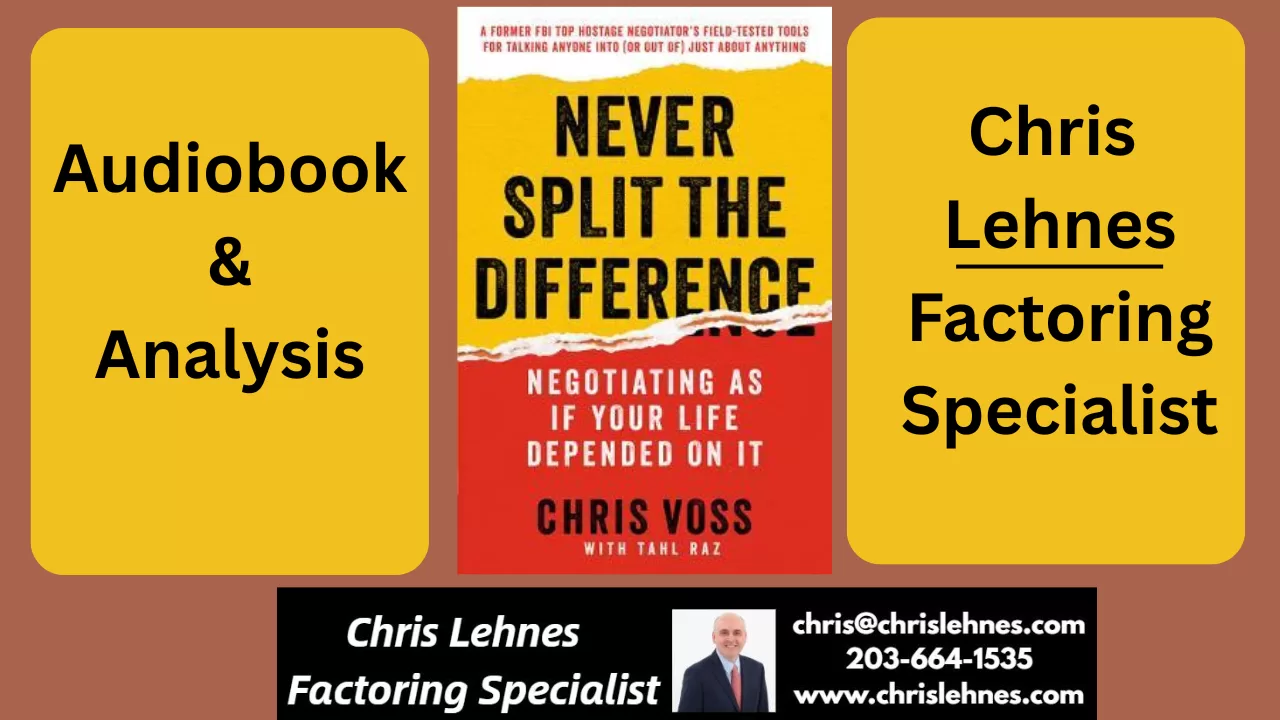
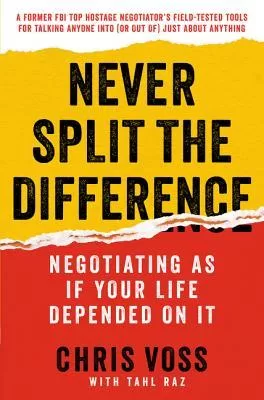
“Never Split the Difference” by Chris Voss, a former FBI lead international kidnapping negotiator, fundamentally challenges traditional negotiation theories, particularly those advocating for rational problem-solving and compromise. Drawing from decades of high-stakes experience, Voss argues that effective negotiation is deeply rooted in human psychology, emotional intelligence, and active listening. The book introduces a system of “tactical empathy” and practical psychological tactics designed to gain the upper hand by understanding and influencing the emotional, often irrational, drivers of counterparts. These methods, proven in life-or-death scenarios, are presented as universally applicable to business, career, and personal interactions, emphasizing that “Life is negotiation.”
Main Themes and Key Concepts
1. The Primacy of Emotion Over Logic
Traditional negotiation, often taught in business schools, emphasizes rational problem-solving and logical arguments. Voss, however, vehemently argues that this approach is flawed because humans are fundamentally “crazy, irrational, impulsive, emotionally driven animals.”
Rejection of Pure Rationality: Voss contends that theories built on “intellectual power, logic, authoritative acronyms like BATNA and ZOPA, rational notions of value, and a moral concept of what was fair and what was not” are based on a “false edifice of rationality.”
System 1 vs. System 2 Thinking: Drawing on Daniel Kahneman’s work, Voss highlights that our “animal mind” (System 1) is “fast, instinctive, and emotional” and “far more influential” than our “slow, deliberative, and logical” mind (System 2). To influence System 2 rationality, one must first affect System 1 feelings.
Emotional Intelligence is Key: The FBI’s shift in negotiation strategy, after failures like Ruby Ridge and Waco, moved from problem-solving to focusing “on the animal, emotional, and irrational.” This made “Emotions and emotional intelligence… central to effective negotiation, not things to be overcome.”
2. Tactical Empathy: Listening as a Martial Art
Tactical Empathy is the cornerstone of Voss’s approach, described as “listening as a martial art.” It’s not about agreement or sympathy, but about profound understanding.
Definition: Tactical empathy is “the ability to recognize the perspective of a counterpart, and the vocalization of that recognition.” It involves “understanding the feelings and mindset of another in the moment and also hearing what is behind those feelings so you increase your influence in all the moments that follow.”
Core Premise: “It all starts with the universally applicable premise that people want to be understood and accepted. Listening is the cheapest, yet most effective concession we can make to get there.”
Benefits of Feeling Understood: Psychotherapy research shows that “when individuals feel listened to, they tend to listen to themselves more carefully and to openly evaluate and clarify their own thoughts and feelings. In addition, they tend to become less defensive and oppositional and more willing to listen to other points of view.”
3. Key Tactical Empathy Tools
Voss introduces several practical techniques to implement tactical empathy:
Mirroring: This is “the art of insinuating similarity.” It involves repeating the “last three words (or the critical one to three words) of what someone has just said.” This triggers a neurobehavioral instinct to copy, establishing rapport and encouraging the counterpart to elaborate, revealing more information.
Example: In a bank robbery, Voss mirrored a kidnapper’s statement: “We chased your driver away?” which led the kidnapper to “vomit information.”
Labeling: Giving a name to a counterpart’s emotions or perceptions. It almost always begins with “It seems like…”, “It sounds like…”, or “It looks like…”.
Purpose: Labeling “disrupts its raw intensity” by applying “rational words to a fear.” It’s used to “neutralize the negative, reinforce the positive.”
Accusation Audit: A proactive form of labeling where you “list every terrible thing your counterpart could say about you” and say them first. This disarms negative dynamics and can often lead the other person to deny the accusation, thus revealing common ground.
Example: In a Harlem standoff, Voss repeatedly stated, “It looks like you don’t want to come out. It seems like you worry that if you open the door, we’ll come in with guns blazing. It looks like you don’t want to go back to jail,” leading to the fugitives’ surrender.
4. Mastering “No” and Striving for “That’s Right”
Voss radically redefines the significance of “Yes” and “No” in negotiation.
“No” as an Asset: Contrary to common belief, “No” is “pure gold” because “it provides a temporary oasis of control” for the speaker. It often means “I am not yet ready to agree,” “I do not understand,” or “I need more information,” rather than outright rejection.
Strategy: “Great negotiators seek ‘No’ because they know that’s often when the real negotiation begins.” It offers safety and control, making the environment more collaborative.
Example: Asking “Is now a bad time to talk?” is preferable to “Do you have a few minutes to talk?” because it offers the counterpart an easy “No” or full focus.
Beware of “Yes”: There are three types of “Yes”: Counterfeit (a polite dodge), Confirmation (a simple affirmation without commitment), and Commitment (the real deal). Most people give counterfeit “yes” to end an uncomfortable conversation.
“That’s Right” as the Breakthrough: The “sweetest two words in any negotiation are actually ‘That’s right.'” This signifies that the counterpart feels truly understood, leading to a subtle epiphany and genuine behavioral change.
How to Achieve: A good summary, combining paraphrasing and labeling, is the best way to trigger a “That’s right.”
Contrast with “You’re Right”: “You’re right” is often a dismissive phrase meaning “just shut up and go away,” leading to no real change.
5. Bending Reality and Leveraging Cognitive Biases
Voss advocates for understanding and using predictable human irrationality, particularly cognitive biases like loss aversion and framing effects, to one’s advantage.
Don’t Compromise: “Compromise is often a ‘bad deal'” because it satisfies neither side and can lead to absurd outcomes. “No deal is better than a bad deal.”
Deadlines as Allies: Deadlines are “the bogeymen of negotiation, almost exclusively self-inflicted figments of our imagination.” They often make people rush into bad deals. By revealing your deadline, you reduce impasse risk and speed up concessions from the other side. Understanding the counterpart’s hidden deadlines (e.g., kidnappers wanting “party money” by Friday) provides significant leverage.
“Fair” is a Weapon: The word “Fair” is “a tremendously powerful word that you need to use with care.” It’s often used defensively (“We just want what’s fair”) or manipulatively (“We’ve given you a fair offer”).
Counter-Tactic: If accused of unfairness, ask, “Okay, I apologize. Let’s stop everything and go back to where I started treating you unfairly and we’ll fix it.” To preempt, state early, “I want you to feel like you are being treated fairly at all times. So please stop me at any time if you feel I’m being unfair, and we’ll address it.”
Anchoring Emotions: Emotionally “anchor them by saying how bad it will be” (an accusation audit) to prepare them for a loss, then make your offer seem reasonable.
Extreme Anchors & Ranges: When talking numbers, letting the other side anchor first can be beneficial. However, if you must anchor, set an extreme anchor to shift their perception or use a range where the low end is your desired price (“bolstering range”).
Odd Numbers: Use “precise, nonround numbers like, say, $37,893 rather than $38,000” to give offers “credibility and weight.”
Loss Aversion: “People will take more risks to avoid a loss than to achieve gains.” To gain leverage, “persuade them that they have something concrete to lose if the deal falls through.”
6. Calibrated Questions: The Illusion of Control
Calibrated questions are open-ended questions designed to subtly guide the conversation and encourage the counterpart to develop your desired solution.
Mechanism: They “remove aggression from conversations by acknowledging the other side openly, without resistance.” They start with “What” or “How” (and sometimes “Why” strategically).
“How am I supposed to do that?”: This is a powerful, gentle “No” that invites collaboration and forces the other side to “expend their energy on devising a solution” to your problem.
“Art of letting someone else have your way”: These questions give the “illusion of control” to the counterpart while you “are framing the conversation.”
Guaranteeing Execution: Asking “How will we know we’re on track?” and “How will we address things if we find we’re off track?” forces the counterpart to articulate implementation in their own words, making them more invested in the solution.
Red Flags: Beware of “You’re right” and “I’ll try,” as they often signal a lack of buy-in or an intention to fail.
7. Finding Black Swans: Uncovering Unknown Unknowns
Black Swans are “hidden and unexpected pieces of information—those unknown unknowns—whose unearthing has game-changing effects on a negotiation dynamic.”
Definition: Unlike “known knowns” (what we know) and “known unknowns” (what we know we don’t know), Black Swans are “pieces of information we’ve never imagined but that would be game changing if uncovered.”
Leverage Multipliers: Black Swans provide the most potent forms of leverage:
Positive Leverage: The ability to give (or withhold) something the counterpart wants.
Negative Leverage: The ability to make the counterpart suffer (based on threats, but used carefully and subtly, e.g., “It seems like you strongly value the fact that you’ve always paid on time”).
Normative Leverage: Using the other party’s “norms and standards to advance your position” by showing inconsistencies between their beliefs and actions.
“Know Their Religion”: Delving into a counterpart’s “worldview, their reason for being, their religion” (their deeply held beliefs, values, and motivations). This provides normative leverage.
Example: In the Dwight Watson standoff, uncovering his identity as a “devout Christian” allowed negotiators to use the concept of “the Dawn of the Third Day” to facilitate his surrender.
Overcoming “They’re Crazy!”: What seems irrational is usually a clue. Counterparts might be “ill-informed,” “constrained” by unstated factors (e.g., internal politics), or have “other interests” (hidden agendas).
Method: Get face time, observe unguarded moments (before/after meetings, during interruptions), and relentlessly ask questions to uncover these underlying realities.
8. The Negotiation One Sheet: Preparation for Agility
Voss proposes a simplified preparation tool, the “Negotiation One Sheet,” contrasting it with traditional methods that can lead to rigidity.
Rejection of BATNA as a Primary Focus: While BATNA (Best Alternative To a Negotiated Agreement) is useful, obsessing over it “tricks negotiators into aiming low” and “sets the upper limit of what you will ask for.”
Focus on High-End Goal: Instead, set an “optimistic but reasonable goal and define it clearly,” writing it down and discussing it to commit.
Dynamic Preparation: The one-sheet includes sections for:
Goal: Best-case scenario (optimistic but realistic).
Summary: Known facts leading to the negotiation.
Labels/Accusation Audit: Anticipated negative perceptions or accusations from the counterpart.
Calibrated Questions: To reveal value, identify deal-killers, and influence behind-the-table players.
Noncash Offers: Ideas for valuable non-monetary concessions.
Most Important Ideas/Facts
Negotiation is primarily emotional, not rational. All decisions are ultimately governed by emotion (Kahneman’s System 1).
Tactical Empathy is the core skill. It’s about profoundly understanding, not necessarily agreeing with, the other side.
“That’s right” is the ultimate goal, not “Yes.” “That’s right” signals genuine understanding and buy-in, while “Yes” can be a counterfeit or confirmation without commitment.
“No” is not a failure; it’s the start of the negotiation. It provides safety and control for the counterpart, opening up the dialogue.
Calibrated Questions (starting with “How” or “What”) give the illusion of control. They subtly guide the counterpart to solve your problems, leading to solutions they “own.” “How am I supposed to do that?” is a powerful, gentle “No.”
Compromise often leads to bad deals. Never “split the difference.”
Loss aversion is a powerful motivator. People will take greater risks to avoid a loss than to achieve an equal gain.
Black Swans are “unknown unknowns” that are leverage multipliers. Uncovering these hidden pieces of information—often related to underlying motivations, constraints, or “religion” (worldview)—can be game-changing.
“Fair” is a highly emotional and manipulative word. Use it with caution or strategically to disarm or set boundaries.
Preparation should focus on anticipating emotional responses and crafting flexible questions, rather than rigid scripts or aiming low (avoiding BATNA as a primary focus).
It’s crucial to influence the “behind the table” players. Few negotiations are solo; many hidden individuals can be deal makers or deal killers.
This briefing highlights the transformative power of a psychological and empathetic approach to negotiation, emphasizing that by understanding and addressing the emotional landscape, one can achieve superior and lasting outcomes in any interaction.
A Study Guide to Chris Voss’s Never Split the Difference
This study guide is designed to help you review and deepen your understanding of Chris Voss’s negotiation principles as outlined in Never Split the Difference.
I. Quiz: Short Answer Questions
Answer each question in 2-3 sentences.
What is the core difference between the FBI’s approach to negotiation and the traditional Harvard Law School approach, as described by Voss?
Explain the “Late-Night FM DJ Voice” and its primary purpose in a negotiation.
How does Voss define “Tactical Empathy” and what is its goal?
Why does Voss advocate for striving for “That’s right” instead of “Yes” in a negotiation?
Describe the concept of an “Accusation Audit” and why it is an effective negotiation tactic.
According to Voss, why is “No” often considered “pure gold” in a negotiation, rather than a negative outcome?
What are “Calibrated Questions” and how do they create the “illusion of control” for the counterpart?
Explain the “Rule of Three” and how it helps a negotiator guarantee execution.
What is an “extreme anchor” in the context of bargaining, and what psychological effect does it aim to achieve?
Define a “Black Swan” in negotiation and explain its significance.
II. Answer Key
What is the core difference between the FBI’s approach to negotiation and the traditional Harvard Law School approach, as described by Voss? The FBI’s approach, rooted in experiential learning from high-stakes crisis situations, emphasizes emotional intelligence, psychology, and crisis intervention to understand and influence irrational human behavior. In contrast, the traditional Harvard approach, exemplified by “Getting to Yes,” focuses on rational problem-solving, logic, and intellectual power to achieve mutually beneficial outcomes.
Explain the “Late-Night FM DJ Voice” and its primary purpose in a negotiation. The “Late-Night FM DJ Voice” is characterized by a deep, soft, slow, and reassuring tone, often with a downward inflection. Its primary purpose is to convey calm, control, and authority without triggering defensiveness, thereby making the counterpart feel safe and encouraging them to open up.
How does Voss define “Tactical Empathy” and what is its goal? Tactical Empathy is defined as the ability to recognize and vocalize a counterpart’s perspective and underlying feelings in the moment, and to understand what drives those feelings. Its goal is to increase influence by acknowledging emotions, creating trust, and guiding the conversation toward a desired outcome.
Why does Voss advocate for striving for “That’s right” instead of “Yes” in a negotiation? Voss argues that “Yes” can often be superficial (“Counterfeit Yes” or “Confirmation Yes”) and doesn’t guarantee genuine agreement or action. “That’s right,” however, indicates that the counterpart feels truly understood and has assessed and confirmed the negotiator’s summary of their world, leading to a deeper level of buy-in and a breakthrough in the negotiation.
Describe the concept of an “Accusation Audit” and why it is an effective negotiation tactic. An “Accusation Audit” involves proactively listing and vocalizing all the negative things the counterpart could say about the negotiator or their position before the counterpart can voice them. This tactic disarms the counterpart by addressing their fears and potential criticisms head-on, reducing defensiveness and fostering a sense of empathy and trust.
According to Voss, why is “No” often considered “pure gold” in a negotiation, rather than a negative outcome? “No” is “pure gold” because it gives the speaker a feeling of safety, security, and control, allowing them to define their boundaries and true desires. It’s often a temporary decision to maintain the status quo, opening the door for clarification, reevaluation, and further negotiation, rather than ending the discussion.
What are “Calibrated Questions” and how do they create the “illusion of control” for the counterpart? Calibrated Questions are open-ended questions, typically starting with “How” or “What” (avoiding “Why”), that force the counterpart to think deeply about the problem and articulate solutions. They create the “illusion of control” because the counterpart feels they are providing the answers and driving the conversation, while the negotiator is subtly framing the discussion and guiding them toward the desired outcome.
Explain the “Rule of Three” and how it helps a negotiator guarantee execution. The “Rule of Three” is a tactic to ensure genuine commitment by getting the counterpart to agree to the same thing three different ways within the same conversation. This helps to uncover any hidden objections or insincerity, as it’s difficult to repeatedly lie or fake conviction, thereby increasing the likelihood of successful implementation.
What is an “extreme anchor” in the context of bargaining, and what psychological effect does it aim to achieve? An “extreme anchor” is a deliberately high or low initial offer made at the beginning of a monetary negotiation. Its psychological effect is to “bend the reality” of the counterpart, unconsciously adjusting their expectations and moving their perceived range of possible outcomes closer to the extreme anchor, making subsequent, more reasonable offers seem highly attractive.
Define a “Black Swan” in negotiation and explain its significance. A “Black Swan” is an unknown unknown—a piece of game-changing information that was previously unimagined or thought impossible, and whose discovery fundamentally alters the negotiation dynamic. Its significance lies in its power to unlock breakthroughs and provide immense leverage, transforming seemingly intractable situations.
III. Essay Format Questions (No Answers Provided)
Compare and contrast the influence of emotional intelligence and logical reasoning in negotiation, drawing on specific examples or theories presented in the text to support your argument.
Analyze how the different bargaining styles (Accommodator, Assertive, Analyst) impact negotiation dynamics and what strategies Voss suggests for effectively dealing with each type.
Discuss the critical role of “listening as a martial art” and “Tactical Empathy” in information gathering and relationship building. How do these concepts challenge traditional notions of negotiation?
Examine the psychological significance of “Yes” and “No” in negotiation according to Voss. How does understanding these words, particularly the power of “No,” transform a negotiator’s approach and potential outcomes?
Explain the concept of “bending their reality” through various tactics like anchoring, loss aversion, and the strategic use of numbers. How does this approach leverage human irrationality to achieve desired results?
IV. Glossary of Key Terms
Accusation Audit: A proactive negotiation tactic where you list and verbalize all the negative things your counterpart could say about you or your position to disarm them and build trust.
Accommodator (Bargaining Style): A negotiator type primarily focused on building and maintaining relationships, often prioritizing agreement and harmonious exchange of information over concrete outcomes.
Ackerman Model: A structured, six-step offer-counteroffer bargaining system (65%, 85%, 95%, 100% of target price) that incorporates psychological tactics like extreme anchors, reciprocity, and diminishing increments to achieve a desired price.
Active Listening: A core component of tactical empathy, involving intense focus on the other person, observing verbal, paraverbal, and nonverbal cues, and demonstrating a sincere desire to understand their perspective.
Analyst (Bargaining Style): A methodical, diligent negotiator type focused on minimizing mistakes, thorough preparation, and data. They are typically reserved, less emotional, and hypersensitive to reciprocity.
Anchoring: The psychological tendency to rely heavily on the first piece of information offered (the “anchor”) when making decisions. In negotiation, it refers to setting a strong initial offer or statement to influence the perceived value of a deal.
Assertive (Bargaining Style): A negotiator type driven by winning and achieving results quickly. They are direct, candid, and often aggressive in their communication, focusing on their own goals rather than primarily on relationships.
BATNA (Best Alternative To a Negotiated Agreement): (Coined by Fisher and Ury) Your best option if a negotiation fails. Voss critiques its overuse as it can lead to aiming low by becoming the negotiator’s psychological target.
Behavioral Change Stairway Model (BCSM): A five-stage model (active listening, empathy, rapport, influence, and behavioral change) developed by the FBI’s Crisis Negotiation Unit to guide negotiators from understanding to influencing behavior.
Black Swan: An “unknown unknown”—a powerful, unexpected piece of information or event that, if discovered, fundamentally changes the entire negotiation dynamic and provides significant leverage.
Calibrated Questions: Open-ended questions, usually starting with “How” or “What” (and generally avoiding “Why”), designed to make the counterpart think and articulate solutions, giving them the “illusion of control” while subtly guiding the conversation.
Certainty Effect: A concept from Prospect Theory stating that people are drawn to sure things over probabilities, even when the probability is a statistically better choice.
Commitment “Yes”: A genuine agreement from the counterpart that leads to action and a signed deal.
Confirmation “Yes”: A simple, reflexive affirmation in response to a black-or-white question, without a promise of action.
Counterfeit “Yes”: A “yes” given by the counterpart who intends to say “no” but uses “yes” as an easier escape route or to gather more information.
“Chris Discount”: A personal tactic where the negotiator uses their own first name in a friendly, humanizing way to establish rapport and potentially secure a small concession.
Deadlines: Time constraints that can create pressure and anxiety in negotiations. Voss argues many are arbitrary and negotiable, and revealing your deadline can lead to better deals.
Extreme Anchor: A deliberately high or low initial offer intended to psychologically shift the counterpart’s perception of value and range of possible agreement.
“Fair”: A highly emotional and often manipulative word in negotiation. Voss advises caution when using or encountering it, suggesting strategies to either preempt accusations of unfairness or deflect them.
“Forced Empathy”: A dynamic created by calibrated “How” questions, where the counterpart is implicitly made to consider and understand the negotiator’s situation, often leading them to offer solutions.
Framing Effect: A cognitive bias where people respond differently to the same choice depending on how it is presented or “framed.”
“How Am I Supposed To Do That?”: A powerful calibrated question used as a gentle way to say “No” and force the counterpart to consider the negotiator’s constraints and propose solutions.
“I” Messages: Statements using the first-person singular pronoun (“I feel X when you Y because Z”) to set boundaries or express a viewpoint without escalating confrontation.
Isopraxism (Mirroring): The unconscious or conscious imitation of another person’s speech patterns, body language, vocabulary, tempo, or tone of voice. Consciously used as a negotiation tactic to build rapport and encourage elaboration.
Labeling: A tactical empathy technique where you verbalize the emotions or assumptions you perceive in your counterpart (“It sounds like…”, “It seems like…”, “It looks like…”). This diffuses negative emotions and reinforces positive ones.
Late-Night FM DJ Voice: A deep, soft, slow, and reassuring vocal tone used to project calm, control, and authority, making the counterpart feel safe and open.
Loss Aversion: A psychological principle (from Prospect Theory) where people are statistically more motivated to avoid a loss than to achieve an equal gain. Effective negotiators leverage this by framing proposals in terms of what the counterpart stands to lose.
Mirroring: The act of repeating the last one to three critical words your counterpart has just said to encourage them to elaborate and build rapport.
Negative Leverage: The ability of a negotiator to make their counterpart suffer, often based on threats of negative consequences. Used with extreme caution.
Negotiation One Sheet: A concise preparatory document used by negotiators to outline their goal, summarize known facts, prepare labels/accusation audits, formulate calibrated questions, and list noncash offers.
“No”: Voss argues that “No” is a powerful word in negotiation, signifying autonomy, safety, and a desire to maintain the status quo. It often marks the beginning of true negotiation, clarifying boundaries and paving the way for creative solutions.
Noncash Offers: Non-monetary items or terms that can be valuable to one party in a negotiation, offering a way to create value without directly adjusting the price.
Nonround Numbers: Specific, precise numbers (e.g., $37,263) used in offers to convey thoughtfulness, credibility, and firmness, in contrast to rounded numbers (e.g., $38,000) which can feel like temporary placeholders.
Normative Leverage: Using the other party’s norms, standards, or moral framework to advance your position, highlighting inconsistencies between their beliefs and actions.
“Paradox of Power”: The phenomenon where the harder one pushes in a negotiation, the more likely they are to be met with resistance from the other party.
Paraphrase: Restating what the other person has said in your own words to demonstrate understanding and clarify meaning.
Pinocchio Effect: A linguistic indicator of deception, where liars tend to use more words and more third-person pronouns to distance themselves from the lie, and often more complex sentences.
Positive Leverage: The ability of a negotiator to provide or withhold things that their counterpart wants.
Positive/Playful Voice: The default voice tone recommended for negotiators, characterized by an easygoing, good-natured, and encouraging attitude, often accompanied by a smile, to promote collaboration and mental agility.
Prospect Theory: A theory by Kahneman and Tversky describing how people choose between options involving risk, highlighting biases like Loss Aversion and the Certainty Effect.
“Religion” (of your counterpart): A metaphor for your counterpart’s worldview, their reason for being, their core beliefs, values, and what truly matters to them. Understanding this helps uncover Black Swans and build influence.
Rule of Three: A technique to ensure genuine commitment by getting the counterpart to affirm an agreement or idea three different ways in a conversation (e.g., “Yes,” “That’s right,” and a “How” question about implementation).
7-38-55 Percent Rule: Albert Mehrabian’s rule stating that in communication, 7% of a message is conveyed by words, 38% by tone of voice, and 55% by body language. It emphasizes the importance of nonverbal cues.
“Sixty Seconds or She Dies”: An introductory exercise Voss uses in his negotiation classes to highlight the urgency and difficulty of high-stakes negotiations and the need for learned skills.
Similarity Principle: The psychological tendency for people to trust and like those they perceive as similar or familiar to themselves. Negotiators can leverage this by finding common ground.
“Slow. It. Down.”: A crucial negotiation principle advocating for deliberate pacing to calm the situation, allow for thorough listening, and prevent impulsive decisions.
Strategic Umbrage: A well-timed expression of (real, controlled) anger directed at a proposal (not the person) to make a counterpart realize their offer is unreasonable and shift their perspective.
Summarize: A powerful active listening technique combining paraphrasing and labeling to rearticulate the meaning of what was said and acknowledge the underlying emotions.
System 1 Thinking: (From Kahneman’s Thinking, Fast and Slow) Our fast, instinctive, and emotional thought process.
System 2 Thinking: (From Kahneman’s Thinking, Fast and Slow) Our slow, deliberative, and logical thought process. Voss argues System 1 often guides System 2.
Tactical Empathy: The ability to understand and verbalize the feelings and mindset of another person in the moment, and to hear what is behind those feelings, to increase influence. It’s empathy as a deliberate tool.
“That’s Right”: A powerful affirmation from the counterpart indicating that they feel truly understood and have embraced the negotiator’s summary of their perspective, signifying a breakthrough in the negotiation.
Ultimatum Game: A game theory experiment demonstrating human irrationality and the powerful role of perceived fairness in decision-making, where responders often reject offers they deem unfair, even if it means getting nothing.
Unconditional Positive Regard: A concept from Carl Rogers, suggesting that real change occurs when a person feels completely accepted and understood, without judgment or conditions. In negotiation, it fosters trust and openness.
“Unbelief”: (From Kevin Dutton) Active resistance and complete rejection of what the other side is saying. The goal in negotiation is to suspend this unbelief to open the path to persuasion.
“Wimp-Win” Mentality: A negotiation mindset where individuals set modest goals to protect their self-esteem, leading to easily claimed victories but ultimately mediocre outcomes.
“You’re Right”: An affirmation from the counterpart that Voss identifies as generally ineffective, often used as a polite way to dismiss or shut down the negotiator without genuine agreement or commitment to action.
ZOPA (Zone of Possible Agreement): (Coined by Fisher and Ury) The overlap between the buyer’s and seller’s acceptable price ranges in a negotiation. Voss downplays its importance in real-world “bare-knuckle bargaining.”
At the heart of Guidara’s work is the concept of “Unreasonable Hospitality,” which he defines as “the remarkable power of giving people more than they expect.” This goes beyond mere “service,” which Guidara describes as “black and white”—competent and efficient. Hospitality, in contrast, is “color”—making people feel great about the service they receive and creating an authentic connection.
Service vs. Hospitality: “Service is black and white; hospitality is color.” Service is doing your job with competence and efficiency; hospitality is genuinely engaging to make an authentic connection.
Challenging the Status Quo: The term “unreasonable” was initially used to shut down Guidara’s ambitious ideas but became a “call to arms.” He argues that “no one who ever changed the game did so by being reasonable.”
Beyond Restaurants: Guidara believes this philosophy is applicable across all service industries, from retail and finance to healthcare and education. He posits that America has transitioned into a “service economy,” where intentional and creative hospitality offers “an incredible opportunity.”
The Power of Feeling Good: While the financial impact of making someone feel good may be hard to quantify, Guidara asserts, “it matters more.” He describes hospitality as a “selfish pleasure” because “it feels great to make other people feel good.”
Can Hospitality Be Taught? Guidara firmly believes it can, contrary to some leaders. He co-founded the Welcome Conference to evolve the craft of dining room professionals, noting that attendees quickly expanded beyond the restaurant industry, demonstrating a broader recognition of the value of a hospitality-first culture.
II. Building a Foundation for Greatness: Early Lessons and Principles
Guidara’s upbringing and early career experiences profoundly shaped his approach to leadership and hospitality.
The Magic of Experience: His twelfth birthday dinner at the Four Seasons, where a server “expertly carved my duck on a gleaming cart” and replaced a dropped napkin, left an indelible mark. This experience taught him that a restaurant “could create magic.” This aligns with Maya Angelou’s (attributed) quote: “People will forget what you do; they’ll forget what you said. But they’ll never forget how you made them feel.”
The Power of Intentionality: His father, Frank Guidara, instilled in him the importance of “intentionality”—making every decision thoughtfully, with “clear purpose and an eye on the desired result.” His father’s selflessness in caring for his ailing mother also taught Guidara “what it’s like to feel truly welcomed.”
The Nobility of Service: A profoundly moving experience at Daniel with his father after his mother’s death revealed “how important, how noble, working in service can be.” Chef Daniel Boulud’s “ray of light” provided “an oasis of comfort and restoration, an island of delight and care in the sea of our grief.”
Enlightened Hospitality (Danny Meyer’s Influence): Working for Danny Meyer’s Union Square Hospitality Group (USHG) introduced Guidara to “Enlightened Hospitality,” which prioritized employees, believing that “if he wanted his frontline teams to obsess about how they made their customers feel, he had to obsess about how he made his employees feel.” Key tenets included:
Go Above and Beyond: Exemplified by a sommelier rescuing a guest’s champagne from a freezer and leaving caviar and a card. This evolved into “grace notes” like feeding parking meters, showing that small, seemingly non-essential acts of hospitality could “blow people’s minds.”
Enthusiasm is Contagious: Randy Garutti, Guidara’s general manager at Tabla, demonstrated unwavering positivity and instilled a “sense of ownership” by entrusting young managers with responsibility.
Language Creates Culture: Danny Meyer’s brilliance in coining phrases like “constant, gentle pressure,” “athletic hospitality,” and “be the swan” helped build a strong, shared culture. Guidara’s favorite was “Make the charitable assumption,” a reminder to “assume the best of people, even when (or perhaps especially when) they weren’t behaving particularly well.”
“Cult” is Short for “Culture”: Guidara embraced the “cult” label given by outsiders, recognizing it as a sign of a deeply invested and positive company culture.
III. Navigating Business Acumen and Creative Freedom
Guidara’s journey involved understanding the balance between strict business controls and creative hospitality.
Restaurant-Smart vs. Corporate-Smart: His father introduced him to this distinction: restaurant-smart companies offer autonomy and human connection but may lack corporate support, while corporate-smart companies have strong back-end systems but can stifle creativity. Guidara’s goal was to build a company that was “corporate-smart and restaurant-smart.”
Control Doesn’t Have to Stifle Creativity: His time at Restaurant Associates (RA) as an assistant purchaser and controller, tracking the financial impact of daily decisions, taught him the power of systems. He realized that corporate controls could “return [chefs] to their creativity” by freeing them from financial worries.
Trust the Process: His mentor at RA, Hani Ichkhan, meticulously guided him through financial reporting, withholding the “big picture” P&L until Guidara had a strong foundational understanding. This taught Guidara to “trust the process” and the importance of a “solid base.”
When Control Stifles Creativity: However, he also experienced the negative side of excessive corporate control when he was reprimanded for moving a vase at Nick + Stef’s Steakhouse and when HR rehired a disruptive employee (Felix) he had fired. This taught him that “corporate-smart could be restaurant-dumb” and the importance of trusting “the people on the ground.” As former navy captain David Marquet says, “the people at the top have all the authority and none of the information, while the people on the front line have all the information and none of the authority.”
The Rule of 95/5: Guidara’s time at MoMA, managing the museum’s cafés, led to the development of this principle: “Manage 95 percent of your business down to the penny; spend the last 5 percent ‘foolishly.'” This “foolish” 5% has an “outsize impact on the guest experience” and can create unforgettable moments, such as the custom tiny blue gelato spoons or a rare, expensive glass of wine in a pairing.
IV. The Eleven Madison Park Transformation: Pursuing a Vision
Guidara’s leadership at EMP was defined by a relentless pursuit of a unique vision.
A True Partnership: Guidara’s condition for taking the GM role at EMP was a true partnership with Chef Daniel Humm, where “what happens in the dining room doesn’t matter as much as what happens in the kitchen.” This led to the foundational decision that EMP would be “a restaurant run by both sides of the wall.”
Setting Expectations: Upon arriving at EMP, Guidara found a “bad bad” situation with internal factions and disorganization. His strategy involved:
Inviting the Team Along: Bridging the gap between the “old guard” and the “fine-dining squad” by improving communication and establishing clear systems.
Leaders Listen: Spending weeks “sitting down with every single member of the team and hearing them out” to understand the restaurant’s true state.
Finding the Hidden Treasures: Identifying and leveraging individual strengths, as he did with Eliazar Cervantes, transforming him from a struggling food runner to a brilliant expeditor.
Keep Emotions Out of Criticism: Emphasizing constructive feedback (“Criticize the behavior, not the person. Praise in public; criticize in private. Praise with emotion, criticize without emotion.”) and implementing initiatives like the “Made Nice Award.”
Thirty Minutes a Day Can Transform a Culture: Implementing mandatory, structured daily pre-meal meetings to “fill the gas tank” of employees, communicate standards, and “speak to the spirit of the restaurant.”
Set Them Up to Succeed: Cutting back on overwhelming demands (like extensive wine knowledge) to allow staff to build a solid foundation, embracing the mantra “slow down to speed up.”
Breaking Rules and Building a Team: Guidara’s “four-star inexperience” allowed him to critically examine fine-dining rules, questioning those that didn’t serve the guest. This led to abandoning norms like not touching the table, serving soufflés “wrong,” and having cooks kneel when describing dishes. They also changed their goodbye gift from elaborate canelés to a jar of granola, focusing on “what our guests might actually want to eat.”
Hire the Person, Not the Résumé: Guidara prioritized attitude and a “philosophy of hospitality” over fine-dining experience. New hires started as kitchen servers, immersing them in the culture and Daniel’s food before interacting with guests.
Every Hire Sends a Message: Emphasizing that hiring is a “sobering responsibility” because new hires impact the entire team. He advocated for “hire slow” to ensure cultural fit and to reward “A players” by surrounding them with other “A players.”
Build a Cultural Bonfire: To combat negativity and foster enthusiasm, he started hiring groups of new employees simultaneously, creating a “bonfire no one could put out.”
Make It Cool to Care: Drawing inspiration from a college friend, Brian Canlis, Guidara fostered an environment where genuine passion and effort were celebrated, transforming EMP into a place where “it had become cool to care.”
Working with Purpose, On Purpose:Don’t Try to Be All Things to All People: While open to criticism, Guidara believed in having a clear “point of view” and not changing everything based on a few negative opinions.
Articulate Your Intentions: Inspired by Miles Davis’s “endless reinvention” and collaborative spirit, Guidara and Humm developed a list of eleven words (Cool, Endless Reinvention, Inspired, Forward Moving, Fresh, Collaborative, Spontaneous, Vibrant, Adventurous, Light, Innovative) to guide their vision.
Strategy is for Everyone: Breaking the industry norm, they involved all staff, “from the assistant general manager and the chef de cuisine all the way to the dishwashers, prep cooks, and assistant servers,” in strategic planning to identify core values (Education, Passion, Excellence, Hospitality).
Choose Conflicting Goals: Embracing “integrative thinking” by choosing seemingly contradictory goals like “hospitality and excellence” forced innovation and ensured a balanced approach.
Know Why Your Work is Important: Guidara aimed to instill a sense of “nobility” in service, encouraging employees to understand that they “make a difference in someone’s life” and “make the world a better place.”
V. Continuous Improvement and Crisis Navigation
EMP’s journey to the top involved constant adaptation and strategic responses to challenges.
Leveraging Affirmation: Guidara actively sought and amplified external praise to boost team morale. He ensured credit went to those responsible, even if it meant risking them being “poached.” He believed “Persistence and determination alone are omnipotent” (Calvin Coolidge).
Restoring Balance (The Nuclear Reactor was Melting Down): The relentless pursuit of perfection led to staff burnout, highlighted by a cook showing up ten hours early due to stress. Guidara recognized the need to “slow down to speed up” and encouraged staff to find their “oxygen” for self-restoration.
The Deep Breathing Club (DBC): Inspired by a friend’s work with agitated youth, Guidara introduced “DBC” as a code word for overwhelmed staff to signal they needed to pause and receive support, de-stigmatizing asking for help.
Touch the Lapel: A staff-generated sign language gesture meaning “I need help,” which streamlined support during busy services and further destigmatized asking for assistance.
The Best Offense is Offense (Navigating the 2008 Recession):Adversity is a Terrible Thing to Waste: Facing financial desperation, Guidara and Humm decided to “play offense” rather than just cut costs.
Raindrops Make Oceans: They meticulously cut “invisible” expenses (e.g., dishwashing detergent, paper toques) but protected the guest experience. Guidara’s father encouraged him to journal these cuts to remember “the best of them” for future profitability.
Building the Top Line: Introduced a $29 two-course lunch to fill seats and attract new demographics. They also introduced a dessert trolley, increasing dessert sales by 300%.
Keep the Team Engaged: They hosted an elaborate Kentucky Derby party, which, while breaking even, “invigorated the team” and “broadened” EMP’s community.
It Doesn’t Have to Be Real to Work: To prepare for Frank Bruni’s anticipated four-star review during a long and stressful waiting period, they designated a “Critic of the Night” table, where every detail of service was flawlessly executed. This “ruse” allowed the team to practice and perfect their performance without the pressure of a real critic, making them ready for the actual review.
VI. Scaling, Evolution, and the Ultimate Achievement
Guidara’s principles extended beyond EMP to new ventures and ultimately led to global recognition.
Earning Informality: After earning four New York Times stars, EMP faced new expectations for formality. Guidara emphasized “earning informality” by initially amping up formality, then gradually building trust to offer a more casual, connected experience. This involved being “present” and focusing on relationships.
Learning to Be Unreasonable: After being ranked 50th on the World’s 50 Best Restaurants list, Guidara used his father’s quote, “What would you attempt to do if you knew you could not fail?” to inspire the team to aim for number one. This involved “radical” changes to hospitality, removing transactional elements (e.g., podiums, coat check tags) to create a more personal “welcome.”
Hospitality is a Dialogue, Not a Monologue: Inspired by Rao’s, Guidara sought to make the dining experience a true “dialogue.” They introduced a menu listing only the main ingredient (beef, duck, lobster), allowing guests choice while still enjoying an element of surprise. They also started asking guests about disliked ingredients, fostering vulnerability by first sharing his own dislike of sea urchin.
Treat Everyone Like a VIP: Unreasonable Hospitality meant extending “thoughtful, high-touch gestures for every one of our guests.” This included kitchen tours for all, not just VIPs, and the “hospitality solution” of leaving a bottle of cognac with the check at the end of the meal, eliminating the “rushed out” feeling.
Improvisational Hospitality: Guidara championed “one-off hospitality,” like serving a street hot dog to guests who mentioned they hadn’t had one. This led to the creation of the “Dreamweaver” role, a dedicated staff member to execute these spontaneous, personalized “Legends” (e.g., a watercolor of a new home, a Nerf gun game for a chef). The true gift of a Legend was “the story that made a Legend a legend.”Creating a Tool Kit: To scale these moments, they developed a “tool kit” of readily deployable gestures for recurring situations (e.g., “Plus One” cards with local recommendations, engagement flutes from Tiffany, hangover kits). He noted, “the value of a gift isn’t about what went into giving it, but how the person receiving it feels.”
Scaling a Culture (The NoMad): When opening the NoMad, Guidara aimed to “rejuvenate a New York neighborhood” and demonstrate that their hospitality culture could be scaled. They brought EMP staff to “seed the new spot with our culture” and made a rare external hire for GM, Jeff Tascarella, for his volume experience and “coolness.” Training was given an “outrageous” budget to ensure cultural transfer, resulting in a “Field Manual” of core values.
Leaders Say Sorry: Guidara admitted to one of his biggest mistakes: trying to manage both EMP and the NoMad simultaneously, leading to a decline in morale at EMP. He publicly apologized to his team and promoted Kirk Kelewae to GM, demonstrating the “power of vulnerability” and reinforcing that “Sometimes the best time to promote people is before they are ready.”
No Guest Left Behind: The NoMad allowed EMP to evolve its elaborate tasting menu without abandoning loyal regulars, offering a more casual yet still exceptional option nearby.
Back to Basics: After a drop on the 50 Best list and a realization that their meals had become “too much,” Guidara and Humm returned to first principles. They cut the menu from fifteen to seven courses, doubled down on Dreamweavers, and eliminated the script-like menu presentations, returning to a menu-less “conversation” about preferences. Their new mission: “To be the most delicious and gracious restaurant in the world.”
The Ultimate Achievement: In 2017, after “seven years of hard work, creativity, a maniacal attention to detail, and a truly unreasonable dedication to hospitality,” Eleven Madison Park was named the best restaurant in the world. Guidara noted it was the “pursuit of excellence that brought us to the table, but it was our pursuit of Unreasonable Hospitality that took us to the top.”
VII. Post-EMP and Future Vision
Guidara’s journey continued beyond EMP, reinforcing his core beliefs.
Doing What’s “Right”: His split with Daniel Humm was guided by his father’s advice to “ask yourself what ‘right’ looks like, then do that,” even if it meant personal sacrifice.
Continuing the Mission: Despite leaving EMP, Guidara remains dedicated to the industry, co-founding the Independent Restaurant Coalition and continuing to advocate for hospitality in various fields. He concludes by inviting leaders across industries to join “the hospitality economy.”
Unreasonable Hospitality: A Comprehensive Study Guide
I. Quiz
Instructions: Answer each question in 2-3 sentences, drawing upon the provided source material.
What was the initial “crazy idea” Will Guidara had for transforming Eleven Madison Park into the best restaurant in the world, and how did it differ from the typical approach to fine dining?
Explain the distinction between “service” and “hospitality” as described in the text, using the “black and white” and “color” analogy.
Describe the “Rule of 95/5” and provide an example of how Eleven Madison Park applied this principle in its operations.
Why did Will Guidara initially decide against accepting the General Manager position at Eleven Madison Park, and what persuaded him to take the role?
What was the significance of Daniel Humm and Will Guidara’s decision to run Eleven Madison Park as a “restaurant run by both sides of the wall”?
How did Will Guidara address the issue of inconsistent service standards and communication among staff in the early days at Eleven Madison Park?
Explain the concept of “making the charitable assumption” as taught by Danny Meyer and how it was applied to both employees and guests.
What were the four core values that emerged from Eleven Madison Park’s first strategic planning meeting, and which two were considered to be in “inherent conflict”?
Describe how the “Deep Breathing Club (DBC)” and the “touch the lapel” sign helped the team at Eleven Madison Park manage high-pressure situations and foster a culture of support.
How did Will Guidara leverage external affirmation for his team at Eleven Madison Park, and what was his philosophy regarding staff members receiving media attention?
Answer Key
Will Guidara’s “crazy idea” was to approach hospitality with the same passion, attention to detail, and rigor as the food. This differed from the typical approach which primarily focused on culinary innovation, aiming instead to prioritize connection and graciousness for both staff and guests.
“Service is black and white; hospitality is color.” Service refers to doing a job with competence and efficiency, like delivering the right plate. Hospitality, however, means genuinely engaging with the person being served to make them feel great and establish an authentic connection.
The “Rule of 95/5” means managing 95% of the business down to the penny, and spending the last 5% “foolishly” on details that have an outsized impact on the guest experience. An example at EMP was splurging on a rare and expensive glass of wine for one course in a pairing, or sending a family on a sledding trip after their meal.
Will Guidara initially hesitated because he didn’t want to work for a chef who didn’t respect the dining room, insisting on a true partnership. He was persuaded when Danny Meyer allowed him to propose a one-year commitment, after which he could transition to Shake Shack, and Daniel Humm committed to a partnership between kitchen and dining room.
The decision to run EMP as a “restaurant run by both sides of the wall” meant that both the chef and the restaurateur would make decisions together. This ensured that choices prioritized the restaurant’s overall best interest, rather than solely focusing on food (chef-driven) or service (restaurateur-driven), creating a more balanced and collaborative environment.
Guidara addressed inconsistent service by reinstituting printed line-up notes with clear standards and information for servers, holding daily mandatory 30-minute pre-meal meetings to communicate expectations and inspire the team, and implementing food and wine tests. He also actively listened to staff feedback to understand underlying issues.
“Making the charitable assumption” meant assuming the best of people, even when they were behaving poorly. For employees, it meant asking if everything was okay when they were late, rather than immediately reprimanding. For guests, it meant considering they might be having a difficult personal experience, and therefore needed more love and hospitality, even if dismissive.
The four core values were Education, Passion, Excellence, and Hospitality. The two considered in “inherent conflict” were Excellence and Hospitality, as achieving both simultaneously required constant innovation and attention to balancing meticulous standards with genuine warmth and connection.
The “Deep Breathing Club (DBC)” encouraged overwhelmed colleagues to take deep breaths during crises, implicitly communicating support. The “touch the lapel” sign provided a discreet and efficient way for staff to signal to a manager or colleague that they needed help, removing the stigma from asking for assistance in a fast-paced environment.
Will Guidara leveraged external affirmation by sharing good press, gushing emails from guests, and compliments from other restaurateurs directly with his staff. His philosophy was to turn the spotlight on those who deserved it, giving credit to staff members like Kirk Kelewae for the beer program, even if it meant risking them being “poached,” as it inspired the team and attracted new talent.
II. Essay Questions (No Answers Supplied)
Analyze the role of intentionality in shaping the culture and success of Eleven Madison Park, drawing examples from both Will Guidara’s personal life and the restaurant’s operational decisions.
Compare and contrast the “restaurant-smart” and “corporate-smart” approaches to business, as described by Will Guidara’s father. Discuss how Guidara aimed to integrate both philosophies at MoMA and later at Eleven Madison Park, and the challenges he faced in doing so.
Discuss the significance of “unreasonable hospitality” as a guiding principle for Eleven Madison Park. How did Guidara and his team operationalize this concept, and what impact did it have on both the guest experience and the internal culture of the restaurant?
Examine the evolution of Eleven Madison Park’s mission and menu over time, including the introduction of the “New York theme” tasting menu and its eventual reevaluation. What lessons did Guidara learn about balancing creativity, tradition, and guest preferences in the pursuit of greatness?
Reflect on the various leadership strategies employed by Will Guidara throughout his career, particularly during moments of adversity or significant change (e.g., the 2008 recession, the Michelin snub, or the separation from Daniel Humm). How did his approach to communication, feedback, and team empowerment contribute to the resilience and growth of his organizations?
III. Glossary of Key Terms
95/5 Rule: A principle of business management where 95% of a budget or operation is managed meticulously down to the penny, while the remaining 5% is spent “foolishly” on details that have a disproportionately large impact on customer experience or employee morale.
“Anchor”: An employee positioned discreetly behind the podium at the entrance of Eleven Madison Park, in communication with the dining room, to signal to the maître d’ whether a guest’s table is ready.
“Athletic Hospitality”: A concept within Enlightened Hospitality referring to actively seeking opportunities to improve the guest experience (“playing offense”) or effectively resolving issues (“playing defense”).
“Being Present”: A state of deep engagement where one focuses entirely on the current interaction or task, putting aside thoughts of future responsibilities. In hospitality, it means being fully with the guest.
“Black and White” (Service): Refers to the competent and efficient execution of job duties, the technical aspects of service.
“Charitable Assumption”: The practice of assuming the best intentions or circumstances for another person’s behavior, especially when they are being difficult or late, rather than immediately judging or criticizing.
“CGS” (China, Glass, and Silver): An abbreviation referring to the department or responsibility for managing and maintaining all tableware.
“Color” (Hospitality): Refers to the emotional and connective aspects of service that make people feel great, going beyond mere competence.
“Conflicting Goals”: The strategic decision to pursue two seemingly opposing objectives simultaneously, such as hospitality and excellence, forcing innovation and deeper understanding to achieve both.
“Constant, Gentle Pressure”: Danny Meyer’s version of kaizen, emphasizing continuous, incremental improvement by everyone in the organization.
“Corporate-Smart”: A business approach characterized by strong back-end systems, controls, and profitability, often with centralized decision-making and less autonomy for frontline staff.
“Critic of the Night”: An internal practice at Eleven Madison Park where one random table each night was treated with the same meticulous attention and heightened service as if a real New York Times food critic were dining there.
“Cult is Short for Culture”: A phrase used to describe companies with strong, immersive cultures, suggesting that outsiders might perceive their shared language and dedication as cult-like due to their unconventional commitment to shared values.
“DBC” (Deep Breathing Club): A cultural initiative at Eleven Madison Park (inspired by a juvenile psychiatric hospital) where taking a few deep breaths was used as a rescue remedy for overwhelmed staff in high-pressure situations, fostering a sense of mutual support.
“Dreamweavers”: A dedicated team at Eleven Madison Park (and later Make It Nice) responsible for executing “improvisational hospitality” and creating bespoke, memorable “Legends” for guests based on overheard conversations or prior knowledge.
“Earning Informality”: The strategy of starting with a more formal approach to service to gain a guest’s respect and trust, gradually transitioning to a more relaxed and personal interaction as the meal progresses, rather than imposing informality from the start.
Eleven Madison Park (EMP): The New York City restaurant co-owned by Will Guidara and Daniel Humm, which transformed from a two-star brasserie to the number one restaurant in the world through a focus on “Unreasonable Hospitality.”
“Endless Reinvention”: One of the core values inspired by Miles Davis, emphasizing continuous and radical evolution in the restaurant’s offerings and approach to stay authentic and at the forefront of the industry.
Enlightened Hospitality: Danny Meyer’s philosophy that prioritizes employees first, believing that if employees are well-treated, they will then take excellent care of customers, leading to investor satisfaction.
Expeditor: A crucial kitchen role responsible for coordinating the timing of dishes, ensuring each plate reaches the correct table in a timely manner, and communicating between the kitchen and dining room.
“Fire Fast”: A management principle advocating for quickly dismissing employees who are a negative influence or poor fit, to prevent damage to team morale and culture.
First Principles: Fundamental truths or beliefs upon which an organization’s mission and operations are built; a return to these principles helps clarify decisions and refocus efforts.
“Four-Star Restaurant for the Next Generation”: The initial mission statement of Eleven Madison Park, aiming to combine the excellence and luxury of classic fine dining with contemporary fun and informality.
Grace Note: A sweet but nonessential addition or gesture that enhances an experience, often unexpected and delightful.
Happy Hour: Weekly meetings at Eleven Madison Park, led by staff members, dedicated to learning about wine, beer, cocktails, and other topics relevant to the restaurant and broader culture, fostering a culture of teaching and shared knowledge.
“Hire Slow”: A management principle advocating for a thorough and unhurried hiring process to ensure the right cultural fit and talent are brought into the organization.
Hospitality Economy: A term suggesting a shift in the broader economy where all businesses, not just traditional hospitality sectors, can differentiate themselves by intentionally focusing on making people feel seen, valued, and welcome.
“Important to Me” Card: A verbal or implied signal used in discussions between Will Guidara and Daniel Humm, indicating that a particular issue was of higher personal importance to one partner, leading the other to concede for the sake of partnership.
Improvisational Hospitality: The art of creating spontaneous, personalized, and unexpected gestures of care and delight for guests, often based on overheard conversations or prior knowledge.
Kaizen: A Japanese philosophy of continuous improvement, involving everyone in an organization making small, incremental changes. (Referenced as “constant, gentle pressure.”)
“Keep Your Eyes Peeled”: Frank Guidara’s advice to his son, emphasizing the importance of staying observant, listening, noticing, and learning in all situations.
“Legends”: A term coined at Eleven Madison Park for extraordinary, personalized acts of improvisational hospitality that create memorable stories for guests.
Make It Nice: The name of the company founded by Will Guidara and Daniel Humm, reflecting Daniel’s signature phrase for meticulous execution and embodying both excellence (“make”) and hospitality (“nice”).
“Making Magic”: The ability of a restaurant or service experience to create an enchanting, immersive atmosphere that makes everything else fade away, leaving a lasting positive impression.
Maître d’: The head of the dining room staff in a restaurant, responsible for welcoming guests, managing reservations, and overseeing service.
Molecular Gastronomy: A style of cooking that explores the physical and chemical transformations of ingredients, often using scientific techniques to create new textures and flavors.
NoMad Hotel: A luxury hotel opened by Will Guidara and Daniel Humm (under their company Make It Nice), aiming to reintegrate high-quality dining and hospitality as a central part of the hotel experience.
“Nobility in Service”: The belief that serving other human beings, through genuine hospitality, is an inherently important and dignified profession.
One-Inch Rule: A metaphor for maintaining focus and precision through the very last step of any task, emphasizing that a lapse in the final “inch” can compromise all preceding efforts.
Optimism Press: An imprint of Penguin Random House LLC, publishing “Unreasonable Hospitality.”
“Perception is Our Reality”: A mantra at Eleven Madison Park meaning that a guest’s subjective experience or belief, even if technically inaccurate, is the restaurant’s reality and must be addressed with hospitality.
“Plus One Cards”: Index cards at Eleven Madison Park containing answers to frequently asked guest questions (e.g., about purveyors, floral arrangements), used to provide “a little extra” information effortlessly.
Podium: A stand or desk typically used by a maître d’ at the entrance of a restaurant. Eleven Madison Park sought to eliminate the “transactional” feeling associated with it.
Pre-meal Meeting (Line-up): A daily meeting held before service in restaurants to review menu changes, wine pairings, and service standards, and to inspire and align the team.
Prix Fixe Menu: A menu offering a complete meal at a fixed price, with limited choices for each course.
Rao’s: An iconic, exclusive Italian American restaurant in Harlem, known for its lack of menus and personalized, conversational ordering.
Reconnaissance: The act of gathering information or intelligence, particularly before starting a new role or project, to understand the current situation and challenges.
Relais & Châteaux: A prestigious international association of independent luxury hotels and restaurants, known for its stringent acceptance guidelines.
“Restaurant-Smart”: A business approach where decision-making and creative latitude are largely held by staff working directly in the restaurants, prioritizing human connection over rigid corporate systems.
Rising Star Chef of the Year Award: A James Beard Award recognizing chefs under the age of thirty.
Roulade: A dish made by rolling a filling inside a piece of meat or pastry.
Rubin Museum: A New York City museum focusing on the art and cultures of the Himalayas, India, and neighboring regions.
Rule of 95/5: See 95/5 Rule.
Sabat’s (Sabrett’s): A brand of hot dogs commonly sold by street vendors in New York City.
Scaling a Culture: The process of successfully expanding an organization while preserving and transmitting its core values and unique way of operating to new locations or teams.
Seder: A Jewish ceremonial dinner, typically held on the first or second night of Passover, characterized by a specific order of prayers, rituals, and readings.
Service Bubble: A metaphorical concept referring to the immersive, undistracted atmosphere created around a dining table when all elements of service (timing, lighting, music) are perfectly executed.
Side Work: Behind-the-scenes maintenance tasks required to keep a restaurant running smoothly, such as polishing glassware, folding napkins, or restocking.
Siphon System (Vacuum Pot): A method of brewing coffee that uses vacuum and vapor pressure to draw water through grounds.
Sky Chefs: American Airlines’ catering arm, where Will Guidara’s parents met.
Skybox: A luxurious, glass-enclosed private dining room overlooking the kitchen at Daniel.
“Slow Down to Speed Up”: A mantra emphasizing that taking the time to solidify foundations, train thoroughly, or restore balance will ultimately lead to more efficient and sustainable progress.
Sous Vide: A cooking method where food is vacuum-sealed in a bag and then cooked in a precisely temperature-controlled water bath.
Spago: Wolfgang Puck’s famous restaurant, known for popularizing California cuisine.
Speakeasy: An illicit establishment that sells alcoholic beverages, especially during Prohibition. Also used to describe bars with hidden entrances or exclusive atmospheres.
Spiel: To give a detailed, often enthusiastic, description or explanation, typically of a dish or wine.
Spidey Sense: An intuitive or instinctive awareness, akin to Spider-Man’s ability to sense danger.
Stained-Glass Yuengling Lamps: Decorative lamps, often found in casual bars, featuring the logo of Yuengling beer.
Stalemate: A situation in which further action or progress by opposing parties seems impossible.
Stages (Stagiare): Unpaid or low-paid internships in a kitchen or dining room, common in the culinary world, where individuals gain experience and learn skills.
Strategic Planning Sessions: Long-form meetings where groups from across an organization brainstorm and define goals for future growth and development.
“Superstition” (song): A hit song by Stevie Wonder, referenced as a song Will Guidara played in his band.
Tasting Menu: A series of small, artfully presented courses, often chosen by the chef, designed to showcase a range of flavors and techniques.
“Their Perception Is Our Reality”: A mantra at Eleven Madison Park emphasizing that the guest’s subjective experience of a dish or service, even if technically “incorrect,” is the truth that the restaurant must address.
“Touch the Lapel”: A non-verbal signal used by staff at Eleven Madison Park to discreetly indicate to a colleague or manager that they needed help during a busy service.
“Transactional Feeling”: An impersonal, business-like exchange that lacks genuine human connection, often associated with routine customer service.
Tribeca Grill: A New York City restaurant owned by Drew Nieporent, where Will Guidara worked as a server.
Unreasonable Hospitality: The core philosophy of Will Guidara’s approach to service, defined as giving people more than they expect, going above and beyond what is reasonable or customary to create profound human connections and memorable experiences.
Union Square Hospitality Group (USHG): Danny Meyer’s restaurant company, known for its Enlightened Hospitality philosophy and for owning several celebrated New York City restaurants, including Eleven Madison Park and Gramercy Tavern.
Wasting Adversity: The idea that challenging times or setbacks should not be passively endured but actively leveraged as opportunities for creativity, growth, and innovation.
Welcome Conference: An annual symposium co-founded by Will Guidara and Anthony Rudolf, designed to foster community, trade ideas, and evolve the craft of dining room professionals and, later, leaders across various industries.
“What would you attempt to do if you knew you could not fail?”: A quote that served as a significant inspiration for Will Guidara and his team, encouraging ambitious goal-setting and overcoming fear of failure.
Win/Win/Win: A situation where all parties involved (e.g., employees, customers, the business itself) benefit from a particular decision or initiative.
World’s 50 Best Restaurants: A prestigious international award and ranking system for restaurants, influencing global culinary trends and industry recognition.
Zagat: A popular restaurant guide known for its survey-based ratings and reviews.
Executive Summary: The Imperative of “Zero to One”
Peter Thiel’s “Zero to One” challenges conventional wisdom in business and entrepreneurship, arguing that true progress comes not from incremental improvements (going from 1 to n), but from creating something entirely new (going from 0 to 1). This “vertical progress” is synonymous with technology and is essential for a sustainable and prosperous future, especially in a world grappling with the limitations of globalization without innovation. The book emphasizes that successful ventures achieve a temporary monopoly by solving unique problems, requiring bold planning, focused execution, and a contrarian mindset that seeks out “secrets” overlooked by the mainstream.
II. Main Themes and Core Ideas
A. The Challenge of the Future: 0 to 1 vs. 1 to n Progress
Thiel posits that progress can take two forms:
Horizontal or Extensive Progress (1 to n): Copying things that work. This is globalization, taking existing ideas and spreading them. China’s economic growth is cited as a paradigmatic example.
Vertical or Intensive Progress (0 to 1): Doing new things, creating something nobody else has ever done. This is technology, broadly defined as “any new and better way of doing things.”
Key Idea: The future of the world will be defined by technology more than globalization. “Without technological change, if China doubles its energy production over the next two decades, it will also double its air pollution… In a world of scarce resources, globalization without new technology is unsustainable.”
The Post-1970 Stagnation: Thiel argues that despite rapid IT advancements, overall technological progress has stalled since the 1970s. Earlier generations expected moon vacations and cheap energy, but this didn’t materialize.
Startup Thinking: New technology typically originates from startups – small groups “bound together by a sense of mission.” Big organizations struggle with innovation due to bureaucracy and risk aversion. Startups provide “space to think” and “question received ideas and rethink business from scratch.”
B. The Myth of Competition: Why Monopolies are Good
Thiel fundamentally refutes the conventional belief that “competition is healthy.”
Capitalism and Competition are Opposites: “Capitalism is premised on the accumulation of capital, but under perfect competition all profits get competed away.”
Monopoly as the Goal: A “monopoly” in Thiel’s view is “the kind of company that’s so good at what it does that no other firm can offer a close substitute.” Google, with its dominance in search, is a prime example.
The Benefits of Monopoly:Sustainable Profits: Monopolies can “capture lasting value” and afford to think beyond daily margins.
Ethical Operation: “Monopolists can afford to think about things other than making money; non-monopolists can’t.” Google’s “Don’t be evil” motto is cited.
Innovation: “Monopolies drive progress because the promise of years or even decades of monopoly profits provides a powerful incentive to innovate.”
Lies Companies Tell: Both monopolists (to avoid scrutiny) and competitive firms (to exaggerate uniqueness) distort their market positions. Startups’ biggest mistake is “to describe your market extremely narrowly so that you dominate it by definition.”
Competition as a Destructive Ideology: Competition is portrayed as “allegedly necessary, supposedly valiant, but ultimately destructive.” It leads to “ruthlessness or death” (e.g., the intense restaurant market) and causes people and companies to “lose sight of what matters and focus on their rivals instead” (e.g., Microsoft vs. Google’s rivalry benefited Apple).
C. Definite Optimism and the Rejection of Chance
Thiel criticizes the modern world’s “indefinite optimism,” where people expect the future to be better but have no concrete plans, relying on diversification and optionality rather than design.
Controlling the Future: The key distinction is between treating the future as “definite” (understand it, shape it) or “hazily uncertain” (ruled by randomness, give up on mastering it).
Four Views of the Future:Indefinite Pessimism: Bleak future, no idea what to do (e.g., Europe since the 1970s).
Definite Pessimism: Bleak future, known and prepared for (e.g., China’s rapid copying of Western methods).
Definite Optimism: Future will be better if planned and worked for. This characterized the Western world from the 17th to mid-20th century (e.g., Empire State Building, Apollo Program).
Indefinite Optimism: Future will be better, but no specific plans; profit from it without designing it (e.g., modern finance, law, consulting, and the “lean startup” methodology).
The Problem with Indefinite Optimism: “How can the future get better if no one plans for it?” It leads to “progress without planning is what we call ‘evolution’,” which Thiel argues is insufficient for startups.
The Return of Design: “Darwinism may be a fine theory in other contexts, but in startups, intelligent design works best.” Steve Jobs is lauded for his multi-year plans to create new products, rejecting “minimum viable products” and focus group feedback.
You Are Not a Lottery Ticket: Rejecting the “unjust tyranny of Chance” means taking definite mastery over one’s endeavors.
D. The Power Law and Focused Investment
Thiel highlights the pervasive “power law” distribution, where a small minority radically outperforms all others, especially in venture capital.
Unequal Distributions: “Small minorities often achieve disproportionate results.” This applies to earthquakes, cities, and businesses.
Venture Capital and the Power Law: “The biggest secret in venture capital is that the best investment in a successful fund equals or outperforms the entire rest of the fund combined.”
Implications for VCs:“Only invest in companies that have the potential to return the value of the entire fund.”
“Because rule number one is so restrictive, there can’t be any other rules.”
Beyond VCs: This principle applies to everyone. Entrepreneurs must consider whether their company will become overwhelmingly valuable. Individuals should “focus relentlessly on something you’re good at doing, but before that you must think hard about whether it will be valuable in the future.” Diversification in life and career is rejected as a “source of strength.”
E. Secrets: The Foundation of New Value
To create something new, one must discover “secrets”—important and unknown truths.
Contrarian Question Link: “Contrarian thinking doesn’t make any sense unless the world still has secrets left to give up.” A valuable company nobody is building is necessarily a secret.
Why People Don’t Look for Secrets:Incrementalism: Taught to take small, safe steps.
Risk Aversion: Fear of being wrong or “lonely and wrong.”
Complacency: Elites benefit from the status quo.
Flatness (Globalization): Belief that if something new were possible, someone smarter would have found it already.
The Case for Secrets: “There are many more secrets left to find, but they will yield only to relentless searchers.” Examples include curing diseases, new energy sources, and efficient transportation.
Types of Secrets:Secrets of Nature: Undiscovered aspects of the physical world.
Secrets About People: Things people don’t know about themselves, or hide. For example, the hidden opportunities in unused capacity (Airbnb, Uber, Lyft).
Finding and Using Secrets: The best place to look is “where no one else is looking.” Once found, a secret should be shared carefully within a “conspiracy to change the world” – a company.
III. Building a Monopoly: Last Mover Advantage and Key Characteristics
A durable monopoly is built on specific qualitative characteristics and a strategic approach to market entry and expansion.
Last Mover Advantage: “It’s much better to be the last mover—that is, to make the last great development in a specific market and enjoy years or even decades of monopoly profits.” This requires focusing on future cash flows.
Characteristics of Monopoly (The Four Pillars):Proprietary Technology: Must be at least “10 times better than its closest substitute” to escape competition.
Network Effects: Product becomes “more useful as more people use it.” Requires starting with “especially small markets” where the product is valuable to early users (e.g., Facebook starting with Harvard).
Economies of Scale: Fixed costs spread over greater sales. Software startups particularly benefit from near-zero marginal costs.
Branding: A strong brand helps claim a monopoly, but must be built on “strong underlying substance” (proprietary technology, network effects, scale). Apple is the prime example.
Building a Monopoly Strategy:Start Small and Monopolize: Dominate a “very small market” (e.g., PayPal targeting eBay PowerSellers, Amazon starting with books). Avoid large, competitive markets.
Scaling Up: “Gradually expand into related and slightly broader markets” (e.g., Amazon from books to other retail, eBay from Beanie Babies).
Don’t Disrupt: Avoid direct confrontation with large competitors. Instead, “expand the market for payments overall,” as PayPal did with Visa. “If your company can be summed up by its opposition to already existing firms, it can’t be completely new and it’s probably not going to become a monopoly.”
IV. Foundational Decisions and Company Culture
Getting the initial decisions right is paramount, as “a startup messed up at its foundation cannot be fixed.”
Founding Matrimony: Choosing co-founders is like “getting married,” requiring a shared “prehistory” and strong working relationships.
Ownership, Possession, and Control: Clear alignment between who owns the equity, who runs the company, and who governs it is crucial to avoid misalignment and bureaucracy (e.g., the DMV as an example of extreme misalignment).
On the Bus or Off the Bus: Everyone involved with the company should be “full-time” to ensure alignment. Remote work is discouraged.
Cash is Not King: High cash compensation incentivizes short-term thinking and value-claiming. Low CEO salaries (under $150,000/year for early-stage startups) and equity compensation (part ownership) foster long-term commitment and value creation.
The Mechanics of Mafia (Company Culture): A good company culture is a “team of people on a mission.”
Beyond Professionalism: Hire people who genuinely “enjoy working together” and envision a long-term future, not just transactional relationships.
Recruiting Conspirators: Specific answers about a unique mission and team are essential to attract top talent, not generic promises or perks. “The opportunity to do irreplaceable work on a unique problem alongside great people.”
Do One Thing: Each employee should be responsible for “just one thing,” reducing internal conflict and fostering long-term relationships. “Internal conflict is like an autoimmune disease.”
Cults and Consultants: The best startups can resemble “slightly less extreme kinds of cults,” where members are “fanatically right about something those outside it have missed.” Consultants, lacking a distinctive mission and long-term connection, are ineffective.
V. The Importance of Sales and Distribution (“Everybody Sells”)
Even the best product won’t sell itself; effective distribution is crucial and often underestimated, especially by engineers.
Nerds vs. Salesmen: Engineers often view sales as “superficial and irrational,” failing to recognize the “hard work to make sales look easy.”
Sales is Hidden: Good sales works best when hidden. Job titles are often obfuscated (e.g., “account executives” for salespeople).
The Bad Business: “If you’ve invented something new but you haven’t invented an effective way to sell it, you have a bad business—no matter how good the product.”
Key Metrics: Customer Lifetime Value (CLV) must exceed Customer Acquisition Cost (CAC).
Distribution Channels (Continuum):Complex Sales: For high-priced products ($1M+), requires close personal attention, often from the CEO (e.g., SpaceX, Palantir).
Personal Sales: For mid-priced products ($10K-$100K), requires a sales team to establish a process (e.g., Box, ZocDoc).
Marketing and Advertising: For low-priced, mass-appeal products without viral potential (e.g., Warby Parker). Startups should avoid competing on ad budgets with large companies.
Viral Marketing: Product’s core functionality encourages users to invite others, leading to “exponential growth” (e.g., Facebook, PayPal’s early strategy). The goal is to “dominate the most important segment of a market with viral potential.”
Power Law of Distribution: “One of these methods is likely to be far more powerful than every other for any given business.” Focus on mastering one channel; a “kitchen sink approach” fails.
Selling to Non-Customers: Companies must also “sell” themselves to employees and investors, and a public relations strategy is vital for attracting talent and funding.
VI. Man and Machine: Complementarity, Not Substitution
Thiel challenges the widespread fear that computers will replace human workers, arguing that the future lies in human-computer collaboration.
Computers as Complements: “Computers are complements for humans, not substitutes.” They excel at fundamentally different things. Humans have “intentionality” and make “basic judgments” where computers struggle. Computers excel at “efficient data processing.”
Gains from Working with Computers: “Much higher than gains from trade with other people.” Computers are tools, not rivals for resources.
Complementary Businesses: Examples include PayPal’s “Igor” fraud detection system (human operators making final judgments on flagged transactions) and Palantir (software empowering human analysts to identify terrorist networks and fraud).
Ideology of Computer Science: The fields of “machine learning” and “big data” often lean towards substitution, mistakenly believing “more data always creates more value.”
The Future: “The most valuable companies in the future won’t ask what problems can be solved with computers alone. Instead, they’ll ask: how can computers help humans solve hard problems?”
VII. Case Study: Cleantech Failure vs. Tesla’s Success
The cleantech bubble serves as a cautionary tale of widespread failure due to neglecting key business questions, contrasting with Tesla’s success.
Cleantech’s Failure (The Seven Questions Unanswered): Most cleantech companies failed because they had “zero good answers” to the seven critical questions:
Engineering: Rarely 10x better; often incremental or worse (e.g., Solyndra’s cylindrical cells).
Timing: Entered a slow-moving market without a definite plan (e.g., solar’s linear vs. microprocessors’ exponential growth).
Monopoly: Focused on “trillion-dollar markets” which meant “ruthless, bloody competition,” failing to dominate a small niche.
People: Run by “shockingly nontechnical teams” (salesman-executives) who prioritized fundraising over product.
Distribution: Forgot about customers, assuming technology would sell itself (e.g., Better Place’s complex battery swapping).
Durability: Failed to anticipate competition (especially from China) or market changes (e.g., fracking making fossil fuels cheaper).
Secrets: Justified themselves with “conventional truths” about a cleaner world, lacking specific, unique insights.
Tesla: 7 for 7: Tesla thrived by answering all seven questions correctly:
Technology: Superior integrated design (Model S), relied on by other car companies.
Timing: Seized a “one-time-only opportunity” for a large government loan.
Monopoly: Dominated a tiny submarket (high-end electric sports cars) before expanding.
Team: Elon Musk, a “consummate engineer and salesman,” built a “Special Forces” team.
Distribution: Owned the entire distribution chain, controlling the customer experience.
Durability: Head start, fast movement, strong brand, founder still in charge.
Secrets: Understood that “fashion drove interest in cleantech,” building a brand around cars that “made drivers look cool, period.”
VIII. The Founder’s Paradox and the Pursuit of a Singular Future
Thiel explores the unique, often paradoxical nature of successful founders and the importance of individual vision for a better future.
Extreme Traits: Founders often exhibit an “inverse normal distribution” of traits—simultaneously insider/outsider, praised and blamed (e.g., Richard Branson, Sean Parker, Steve Jobs). They are “unusual people” who become more unusual.
The Scapegoat Analogy: Historically, extreme figures (kings, deities, scapegoats) served to resolve societal conflict. Modern celebrities and tech founders share this dynamic, experiencing intense adulation and demonization.
The Irreplaceable Value of Founders: Companies that create new technology often resemble “feudal monarchies” rather than impersonal bureaucracies. A unique founder can make authoritative decisions, inspire loyalty, and plan decades ahead.
The Need for Founders: We need founders who are “strange or extreme” to lead companies beyond “mere incrementalism.”
Caution for Founders: Avoid becoming “so certain of his own myth that he loses his mind.” Recognize that individual prominence is often a reflection of societal needs and can be fleeting.
Conclusion: Stagnation or Singularity?: Humanity faces a choice between stagnation (leading to conflict or extinction) or “accelerating takeoff toward a much better future” through new technology (the Singularity). “The future won’t happen on its own.” It’s up to us to “find singular ways to create the new things that will make the future not just different, but better—to go from 0 to 1.” This begins with thinking for oneself.
Zero to One vs. One to N: Explain the fundamental difference between “going from 0 to 1” and “going from 1 to n” in the context of business progress. Why does the author argue that going from 0 to 1 is more crucial for the future?
The Contrarian Question: What is the “contrarian question” that Peter Thiel frequently asks, and why does he consider it a crucial indicator of brilliant thinking and potential for future success? Provide an example of a “bad” answer and explain why.
Monopoly vs. Competition: According to the author, why is it more advantageous for a company to strive for a monopoly rather than compete in a perfectly competitive market? Explain the negative consequences of intense competition for businesses.
Lessons from the Dot-Com Crash: List and briefly explain two of the “dogmas” that emerged from the dot-com crash, and then state the author’s contrarian perspective on each.
Characteristics of a Monopoly: Identify and briefly describe two of the four key characteristics that contribute to a company’s ability to maintain a durable monopoly.
Definite vs. Indefinite Views of the Future: Distinguish between a “definite” and an “indefinite” view of the future. How does each perspective influence an individual’s or society’s approach to planning and action?
The Power Law in Venture Capital: Explain the “power law” as it applies to venture capital investments. How does understanding this principle influence a VC’s investment strategy?
Why People Don’t Look for Secrets: Discuss two reasons why, according to the author, most people act as if there are no secrets left to find, leading to a lack of innovation.
Founding Matrimony and Company Alignment: Why does the author compare choosing a co-founder to getting married? Explain how this initial decision is critical for a startup’s long-term alignment and success, and discuss the impact of misalignment.
Sales is Hidden: Explain the author’s concept that “sales is hidden.” Why do people in roles involving distribution often use job titles that obscure their sales function, and why do engineers often underestimate the importance of sales?
Answer Key
Zero to One vs. One to N: “Going from 0 to 1” refers to creating something entirely new, an act of singular innovation that produces something fresh and strange. “Going from 1 to n” means copying things that already work, adding more of something familiar (horizontal progress or globalization). The author argues that 0 to 1 is crucial because relying on existing practices (1 to n) will eventually lead to stagnation and failure, especially in a world with scarce resources.
The Contrarian Question: The “contrarian question” is: “What important truth do very few people agree with you on?” It’s a crucial indicator because knowledge everyone is taught is by definition agreed upon, and it takes courage to articulate an unpopular truth. A bad answer merely takes one side in a familiar debate or states something many people already agree with, rather than revealing a hidden truth.
Monopoly vs. Competition: The author argues that monopolies are more advantageous because under perfect competition, all profits are competed away, leading to an undifferentiated commodity business. Intense competition pushes companies toward ruthlessness, prevents long-term planning, and destroys profits, making it difficult to innovate or care for employees.
Lessons from the Dot-Com Crash:Dogma 1: Make incremental advances. The author’s contrarian view is: It is better to risk boldness than triviality. Grand visions might have fueled the bubble, but small, incremental steps lead to dead ends.
Dogma 2: Stay lean and flexible. The author’s contrarian view is: A bad plan is better than no plan. While flexibility is good, treating entrepreneurship as agnostic experimentation without a concrete plan is flawed.
(Other possible answers: Dogma 3: Improve on the competition – Contrarian: Competitive markets destroy profits. Dogma 4: Focus on product, not sales – Contrarian: Sales matters just as much as product.)
Characteristics of a Monopoly:Proprietary Technology: Technology that is at least 10 times better than its closest substitute, making the product difficult or impossible to replicate (e.g., Google’s search algorithms).
Network Effects: A product becomes more useful as more people use it, creating a natural barrier to entry for competitors (e.g., Facebook).
Economies of Scale: A business gets stronger as it gets bigger because fixed costs can be spread over greater quantities of sales, leading to higher margins (e.g., software startups with near-zero marginal costs).
Branding: A strong brand creates a perception of uniqueness and quality that is difficult for competitors to replicate, reinforcing other underlying monopolistic advantages (e.g., Apple).
Definite vs. Indefinite Views of the Future: A “definite” view assumes the future can be known and shaped through specific plans and actions, fostering a sense of agency. An “indefinite” view treats the future as uncertain and random, leading to a portfolio approach where individuals try to keep options open without committing to a specific path. The former encourages creation, the latter leads to process-oriented work and stagnation.
The Power Law in Venture Capital: The power law states that in venture capital, a small handful of companies (e.g., the top investment) will radically outperform all others, often returning more than the entire rest of the fund combined. This understanding leads VCs to focus on identifying and heavily investing in a very few companies with the potential for overwhelming value, rather than diversifying broadly (“spray and pray”).
Why People Don’t Look for Secrets:Incrementalism: Education systems teach people to take small steps and conform to existing knowledge, discouraging exploration beyond established boundaries.
Risk Aversion: People are afraid of being wrong or being lonely in their convictions, making them hesitant to pursue unvetted or unpopular truths.
Complacency: Social elites, comfortable with their current standing, may not see the need to search for new secrets, content to collect rents on existing achievements.
“Flatness” / Globalization: The perception of a globalized, highly competitive marketplace can lead individuals to doubt their ability to discover something unique, assuming someone else would have found it already.
Founding Matrimony and Company Alignment: The author compares choosing a co-founder to getting married because it’s the most crucial initial decision, and founder conflict can be as destructive as divorce. A good founding team should have a shared prehistory, complementary skills, and strong working relationships to ensure alignment. Misalignment, especially between ownership, possession, and control, can lead to internal conflicts, slow decision-making, and ultimately jeopardize the company’s future.
Sales is Hidden: “Sales is hidden” means that effective sales often operate subtly and without overt labeling. People in sales, marketing, or advertising roles frequently have job titles that don’t explicitly state their sales function (e.g., “account executive,” “business development”). Engineers often underestimate sales because they value transparency and objective technical merit, seeing sales as superficial or dishonest, while failing to recognize the hard work and persuasion involved in making sales appear effortless.
Essay Format Questions (No Answers Supplied)
Peter Thiel argues that “capitalism and competition are opposites.” Discuss this assertion by explaining his definitions of perfect competition and monopoly, the incentives each creates for businesses, and why he believes creative monopolies are beneficial for society.
Analyze the concept of “indefinite optimism” as presented in the text. How does this mindset manifest in various aspects of modern American society (finance, politics, philosophy, life sciences), and what are its perceived consequences for progress and innovation?
Thiel posits that “every great business is built around a secret that’s hidden from the outside.” Explore the nature of secrets (natural vs. about people), the societal reasons why people tend not to look for them, and how founders can identify and leverage secrets to build valuable companies.
The author dedicates a significant portion to the “lessons learned” from the dot-com crash and the subsequent failure of cleantech companies. Compare and contrast the common mistakes made by businesses in these two periods, focusing on how a misunderstanding of key business questions (e.g., timing, monopoly, distribution) contributed to their downfalls.
Examine the “Founder’s Paradox” and the idea that “we need founders.” Discuss the extreme traits often associated with successful founders, how these traits contribute to their ability to build companies that “go from 0 to 1,” and the potential dangers or downsides of such individuality.
Glossary of Key Terms
0 to 1 (Vertical Progress/Intensive Progress): The act of creating something entirely new, a singular innovation that results in something fresh and strange. This is contrasted with “1 to n” progress.
1 to N (Horizontal Progress/Extensive Progress): Copying things that already work, adding more of something familiar. This is also referred to as globalization.
Contrarian Question: Peter Thiel’s signature interview question: “What important truth do very few people agree with you on?” It’s used to identify original thinkers who can see beyond conventional wisdom.
Perfect Competition: An economic model where many firms sell identical products, have no market power, and thus make no economic profit in the long run. The author views this as a destructive state for businesses.
Monopoly: A company that is so good at what it does that no other firm can offer a close substitute. The author advocates for “creative monopolies” that innovate and provide unique value.
Creative Monopoly: A company that creates entirely new categories of abundance in the world through innovation, rather than by unfairly eliminating rivals or exploiting customers.
Last Mover Advantage: The concept that it is better to be the last great developer in a specific market, dominating a small niche and scaling up, to enjoy long-term monopoly profits, rather than just being the first (first mover advantage).
Cash Flow: The movement of money into and out of a business. The author emphasizes that the value of a business is the sum of its future discounted cash flows, making durability crucial.
Proprietary Technology: Technology that is difficult or impossible for others to replicate, offering a substantive advantage (e.g., being 10x better than substitutes).
Network Effects: A phenomenon where a product or service gains additional value as more people use it.
Economies of Scale: The cost advantages that enterprises obtain due to their size, with fixed costs spread over a larger volume of production, leading to lower per-unit costs.
Branding: The process of creating a unique name, image, and identity for a product or company. A strong brand can reinforce a monopoly by creating a perception of unique value.
Definite Optimism: A belief that the future can be made better through specific plans and hard work. Characterized by active creation and long-term vision.
Indefinite Optimism: A belief that the future will be better, but without specific plans on how to make it so. Characterized by keeping options open, process over substance, and diversification.
Definite Pessimism: A belief that the future will be bleak but can be prepared for through known actions (e.g., relentless copying).
Indefinite Pessimism: A belief that the future will be bleak, with no idea what to do about it. Characterized by undirected bureaucratic drift and waiting for things to happen.
Power Law: An exponential distribution pattern where a small number of instances account for a disproportionately large share of the total, especially relevant in venture capital returns.
Secrets: Important, unknown, and hard-but-doable truths about the natural world or about people. Great companies are built on these hidden insights.
Customer Lifetime Value (CLV): The total net profit a company expects to earn from a customer over the course of their relationship.
Customer Acquisition Cost (CAC): The average cost to acquire one new customer. For a sustainable business, CLV must exceed CAC.
Complex Sales: A distribution method for high-value products (e.g., seven figures or more) that requires extensive personal attention, relationship building, and often involves the CEO.
Personal Sales: A distribution method for products with average deal sizes (e.g., $10,000 to $100,000) that relies on a sales team to build relationships and move the product to a wide audience.
Marketing and Advertising: Distribution methods for relatively low-priced products with mass appeal, often used when other viral or personal sales channels are uneconomical.
Viral Marketing: A distribution method where a product’s core functionality encourages users to invite others, leading to exponential growth.
Complementarity (Man and Machine): The idea that humans and computers are fundamentally good at different things and can achieve dramatically better results by working together, rather than computers simply replacing humans.
Founding Matrimony: The analogy used to describe the critical importance of selecting co-founders, emphasizing that this relationship is as crucial and potentially fraught with conflict as a marriage.
Ownership, Possession, and Control: Three distinct aspects of a company’s structure: ownership (equity holders), possession (day-to-day management), and control (board of directors). Misalignment among these can lead to dysfunction.
PayPal Mafia: The term used to describe the closely-knit team from PayPal, many of whom went on to found and invest in other highly successful tech companies, demonstrating the power of strong company culture and relationships.
Founder’s Paradox: The phenomenon where successful founders often exhibit extreme and contradictory traits (e.g., insider/outsider, brilliant/crazy), which are both powerful for innovation and potentially dangerous for the individual.
Singularity: A theoretical future point where technological growth becomes uncontrollable and irreversible, resulting in unfathomable changes to human civilization.
Several non-Big Tech companies have been in the news over the past 24 hours. Here’s a summary of recent stories about a few of them:
Southwest Airlines: Southwest is the first airline to install new, FAA-mandated secondary flight deck barriers on its Boeing 737 MAX 8 jets. These barriers are designed to prevent cockpit intrusions and are a new safety feature for the airline.
Spirit Airlines : The low-cost carrier, Spirit Airlines, has filed for bankruptcy for the second time in under a year, continuing its financial struggles.
Nestlé : The Swiss food and beverage giant, Nestlé, dismissed its CEO after an investigation found he was in an inappropriate romantic relationship with a direct subordinate, which violated the company’s code of conduct.
Cracker Barrel : The restaurant and gift store chain faced customer backlash, particularly in its hometown, over a recent logo rebrand. Following the negative feedback, the company reversed its decision. This situation has also drawn attention to the company’s financial struggles.
Intel: The U.S. government will take a 10% equity stake in the semiconductor company, Intel, as part of a move by the Trump administration.
Anker Innovations is recalling more than 1.1 million power banks. The recall was prompted by reports of the lithium-ion batteries inside the products overheating, which poses a burn risk to consumers.
General Motors: A news report mentions that the company is facing a decline in factory output in China for the fifth consecutive month, as trade talks with the US continue.
TVS: The company aims to boost its market share in the electric two-wheeler segment with its new “Orbiter” model.
CoreWeave, a cloud computing and AI infrastructure company, has made a significant acquisition. It has purchased Core Scientific in a deal valued at $9 billion.
Factoring can meet the working capital needs of businesses impacted by rising tariffs. Contact Chris Lehnes to learn if your business is a factoring fit.
Upward Revision of Q2 GDP: The US economy saw a stronger rebound in the second quarter than initially estimated. The Bureau of Economic Analysis revised its Gross Domestic Product (GDP) figure for April through June to an annual rate of 3.3%, up from the previous estimate of 3.0%. The growth was primarily driven by a sharp drop in imports and an increase in consumer spending. This follows a 0.5% contraction in the first quarter of the year.
Consumer Confidence Falls:The Conference Board’s Consumer Confidence Index dropped slightly in August, marking a 1.3-point decrease from July. Consumers’ assessments of both current business and labor market conditions, as well as their short-term outlook, worsened. Concerns about higher prices and inflation, with tariffs being a notable contributing factor, were cited by consumers in their responses.
Tariffs and Trade Policy: The ongoing US trade policy and the imposition of tariffs continue to be a dominant theme in economic news. The recent 50% tariff on Indian goods, in particular, has created uncertainty and is weighing on market sentiment. The unpredictability of these policies has left businesses unsettled and cautious about investments and hiring.
News for Business Owners (Big and Small)
Small Business Lending: The Kansas City Federal Reserve reported an increase in demand for small business loans for the first time since the first quarter of 2022. However, the report also noted that fewer loan applications were approved, indicating tightening credit standards.
SBA Reforms: The Small Business Administration (SBA) has reinstated fees for its 7(a) loan program, which were previously waived. The SBA administrator also announced the relocation of several regional offices to new locations aimed at better serving the small business community.
Corporate Transparency Act: Enforcement of the Corporate Transparency Act’s beneficial ownership reporting requirement has been suspended, with the US Treasury Department making an announcement to that effect. This provides a reprieve for many US citizens and domestic reporting companies.
AI Adoption by Small Businesses: A recent survey by Goldman Sachs found that 68% of small businesses are now using artificial intelligence (AI), a significant jump from the previous year. The survey indicates that business owners are using AI to enhance their workforce rather than replace jobs.
“Profit First” by Mike Michalowicz introduces a revolutionary approach to business financial management that flips the traditional accounting formula. Instead of the common “Sales – Expenses = Profit,” the “Profit First” formula is “Sales – Profit = Expenses.” This system leverages human behavioral tendencies, rather than fighting them, to ensure businesses are profitable from the moment of their next deposit. It emphasizes a “small plate” approach to managing money, creating separate bank accounts for different purposes (Profit, Owner’s Pay, Taxes, Operating Expenses) and allocating funds in predetermined percentages, with profit being taken first. The book argues that many businesses, even seemingly successful ones, operate in a “check-to-check” and “panic-to-panic” cycle due to a sole focus on revenue growth and the inherent flaw of GAAP (Generally Accepted Accounting Principles) when it comes to human behavior. “Profit First” aims to empower entrepreneurs to achieve permanent financial health, reduce debt, and live a life where their business serves them, not the other way around.
II. Main Themes and Core Principles
A. The Flawed Traditional Accounting Formula and its Impact
Traditional Formula: The prevalent business financial management approach, “Sales – Expenses = Profit,” leads entrepreneurs to treat profit as an afterthought or “leftovers.”
“Simply put, the Profit First system flips the accounting formula. To date, entrepreneurs, CEOS, freelancers, everyone in nearly every type of business has been using the ‘sell, pay expenses, and see what’s left over’ method of profit creation.”
This often results in businesses barely surviving, accumulating debt, and never reaching true profitability, regardless of their revenue size.
“Most entrepreneurs are just covering their monthly nut (or worse) and accumulating massive debt. We think bigger is better, but so often all we get with a bigger business are bigger problems.”
GAAP’s Misalignment with Human Behavior: While logically sound, GAAP (Generally Accepted Accounting Principles) goes against human nature by encouraging a focus on sales and expenses first.
“Logically, GAAP makes complete sense… But humans aren’t logical… Just because GAAP makes logical sense doesn’t mean it makes ‘human sense.’ GAAP both supersedes our natural behavior and makes us believe bigger is better.”
This leads to spending whatever is available and justifying all expenses, often in pursuit of growth without concern for health.
“No matter how much income we generate, we will always find a way to spend it—all of it. And we have good reasons for all of our spending choices. Everything is justified. Everything is necessary.”
B. The “Profit First” Formula and its Behavioral Foundation
The New Formula: “Sales – Profit = Expenses.” This simple reordering fundamentally changes behavior.
“The math in both formulas is the same. Logically, nothing has changed. But Profit First speaks to human behavior—it accounts for the regular Joes of the world, like me, who have a tendency to spend all of whatever is available to us.”
Leveraging Human Nature: The system works with natural tendencies, not against them, by creating the experience of having less cash available for expenses than actually exists.
“The solution is not to try to change our ingrained habits, which is really hard to pull off and nearly impossible to sustain; but instead to change the structure around us and leverage those habits.”
The “Small Plate” Metaphor: Inspired by diet psychology, the core idea is to allocate money into separate, smaller “plates” (bank accounts) for specific purposes, preventing overspending.
“When we use smaller plates, we dish out smaller portions, thus eating fewer calories while continuing our natural human behavior of serving a full plate and eating all of what is served.”
C. The Four Core Principles of Profit First
Use Small Plates (Account Allocation): Immediately disperse incoming revenue into different bank accounts with predetermined percentages for:
Profit Account: For owner’s profit distributions and cash reserves.
Owner’s Pay Account: For consistent, realistic owner salaries.
Tax Account: To reserve money for tax obligations.
Operating Expenses Account: For all other business expenses.
“When money comes into your main operating account, immediately disperse it into different accounts in predetermined percentages.”
Serve Sequentially (Prioritize Profit): Always move money to the Profit Account first, then Owner’s Pay, then Tax, and then whatever remains to Operating Expenses.
“Always, always move money to your Profit Account first, then to your Owner Pay Account and then to your Tax Account, with what remains to expenses. Always in that order. No exceptions.”
Remove Temptation (Separate Bank Accounts): Keep Profit and Tax Accounts at a separate bank, making it difficult and inconvenient to “borrow” from them.
“Move your Profit Account and other accounts out of arm’s reach. Make it really hard and painful to get to that money, thereby removing the temptation to ‘borrow’ (i.e., steal) from yourself.”
Enforce a Rhythm (Bi-weekly Allocations): Implement a consistent schedule (e.g., 10th and 25th of each month) for allocating funds and paying bills. This creates control and clarity over cash flow.
“Do your payables twice a month (specifically, on the 10th and 25th). Don’t pay only when money is piled up in the account. Get into a rhythm of paying bills twice a month so you can see how cash accumulates and where the money really goes.”
D. The “Survival Trap” and the Illusion of Growth
Crisis-Driven Decisions: The traditional revenue-focused approach often leads entrepreneurs to make short-term decisions that pull them away from their long-term vision.
“The Survival Trap is not about driving toward our vision. It is all about taking action, any action, to get out of crisis.”
“Bigger is Not Always Better”: Constant growth without financial health only creates “a bigger monster” with “bigger problems.”
“Most business owners try to grow their way out of their problems, hinging salvation on the next big sale or customer or investor, but the result is simply a bigger monster.”
All Revenue is Not Equal: Some revenue is highly profitable, while other revenue sources (e.g., bad clients, unprofitable offerings) can actively generate debt and pull a business down.
“Never forget: All revenue is not the same. Some revenue costs you significantly more in time and money; some costs you less.”
E. Importance of Efficiency and Focused Operations
Efficiency Drives Profit: True profitability comes from increasing efficiency, meaning achieving more results with less effort and cost.
“If you want to increase profitability (and you’d better friggin’ want to do that), you must first build efficiencies.”
This includes focusing on serving “great” clients with consistent needs using refined solutions, like McDonald’s focusing on a few core products.
“The fewest things you can do repetitively to serve a consistent core customer need—this spells efficiency.”
Firing Bad Clients: Unprofitable clients drain resources and dilute the profits generated by good clients. Eliminating them frees up time and money to clone ideal clients.
“The top quartile generated 150% of a company’s profit… the bottom quartile, the one that generated 1% of the total revenue, resulted in a profit loss of 50%!”
“Just One More Day” Game: A tactic to delay unnecessary spending, encouraging frugal behavior and fostering alternatives.
“He challenges himself to go just one more day without the item. Every time he passes up an opportunity to buy whatever he needs, he gets pumped. He gets a high from going without for one more day.”
F. Debt Destruction and Lifestyle Management
Debt Freeze and Snowball: Stop accumulating new debt immediately and systematically pay off existing debt, starting with the smallest, to build emotional momentum (following Dave Ramsey’s “Debt Snowball” principle).
“You need to get your Debt Freeze on. And then destroy debt, once and for all.”
“It is getting to tear up a statement—any statement, because it is fully paid off—that gives you a sense of momentum and gets you charged up to tackle the next one.”
Quarterly Profit Distributions: Regularly celebrating profit (e.g., taking 50% of the Profit Account balance as a personal distribution quarterly) reinforces the positive habit and shows the business is serving the owner.
“Your business is serving you, now. You are going to take a distribution check every quarter. Every ninety days, profit will be shared to you.”
“Lock In Your Lifestyle”: Resist the urge to increase personal spending as income grows. Create a significant gap between earnings and expenditures to build wealth and achieve financial freedom.
“You will not expand your lifestyle in response. You need to accumulate cash—lots of it—and that means no new cars, no brand-new furniture or crazy vacations. For the next five years, you will lock it in and live the lifestyle you are designing now so that all of your extra profit goes toward giving you that ultimate reward: financial freedom.”
Personal Application: The Profit First principles extend to personal finance, promoting financial freedom and teaching children sound money management.
G. The Role of Accountability and Continuous Improvement
Accountability Groups: Joining or forming “Profit Pods” or “Profit Accelerator Groups” is crucial for maintaining discipline and consistent implementation of the system.
“The worst enemy of Profit First is you… This is why it is imperative that we join (or start) an accountability group… immediately.”
These groups provide support, shared learning, and external pressure to stick to the plan.
“The action of enforcing a plan or system with someone else ensures that you are more likely to do your part. You are accountable to the group, and therefore integral to the group, which means you are less likely to drop the ball.”
Continuous Tweaking: The system is not static; entrepreneurs should constantly look for ways to improve efficiency, adjust allocation percentages (TAPs – Target Allocation Percentages), and refine their processes.
The Power of Small Actions: Big transformations are the result of consistently applied small, repetitive actions.
No-Temptation Accounts: Profit and Tax accounts should be at a separate bank.
Instant Assessment: A quick method to gauge financial health and identify “bleeds” (areas of overspending). Uses Target Allocation Percentages (TAPs) based on Real Revenue.
“The Real Revenue number is a simple, fast way to put all companies on equal footing.” (Real Revenue = Total Revenue – Materials & Subcontractor costs).
Expense Cuts: Aim to reduce operating expenses by at least 10% initially to cover initial profit allocations and build reserves.
Debt Freeze: Immediately stop incurring new debt and implement a Debt Snowball to pay off existing debt.
When paying down debt, 99% of quarterly profit distribution goes to debt, 1% to personal reward.
Efficiency Goal: Double results with half the effort.
Client Management: Focus on cloning “best clients” (those who pay on time, trust you, and buy profitable offerings) and firing “bad clients” (who drain resources and generate losses).
Owner’s Pay: Should reflect what it would cost to hire a replacement for the work the owner actually does, not just a CEO title.
“My business serves me; I do not serve my business. Paying yourself next to nothing for hard work is servitude.”
Tax Account Naming: Change the Tax Account name to “The Government’s Money” to mentally deter “borrowing.”
The Vault: A low-risk, interest-bearing account for short-term emergencies and eventually a source of income, with clear rules for withdrawal.
Drip Account: For managing large, upfront payments for services rendered over time, ensuring consistent monthly income recognition.
Employee Formula: Real Revenue should be $150,000 to $250,000 per full-time employee. For tech businesses, Real Revenue should be 2.5x total labor cost; for “cheap labor” fields, 4x total labor cost.
Financial Freedom: Achieved when accumulated money yields enough interest/returns to support one’s lifestyle.
Loss Aversion & Endowment Effect: Psychological principles explaining why people cling to things they possess and resist letting go, even when financially detrimental. The system encourages ripping off the “Band-Aid” quickly.
Accountability: Join or form Profit Accelerator Groups (PAGs) or Profit Pods to ensure consistent application of the system.
“The fastest way to screw up Profit First is to start sliding back into old belief systems that got you into trouble in the first place.”
Bring printed Profit Account statements to meetings to ensure honesty.
This study guide is designed to help you review and solidify your understanding of the “Profit First” system as presented in Mike Michalowicz’s book.
Quiz: Short Answer Questions
Answer each question in 2-3 sentences.
What is the core difference between the traditional accounting formula and the Profit First formula? The traditional formula is Sales – Expenses = Profit, making profit an afterthought. The Profit First formula, Sales – Profit = Expenses, prioritizes profit by allocating it first, forcing businesses to operate on the remaining funds.
Explain the “Recency Effect” and how it applies to an entrepreneur’s financial decisions. The Recency Effect is a psychological phenomenon where individuals place disproportionate significance on their most recent experiences. For entrepreneurs, this means making financial decisions based on their current bank balance, leading to cycles of overspending during good times and panic during lean times.
How does the author relate the concept of “small plates” in dieting to the Profit First system? The “small plates” concept suggests that using smaller plates leads to smaller portions and, consequently, less consumption, without requiring a change in the habit of cleaning one’s plate. In Profit First, this translates to immediately dispersing revenue into various smaller accounts, forcing the business to operate on a reduced “plate” of funds for expenses.
What is the “Survival Trap” and why is “just selling” a dangerous part of it? The Survival Trap is a cycle where businesses focus solely on generating revenue to escape immediate crises, often taking on any sale regardless of its long-term fit or profitability. “Just selling” is dangerous because it can lead to increased expenses, inefficient operations, and taking on bad clients, moving the business further from its vision rather than towards it.
Describe the author’s “piggy bank moment” and its significance in his development of the Profit First system. The author’s “piggy bank moment” occurred when his young daughter offered her savings to help him after he lost his fortune. This humbling experience taught him the importance of saving money and securing it from oneself, highlighting that cash is king and true financial security comes from disciplined saving, not just making money.
What are Target Allocation Percentages (TAPs) and why are they important in Profit First? TAPs are the predetermined percentages of income that are allocated to different accounts (Profit, Owner’s Pay, Tax, Operating Expenses) in the Profit First system. They are important because they provide a structured goal for how money should be distributed, helping businesses move towards financial health and efficiency over time.
Explain the “10/25 Rhythm” in Profit First and its benefits. The 10/25 Rhythm involves paying bills and allocating funds twice a month, specifically on the 10th and 25th. This rhythm helps entrepreneurs gain control over their cash flow, identify spending patterns, and manage bills on time, reducing reactive financial decisions and fostering a more controlled, predictable financial flow.
How does the Debt Freeze strategy combine with the Debt Snowball method to address business debt? The Debt Freeze involves aggressively cutting unnecessary expenses to operate at a leaner level, preventing new debt accumulation. This is combined with the Debt Snowball, which prioritizes paying off the smallest debt first to build emotional momentum, then using the freed-up funds to tackle the next smallest debt, systematically eradicating all debt.
What is the “Just One More Day” game and what psychological principle does it leverage? The “Just One More Day” game is a technique where an individual challenges themselves to delay a purchase for one more day, finding joy in saving money. It leverages the psychological principle of deriving pleasure from saving rather than spending, helping to foster frugality and uncover alternatives to unnecessary expenses.
According to the author, why is joining an accountability group (like a PAG or Profit Pod) crucial for sticking with Profit First? Accountability groups are crucial because human willpower can falter, and internal justifications for straying from the system are common. These groups provide external support, shared commitment, and a rhythm for consistent action, making it easier to maintain discipline, share best practices, and overcome challenges in implementing Profit First.
Answer Key
Core Difference: The traditional formula (Sales – Expenses = Profit) treats profit as what’s left over, often leading to an empty plate. The Profit First formula (Sales – Profit = Expenses) flips this, ensuring profit is taken first, forcing the business to operate efficiently on the remaining funds.
Recency Effect: The Recency Effect causes people to make decisions based on their most recent experiences, like a high bank balance. For entrepreneurs, this can lead to overspending when funds are plentiful, only to panic and scramble for sales when the balance drops, perpetuating a check-to-check cycle.
“Small Plates” Analogy: In dieting, small plates encourage smaller portions without changing the habit of cleaning the plate. In Profit First, this translates to immediately allocating portions of incoming revenue to different accounts, creating a “smaller plate” for operating expenses and forcing more efficient spending.
Survival Trap: The Survival Trap is a cycle where businesses prioritize “just selling” to escape immediate crises. This is dangerous because it often leads to taking on unprofitable clients, expanding services unsustainably, and incurring unchecked expenses, ultimately moving the business further from true profitability.
“Piggy Bank Moment”: The author’s “piggy bank moment” was when his daughter offered her savings to him after he lost his fortune. This experience was a humbling wake-up call, emphasizing that true financial security comes from saving and protecting money, leading him to develop a system that prioritized profit and disciplined allocation.
Target Allocation Percentages (TAPs): TAPs are the target percentages of Real Revenue allocated to different accounts (Profit, Owner’s Pay, Tax, Operating Expenses) in the Profit First system. They are essential as they provide a clear roadmap and measurable goals for how a business should distribute its income to achieve and maintain financial health.
10/25 Rhythm: The 10/25 Rhythm is the practice of allocating funds and paying bills twice a month, on the 10th and 25th. This routine fosters consistent cash flow management, reduces financial anxiety by providing regular check-ins, and helps identify spending patterns and unnecessary expenses.
Debt Freeze & Debt Snowball: The Debt Freeze involves aggressively cutting all non-essential expenses and stopping new debt accumulation. The Debt Snowball, then, focuses on paying off the smallest debt first to build emotional momentum, subsequently rolling those payments into the next smallest debt until all are eliminated.
“Just One More Day” Game: This game involves intentionally delaying a purchase for “just one more day” to cultivate a sense of pleasure from saving. It leverages the emotional satisfaction of frugality, often revealing that the item wasn’t truly necessary or leading to the discovery of cheaper alternatives.
Accountability Groups: Accountability groups are crucial for Profit First because human nature often leads to self-sabotage and backsliding on financial discipline. A group provides external motivation, shared commitment, and a platform for discussing challenges and celebrating wins, helping individuals consistently adhere to the system.
Essay Format Questions
Analyze the psychological underpinnings of the Profit First system, specifically discussing how it leverages human behavioral traits like the Recency Effect, Loss Aversion, and the desire for instant gratification, rather than relying solely on logical accounting principles.
Compare and contrast the author’s personal journey from being a “King Midas” with a focus on revenue to a proponent of “Profit First.” What key lessons did he learn, and how did these experiences shape the core principles and practical advice offered in the book?
Discuss the concept of “efficiency” as presented in “Profit First,” including its relationship to profitability and the author’s challenge to “get two times the results with half the effort.” Provide examples from the text to illustrate how businesses can achieve this, both by eliminating “bad clients” and “cloning good ones,” and by making operational changes.
Evaluate the role of debt in the entrepreneurial journey according to “Profit First.” Explain how the “Debt Freeze” and “Debt Snowball” strategies, combined with the continuous application of Profit First, offer a permanent solution to debt rather than a temporary fix.
Beyond business, how does the “Profit First Lifestyle” extend the system’s principles to personal finance and family life? Discuss the strategies for personal financial freedom, including managing income, savings, and teaching financial literacy to children, and consider the underlying philosophy that connects business and personal financial health.
Glossary of Key Terms
10/25 Rhythm: A key operating rhythm in Profit First where a business allocates funds and pays bills twice a month, on the 10th and 25th.
Accountability Group (PAG/Profit Pod): A group of entrepreneurs who meet regularly to provide mutual support, share best practices, and hold each other accountable to the Profit First system.
Analysis Paralysis: The state of over-analyzing a situation or problem so that a decision or action is never taken, crippling progress.
Angel of Death: A term used by the author to describe his failed investments, where he unknowingly caused the downfall of the businesses he invested in due to his arrogance and poor financial management.
Assets: In the context of “Profit First,” things that bring more efficiency to a business by allowing for more results at a lower cost per result.
Bank Balance Accounting: The common, yet flawed, practice of making financial decisions based solely on the current balance visible in a bank account.
Cash Cow: A term for a business that consistently generates a steady and reliable profit, often used to describe the ideal outcome of applying Profit First.
Cash Flow Statements: One of the three key financial reports in GAAP, providing a detailed breakdown of how cash is generated and used over a period.
Debt Freeze: A strategy in Profit First to immediately stop accumulating new debt by drastically cutting expenses and making a commitment to only pay for purchases with cash.
Debt Snowball: A debt reduction strategy where debts are paid off in order from smallest to largest, regardless of interest rate, to build psychological momentum.
Drip Account: An advanced Profit First account used to manage retainers, advance payments, or pre-payments for work that will be completed over a long period, releasing funds into the main income account incrementally.
Endowment Effect: A behavioral theory stating that individuals place a higher value on something they already possess compared to an identical item they do not own.
Employee Formula: A guideline in Profit First suggesting that for each full-time employee, a company should generate $150,000 to $250,000 in Real Revenue.
Frankenstein Formula (Sales – Expenses = Profit): The traditional accounting formula criticized in Profit First for making profit an afterthought and leading to inefficient spending.
GAAP (Generally Accepted Accounting Principles): The standard framework of guidelines for financial accounting, criticized in Profit First for being complex and working against human nature by focusing on sales first.
Gross Profit (Gross Income): Total Revenue minus the cost of materials and subcontractors directly used to create and deliver a product or service.
Hedgehog Leatherworks: The author’s one surviving investment from his earlier business ventures, which successfully implemented Profit First.
Income Account: An advanced Profit First account where all incoming deposits are collected, providing a clear picture of total revenue before allocation.
Income Statement: One of the three key financial reports in GAAP, summarizing a company’s revenues, expenses, and profits over a period.
Instant Assessment: A quick method provided in “Profit First” to gauge the real financial health of a business and identify areas of financial “bleed.”
Just One More Day Game: A psychological tactic to cultivate frugality by challenging oneself to delay a purchase for an additional day, finding joy in the saving.
King Kong: A metaphor used to describe the overwhelming, hidden financial problems that many businesses face, larger than a mere “elephant in the room.”
Labor Costs: The expenses associated with employing staff, including salaries, commissions, and bonuses.
Loss Aversion: A psychological tendency where the pain of losing something is felt more strongly than the pleasure of gaining an equivalent item.
Material & Subs: Costs associated with materials for manufacturing/retail or subcontractors for service delivery, subtracted from Top Line Revenue to calculate Real Revenue.
Materials Account: An advanced Profit First account specifically for funds allocated to the purchase of materials, distinct from general operating expenses.
Monthly Nut: A term for the total amount a business needs to cover its expenses each month, criticized in Profit First for focusing on expenses over profit.
Operating Expenses Account: The primary account in Profit First used for managing day-to-day business expenses after profit, owner’s pay, and tax allocations.
Owner’s Pay Account: A dedicated account in Profit First for the regular salary or distributions paid to the business owner(s) for their work.
Parkinson’s Law: A principle stating that work expands to fill the time available for its completion, or, in a financial context, expenses rise to meet available income.
Pass-Through Account: An advanced Profit First account for income received from customers that is not considered true revenue for profit allocation, such as reimbursements for travel costs.
Pareto Principle (80/20 Rule): An observation that roughly 80% of effects come from 20% of causes, applied in Profit First to clients and product profitability.
Petty Cash Account: A small bank account, often with a debit card, for minor day-to-day purchases like client lunches or office supplies.
PFP (Profit First Professional): A financial professional (accountant, bookkeeper, coach) trained and certified in the Profit First system, who helps clients implement it.
Profit First Formula (Sales – Profit = Expenses): The core accounting formula in the system, prioritizing profit allocation before expenses.
Profit Account: A dedicated account in Profit First for the allocated profit of the business, often held in a separate bank to remove temptation.
Profit Leader: An entrepreneur who starts and leads a voluntary Profit Pod, helping others with accountability and implementation of Profit First.
Profit First Lifestyle: The application of the Profit First principles to personal finances, aiming for financial freedom and a disciplined approach to spending and saving.
Plowback/Re-invest: Terms used to justify taking money from profit accounts to cover operating expenses, which Profit First identifies as “borrowing” or “stealing” from oneself.
Real Revenue: Total Revenue minus the cost of materials and subcontractors, representing the true income the company generates from its core services or products.
Recency Effect: See above in Quiz.
Recurring Payments Account (Personal): A personal finance account for fixed, varying, and short-term recurring household bills.
Required Income For Allocation (RIFA): A Profit First metric that calculates the minimum business income needed to cover desired owner’s pay, taxes, and operating expenses after allocations.
Sales Tax Account: A dedicated account in Profit First for collecting and holding sales tax, emphasizing that this money is not income but funds collected for the government.
Secretly Spoiled: Laurie Udy’s company, an example of a business successfully implementing Profit First.
Serving Sequentially: A Profit First principle from dieting, meaning to allocate money to accounts in a specific order (Profit first, then Owner’s Pay, then Tax, then Expenses).
Small Plates: See above in Quiz.
Stocking Account: An advanced Profit First account used to save for large, infrequent purchases or to stock inventory parts over time.
Survival Trap: See above in Quiz.
Tax Account: A dedicated account in Profit First for setting aside money to cover tax responsibilities, often held in a separate bank.
The Government’s Money: A renaming tactic for the Tax Account to psychologically deter “borrowing” from it, emphasizing it’s not the business’s funds.
The Vault (Business & Personal): An ultra-low-risk, interest-bearing account for short-term emergencies and long-term savings, with strict rules for its use to prevent cash crises.
Top Line Thinking: A revenue-focused approach to business management, prioritizing sales growth above all else, often leading to profitability issues.
Wedge Theory: A personal finance strategy to gradually upgrade one’s lifestyle as income increases, setting aside half of every income bump into savings to build wealth.